谷歌

Search documents
太空算力:苍穹之上的算力新纪元
GOLDEN SUN SECURITIES· 2025-09-12 06:55
Investment Rating - The report maintains an "Accumulate" rating for the space computing industry [6] Core Insights - Space computing represents a new paradigm for AI computing infrastructure, extending capabilities from terrestrial to orbital environments, leveraging unique conditions in space for enhanced efficiency and autonomy [12][17] - The demand for computing power is expected to surge, with projections indicating that global AI data center (AIDC) electricity demand could reach 347 GW by 2030, highlighting the urgent need for innovative solutions like space computing to address energy and cooling challenges [2][67] - Several companies, including Starcloud and ADA Space, are actively developing space computing projects, indicating a strong market potential and commercial viability for this technology [3][15] Summary by Sections What is Space Computing? - Space computing involves deploying data centers in low or medium Earth orbit, utilizing modular server nodes capable of AI inference and training, thus forming "orbital data centers" [17][20] - It is distinct from edge computing, as it integrates distributed AI architecture in space, enhancing real-time processing and collaboration capabilities [20] Energy Constraints and Cooling Challenges - The report emphasizes that the explosive growth in computing demand is straining existing energy supplies, particularly in the U.S., where electricity infrastructure has not kept pace with demand [13][69] - Space computing offers significant advantages in energy efficiency and cooling, as it can harness solar energy continuously and utilize the vacuum of space for effective heat dissipation [14][14] Global Deployment Progress - Numerous companies are initiating space computing projects, with notable examples including Starcloud's plans for a gigawatt-scale data center in space and ADA Space's launch of AI satellites [3][15] - The report suggests that space computing is transitioning from conceptual validation to engineering implementation, with strong commercial prospects [3][15] Investment Recommendations - The report advises investors to focus on companies that are strategically positioning themselves within the space computing supply chain, such as SOCE, RKLB in the U.S., and Shunhao Co., Hangang Co., Putian Technology, and China Satellite in China [4][15]


日本芯片股“新王”诞生
Hua Er Jie Jian Wen· 2025-09-12 04:19
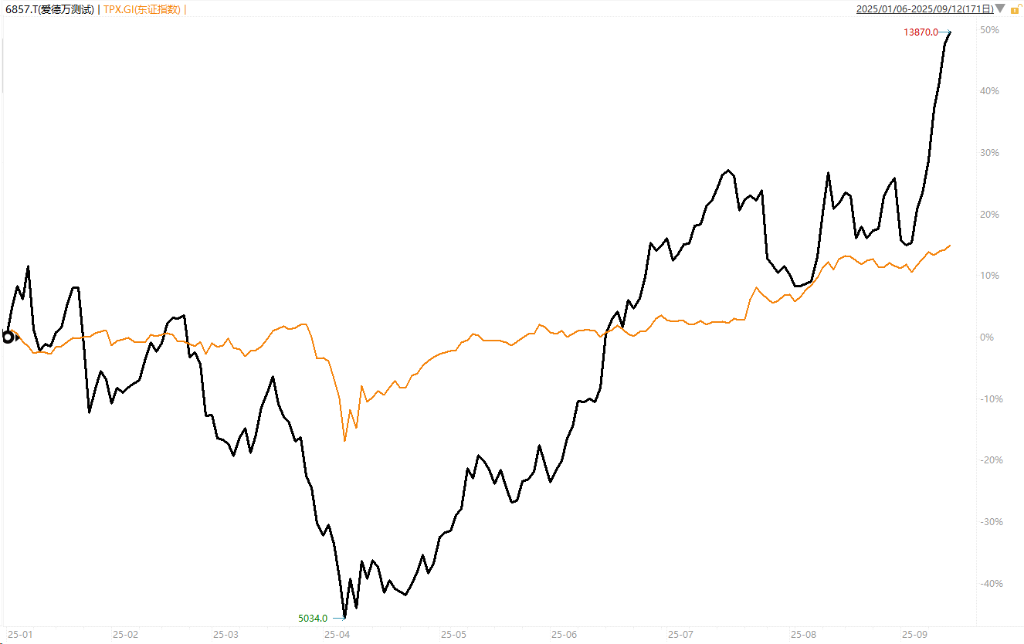
Core Viewpoint - Advantest, a Japanese semiconductor testing equipment manufacturer, has seen its market capitalization exceed 10 trillion yen (approximately 68 billion USD) for the first time, becoming the largest company in the semiconductor-related sector in Japan, driven by strong profit growth expectations fueled by AI demand [1]. Group 1: Market Performance - Advantest's stock price closed at 13,125 yen on September 10, marking a significant milestone as its market value surpassed 10 trillion yen for the first time since 2006, outpacing Tokyo Electron [1]. - The stock has risen over 50% this year, significantly outperforming the Tokyo Stock Exchange index [2]. Group 2: Financial Flows and Returns - Strong capital inflows have provided solid support for Advantest's stock price, with a net inflow of 17.34 billion yen recorded on September 11, making it one of the highest net bought stocks [3]. - Over the past five years, Advantest's total return has reached 967.12%, reflecting long-term investor confidence in its market strategy, with a recent quarterly stock price surge of 58%, far exceeding the semiconductor industry's 13.3% return [3]. Group 3: Technological Innovation - Advantest's recent launch of the next-generation CD-SEM E3660 aims to meet the stringent requirements of 2-nanometer advanced node semiconductor manufacturing, reinforcing its position in the measurement sector [4]. - The company's stock buyback plan, set to be completed by mid-2025, has further boosted investor confidence [4]. Group 4: Valuation and Future Outlook - Despite the positive market sentiment, Advantest faces challenges related to high valuation, with its stock trading above the consensus target price of 11,562.11 yen [5]. - Analysts predict a revenue growth rate of 5.2% and an earnings growth rate of 6.9%, indicating moderate growth expectations [5].

中州国际证券:港股晨報
CENTRAL CHINA INTERNATIONAL SECURITIES· 2025-09-12 02:46
Core Insights - The report highlights the performance of the Hong Kong stock market, with the Hang Seng Index at 26,086 points, reflecting a year-to-date increase of 30.0% despite a daily decline of 0.4% [3] - The report discusses the impact of macroeconomic factors, including the recent interest rate adjustments by the People's Bank of China and ongoing trade tensions between China and the U.S., which are expected to influence market conditions in the short to medium term [10][11] - The report provides a detailed analysis of the performance of individual stocks within the Hang Seng Index, noting significant gains for companies like SMIC and China Hongqiao, while highlighting losses for companies such as Hansoh Pharmaceutical [4][25] Market Overview - The Hang Seng Index has seen a trading volume of HKD 3,252.1 billion, with a price-to-earnings (PE) ratio of 11.9 and a price-to-book (PB) ratio of 1.22 [5] - The report notes that the H-share index and technology index also experienced declines, with the H-share index at 9,260 points, down 0.7% for the day and up 27.0% year-to-date [3][11] - The report indicates that the A-share market has shown positive performance, with the Shanghai Composite Index rising to 3,875 points, an increase of 1.7% [13] Company Performance - Galaxy Entertainment reported a year-on-year revenue increase of 8.3% to HKD 23.25 billion, with adjusted EBITDA rising 14.2% to HKD 6.87 billion, and a net profit increase of 19.4% to HKD 5.24 billion [25][26] - The report details the revenue breakdown for Galaxy Entertainment, noting a 10.7% increase in gaming operations revenue, while hotel and shopping center revenues grew by 2.5% [25] - The company's total assets are approximately HKD 94.8 billion, with total liabilities decreasing by 18.9% to HKD 14.7 billion, indicating a strong balance sheet [26] New Stock Dynamics - The report outlines upcoming IPOs, including Health 160 and Jinfang Pharmaceutical-B, with expected market interest due to their moderate fundraising sizes and potential for high demand [30][31] - The report provides insights into the pricing and expected market performance of these new listings, suggesting a favorable environment for new stock offerings [31]
云计算概念股延续涨势 甲骨文巨额算力订单震动市场 北美云厂商上调资本支出预算
Zhi Tong Cai Jing· 2025-09-12 02:40
Group 1 - Cloud computing stocks continue to rise, with notable increases in companies such as GDS Holdings (up 18% to HKD 39.6), Alibaba (up 6.56% to HKD 152.7), New Oriental (up 3.63% to HKD 7.13), and Kingsoft Cloud (up 3.14% to HKD 8.87) [1] - Oracle reported a future contract revenue increase of USD 317 billion for Q1 of fiscal year 2026, indicating strong demand in the cloud computing sector [1] - OpenAI has reportedly signed a five-year agreement to purchase USD 300 billion worth of computing power from Oracle, highlighting the growing collaboration between AI and cloud services [1] Group 2 - The four major North American cloud providers—Google, Microsoft, Meta, and Amazon—have significantly increased their capital expenditures, totaling USD 87.4 billion in Q2 2025, a 69% year-over-year increase and a 23% quarter-over-quarter increase [1] - Analysts predict that the demand for AI servers will continue to grow, with major cloud service providers expected to maintain double-digit growth in procurement to meet the needs for AI training and inference [1]


中原证券:半导体行业25Q2持续稳健增长 国产AI算力厂商进入加速发展期
智通财经网· 2025-09-12 02:21
Core Viewpoint - The semiconductor industry is currently in an upward cycle, with AI being a significant driver of growth [1][3][4] Group 1: Semiconductor Industry Performance - In August 2025, the domestic semiconductor industry (CITIC) rose by 23.84%, outperforming the CSI 300, which increased by 10.33% [1] - The integrated circuit sector saw a 31.47% increase, while discrete devices rose by 16.29%, semiconductor materials by 15.24%, and semiconductor equipment by 13.67% [1] - Year-to-date, the semiconductor industry (CITIC) has increased by 36.16% [1] - The Philadelphia Semiconductor Index rose by 1.09% in August 2025, with a year-to-date increase of 13.84% [1] Group 2: Financial Performance of AI Chip Manufacturers - In Q2 2025, the semiconductor industry reported revenues of 188.43 billion yuan, a year-on-year increase of 13.87%, and a net profit of 14.763 billion yuan, up 23.99% [2] - Major domestic AI chip manufacturers showed remarkable performance: Cambrian's revenue grew by 4425.01% year-on-year and 59.19% quarter-on-quarter, with a net profit increase of 324.97% year-on-year [2] - Haiguang Information's revenue increased by 41.15% year-on-year and 27.66% quarter-on-quarter, while Chipone's revenue rose by 49.90% quarter-on-quarter [2] Group 3: Global Semiconductor Market Trends - Global semiconductor sales in July 2025 increased by 20.6% year-on-year, marking the 21st consecutive month of growth [3] - North American cloud providers' capital expenditures rose by 69% year-on-year in Q2 2025, with a quarter-on-quarter increase of 23% [3] - Domestic internet companies' capital expenditures grew by 168% year-on-year in Q2 2025 [3] - Global wafer fab capacity utilization improved significantly in Q2 2025, with a slight decrease in inventory levels for some chip manufacturers [3] Group 4: Investment Opportunities - Nvidia's CEO estimates that the Chinese market will present approximately $50 billion in opportunities by 2025, with a projected compound annual growth rate of 50% [4] - The domestic AI chip manufacturers are expected to continue gaining market share, suggesting investment opportunities in the AI chip supply chain [4] - North American cloud providers are expected to increase their capital expenditures significantly, with a forecast of $600 billion in 2025 [6]


甲骨文大象起舞,带飞国产算力!芯原股份收购芯来,强化ASIC竞争力!科创人工智能ETF(589520)盘中涨近3%
Xin Lang Ji Jin· 2025-09-12 02:07
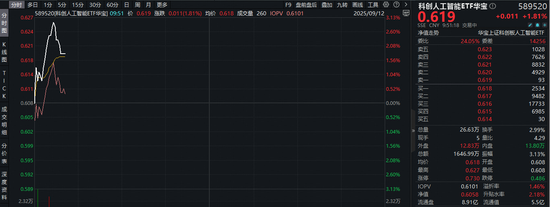
Core Viewpoint - The domestic AI industry is experiencing significant growth, driven by strong policy support, technological advancements, and surging market demand, particularly highlighted by the performance of the domestic AI-focused ETF and its constituent stocks [1][4][5]. Group 1: Market Performance - The domestic AI-focused ETF (589520) saw an intraday price increase of nearly 3%, currently up 1.81%, marking a three-day consecutive rise [1]. - Key constituent stocks such as Chipone Technology surged over 15%, while Cambricon and Yuke Tech rose by more than 4% and 3% respectively [1]. - The ETF's trading threshold was reduced from approximately 120 yuan to about 60 yuan following a 1:2 share split, making it more accessible for investors [5]. Group 2: Industry Trends - Major global tech companies, including Oracle, Microsoft, Google, and Meta, are significantly increasing their capital expenditures on AI infrastructure, indicating a robust demand for high-end chips and related hardware [3]. - The Chinese government's policies are strongly supporting the integration of AI across key sectors, with initiatives like the "Artificial Intelligence+" action plan aiming for deep integration by 2027 [4]. Group 3: Technological Advancements - Domestic companies are making rapid technological breakthroughs, with Huawei and Alibaba Cloud demonstrating advancements in large-scale computing capabilities [4]. - The processing capacity in China has dramatically increased, with daily token processing volume soaring from 100 billion to 30 trillion within a year and a half [4]. Group 4: Investment Opportunities - The ETF is positioned to benefit from the ongoing domestic AI industry growth, with a focus on companies that are well-placed in the AI supply chain [6][7]. - The ETF's top ten holdings account for over 71.66% of its weight, with semiconductors being the largest sector, representing over 54.1% [7].
报道称阿里、百度使用自研芯片训练AI模型 阿里巴巴高开近6% 百度高开近4%
Zhi Tong Cai Jing· 2025-09-12 01:36
Core Viewpoint - Alibaba and Baidu have begun using internally designed chips to train their AI models, replacing some NVIDIA chips, indicating a shift towards self-sufficiency in AI infrastructure [1] Group 1: Company Developments - Alibaba's stock rose by 5.86% to HKD 151.7, while Baidu's stock increased by 3.76% to HKD 110.5 [1] - Alibaba has been applying its self-developed chips for lightweight AI model training since the beginning of this year [1] - Baidu is experimenting with its Kunlun P800 chip to train the new version of its Wenxin AI model [1] Group 2: Industry Trends - The trend of self-developed AI chips is emerging, as evidenced by OpenAI's collaboration with Broadcom to design its first self-developed AI chip [1] - Google is accelerating its self-developed TPU to compete directly with NVIDIA in third-party data centers [1] - According to招商证券, the shift towards self-developed AI chips signifies a transition in the AI infrastructure industry from a "single GPU supply constraint" to "diversified custom chip solutions," altering the investment logic from hardware monopoly to ecosystem competition [1]

港股异动 | 报道称阿里、百度使用自研芯片训练AI模型 阿里巴巴(09988)高开近6% 百度(09888)高开近4%
Zhi Tong Cai Jing· 2025-09-12 01:36
Core Viewpoint - Alibaba and Baidu have begun using internally designed chips to train their AI models, replacing some NVIDIA chips, which has led to significant stock price increases for both companies [1][1][1] Group 1: Company Developments - Alibaba's stock rose by 5.86% to HKD 151.7, while Baidu's stock increased by 3.76% to HKD 110.5 following the news [1][1][1] - Since the beginning of this year, Alibaba has been applying its self-developed chips for training lightweight AI models [1][1][1] - Baidu is experimenting with its Kunlun P800 chip to train the new version of its Wenxin AI model [1][1][1] Group 2: Industry Trends - The trend of self-developed AI chips is emerging, indicating a shift in the AI infrastructure industry from a "single GPU supply constraint" to "diversified custom chip solutions" [1][1][1] - This shift in investment logic is moving from hardware monopoly to ecological competition [1][1][1] - OpenAI has announced a partnership with Broadcom to design its first self-developed AI chip, while Google is accelerating its self-developed TPU into third-party data centers to compete directly with NVIDIA [1][1][1]
AI算力下半场,具备预期差的方向梳理
Ge Long Hui A P P· 2025-09-12 00:18
Core Insights - The rise of ASIC chip manufacturers, exemplified by Broadcom, is reshaping the technology investment landscape, with ASICs transitioning from a supporting role to a leading position in the market [1] Market Overview - The global ASIC chip market is projected to reach approximately $12 billion in 2024, with expectations to exceed $30 billion by 2027, reflecting a compound annual growth rate (CAGR) of 34% from 2024 to 2027 [1] Company Performance - Broadcom reported a 63% year-over-year increase in AI chip revenue in Q3, driven by a significant $10 billion custom AI chip (XPU) order from a fourth major client [3] - The demand for ASICs is being fueled by cloud service providers (CSPs) favoring ASICs over traditional GPUs due to performance and cost advantages [3] Technological Advancements - ASICs are designed for specific tasks, offering superior efficiency compared to general-purpose GPUs, which are likened to multi-functional tools [4] - Recent innovations have reduced the design cycle for ASICs from 18-24 months to 6-12 months, cutting costs by over 60% [4] Competitive Landscape - Major players in the ASIC design space include IDM giants like Broadcom, cloud companies like Amazon and Google, and specialized design firms such as Cambricon and Rockchip [6] - Broadcom holds a 60% market share in data center interconnect scenarios with its XPU products [6] Manufacturing and Supply Chain - Domestic manufacturers are leveraging advanced manufacturing and packaging technologies to meet ASIC production demands, with companies like SMIC and Changdian Technology playing key roles [7] Supporting Industries - The high power consumption of ASICs has led to increased demand for cooling solutions and optical interconnects, with companies like Invec and Taicheng providing innovative products [8] Investment Opportunities - Investors are advised to focus on companies with visible long-term orders, strong technological barriers, and flexible supply chains in the ASIC ecosystem [9] - The shift towards ASICs represents a significant investment opportunity as the technology landscape evolves, similar to the transition from feature phones to smartphones [9]

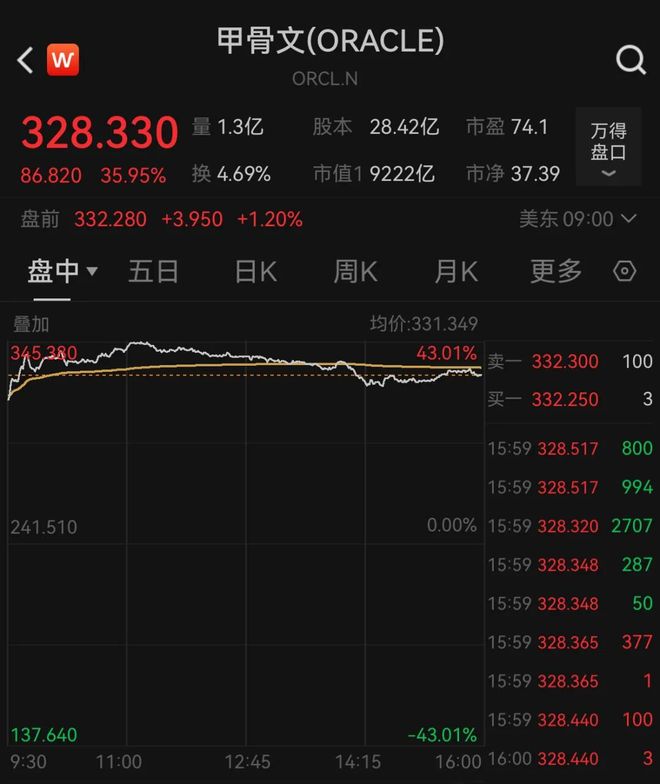
甲骨文市值逼近万亿美元,AI大订单是主要原因
2 1 Shi Ji Jing Ji Bao Dao· 2025-09-11 14:52
Core Viewpoint - Oracle's stock price surged significantly due to its latest financial report and substantial AI contracts, with a notable increase in its Remaining Performance Obligations (RPO) [1][3][6] Financial Performance - For Q1 of fiscal year 2026, Oracle reported total revenue of $14.9 billion, a year-over-year increase of 12% [6] - Cloud revenue grew by 28% to $7.2 billion, with IaaS revenue increasing by 55% to $3.3 billion and SaaS revenue rising by 11% to $3.8 billion [6][10] - RPO surged to $455 billion, exceeding market expectations of $178 billion, driven by demand for AI computing power and multi-cloud services [3][6] AI Contracts and Market Impact - Oracle signed four contracts worth billions with three major clients, contributing to the RPO increase and indicating strong future revenue potential [4][6] - A reported $300 billion, five-year computing power procurement agreement with OpenAI may explain the RPO surge and market revaluation of Oracle's stock [7][8] Competitive Positioning - Oracle's multi-cloud strategy has led to a 1529% year-over-year increase in multi-cloud database revenue, expanding its market presence [8][10] - The company is actively collaborating with major cloud providers like Google, Microsoft, and Amazon to enhance its service offerings and customer reach [11][12] Future Outlook - Oracle anticipates Q2 fiscal year 2026 total revenue growth of 12% to 14%, with cloud business expected to grow by 32% to 36% [6][10] - The company is focused on converting RPO into actual revenue, contingent on its ability to fulfill contracts and secure necessary AI chip supplies [10] Market Reaction - Following Oracle's stock surge, related AI hardware stocks in the Chinese market also experienced significant gains, indicating a broader market enthusiasm for AI investments [14]