
中国银河

Search documents
中国银河(601881) - 中国银河:关于行使21银河Y1发行人赎回选择权的第一次提示性公告
2026-02-10 09:15
本公司董事会及全体董事保证本公告内容不存在任何虚假记载、误导 性陈述或者重大遗漏,并对其内容的真实性、准确性和完整性承担个别及连带 责任。 证券代码:601881 证券简称:中国银河 公告编号:2026-018 中国银河证券股份有限公司 关于行使"21 银河 Y1"发行人赎回选择权的 第一次提示性公告 公司将根据相关业务规则,做好 21 银河 Y1 后续信息披露及还本付息工作。 特此公告。 中国银河证券股份有限公司(以下简称"公司"或"发行人")于 2026 年 2 月 7 日披露了《中国银河证券股份有限公司公开发行 2021 年永续次级债券(第 一期)发行人不行使续期选择权暨行使赎回权并全额兑付的公告》(公告编号: 2026-015),本公告为上述事项的提示性公告。 公司于 2021 年 3 月 29 日完成中国银河证券股份有限公司公开发行 2021 年永续次级债券(第一期)(以下简称"21 银河 Y1")的发行工作。根据《中 国银河证券股份有限公司公开发行 2021 年永续次级债券(第一期)募集说明书》, 21 银河 Y1 设发行人赎回权,于 21 银河 Y1 第五个和其后每个付息日,发行人 有权按面值加 ...
中国银河行使“21银河Y1”发行人赎回权
Zhi Tong Cai Jing· 2026-02-10 09:04
公司决定行使21银河Y1发行人赎回权,即全部赎回21银河Y1。 中国银河(601881)(06881)发布公告,公司于2021年3月29日完成中国银河证券股份有限公司公开发行 2021年永续次级债券(第一期)(以下简称"21银河Y1")的发行工作。根据《中国银河证券股份有限公司公 开发行2021年永续次级债券(第一期)募集说明书》,21银河Y1设发行人赎回权,于21银河Y1第五个和 其后每个付息日,发行人有权按面值加应付利息(包括所有递延支付的利息及其孳息)赎回21银河Y1。 ...
中国银河(06881) - 海外监管公告
2026-02-10 08:54
香港交易及結算所有限公司及香港聯合交易所有限公司對本公告之內容概不負責,對其準確性 或完整性亦不發表任何聲明,並明確表示,概不對因本公告全部或任何部分內容而產生或因依 賴該等內容而引致之任何損失承擔任何責任。 (在中華人民共和國註冊成立之股份有限公司) (股份代號:06881) 海外監管公告 本公告乃由中國銀河證券股份有限公司(「本公司」)根據香港聯合交易所有限公司 證券上市規則第13.10B條作出。 茲載列本公司於上海證券交易所網站發佈之《中國銀河證券股份有限公司關於行 使「21銀河Y1」發行人贖回選擇權的第一次提示性公告》,僅供參閱。 承董事會命 本公司董事会及全体董事保证本公告内容不存在任何虚假记载、误导 性陈述或者重大遗漏,并对其内容的真实性、准确性和完整性承担个别及连带 责任。 王晟 董事長及執行董事 中國北京 2026年2月10日 於本公告日期,本公司執行董事為王晟先生(董事長)及薛軍先生(副董事長及總 裁);非執行董事為楊體軍先生、李慧女士、黃焱女士及宋衛剛先生;以及獨立非 執行董事為羅卓堅先生、劉力先生、麻志明先生及范小雲女士。 证券代码:601881 证券简称:中国银河 公告编号:2026- ...
中国银河证券:存储价格延续上涨 预计本轮涨价周期将延续至2026年中
智通财经网· 2026-02-10 07:55
Group 1 - The core viewpoint of the report indicates a significant price increase in memory chips, with NAND flash prices rising over 100% and DRAM prices increasing by 60%-70% in Q1, driven by surging demand from AI servers and data center capital expenditures [1] - The current memory chip price increase is expected to continue until mid-2026, marking a new cycle in the storage chip sector, with strong growth in AI server demand and domestic substitution creating investment opportunities in related listed companies [1] - The price hikes in memory chips are impacting downstream industries, with consumer electronics manufacturers facing cost pressures, leading to potential adjustments in product structure and pricing strategies [1] Group 2 - TSMC reported a record high revenue of $33.73 billion in Q4 2025, a year-on-year increase of 25.5%, exceeding previous guidance, with a net profit of approximately $16.3 billion, reflecting a 35% year-on-year growth [2] - The gross margin reached 62.3%, marking a 3.3 percentage point increase year-on-year, while the operating profit margin was 54%, and the net profit margin was 48.3%, all significantly surpassing market expectations [2] - Advanced process revenue accounted for 77% of total revenue, with 3nm process contributing 28%, indicating a strong growth engine for revenue [2] Group 3 - The passive components market is experiencing a new wave of price increases, with major manufacturers raising prices by 5%-30%, driven by rising raw material costs and increased demand from high-end sectors like AI servers and electric vehicles [3] - Price increases in passive components such as MLCCs, inductors, and resistors are expected to transmit to various downstream applications, influenced by rising wafer processing costs and strong demand in automotive and industrial sectors [3] Group 4 - Companies to watch include IC design firms such as Zhaoyi Innovation, Puran, Dongxin, Beijing Junzheng, and Lanke Technology, as well as storage module manufacturers like Demingli and Shannon Chip Creation [4] - AI-related PCB companies such as Shenghong Technology, Hudian Co., Jingwang Electronics, and Kexiang Technology are also recommended for attention [4]
资本热话 | 春节持股VS持币?一众新基金给出破题思路
Sou Hu Cai Jing· 2026-02-10 07:54
Core Insights - The A-share market is experiencing fluctuations as the Spring Festival approaches, leading to discussions among investors about whether to hold cash or stocks during the holiday [5][6] - New fund issuance has accelerated, with 163 new funds established by February 6, totaling 1510.7 billion units, marking a 76% increase in issuance compared to the previous year [2][3] Fund Issuance and Market Activity - There are currently 47 funds in the issuance process, with nearly 30 new products confirmed for upcoming sales, indicating a potential influx of capital into the A-share market [2] - 63 funds have announced early closure of fundraising, a nearly 50% increase year-on-year, reflecting a strong market recovery trend [2][3] - Some funds have seen rapid fundraising success, with 52 products closing in under five days, including notable cases of "one-day sellouts" [3] Investment Themes and Strategies - New funds are targeting sectors such as non-ferrous metals, chips, and new energy batteries, with 7 funds focused on non-ferrous metals and 16 on Hong Kong stock opportunities [4] - Fund managers are actively buying into the market, with 151 new products showing net value fluctuations, indicating a proactive investment approach [4] Market Sentiment and Predictions - Analysts suggest that there is no absolute advantage to holding cash or stocks; the decision should align with investors' risk tolerance [6] - The market is expected to shift focus to growth sectors with clear performance catalysts post-holiday, as risk appetite is anticipated to rebound [6][7] - The A-share market is currently characterized by strong upward momentum, with a significant probability of price increases after the Spring Festival [7]


国内金饰每克突破1560元:大家不必等待了!接下来,金价有可能会重演历史!
Sou Hu Cai Jing· 2026-02-10 06:31
Core Viewpoint - The gold market has experienced significant volatility, with prices fluctuating dramatically in a short period, leading to mixed investor behavior and differing institutional forecasts for future gold prices [1][3][5]. Group 1: Price Movements - On February 10, 2026, international gold prices rebounded to around $4995.39 per ounce after a significant drop from a historical high of $5626.8 per ounce on January 29, marking a decline of over 10% [1]. - The gold market saw extreme volatility on January 29, with prices soaring to $5626.8 per ounce before plummeting to $4403 per ounce within 28 minutes on January 30, marking the largest single-day drop since 1980 [3]. - Silver prices also experienced significant fluctuations, with a peak increase of 90% in early 2026, but later losing all gains and dropping to a repurchase price of 18 yuan per gram, which is 30% lower than the selling price [3]. Group 2: Market Dynamics - Investor behavior has polarized, with some speculators retreating and long-term holders opting to hold onto their investments amid extreme price fluctuations [5]. - In Guangzhou, gold buyback transactions surged, while silver dealers in Shenzhen paused repurchase activities due to price volatility [5]. - Institutional views on future gold prices are divided, with Goldman Sachs and JPMorgan raising their 2026 gold price targets to $6000 and $6300 respectively, while Citigroup warns of a potential price halving due to extreme valuation levels [5]. Group 3: Supply and Demand Changes - For the first time since the establishment of the Shanghai Gold Exchange in 2002, domestic retail investment demand for gold has surpassed gold jewelry consumption [7]. - In brand gold stores, there are many inquiries about wedding jewelry, but actual transactions are low, while sales of investment gold bars and commemorative notes have doubled [7]. - Globally, silver's industrial demand is increasing due to growth in photovoltaic and electric vehicle sectors, but price volatility has led to a 40% reduction in foreign trade orders for silver jewelry [7].

红利低波ETF华泰柏瑞(512890)近20个交易日吸金31.5亿 机构:高股息策略或仍受青睐!
Xin Lang Cai Jing· 2026-02-10 04:20
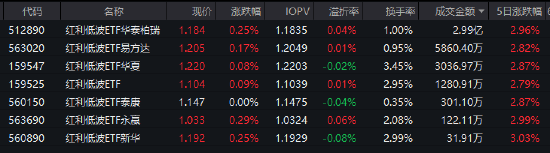
Market Overview - On February 10, the A-share market showed a narrow fluctuation pattern with the three major indices slightly declining, where the Shanghai Composite Index fell by 0.02% and the North Exchange 50 Index experienced a drop of over 1% [1][7] - In this context, the Huatai-PB Low Volatility ETF (512890) rose by 0.25%, closing at 1.184 yuan, with a turnover rate of 1% and a half-day trading volume of 299 million yuan, ranking first among similar ETFs [1][7] ETF Performance - The Huatai-PB Low Volatility ETF (512890) had a net inflow of 440 million yuan over the past five trading days, 3.15 billion yuan over the past 20 days, and 4.57 billion yuan over the past 60 days, with a circulating scale of 29.987 billion yuan as of February 9, 2026 [3][9] - The top ten holdings of the ETF showed mixed performance, with Shanghai Bank up by 1.32%, Nanjing Bank up by 0.18%, and Ping An Bank down by 0.18% [2][8] Institutional Insights - Everbright Securities believes that the current spring market is still promising, with positive signals expected from both policy and fundamentals in the coming months, suggesting a potential rebound in trading activity after the Spring Festival [5][11] - China Galaxy Securities noted a typical "pre-holiday risk aversion" in the market, with a shift of funds from high-valuation technology and cyclical sectors to value and consumer sectors, indicating strong performance in defensive sectors like banks and food and beverage [6][11] - The Huatai-PB Low Volatility ETF, established on December 19, 2018, has outperformed its benchmark with a return of 39.62% over the past three years, ranking 392nd among 1,634 funds [11]
持股过节!十大券商集体喊话,布局节后“红包”行情
Bei Ke Cai Jing· 2026-02-10 04:16
Core Viewpoint - As the Spring Festival approaches, the choice between "holding stocks or holding cash" has become a focal point for investors, with a consensus emerging among major brokerages favoring "holding stocks" as the better option this year [1][2]. Group 1: Market Sentiment and Predictions - Major brokerages, including Guotai Junan and GF Securities, express optimism about the market's potential for recovery post-holiday, suggesting that the A-share market may experience a favorable "timing, location, and human factors" for an upward trend [2][17]. - Despite a general consensus on holding stocks, several brokerages caution that market performance may still be influenced by multiple risks, including slower-than-expected economic recovery and geopolitical uncertainties [3]. Group 2: Investment Strategies and Sector Focus - Guotai Junan recommends focusing on emerging technology and value sectors, highlighting themes such as commercial aerospace, robotics, urban renewal, and domestic consumption [4]. - Dongwu Securities suggests three main investment directions: overvalued technology sectors, booming industries like energy storage and lithium batteries, and themes related to the 14th Five-Year Plan, including commercial aerospace and 6G technology [5]. - Galaxy Securities advocates for a cautious approach with "light positions," emphasizing the importance of the upcoming "Two Sessions" and the shift towards "new productive forces" in sectors like semiconductors and artificial intelligence [6][7]. - Huaxia Securities emphasizes the importance of preparing for the post-holiday "red envelope" market, noting that technology sectors typically show better elasticity after the holiday [13]. - The investment focus should also include sectors that have underperformed but are expected to recover, such as food and beverage, agriculture, and healthcare [12]. Group 3: Market Dynamics and Historical Trends - Historical data indicates that the market tends to perform better after the Spring Festival, with a common pattern of "lower before the holiday and higher after" across various style indices [11]. - The current market environment is characterized by a high trading volume, with brokerages maintaining a cautious yet optimistic stance, suggesting that the market is not likely to turn bearish easily [8][9]. - The upcoming Spring Festival is seen as a critical period for potential market recovery, with many brokerages encouraging investors to remain confident and prepared for the first wave of the new year's upward cycle [17].




中国银河证券:食饮行业供需关系有望改善 看好价格修复相关机会
Zhi Tong Cai Jing· 2026-02-10 04:06
Core Viewpoint - The food and beverage industry is expected to see improvements in supply and demand dynamics across multiple sub-sectors by 2026, with a clearer recovery trend in CPI, indicating sustained new consumption but with internal rotations. Traditional consumption sectors benefiting from CPI recovery are anticipated to experience bottom improvements, particularly in the mass consumer goods and liquor sectors [1] Group 1: CPI and PPI Trends - The CPI turned positive for the first time in October 2025, showing a month-on-month improvement with November and December CPI at +0.7% and +0.8% respectively, while food CPI was +0.2% and +1.1% [1] - Fresh vegetable and fruit prices have seen significant increases, with November and December fresh vegetable CPI at +14.5% and +18.2%, and fresh fruit CPI at +0.7% and +4.4% [1] - The decline in prices for grains, edible oils, and livestock has narrowed, with November and December grain CPI at -0.4% and -0.3%, edible oil CPI at -1.2% and -1.0%, and livestock CPI at -6.6% and -6.1% [1] Group 2: Liquor Sector Insights - The price of Feitian Moutai has shown signs of recovery, with prices for whole boxes and individual bottles at 1710 and 1660 yuan respectively, reflecting increases of 30 yuan and 10 yuan since January 31 [2] - The demand for liquor is strong due to festive consumption, and the recent price drop has activated potential consumers, leading to improved sales [2] - Moutai's supply chain adjustments and channel reforms are effectively supporting the price stability of its products [2] Group 3: Dairy Industry Developments - The average price of fresh milk in major production areas was 3.04 yuan/kg as of January 29, showing a year-on-year decrease of 2.9% but a month-on-month increase of 0.3%, indicating a strong bottoming signal [3] - The dairy price is expected to enter an upward trend in 2026 due to supply-side adjustments and improved demand driven by demographic policies and product upgrades [3] Group 4: Consumer Goods Price Movements - The frozen food sector is nearing a competitive bottom, with potential demand recovery in 2026 expected to drive fundamental improvements [4] - Leading company Anjijia has begun to recover some promotional policies, which may lead to profit recovery [4] - Three squirrels have raised the ex-factory prices of certain nut gift products, which may alleviate pressures from rising raw material and transportation costs, improving profitability [4]

中国银河证券:空调行业提价坚决 扫地机在犹豫中减少自补
智通财经网· 2026-02-10 01:51
Core Viewpoint - The home appliance industry is facing price increases driven by costs and some structural upgrades, with a significant difference from the previous cost increase cycle from Q3 2020 to Q2 2022 [1][2] Group 1: Cost-Driven Price Increases - The current cost increase cycle is primarily driven by rising prices of various metal raw materials, memory, and MCU, rather than strong retail demand [2] - The CPI is expected to return to positive growth in October 2025, with rates of +0.2%, +0.7%, and +0.8% for October, November, and December respectively [1] - The demand for home appliances is weak, and the marginal utility of national subsidies is decreasing, leading to cost-driven price increases [1][2] Group 2: Air Conditioner Price Increases - Air conditioners face higher cost pressures due to the significant cost share of copper, leading to decisive price increases by major brands like Midea, which implemented a tiered price increase strategy [3] - Retail prices for air conditioners have risen, with online and offline average prices reaching 3151 yuan and over 4000 yuan respectively in early 2026 [3] - The peak of competition and cost pressure in the air conditioner market is expected in Q4 2025, with price increases in 2026 alleviating some of the cost pressures [3] Group 3: Robotic Vacuum Cleaners - The robotic vacuum cleaner market is experiencing complexities as national subsidies are set to stop in the second half of 2025, leading brands like Ecovacs and Roborock to face profit pressures [4] - Despite attempts to end self-subsidization, some provinces have resumed subsidies, affecting market dynamics [4] - The average retail price of robotic vacuum cleaners showed a decline in late 2025 but began to recover in early 2026 [4] Group 4: TV Structural Upgrades and Competition in Action Cameras - Although TV demand is declining, the penetration rate of MiniLED TVs has increased since September 2024, contributing to a rise in retail prices [5] - Retail volume and value for TVs in 2025 decreased by 10.4% and 7.3% respectively, while the average retail price increased by 3.51% [5] - The action camera market is seeing intense competition, particularly with brands like DJI and Insta360, leading to price reductions for popular models [6]