燕京啤酒

Search documents
年度投资策略报告:底部向阳,寻找结构性亮点-20260105
Tai Ping Yang Zheng Quan· 2026-01-05 14:15
Overall Industry Review - The food and beverage sector significantly underperformed the market, with a year-to-date decline of -0.62%, lagging behind the Shanghai Composite Index by 15.0 percentage points [7][11] - The snack sector showed strong performance with a year-to-date increase of 28.88%, driven by channel expansion and a total revenue growth of 30.97% in the first three quarters of 2025 [11] - The beverage sector, particularly soft drinks, benefited from travel demand and low-price, high-frequency consumption, achieving a revenue and profit growth in double digits [11][14] Alcoholic Beverages - The liquor sector exhibited weak performance, with a decline in sales and prices, particularly for white liquor, which saw a year-on-year revenue drop of -5.83% and a net profit decline of -6.93% in the first three quarters of 2025 [11][44] - The overall white liquor sector's revenue decreased by -5.8% and net profit by -6.9% in the first three quarters of 2025, with a significant drop in Q3, where total revenue fell by -18.4% [44] - The report indicates that the white liquor industry is in a prolonged adjustment phase, with the current downturn lasting 57 months, marking the longest adjustment period in history [35][40] Future Outlook - The central economic work conference emphasized the importance of boosting domestic demand in 2026, with expectations for policy support to stimulate recovery [3] - The report suggests focusing on sectors with low bases for recovery, such as frozen foods and beverages, which are expected to benefit from demand recovery and new product opportunities [3][4] - The report highlights the potential for structural opportunities in the food and beverage sector, particularly in overseas markets and cost improvements, recommending companies like Anqi Yeast and Mijiu Group for their overseas expansion strategies [4][34] Investment Strategies - The report identifies four key investment themes for 2026: opportunities in overseas markets, cost benefits, new product launches, and value-for-money consumption [4] - Companies with strong platform capabilities and innovative products, such as Dongpeng Beverage and Wancheng Group, are recommended for their potential in the beverage sector [4] - The report also emphasizes the importance of identifying companies that can adapt to a low-inflation, low-confidence environment by offering high-value products [14]






“i茅台”火爆霸榜!吃喝板块开门红,食品饮料ETF华宝(515710)上探1.71%!“茅五泸汾洋”集体爆发
Xin Lang Cai Jing· 2026-01-05 11:45
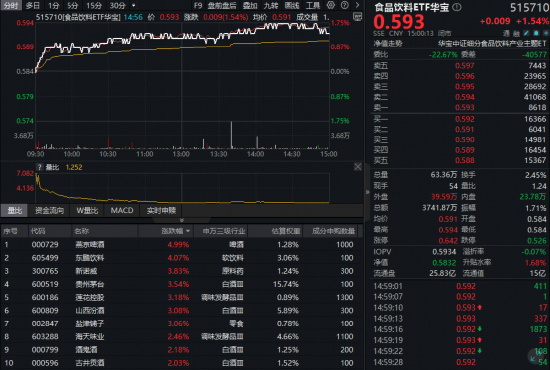
Core Viewpoint - The food and beverage sector experienced a strong start in 2026, with the Huabao Food and Beverage ETF (515710) showing significant gains, particularly in leading liquor stocks like Kweichow Moutai and Wuliangye [1][9]. Group 1: Market Performance - On January 5, 2026, the Huabao Food and Beverage ETF opened with a maximum intraday increase of 1.71% and closed up by 1.54% [1][9]. - Major liquor stocks saw substantial increases, with Kweichow Moutai rising by 3.54%, Shanxi Fenjiu by 3.08%, and others like Wuliangye and Luzhou Laojiao increasing by over 1% [1][9]. - Popular consumer products also performed well, with Yanjing Beer and Dongpeng Beverage both rising over 4% [1][9]. Group 2: Company Insights - Kweichow Moutai is the largest holding in the Huabao Food and Beverage ETF, accounting for 14.89% of the fund's assets as of Q3 2025 [3][11]. - The launch of the "i Moutai" platform has significantly increased consumer engagement, with the app reaching over 300 million installations and ranking high in app store charts [2][11]. Group 3: Valuation and Investment Strategy - The food and beverage sector is currently at a historical low in terms of valuation, with the price-to-earnings ratio of the underlying index at 19.75, placing it in the 2.94% percentile over the past decade, indicating a favorable long-term investment opportunity [4][12]. - Analysts suggest that the white liquor industry is nearing a bottom, with expectations for a rebound in 2026, supported by recent market adjustments from leading companies [5][13]. - The current consumer environment is seen as a strategic opportunity for the food and beverage sector, benefiting from policies aimed at boosting domestic demand [14].

2025年主动权益产品排名出炉,广发基金6只产品年度跌幅超过10%
Xin Lang Cai Jing· 2026-01-05 10:38
Core Insights - In 2025, approximately 75 actively managed equity funds achieved a net value increase of over 100%, but there was significant disparity, with several funds reporting negative returns exceeding 10% [2][8] - Among the underperformers, six funds from GF Fund were highlighted, all managed by Wang Mingxu, indicating a potential issue with his management strategy [2][8] Fund Performance Analysis - Wang Mingxu managed a total of eight funds, with six showing negative annual returns, including the flagship fund, GF Domestic Demand Growth, which reported a -16.31% return for the year [10] - The fund underwent a significant style shift in its holdings throughout 2025, moving from a focus on real estate, liquor, and banking stocks in Q1 to a more diversified approach in Q2, yet the results remained unsatisfactory [3][11] Managerial Challenges - Wang Mingxu's management faced criticism as his long-held fund, GF Domestic Demand Growth, became a significant underperformer despite his overall fund management experience and a reported best-term return of 115.25% [10] - The fund's quarterly reports indicated attempts to adjust the portfolio by selling overvalued stocks and increasing positions in high-end liquor and IT services, but these adjustments did not yield the desired improvement in performance [4][11] Performance of Other Managers - Zheng Chengran, another manager at GF Fund, also faced challenges, with his funds showing a wide performance range; one fund achieved over 70% returns while five others fell below 20% [5][12] - His investment strategy included a mix of sectors that did not align with his expertise, leading to underwhelming results, particularly in the healthcare and steel sectors [12]
非白酒板块1月5日涨1.26%,燕京啤酒领涨,主力资金净流出5761.27万元
Zheng Xing Xing Ye Ri Bao· 2026-01-05 08:59
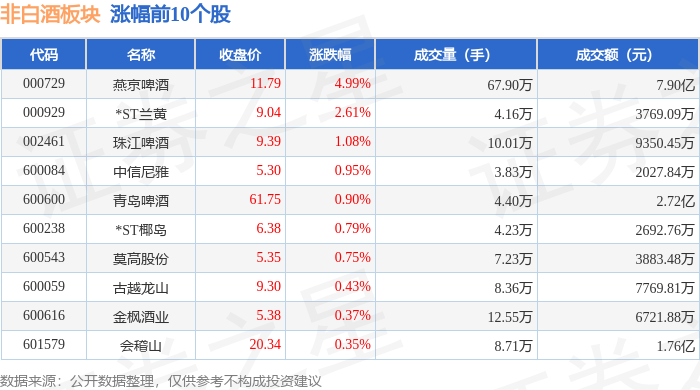
Market Overview - The non-liquor sector increased by 1.26% on January 5, with Yanjing Beer leading the gains [1] - The Shanghai Composite Index closed at 4023.42, up 1.38%, while the Shenzhen Component Index closed at 13828.63, up 2.24% [1] Stock Performance - Wujing Beer (000729) closed at 11.79, up 4.99% with a trading volume of 679,000 shares and a transaction value of 790 million yuan [1] - ST Lanhua (000929) closed at 9.04, up 2.61% with a trading volume of 41,600 shares and a transaction value of 37.69 million yuan [1] - Zhujiang Beer (002461) closed at 9.39, up 1.08% with a trading volume of 100,100 shares and a transaction value of 93.50 million yuan [1] - Other notable stocks include Chongqing Beer (600132) at 52.39, up 0.29%, and Huichuan Beer (600573) at 11.92, down 0.08% [2] Capital Flow - The non-liquor sector experienced a net outflow of 57.61 million yuan from institutional investors, while retail investors saw a net inflow of 86.47 million yuan [2] - The main capital inflow and outflow for specific stocks include: - Huichuan Beer had a net inflow of 14.29 million yuan from institutional investors [3] - Kuaijishan (601579) saw a net outflow of 22.50 million yuan from speculative funds but a net inflow of 17.31 million yuan from retail investors [3] - Zhujiang Beer had a net inflow of 4.08 million yuan from institutional investors [3]


国泰海通晨报-20260105
国泰海通· 2026-01-05 05:41
Macro Research - The recovery momentum in consumption is strong, but investment and production still require further policy support [2] - The A-share market is expected to welcome a "spring opening red" as policy expectations, liquidity, and fundamentals resonate positively [2] - The price signals indicate that industrial prosperity is beginning to emerge and continue [2] Strategy Research - The A-share market closed 2025 at 3968.84 points, with an annual increase of 18.41%, confirming the strategic judgment made by Guotai Junan [3] - The market is anticipated to stabilize and appreciate due to the upcoming announcement of the new Federal Reserve chairman and expectations of U.S. interest rate cuts in 2026 [3][24] - The decision-makers have emphasized the need to "promote investment stabilization," indicating a potential increase in policy support for growth [3][24] Food and Beverage Research - Yanjing Beer shows strong reform momentum, with significant potential for national expansion of its U8 product line, expected to exceed 1.5 million tons in the future [3][8] - The company is expected to enhance its product structure and profitability through the expansion of high-priced products above 10 yuan [8][9] - The beer industry is stabilizing, with leading companies like Yanjing benefiting from structural upgrades and improved profit margins [8][9] Industry Comparison - The report highlights a favorable outlook for technology, non-bank financials, and consumer sectors, driven by the industrialization of emerging markets and the AI trend [6][27] - The technology sector is expected to benefit from global chip technology breakthroughs and rising storage prices, with domestic infrastructure shortages accelerating the pace of domestic production [6][27] - Non-bank financials are poised to gain from increased wealth management demand and capital market reforms, while cyclical stocks are seen as bottoming out and benefiting from domestic demand expansion [6][27]
73股连续5日或5日以上获融资净买入
Zheng Quan Shi Bao Wang· 2026-01-05 03:32
Core Insights - As of December 31, 2025, a total of 73 stocks in the Shanghai and Shenzhen markets have experienced net financing inflows for five consecutive days or more [1] - The stock with the longest consecutive net inflow is Yan'ao Co., which has seen net buying for 14 trading days [1] - Other notable stocks with significant consecutive net inflows include Yongtai Technology, Yanjing Beer, Sanrenxing, Wanxiang Qianchao, Supor, Huanyu Electronics, Haier Smart Home, and Morninglight Co. [1]



中信、华泰、国泰等七大券商最新高目标价个股曝光!(附2026年投资策略)
私募排排网· 2026-01-05 03:15
Group 1 - The core viewpoint of the article is that the A-share market is expected to experience a steady upward trend in 2026, driven by various sectors and companies with significant growth potential [2][6][19] - Major themes for 2026 include the global restructuring of order, the AI revolution, and the transition of China's economic dynamics [19] - Analysts from different securities firms have provided high target price stocks, indicating potential investment opportunities, with some companies showing target price increases exceeding 50% [3][10][13] Group 2 - CITIC Securities emphasizes three key areas for investment: upgrading traditional manufacturing, globalization of Chinese enterprises, and the commercialization of AI applications [2] - Guotai Junan predicts that emerging technologies will remain a primary focus, with a target for the Shanghai Composite Index to reach 5200 points [6] - Huachuang Securities highlights the awakening of value in the stock market, with a focus on companies like Wuliangye, which has a target price indicating a potential increase of over 100% [10][11] Group 3 - GF Securities suggests that 2026 will continue the structural transformation seen in 2025, focusing on sectors linked to global markets and technology [15] - Dongfang Securities recommends mid-cap blue-chip stocks in the early part of 2026, transitioning to technology innovation stocks later in the year [21] - The article also lists companies with significant target price spaces, such as Ying Shi Innovation and Weichai Power, indicating strong growth potential [17][22]

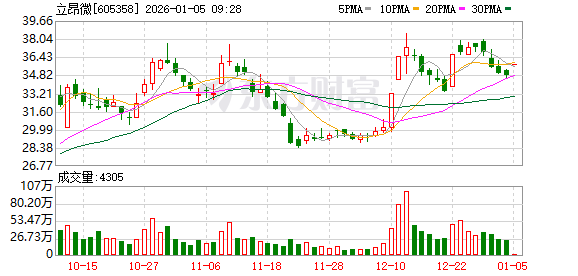
立昂微目标价涨幅超120%;147家上市公司获券商推荐
2 1 Shi Ji Jing Ji Bao Dao· 2026-01-05 01:44
Summary of Key Points Core Viewpoint - The report highlights the target price increases for several listed companies from December 29 to January 4, indicating strong bullish sentiment from brokers towards specific sectors, particularly semiconductor, pharmaceutical, and non-alcoholic beverage industries. Group 1: Target Price Increases - The companies with the highest target price increases include: - Lian Microelectronics (立昂微) with a target price increase of 121.14% to 77.00 CNY [1][2] - Fosun Pharma (复星医药) with a target price increase of 73.65% to 46.00 CNY [1][2] - Yanjing Beer (燕京啤酒) with a target price increase of 58.06% to 17.75 CNY [1][2] Group 2: Broker Recommendations - A total of 147 listed companies received broker recommendations during the same period, with notable mentions: - Guiguan Electric (桂冠电力) received recommendations from 3 brokers [3][4] - Haier Home (海澜之家) and Three Gorges Tourism (三峡旅游) each received recommendations from 2 brokers [3][4] Group 3: Rating Adjustments - Two companies had their ratings upgraded: - SF Express (顺丰控股) was upgraded from "Hold" to "Strong Buy" by China Merchants Securities [5] - Ruisheng Intelligent (瑞晟智能) was upgraded from "Hold" to "Buy" by Northeast Securities [5] Group 4: First-Time Coverage - During the same period, 54 instances of first-time coverage were reported, with key companies including: - Guohuo Airlines (国货航) receiving an "Accumulate" rating from Zheshang Securities [6] - Jing Shan Light Machinery (京山轻机) also received an "Accumulate" rating from Guotai Junan Securities [6]

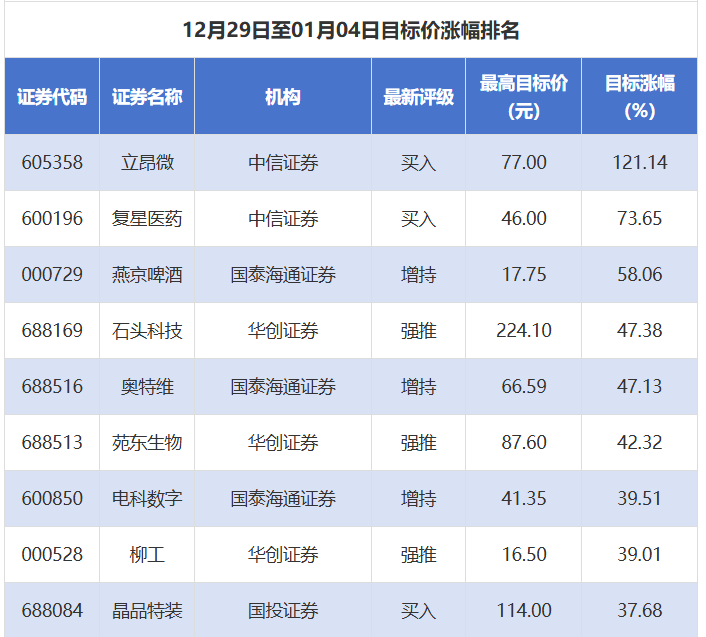
立昂微目标价涨幅超120% 147家上市公司获券商推荐丨券商评级观察
2 1 Shi Ji Jing Ji Bao Dao· 2026-01-05 01:32
Summary of Key Points Core Viewpoint - During the period from December 29 to January 4, brokerage firms provided target prices for listed companies, with notable increases in target prices for companies such as Lianang Micro, Fosun Pharma, and Yanjing Beer, indicating strong market interest in these sectors [2]. Group 1: Target Price Increases - Lianang Micro (605358) has a target price increase of 121.14%, with a highest target price set at 77.00 yuan by CITIC Securities [3]. - Fosun Pharma (600196) shows a target price increase of 73.65%, with a highest target price of 46.00 yuan, also by CITIC Securities [3]. - Yanjing Beer (000729) has a target price increase of 58.06%, with a highest target price of 17.75 yuan, recommended by Guotai Junan Securities [3]. - Other companies with significant target price increases include Stone Technology (688169) at 47.38% and Aotwei (688516) at 47.13% [3]. Group 2: Brokerage Recommendations - A total of 147 listed companies received brokerage recommendations during the same period, with Guiguan Electric (600236) receiving the highest number of recommendations at 3 [4]. - Other companies with multiple recommendations include Hailan Home (600398) and Three Gorges Tourism (002627), each receiving 2 recommendations [4]. Group 3: Rating Upgrades - Two companies had their ratings upgraded: SF Express (002352) from "Hold" to "Strong Buy" by China Merchants Securities, and Ruisheng Intelligent (688215) from "Hold" to "Buy" by Northeast Securities [5]. Group 4: First-Time Coverage - A total of 54 instances of first-time coverage were reported, with Guohang (001391) receiving an "Increase" rating from Zheshang Securities [6]. - Other companies receiving first-time coverage include Jing Shan Light Machinery (000821) and Haige Communication (002465), both rated "Increase" by their respective brokers [6].
\每食每刻\系列之(十五):逆境求变,啤酒企业探寻多元化发展之路
Changjiang Securities· 2026-01-04 13:11
Investment Rating - The industry investment rating is "Positive" and maintained [12] Core Insights - The beer industry in China has transitioned from a volume-driven growth phase, which peaked in 2013, to a focus on premiumization and diversification due to weakening demand in on-premise consumption and slowing price increases [2][5][29] - Since 2018, beer companies have been optimizing product structures and launching premium products, leading to a sustained increase in average prices and profitability [5][21] - As of 2023, beer companies are actively exploring diversification strategies to adapt to changing market conditions [29][40] Summary by Sections Industry Overview - The beer industry's growth phase driven by volume has ended, with companies now focusing on premiumization and product optimization [2][5] - The average price of beer has been increasing due to the rising share of mid-to-high-end products [21] Company Strategies - **China Resources Beer**: Initiated a dual-growth model by entering the liquor market, acquiring several liquor brands, and leveraging its management experience [6][29] - **Tsingtao Brewery**: Engaged in strategic restructuring with local beverage companies to expand into new beverage and biotechnology sectors, including a new production base for biotechnology [7][30] - **Yanjing Beer**: Developed a significant beverage and health product line, including a successful natto series, and launched a new soda brand to synergize with its beer business [8][32][36] - **Chongqing Beer**: Expanded its product range to include non-beer beverages, leveraging its parent company's product matrix to enhance sales channels [9][40]