
腾讯

Search documents
港股在降息潮中表现出色的原因分析
Xin Lang Cai Jing· 2025-09-21 09:18
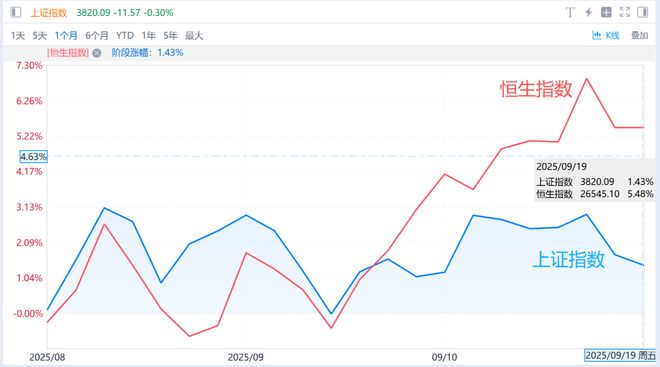
Group 1: Market Performance - The Hong Kong stock market has shown a significant rebound in September, with the Hang Seng Index achieving a cumulative increase of 5.85%, contrasting with a 0.98% decline in the Shanghai Composite Index during the same period [1] - The unique offshore market characteristics and high foreign capital participation of the Hong Kong stock market have made it increasingly attractive amid a global interest rate cut environment [1] - Historical data indicates that preemptive interest rate cuts tend to have a positive impact on stock assets, emphasizing the resilience of the Hong Kong stock market [1] Group 2: AI Industry Impact - The development of the AI industry has been a crucial driver for the rise of the Hong Kong stock market, with significant advancements in both hardware infrastructure and software applications since 2025 [2] - Major internet companies in Hong Kong have begun self-developing chips for AI training, achieving performance levels comparable to overseas counterparts [2] - Alibaba's cloud computing revenue growth rate reached 26%, Tencent's profit increased by 16%, and Xiaomi's automotive business revenue hit 21.3 billion yuan with a year-on-year growth of 234%, providing strong support for the tech sector in Hong Kong [2] Group 3: Capital Inflows - Net inflows of southbound funds have exceeded 1.1 trillion Hong Kong dollars this year, marking a record high since the establishment of the mutual market access mechanism [2] - The narrowing of the Hong Kong-US interest rate differential has led to a gradual recovery of the Hong Kong dollar, prompting international investment banks to upgrade their ratings for Hong Kong stocks [2] - Major investment banks like Goldman Sachs, Standard Chartered, and Morgan Stanley have given positive evaluations of the Hong Kong stock market, particularly in sectors like AI and semiconductors [2] Group 4: Valuation Advantage - As of September 17, 2023, the price-to-earnings ratio of the Hang Seng Tech Index was only 24.24 times, significantly lower than the NASDAQ Tech Index at 36.66 times and the STAR 50 Index at 177.25 times, highlighting the valuation advantage of Hong Kong tech stocks [3] - The Hang Seng Tech ETF (513130) has a strong liquidity profile, with an average daily trading volume of 4.8 billion Hong Kong dollars over the past three months, making it suitable for investors focusing on the AI industry [3] - The Hong Kong Stock Connect Tech ETF (513150) focuses on internet, new energy vehicles, and biotechnology sectors, offering a cost-effective and policy-friendly investment option for long-term investors [3]
短期科技承压,市场震荡中低位蓝筹配置窗口逐步打开
Haitong Securities International· 2025-09-21 08:03
Group 1 - The report indicates that A-shares are expected to consolidate to digest previous gains, while Hong Kong stocks may continue to benefit from positive sentiment following the Fed's rate cut [1][7] - Following the Fed's 25 basis point cut on September 17, the dollar rebounded, gold prices fell, and emerging markets experienced a retreat [1][7] - The Shanghai Composite Index fell by 1.3%, while the ChiNext Index rose by 2.3% after an initial spike and pullback [1][7] Group 2 - The report highlights a relatively positive tone from the recent U.S.-China presidential phone call, with a meeting scheduled for the APEC summit in late October [2][8] - However, no substantial breakthroughs were made on critical issues such as fentanyl and tariffs, suggesting that the bilateral relationship will likely remain stable in the near term [2][8] - The next catalysts for the Chinese market are expected to come from domestic policy, particularly the drafting of the 15th Five-Year Plan focusing on new energy vehicles and advanced manufacturing [2][8] Group 3 - A-shares have shown volatility with active fund flows and sector rotations, particularly in technology and financial sectors [3][9] - The financial sector has continued to lag, impacting the overall index, while coal and other lagging sectors have shown gains [3][10] - Daily trading volume remained high at RMB 2.5 trillion, indicating active market participation [3][11] Group 4 - In Hong Kong, market sentiment remained strong, driven by significant gains in Alibaba and Baidu due to advancements in AI technology [4][12] - However, currency fluctuations have started to exert pressure on the market, with the AH premium index declining to 117 [4][13] - Southbound capital inflows decreased to HKD 36.9 billion, with notable investments in Alibaba and Meituan, while Tencent and Xiaomi experienced outflows [4][13] Group 5 - The report suggests that Hong Kong equities may enter a consolidation phase alongside A-shares, with technology facing short-term pressure [4][14] - Non-bank financials, after significant corrections, are now viewed as attractive investment opportunities [4][14] - There is increasing interest in property and consumption-related sectors, as well as themes related to anti-involution [4][14]
降息潮下,看好港股的几点理由...
Xin Lang Cai Jing· 2025-09-21 06:15
Group 1 - The core viewpoint of the article highlights that the Hong Kong stock market is becoming a new focus for capital amid a global interest rate cut trend, with significant advantages such as offshore attributes, high foreign participation, and low valuations [3][10]. - In September, the Hang Seng Index rose by 5.85%, while the Shanghai Composite Index fell by 0.98%, indicating a clear outperformance of the Hong Kong market [1]. - The influx of liquidity due to anticipated interest rate cuts from the Federal Reserve is expected to benefit the Hong Kong stock market, making it an attractive destination for foreign capital seeking higher returns [3][9]. Group 2 - The AI industry is experiencing significant advancements, with Hong Kong's tech sector showing positive changes in fundamentals, including the use of self-developed chips by internet giants for AI training and the launch of new AI models [7][8]. - Notable financial performances from major companies in the tech sector include Alibaba Cloud's revenue growth of 26%, Tencent's profit increase of 16%, and Xiaomi's automotive business revenue soaring by 234% year-on-year [8][9]. - The net inflow of southbound funds has exceeded HKD 1.1 trillion this year, marking a record high since the establishment of the Stock Connect mechanism, further supporting the Hong Kong market [9]. Group 3 - The valuation of the Hang Seng Technology Index stands at a price-to-earnings ratio of 24.24, significantly lower than that of the Nasdaq Technology Index at 36.66 and the STAR Market at 177.25, indicating a valuation advantage for global investors [11]. - International investment banks are raising their ratings for Hong Kong stocks, with Goldman Sachs maintaining an "overweight" rating and Morgan Stanley highlighting the concentration of trading in AI and semiconductor sectors in Hong Kong and A-shares [10][11]. - The article suggests that investors can utilize ETF tools to gain exposure to the Hong Kong tech sector, capitalizing on the benefits of global liquidity easing and the AI industry transformation [15][16].

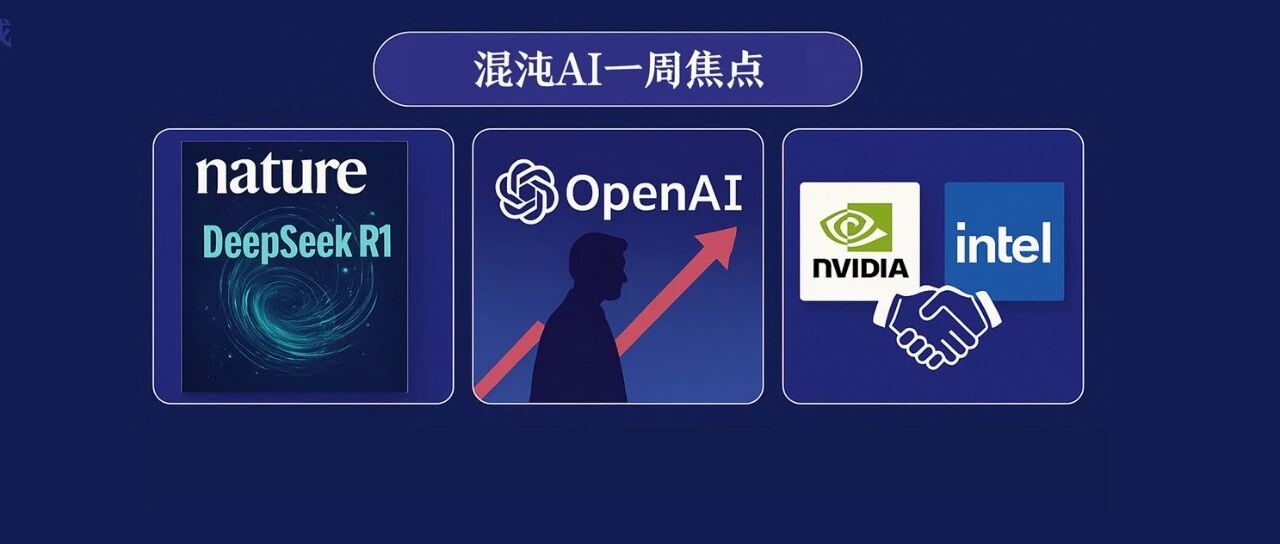
DeepSeek R1论文登上Nature封面;OpenAI顶尖人才出走;英伟达英特尔宿敌握手言和| 混沌AI一周焦点
混沌学园· 2025-09-19 11:58
Core Insights - Nvidia and Intel have formed a strategic partnership, with Nvidia investing $5 billion to acquire a 5% stake in Intel, leading to a 22% surge in Intel's stock price. The collaboration focuses on developing customized products for data centers and PCs, marking a significant shift in their competitive relationship [3][6][21]. Group 1: Technological Breakthroughs - DeepSeek's R1 model has been published in Nature, showcasing a training cost of approximately $294,000 and emphasizing the use of reinforcement learning instead of extensive manual data, setting a new standard for scientific transparency in AI [4][5]. - World Labs, founded by Fei-Fei Li, has released the Marble model, capable of generating persistent 3D worlds from a single image or text prompt, offering significant advancements in environmental modeling for various industries [9][10]. - Math's AI agent, Gauss, has achieved a formal proof of a complex mathematical theorem in just three weeks, a task that took a renowned mathematician 18 months, indicating a major leap in AI's capabilities in research [15][17]. Group 2: Industry Trends - The AI talent gap in China has exceeded 5 million, with a supply-demand ratio of 1:10, prompting a shift towards vertical AI competitions as a means to identify and cultivate practical talent [7][24]. - OpenAI's report reveals that ChatGPT has over 700 million weekly active users, primarily using the platform for practical guidance, information search, and writing, indicating its growing global reach and application [12][13][22]. - The 2025 Smart Expo highlighted five key sectors: intelligent robotics, low-altitude economy, smart homes, intelligent driving, and digital cities, showcasing the competitive landscape among major tech companies [14][16]. Group 3: Product Developments - The launch of the "ZhiYue Agent All-in-One Machine" aims to address information management challenges for CEOs, providing a localized solution that integrates with existing enterprise systems [10][23]. - Meituan has introduced its first life service agent, "Xiao Mei," which simplifies user interactions across various services, indicating a shift towards more personalized AI applications in local services [17][18]. - ByteDance has released Seedream 4.0, a powerful image model integrated into its AI creative agent, revolutionizing e-commerce marketing content production [19][20]. Group 4: Strategic Movements - The departure of prominent AI researcher Yao Shunyu from OpenAI signifies a shift in focus from enhancing model capabilities to creating valuable real-world applications, suggesting new opportunities for startups [19][22]. - The collaboration between Nvidia and Intel is seen as a restructuring of the core value network in the chip industry, indicating a move towards ecosystem collaboration rather than zero-sum competition [21][24].


马云和刘强东都盯上了微信这块肥肉
Sou Hu Cai Jing· 2025-09-19 10:36
Core Viewpoint - Alibaba is reportedly negotiating a significant partnership with Tencent's WeChat, which may allow Taobao to launch an official mini-program within the WeChat ecosystem, enabling seamless transactions without external links [1][5][15] Group 1: Partnership Details - The collaboration aims to integrate Taobao's services into WeChat, allowing users to browse, order, and pay directly within the WeChat environment [1][5] - Taobao may offer WeChat Pay the "no-password payment" feature, enhancing user experience and potentially increasing transaction conversion rates [1][5] - This partnership would mark the first time the two major ecosystems—Alibaba's e-commerce and WeChat's social platform—are interconnected in core transaction processes [5][15] Group 2: Market Implications - The partnership could provide WeChat access to over 1.2 billion monthly active users, while Taobao would need to relinquish some control over payment processes, breaking down previous barriers between e-commerce and social media [5][15] - The closure of the JD.com shopping entry on WeChat, following the expiration of its contract with Tencent, has led to speculation that Alibaba's potential partnership with WeChat is a strategic move to capture the social media traffic that JD.com previously utilized [7][15] Group 3: Regulatory and Operational Considerations - There are uncertainties regarding data sharing, transaction commission structures, risk management, and user privacy standards that need to be addressed before the partnership can be finalized [6][15] - The "no-password payment" feature raises concerns about user security and compliance with financial regulations, which are critical factors in the partnership's progression [6][15] Group 4: Alibaba's Broader Strategy - Alibaba's stock has surged nearly 100% this year, reaching a market capitalization of approximately 3.08 trillion HKD, partly due to its AI strategy, which includes a planned investment of over 380 billion CNY in cloud and AI infrastructure over the next three years [17][20] - The company has reported a 26% year-on-year revenue growth in its cloud segment, indicating the successful integration of AI technologies into its business model [20][23] - Alibaba is also developing a new AI chip to fill market gaps left by Nvidia, which is currently in the testing phase and aims to enhance its AI capabilities [25][28]

中概互联回暖:三年守望终获47%涨幅
Sou Hu Cai Jing· 2025-09-19 09:21
Core Viewpoint - The Chinese internet sector has shown a remarkable recovery with a 47.77% increase since early 2023, reflecting a reassessment of its value and long-term potential by the market [1] Group 1: Market Performance - The Chinese internet ETF (KWEB) has risen by 47.77%, while the Hang Seng Internet ETF (2822) and Hang Seng Technology ETF (3080) have increased by 45.08% and 41.44% respectively [1] - The sector's recovery is attributed to a combination of market revaluation and recognition of its long-term potential [1] Group 2: Industry Challenges and Sentiment - Despite facing significant challenges, including regulatory pressures and a tough operating environment, investors have maintained a belief in the sector's eventual recovery [1][2] - The sentiment among investors remains optimistic, particularly with the anticipated impact of artificial intelligence on the industry [2] Group 3: Economic Environment - The recent decision by the Federal Reserve to lower the benchmark interest rate by 25 basis points to 4%-4.25% signals a shift towards a more accommodative financial environment, which is favorable for growth sectors like the internet [2] - In China, the 10-year government bond yield is at historical lows, and the overall monetary policy remains supportive, providing a conducive environment for the valuation of Chinese internet companies [3] Group 4: Valuation Metrics - The current price-to-earnings (PE) ratio for the Chinese internet sector is 21.65, which is relatively low compared to the historical average and indicates potential for recovery [3] - The price-to-sales (PS) ratio has doubled from 1.44 to 3.04, reflecting the sector's recovery potential [3] - Compared to other growth sectors, the Chinese internet sector maintains a valuation advantage, with a PE of 21.65 versus 24.67 for Hang Seng Technology and 23.11 for Hang Seng Internet [3]


打造全国广电视听领域重要风向标,2025“金茉莉”视听论坛在宁举办
Yang Zi Wan Bao Wang· 2025-09-19 09:07
Core Insights - The 2025 "Golden Jasmine" Audiovisual Forum will open on September 26 in Nanjing, aiming to inject new momentum into the integrated development of the Yangtze River Delta and the high-quality development of the audiovisual industry [1] - The forum will feature a main forum, five sub-forums, and two investment activities, gathering key figures from government, research institutions, industry associations, leading platforms, and frontline enterprises to discuss the deep integration and future direction of the audiovisual industry [1] Forum Structure - The main forum will include keynote speeches from prominent figures such as Feng Jingfeng, Director of the Planning Institute of the State Administration of Radio and Television, and Zhao Zizhong, Director of the New Media Research Institute of Communication University of China, focusing on high-quality development and systemic reform in the audiovisual media [1] - Sub-forums will cover various topics including the development paths of TV dramas, animation, documentaries, micro-short dramas, and channel frequency, with a focus on sharing cutting-edge experiences and insights from different sectors [2] Project Incubation - The forum will serve as a practical platform for project incubation, having attracted nearly a hundred high-quality submissions for the animation and online drama investment activities since July [3] - A total of 16 animation projects and 20 online drama projects have been shortlisted for live pitching, showcasing a variety of themes including history, mythology, and social realities [3] Strategic Vision - The "Golden Jasmine" Audiovisual Forum aims to respond to current industry developments while strategically positioning itself for the future, focusing on innovation and project incubation to contribute to a competitive audiovisual IP ecosystem [4]
ETF热点追踪 | A股本周冲击3900点未果,机器人ETF、恒生互联网ETF“越涨越吸金”
Ge Long Hui A P P· 2025-09-19 07:09
Group 1 - The core viewpoint of the articles highlights the volatility in the A-share market, with the Shanghai Composite Index struggling to break through the 3900-point mark, while the Shenzhen Composite Index and ChiNext Index showed positive growth due to sectors like AI computing power and new energy [1] - The Hong Kong stock market experienced a strong rally, driven by the return of AI narratives and expectations of interest rate cuts by the Federal Reserve, with the Hang Seng Technology Index breaking through its consolidation range [1][2] - The ETF market remains a key tool for capital allocation, with significant inflows into industry themes, particularly the securities sector, which saw a net inflow of 98 billion yuan, making it the top "capital-absorbing" index [2] Group 2 - The "only double-hundred" robot-themed ETF (562500) has surpassed 20 billion yuan in size, with a net inflow of 11.676 billion yuan this year, featuring leading stocks like Huichuan Technology and Stone Technology [3] - The focus on domestic semiconductor replacement equipment and materials is evident in the Sci-Tech Semiconductor ETF (588170), which includes key companies like Zhongwei Company and Huaihai Qingke [3] - The Hang Seng Internet ETF (513330) has over 80% weight in leading internet stocks, including Alibaba and Tencent, indicating strong market positioning [3]

关注中国互联网软件板块估值提升的结构性机会
Zhao Yin Guo Ji· 2025-09-19 06:11
Investment Rating - The report maintains a positive long-term investment outlook for the Chinese internet and software sectors, suggesting structural opportunities for valuation improvement [3][5][14]. Core Insights - The Chinese stock market liquidity is improving, and the narrative around AI is becoming more optimistic, which is expected to drive growth in the internet and software sectors [3][5]. - The report highlights the strong growth potential of cloud services and AI applications, with companies like Alibaba, Baidu, and Tencent expected to benefit significantly from these trends [3][5][27]. - The valuation of Chinese internet companies is currently at a discount compared to their overseas counterparts, indicating potential for recovery and growth [5][14]. Summary by Sections Market Trends - The report notes that the performance of Chinese internet companies is expected to improve due to better-than-expected revenue growth in cloud services and AI applications [5][27]. - AI-related revenue growth is projected to continue, with significant contributions from both consumer and enterprise applications [27][28]. Company Performance - Alibaba's cloud revenue grew by 26% year-on-year, driven by AI-related products, which have maintained triple-digit growth for eight consecutive quarters [27][28]. - Tencent's advertising revenue increased by 20% year-on-year, supported by AI-driven improvements in platform traffic and ROI [27][28]. - Baidu's AI search capabilities have significantly enhanced user experience, covering 64% of mobile search results [27][28]. Valuation Comparisons - The current trading PE for Chinese internet and software sectors is 22x FY25E, compared to 29x for overseas counterparts, indicating a substantial valuation gap [14][19]. - The report suggests that the domestic sector's EPS growth rate of 17% for 2026, while slightly lower than the 21% for overseas, still presents an attractive investment opportunity [14][19]. AI Commercialization - AI applications are expected to play a crucial role in supporting valuation levels, with significant revenue contributions from both cloud computing and advertising sectors [27][28]. - Companies like Salesforce and Kuaishou are highlighted for their strong growth in AI-related revenues, with Kuaishou's AI revenue projected to reach 950 million yuan for FY25 [27][28]. Chip Development - Major Chinese internet companies are increasingly investing in self-developed chips to meet the growing demand for AI computing power, with Alibaba's PPU chip expected to outperform NVIDIA's offerings [19][20][24]. - Baidu and Tencent are also making significant strides in chip development, enhancing their competitive positions in the AI landscape [19][20][24].




大厂AI应用进展不断,恒生科技ETF易方达(513010)连续17日获资金净流入
Mei Ri Jing Ji Xin Wen· 2025-09-19 03:57
Core Insights - The Hong Kong technology sector is experiencing a positive trend, with the Hang Seng Tech Index rising by 0.7% as of 11:20 AM, and the E Fund Hang Seng Tech ETF (513010) recording a trading volume exceeding 1.2 billion yuan [1] - The E Fund Hang Seng Tech ETF has seen net inflows for 17 consecutive trading days, totaling over 3 billion yuan [1] - Kuaishou's subsidiary, Keling AI, has launched a new digital human feature that allows users to create 1080p/48FPS digital human videos up to one minute long using a character image and a text or audio input [1] - S&P Global has announced a strategic partnership with Alibaba Cloud to introduce AI-ready data for commodities into China, which will integrate seamlessly with Alibaba Cloud's analytical services and AI engine, including the Tongyi Qianwen large language model [1] - The continuous advancements in AI by major internet companies indicate a growing investment value in the Hong Kong technology sector [1] - The Hang Seng Tech Index comprises the 30 largest stocks related to technology themes listed in Hong Kong, including major players like Alibaba, Tencent, Meituan, and Kuaishou [1] - The E Fund Hang Seng Tech ETF (513010) tracks this index, providing investors with a streamlined way to invest in leading technology firms in Hong Kong [1]