
三只松鼠

Search documents
玩过“奥特蛋”吗?金添动漫冲击港股IPO:IP授权方撤资,渠道转型反噬现金流
市值风云· 2025-12-26 10:13
Core Viewpoint - The article discusses the rise of the IP economy in the snack industry, focusing on Jin Tian Animation's potential as the first "IP food play" stock in Hong Kong, while highlighting the challenges and risks associated with reliance on licensed IPs [3][4]. Group 1: Market Potential - The IP snack market in China is projected to grow from 11.5 billion RMB in 2024 to 30.5 billion RMB by 2029, with a compound annual growth rate (CAGR) of approximately 20.9%, significantly outpacing the overall retail market growth of 4.1% [6]. - Jin Tian Animation's gross margin reached 34.7% in the first half of 2025, an increase of over 8 percentage points compared to 2022, while competitors like Three Squirrels and Liangpinpuzi maintained margins around 25% [5]. Group 2: Company Performance - Jin Tian Animation reported revenues of 877 million RMB and a net profit of 122 million RMB in 2024, holding a market share of 7.6% in the IP snack sector, making it the leading company in this niche [13]. - The company has a diverse portfolio with 26 licensed IPs and over 600 active SKUs, covering five major categories of snacks, and has a distribution network that spans over 1,700 counties in China [15]. Group 3: Dependency on IPs - The company's flagship product, "Ultraman Egg," has sold 70 million units since its launch, contributing 12.7 billion RMB in revenue over the past three and a half years, but the IP license is set to expire in less than 12 months [17][19]. - Approximately 63% of the company's revenue in 2022-2023 came from the Ultraman IP, which dropped to 43.9% in the first half of 2025, indicating a heavy reliance on a single IP [19]. Group 4: Licensing Risks - The company faces significant risks as it does not own the IPs it relies on, making it vulnerable to potential increases in licensing fees and the possibility of losing key IPs upon contract expiration [10][28]. - Following the exit of a key shareholder who was also the IP agent for Ultraman, the company lost its close ties to the IP source, raising concerns about future licensing negotiations and costs [25][27]. Group 5: Financial Health - From 2022 to 2024, the company experienced rapid revenue growth from 596 million RMB to 877 million RMB, with a CAGR of 21.3%, and net profit growth of 98% [41]. - However, the company's cash flow has shown signs of deterioration, with a 34.7% decline in net cash flow from operating activities in the first half of 2025 compared to previous years [49][51].


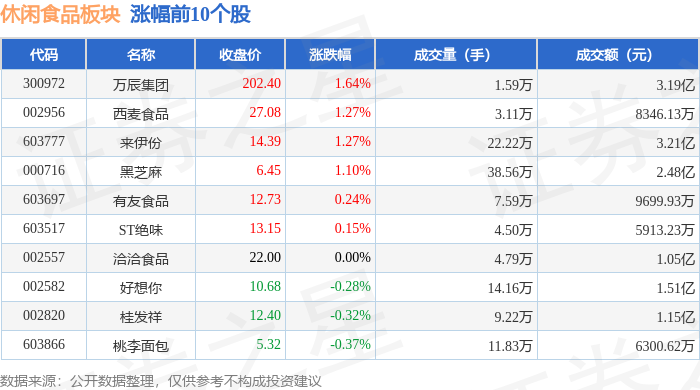
休闲食品板块12月26日涨0.02%,万辰集团领涨,主力资金净流出5517.24万元
Zheng Xing Xing Ye Ri Bao· 2025-12-26 09:07
Core Viewpoint - The leisure food sector experienced a slight increase of 0.02% on December 26, with Wancheng Group leading the gains, while the overall market indices also showed positive movement [1]. Group 1: Market Performance - The Shanghai Composite Index closed at 3963.68, up by 0.1% [1]. - The Shenzhen Component Index closed at 13603.89, up by 0.54% [1]. - Key stocks in the leisure food sector showed varied performance, with Wancheng Group closing at 202.40, up by 1.64% [1]. Group 2: Stock Performance Summary - Wancheng Group (300972) led the sector with a closing price of 202.40 and a gain of 1.64% [1]. - Other notable performers included Ximai Food (002956) at 27.08, up by 1.27%, and Laiyifen (603777) at 14.39, also up by 1.27% [1]. - Stocks such as Good Idea (002582) and Guilin Faxiang (002820) saw slight declines of 0.28% and 0.32%, respectively [1]. Group 3: Capital Flow Analysis - The leisure food sector saw a net outflow of 55.17 million yuan from institutional investors, while retail investors contributed a net inflow of 48.18 million yuan [2]. - The overall capital flow indicates a mixed sentiment, with institutional investors withdrawing funds while retail investors showed interest [2]. Group 4: Individual Stock Capital Flow - Laiyifen (603777) experienced a significant net outflow of 42.53 million yuan from institutional investors, indicating a bearish sentiment [3]. - Wancheng Group (300972) had a net inflow of 2.78 million yuan from retail investors, suggesting some level of support from individual investors [3]. - Ximai Food (002956) saw a net inflow of 3.03 million yuan from institutional investors, reflecting positive interest [3].



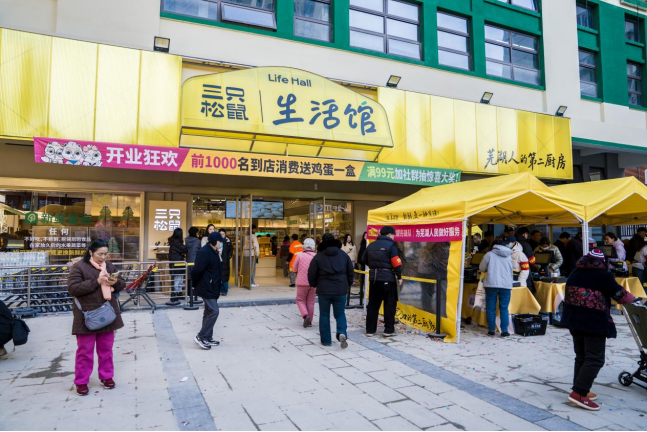
三只松鼠生活馆7店同开,探索社区零售新路径
Zhong Guo Zhi Liang Xin Wen Wang· 2025-12-26 07:40
Core Insights - The community instant retail sector is experiencing explosive growth, with an expected market size exceeding 5.2 trillion yuan by 2025, driven by consumer demand for quality and experience [1] - Three squirrels are transforming from a snack-focused retailer to a comprehensive self-owned brand retailer, launching new lifestyle stores to align with changing consumer trends [1][12] Group 1: Store Launch and Strategy - Three squirrels opened seven standard lifestyle stores in December, marking a significant step in their strategy to become a full-category self-owned brand retailer [1][5] - The stores are strategically located in the Anhui region, targeting the underserved instant retail market and emphasizing convenience for local residents [3][5] Group 2: Product Offering and Consumer Engagement - The new stores feature a diverse product range, including over 1,500 essential items, with more than 90% being self-owned brands and 70% being new products [5][10] - The stores aim to meet the daily needs of families, offering products that appeal to all age groups, from fresh produce to snacks [8][10] Group 3: Quality Assurance and Pricing Strategy - Three squirrels emphasize product quality through their "True Fresh, True Value, True Good" branding, ensuring fresh products are delivered within 24 hours [10][12] - Competitive pricing strategies are implemented, with significant reductions in prices compared to traditional channels, enhancing consumer perception of value [8][10] Group 4: Operational Efficiency and Supply Chain - The company is building three core capabilities: direct sourcing from producers, regional cold chain logistics, and a focus on self-owned brands to enhance supply chain transparency and efficiency [12][15] - A central kitchen has been established to support the operational needs of the lifestyle stores, ensuring fresh and efficient product delivery [13][15] Group 5: Future Expansion Plans - Three squirrels plan to accelerate store openings, with 20 new stores set to launch in early 2026, indicating a strategy of rapid market penetration [15]

三只松鼠全面拥抱消费趋势变化
Zheng Quan Ri Bao Wang· 2025-12-26 06:13
Core Viewpoint - The company, Three Squirrels, is transitioning from a snack-focused private brand retailer to a comprehensive private brand retailer, marking a significant strategic shift with the opening of its first seven standard stores across various locations in Anhui province [1] Group 1: Store Launch and Strategy - The first batch of seven standard stores will be launched from December 26 to December 28, covering cities such as Wuhu, Wuwei, Ningguo, Langxi, and Guangde [1] - This launch signifies the company's strategic shift towards a full-category private brand retail model, aiming for rapid scaling [1] Group 2: Store Concept and Community Focus - The new stores maintain a "fresh and accessible" shopping experience, emphasizing convenience within a 15-minute community living circle [1] - The store design has shifted to a simpler, more efficient, and quality-focused aesthetic [1] Group 3: Market Positioning and Trends - The company is entering a rapidly growing sector of community instant retail, which caters to high-frequency consumer needs [1] - By adopting a private brand lifestyle store model, the company aims to align with changing consumer trends and enhance its position in the competitive community retail landscape [1]
停产会让女人崩溃的护手霜,一抹水润软滑、持久留香,59元3瓶抢疯了
洞见· 2025-12-25 12:35
洞见 (DJ00123987) ——不一样的观点,不一样的故事,3000万人订阅的微信大号。点击标 题下蓝字"洞见"关注,我们将为您提供有价值、有意思的延伸阅读。 年衣专场!大人小孩全都有 预约直播,抢过年新衣 29岁小姑娘,手却看起来像70岁,天生如此 (懂的姐妹都懂) 。 更尴尬的是跟前男朋友刚认识的时候他牵我的手,后面在我不知道的情况下。 他对他兄弟说: 这根本不是96年该有的手!真的心塞! 甚至每次去美甲,都能收获美甲师深切关怀: "哦哟哟!要好好涂护手霜啊,都糙成什么样子了 呀" 从初中到现在,别人看到就会问我为什么手那么粗糙, 像干了很多农活一样。 黄黄的,皱皱的,还容易看起来脏脏的 ,甚至嘴欠的人还会这么问: "你在家是不是天天干活?" "对象是不是对你不好" "生活是不是过得不咋地?" 你别说,自从被打击后,我还真把保养双手提上了日程! 有一说一, 勤勤恳恳用护手霜真的有用! *真人实拍,实际效果因人而异 真不是偷偷动了什么高科技,而是 实实在在坚持用护手霜 ! 不少姐妹也印证了这个方法真的可行! 肌安妮白檀雪松香氛维E护手霜 但说实在, 护手霜这玩意也不好挑: ×要么是味道刺鼻得像打翻了瓶劣 ...

那些看着很有意思的职业,有苦也难言
3 6 Ke· 2025-12-25 06:31
Core Viewpoint - The role of "taste testers" in the food industry is increasingly glamorized on social media, presenting it as an easy and enjoyable job, but the reality is much more complex and demanding [1][2][26]. Group 1: Job Description and Responsibilities - The position of "taste tester" is officially referred to as a sensory evaluation specialist, requiring a deep understanding of consumer preferences and product characteristics [3][5]. - Taste testers must provide detailed feedback on various food products, including quantitative assessments of taste, texture, and aroma, which are crucial for product development [9][11][12]. - Each tasting session involves strict protocols, including pre-meeting to select products, controlled tasting amounts, and writing comprehensive reports that contribute to product optimization [7][8][9]. Group 2: Skills and Challenges - The job demands high levels of concentration and objectivity, as taste testers must accurately capture subtle differences in flavor and texture across product batches [10][18][27]. - Taste testers face physical challenges, such as maintaining their weight and avoiding taste fatigue, which can affect their ability to perform their duties effectively [19][20][21]. - The role is not merely about enjoying food; it requires a professional approach to sensory evaluation, where personal preferences must be set aside for objective assessments [23][24][41]. Group 3: Industry Context and Evolution - The emergence of taste testers reflects a broader trend in the labor market, where sensory experiences are being professionalized and quantified, similar to roles like hotel testers and scent evaluators [28][31][37]. - These new professions, while appearing appealing, involve rigorous standards and responsibilities that challenge the notion of "easy" jobs [39][40]. - The increasing demand for sensory evaluation in product development highlights the importance of human perception in industries that rely on consumer satisfaction [38][41].

2025零售业十大事件
Sou Hu Cai Jing· 2025-12-24 16:41
Group 1 - The hard discount supermarket format has gained significant attention in the second half of this year, with major internet companies launching new stores and expanding their presence [3][5] - Companies like Hema, JD, and Meituan have opened multiple hard discount stores, indicating a shift towards more price-sensitive consumer behavior [3][5] - The core competitiveness of hard discount formats lies in efficiency rather than just low prices, utilizing standardized models to reduce costs and improve turnover [5][7] Group 2 - Hema's X membership store has exited the market due to unclear positioning and high operational costs, highlighting the challenges faced by membership-based retail formats [9][10] - Despite Hema's exit, other local players are still attempting to establish membership stores, but they face strong competition and challenges in attracting price-sensitive customers [12][13] Group 3 - The retail sector has seen a wave of leadership changes among major players like Aldi, Sam's Club, and Yonghui, indicating a need for new strategies to adapt to market conditions [14][15] - These leadership changes are aimed at enhancing local procurement and supply chain management to support expansion while maintaining cost efficiency [15][17] Group 4 - The "prepaid card redemption" issue at Meitohai in Shanxi has raised concerns about cash flow and operational stability, as customers rush to redeem their prepaid cards amid fears of financial instability [18][21] - The situation has been exacerbated by recent store adjustments and closures, leading to a loss of consumer confidence and further financial strain [21][22] Group 5 - The trend of online players moving into offline retail is gaining momentum, with companies like Xiaoxiang Supermarket and Pupu planning to open physical stores to complement their online operations [23][24] - This shift is driven by rising costs associated with pure online fulfillment and the need to enhance consumer trust through physical retail experiences [25][28] Group 6 - The supermarket sector is undergoing a transformation as companies adopt the "learn from Pao Donglai" strategy, focusing on improving store layouts and customer experience [30][32] - However, many traditional supermarkets are still struggling with profitability despite initial positive performance post-renovation, indicating deeper systemic issues [32][33] Group 7 - Major online retailers like JD and Hema are retracting from partnerships with traditional supermarkets to refocus on self-operated models, aiming to streamline operations and improve efficiency [34][35] - This strategic shift reflects a broader trend of integrating online and offline capabilities to enhance customer experience and operational effectiveness [37][38] Group 8 - Regional retailers are emerging as new players in the market, focusing on local consumer needs and adapting their offerings accordingly, which may provide a competitive edge [39][41] - These regional players face challenges related to cost management and operational execution, particularly as they expand into new markets [41][42] Group 9 - The snack industry is experiencing a shift towards low-cost, high-density store formats, with companies like Mingming and Wancheng rapidly expanding their presence [42][44] - Traditional brands are facing pressure as they struggle to maintain market share amid aggressive pricing strategies from new entrants [44][45] Group 10 - The recent subsidy wars in instant retail have led to significant increases in order volumes, but also heightened financial pressures due to intensified price competition [47][51] - The long-term implications of these subsidy strategies remain uncertain, as companies navigate the balance between growth and profitability [51][52]
告别旧战役! 看休闲零食如何打响升维之战
Sou Hu Cai Jing· 2025-12-23 16:31
Core Insights - The leisure food market continues to face significant pressure in Q3, with many companies experiencing declines in both revenue and net profit, often exceeding 20% year-on-year in net profit [1][3] - Companies that previously thrived on e-commerce benefits are now struggling with transformation pains, compounded by external market pressures and internal structural issues [1][4] Group 1: Financial Performance - Three Squirrels reported a revenue of 7.759 billion yuan in the first three quarters, an increase of 8.22% year-on-year, but its net profit plummeted by 52.91% to 161 million yuan [3] - Laiyifen's revenue grew by 13.12% year-on-year, yet its net loss surged by 194.06% to 125 million yuan [3] - Liangpinpuzi faced a severe decline, with a revenue of 4.14 billion yuan, down 24.45% year-on-year, and a net profit loss of 1.22 billion yuan, a staggering drop of 730.83% [3] Group 2: Market Dynamics - The decline in traffic benefits has led to increased customer acquisition costs, making marketing expenses a heavy burden for companies [4] - The shift in consumer decision-making from chasing viral products to valuing product quality, health attributes, and brand values has disrupted the growth foundation of these brands [4][8] - The leisure food market is transitioning from incremental competition to stock competition, necessitating brands to reconstruct their growth logic for sustainable development [4] Group 3: Channel Challenges - Traditional snack brands have struggled to find new growth avenues through channel transformations, with many initiatives yielding disappointing results [5] - Brands have attempted to expand offline channels but faced challenges such as store closures and unsuccessful partnerships [5][6] - The lack of a cohesive operational system that aligns online and offline channels has hindered performance, with online revenue growth slowing significantly [6] Group 4: Product and Supply Chain Issues - Product homogenization remains a core issue, with many brands offering similar products, leading to diminished brand differentiation and pricing power [7][8] - The reliance on a light-asset model and external manufacturing has weakened brands' control over quality and supply chain resilience [7][9] - Rising raw material costs have significantly impacted profit margins, with brands struggling to pass on these costs to consumers [9][10] Group 5: Organizational Challenges - Many brands face organizational inertia, with outdated team structures hindering their ability to adapt to new market demands [14][15] - The integration of new talent and ideas into traditional structures has proven difficult, leading to internal conflicts and slow responses to market changes [16] - The need for a comprehensive transformation in thinking, organization, and business models is critical for brands to navigate the current challenges [18]


呷哺呷哺、西贝,给员工们分钱救市
2 1 Shi Ji Jing Ji Bao Dao· 2025-12-23 04:53
Core Insights - The core focus of the articles is on how restaurant owners are trying to enhance employee motivation and engagement through innovative partnership models, particularly the "Feng Huan Chao" partnership plan initiated by Xia Bo Xia Bo, which aims to transform employees from "workers" to "partners" [1][3]. Group 1: Employee Engagement Strategies - Xia Bo Xia Bo has launched its second "Feng Huan Chao" partnership plan, which emphasizes profit-sharing with employees to boost their motivation [1]. - The first phase of the partnership plan led to a 2% reduction in management fees for partner stores and a shift in profit distribution from quarterly to monthly, resulting in increased employee participation [1]. - Revenue for the first batch of partner stores increased by over 30% year-on-year, with profit margins exceeding 30% after employees transitioned to partner roles [1]. Group 2: Industry Challenges - The restaurant industry is facing significant growth pressures, with many national brands reporting revenue declines and operational difficulties [3]. - Xia Bo Xia Bo's revenue fell by 18.88% year-on-year to 1.942 billion yuan, with a net loss of 84 million yuan [3]. - Similar sentiments were echoed by Xi Bei's founder, who noted that the company is also experiencing a revenue decline and is under survival pressure due to previous controversies [3]. Group 3: Learning from Industry Leaders - Companies like Xi Bei are adopting similar strategies to enhance employee satisfaction and customer experience, aiming to increase labor costs from the industry average of 25% to 30% [2]. - Hai Di Lao serves as a model for other restaurants, emphasizing the importance of employee satisfaction in improving customer experiences [5]. Group 4: Market Evolution - The Chinese restaurant market is moving towards a phase of refined corporate governance, which is seen as beneficial for the long-term development of the industry [6].

呷哺呷哺、西贝,给员工们分钱救市丨消费参考
2 1 Shi Ji Jing Ji Bao Dao· 2025-12-23 04:49
Core Insights - The core focus of the articles is on the strategies employed by restaurant companies, particularly Xibei and Xiaobai Xiaobai, to enhance employee motivation and operational efficiency through partnership programs and profit-sharing initiatives. Group 1: Employee Engagement Strategies - Xiaobai Xiaobai has launched its "Feng Huan Chao" partner program, aiming to transform employees from "workers" to "partners" by offering profit-sharing opportunities [1][2] - The first batch of partner stores has seen revenue growth exceeding 30% year-on-year, with profit margins above 30% since the program's initiation [2] - Xibei is also implementing similar strategies, increasing labor costs to enhance employee income and improve customer experience through higher employee satisfaction [3] Group 2: Industry Challenges - The restaurant industry is facing significant growth pressures, with many national brands reporting revenue declines and operational difficulties [4] - Xiaobai Xiaobai's revenue fell by 18.88% year-on-year to 1.942 billion yuan, with a net loss of 84 million yuan [4] - Xibei's revenue is projected to remain in a declining range until May 2025, exacerbated by previous public relations issues [4] Group 3: Operational Improvements - The transition of employees to partners has led to increased work motivation, resulting in extended operating hours and better resource management to reduce waste [2] - The overall trend in the Chinese restaurant market is moving towards refined corporate governance, which is seen as beneficial for long-term industry development [6]
