
中材科技

Search documents
超600家上市公司预告2025年业绩
Shang Hai Zheng Quan Bao· 2026-01-21 18:12
Group 1: Chemical and Metal Industries - Several chemical companies, including Xinong Co. and Dayang Bio, are showing continuous improvement in their operations [1] - The non-ferrous metal sector benefits from high prices and capacity release, with Zijin Mining expected to achieve a net profit of 51 billion to 52 billion yuan in 2025, a year-on-year increase of 59% to 62% [1] - Zijin Mining's growth is driven by increased production and higher sales prices of gold, copper, and silver [1] - The high-end manufacturing sector shows resilience, with Okoyi's net profit projected to grow by 67.53% to 91.96% in 2025, despite rising raw material costs [1] - The new materials industry is also performing well, with China National Materials Technology expected to achieve a net profit of 1.55 billion to 1.95 billion yuan in 2025, a year-on-year increase of 73.79% to 118.64% [1] Group 2: International Market Growth - The overseas market is becoming a new growth engine for many listed companies [2] - Siyuan Electric is expected to achieve total revenue of 21.205 billion yuan in 2025, a year-on-year increase of 37.18%, and a net profit of 3.163 billion yuan, up 54.35% [2] - Absen, a leading global LED display provider, anticipates a net profit of 240 million to 290 million yuan in 2025, representing a year-on-year growth of 105.32% to 148.09% [2] - Absen's overseas revenue reached approximately 3.193 billion yuan, a year-on-year increase of about 8.94% [2] Group 3: Company-Specific Developments - Chutian Technology expects a net profit of 235 million to 300 million yuan in 2025, marking a turnaround to profitability driven by strong international market breakthroughs [3] - The company has made significant progress in Southeast Asia, the Middle East, and the Americas, with overseas sales revenue steadily increasing [3] - Hangcha Group is also expanding into emerging markets while consolidating its traditional markets, indicating the effectiveness of its globalization strategy [3]




超600家上市公司预告2025年业绩 新兴产业增势亮眼
Shang Hai Zheng Quan Bao· 2026-01-21 18:12
Core Viewpoint - The overall performance of A-share listed companies is showing a solid growth trend, with emerging industries such as semiconductors, new energy vehicles, and artificial intelligence driving significant earnings growth [1][2]. Group 1: Emerging Industries Performance - Semiconductor, new energy vehicles, and communication equipment sectors are performing exceptionally well, with AI and robotics becoming key growth engines for companies [2]. - Over 20 companies in the new energy vehicle supply chain have reported significant earnings growth, with companies like Sanhua Intelligent Control and Asia-Pacific Shares attributing their success to the booming market [2]. - AI is penetrating various industries, with companies like DingTong Technology expecting a 119.59% increase in net profit due to AI-driven demand [2]. Group 2: High-Performance Sectors - The basic chemical sector is notably strong, with companies like Sanmei Co. projecting a net profit increase of 155.66% to 176.11% due to structural reforms and demand recovery [4]. - The non-ferrous metal sector is benefiting from high commodity prices, with Zijin Mining expecting a net profit of 510 billion to 520 billion yuan, a growth of 59% to 62% [5]. - High-end manufacturing is also resilient, with companies like Oke Yi projecting a net profit increase of 67.53% to 91.96% despite rising raw material costs [6]. Group 3: International Market Growth - The overseas market is becoming a new growth engine for many companies, with Siyuan Electric reporting a 37.18% increase in revenue due to international market expansion [7]. - Absen, a leading LED display provider, expects a net profit increase of 105.32% to 148.09% as it strengthens its global presence [7]. - Chutian Technology anticipates a turnaround in profitability driven by breakthroughs in international markets, with significant growth in overseas sales [8].
高速覆铜板CCL:四大核心材料机遇与挑战(附报告)
材料汇· 2026-01-21 15:30
Core Viewpoint - The article emphasizes the AIPCB wave and highlights the investment opportunities arising from the upgrade of M9 materials, focusing on four main lines of development [1]. Group 1: Low Dielectric Electronic Fabrics - The transition from LDK to second-generation fabrics is underway, with M9 paired with Q fabrics evolving towards third-generation products [17]. - The market for low dielectric electronic fabrics is expected to grow rapidly, driven by AI server demand, with a projected compound annual growth rate of 23.8% from 2024 to 2033 [20][23]. Group 2: Electronic Resins - The use of hydrocarbon resins in M9 is expected to increase significantly, with a ratio of hydrocarbon resins to PPO rising to 2:1, enhancing the value of materials [31][34]. - New types of resins are becoming mainstream, with hydrocarbon resins being the preferred choice for next-generation high-frequency CCLs [31][39]. Group 3: Fillers - The proportion of spherical silica micro-powder in M9 is expected to increase significantly, with high-performance spherical silica micro-powder filling ratios expanding to over 40% [36][40]. - Liquid-phase preparation methods for silica are becoming the industry standard, meeting the requirements for M7 and above [40]. Group 4: Other Upstream PCB Materials - Attention is drawn to electronic-grade fluorinated copper powder and PCB-specific electronic chemicals, which are essential for the upgrade trends in high-end PCBs [3][43]. - The supply of high-end materials, including Low Dk electronic fabrics and HVLP copper foil, is facing shortages, with major manufacturers accelerating production to meet demand [7][29]. Group 5: Market Performance - The demand for high-end CCL driven by AI is accelerating the upgrade of upstream materials, with significant performance improvements observed in various AIPCB sub-sectors since mid-2025 [5][8]. - The average increase in AIPCB sub-sector indices from May to August 2025 shows substantial growth, particularly in electronic fabrics and copper foil [6]. Group 6: Investment Recommendations - Companies to watch include: 1. Low dielectric electronic fabrics: Honghe Technology, Feilihua, Zhongcai Technology [4]. 2. HVLP networks: Gangguan Copper Foil, Rongfu Technology, Longyang Electronics [4]. 3. Electronic resins: Dongcai Technology, Shengnong Group, Hongchang Electronics, Tongzi New Materials [4]. 4. Other upstream materials: Jiangnan New Materials for electronic-grade oxidized copper powder, Tiancheng Technology for PCB-specific electronic chemicals [4].




电子行业专题:AIPCB浪潮,关注M9材料升级机会
Shanghai Securities· 2026-01-21 11:56
Investment Rating - The report maintains an "Overweight" rating for the electronic industry [1] Core Insights - The AI wave is driving higher value consumption in CCL (Copper Clad Laminate) materials, with a focus on M9 material upgrades and four main lines of development [4][8] - The demand for high-performance electronic materials is expected to surge, particularly with the anticipated release of Nvidia's Rubin platform in 2026, which will require M9-level CCL using Q-glass [8][29] - The supply of high-performance electronic materials is facing constraints, particularly in Low Dk electronic cloth and HVLP copper foil, leading to a supply-demand imbalance [8][35] Summary by Sections CCL and Key Materials - CCL's cost structure shows that upstream raw materials account for approximately 90% of the total cost, with copper foil, resin, and glass fiber being the primary components [13][15] - The transition from M7 and M8 to M9 CCL is underway, with M9 expected to utilize high-performance Q-glass and HVLP4 copper foil as the next mainstream products [21][36] Electronic Cloth - The global low dielectric electronic cloth market is projected to grow significantly, with a compound annual growth rate (CAGR) of 23.8%, reaching approximately $1.94 billion by 2033 [24][26] - The industry is transitioning from first-generation to second-generation low dielectric cloth, with a notable shift towards Q-glass for M9 applications [29][30] HVLP Copper Foil - HVLP copper foil has evolved to HVLP4, which is expected to become the mainstream product for AI server applications by 2026 [41][44] - Major manufacturers like Mitsui and Jincheng are accelerating production to meet the high demand for advanced copper foil [42][44] Electronic Resins - The use of hydrocarbon resins in M9 is expected to increase significantly, with a ratio of 2:1 compared to PPO, enhancing the value of resin in M9 materials [45][48] - The market for hydrocarbon resins is currently dominated by overseas suppliers, but domestic companies are ramping up production capabilities [49][52] Fillers - The use of spherical silica powder is increasing, with a projected market size exceeding 61,685.97 tons by 2026, driven by the demand for high-speed substrates [53][56] - Liquid-phase preparation methods for silica are becoming the industry standard, meeting the requirements for M7 and above [53][54] Other Upstream Materials - Electronic-grade copper oxide powder is crucial for high-end PCB upgrades, accounting for about 6% of PCB costs [57][60] - The market for PCB-specific electronic chemicals is evolving towards higher-end products, with domestic suppliers increasingly replacing foreign ones [61][62]
建材周专题 2026W3:AI电子布紧缺发酵,普通电子布亦存涨价弹性
Changjiang Securities· 2026-01-21 09:09
Investment Rating - The industry investment rating is "Positive" and maintained [11] Core Insights - The report highlights a significant shortage of AI electronic cloth, particularly Low CTE electronic cloth, driven by increased demand from companies like Apple and Qualcomm for chip substrates and printed circuit boards. The only supplier, Nitto Denko, has not increased production capacity, creating opportunities for domestic companies like China National Materials and Honghe Technology to fill the gap and accelerate domestic substitution [5][6] - Ordinary electronic cloth is expected to see an upward trend in prices from 2025 to 2026, following a period of price stabilization. The price of ordinary electronic cloth has risen from 3.4 CNY/m in early 2025 to 4.1 CNY/m in January 2026, indicating a tightening supply-demand relationship [6] - Cement shipments have slightly increased due to seasonal demand recovery, while glass inventory has decreased. The average shipment rate for key domestic cement companies is around 40%, with a 1.2 percentage point increase month-on-month [7][24] Summary by Sections Cement - In mid-January, cement demand has shown signs of recovery due to warmer temperatures in southern regions and pre-holiday construction rushes, with an average shipment rate of 40% for key cement companies, up 1.2 percentage points month-on-month and 7.7 percentage points year-on-year [7][30] - The national average cement price is 352.58 CNY/ton, down 4.68 CNY/ton month-on-month and down 55.97 CNY/ton year-on-year [24] - Cement inventory stands at 57.44%, a decrease of 1.19 percentage points month-on-month [24] Glass - The national average price for glass is 62.61 CNY/weight box, up 0.63 CNY/weight box month-on-month but down 12.34 CNY/weight box year-on-year [37] - The total inventory of glass in key monitored provinces is 4,986 million weight boxes, a decrease of 209 million weight boxes month-on-month [36][37] Industry Outlook for 2026 - The report identifies three main lines for investment: the stock chain, the African chain, and the AI chain. The stock chain focuses on optimizing demand and clearing supply, with a significant shift towards renovation demand in housing expected to drive industry demand back to historical highs [8] - The African chain highlights undervalued growth opportunities in the African market, with companies like Keda Manufacturing and Huaxin Cement recommended for their potential in overseas markets [8] - The AI chain emphasizes the upgrade of special electronic cloth, with a focus on Low-Dk products and the significant opportunity for domestic substitution in Low CTE supply [8]
玻璃玻纤板块1月21日涨4.89%,宏和科技领涨,主力资金净流入4.2亿元
Zheng Xing Xing Ye Ri Bao· 2026-01-21 08:54
Market Performance - The glass fiber sector increased by 4.89% compared to the previous trading day, with Honghe Technology leading the gains [1] - The Shanghai Composite Index closed at 4116.94, up 0.08%, while the Shenzhen Component Index closed at 14255.12, up 0.7% [1] Stock Performance - Honghe Technology (603256) closed at 43.12, up 10.00%, with a trading volume of 365,700 shares and a transaction value of 1.505 billion yuan [1] - International Composites (301526) closed at 8.12, up 9.58%, with a trading volume of 2.9358 million shares and a transaction value of 2.395 billion yuan [1] - China Jushi (600176) closed at 20.44, up 7.07%, with a trading volume of 1.0154 million shares and a transaction value of 2.031 billion yuan [1] - Other notable stocks include Zhongcai Technology (002080) up 5.51%, Changhai Co. (300196) up 3.91%, and Shandong Glass Fiber (605006) up 2.91% [1] Capital Flow - The glass fiber sector saw a net inflow of 420 million yuan from main funds, while retail funds experienced a net outflow of 139 million yuan [2] - The main funds' net inflow for China Jushi was 284 million yuan, accounting for 14.00% of its trading volume [3] - Honghe Technology had a net inflow of 200 million yuan, representing 13.32% of its trading volume, while retail funds saw a net outflow of 87.96 million yuan [3]


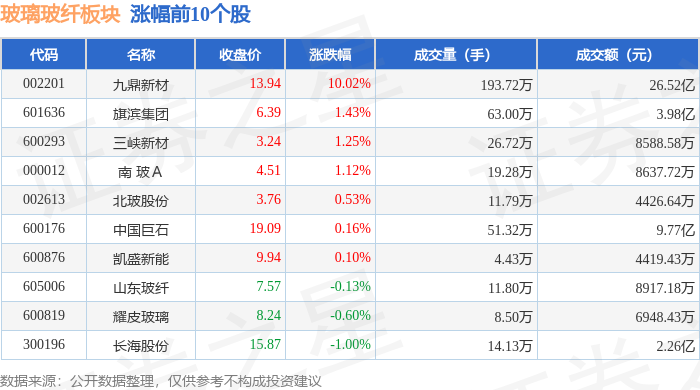
玻璃玻纤板块1月20日跌2.34%,国际复材领跌,主力资金净流出3.6亿元
Zheng Xing Xing Ye Ri Bao· 2026-01-20 08:57
Market Overview - The glass and fiberglass sector experienced a decline of 2.34% compared to the previous trading day, with International Composite Materials leading the drop [1] - The Shanghai Composite Index closed at 4113.65, down 0.01%, while the Shenzhen Component Index closed at 14155.63, down 0.97% [1] Stock Performance - Notable stock performances include: - Jiuding New Materials (002201) rose by 10.02% to a closing price of 13.94, with a trading volume of 1.9372 million shares and a transaction value of 2.652 billion [1] - Qibin Group (601636) increased by 1.43% to 6.39, with a trading volume of 630,000 shares and a transaction value of 286.8 million [1] - China Jushi (600176) saw a slight increase of 0.16% to 19.09, with a trading volume of 513,200 shares and a transaction value of 977 million [1] - International Composite Materials (301526) fell by 7.95% to 7.41, with a trading volume of 1.979 million shares and a transaction value of 1.497 billion [2] Capital Flow - The glass and fiberglass sector saw a net outflow of 360 million from institutional investors, while retail investors contributed a net inflow of 506 million [2] - Detailed capital flow for specific stocks indicates: - Jiuding New Materials had a net inflow of 30.3 million from institutional investors, while retail investors had a net outflow of 12.9 million [3] - North Glass (002613) experienced a net outflow of 1.859 million from institutional investors but a net inflow of 735,600 from retail investors [3] - China Jushi had a net outflow of 7.5775 million from institutional investors, with retail investors contributing a net outflow of 2.93287 million [3]

建筑材料行业今日净流入资金2.56亿元,九鼎新材等7股净流入资金超5000万元
Zheng Quan Shi Bao Wang· 2026-01-20 08:50
Market Overview - The Shanghai Composite Index fell by 0.01% on January 20, with 20 industries experiencing gains, led by the oil and petrochemical sector and construction materials, which rose by 1.74% and 1.71% respectively [1] - The telecommunications and defense industries saw the largest declines, with drops of 3.23% and 2.87% respectively [1] - Overall, there was a net outflow of 95.72 billion yuan in the main funds across the two markets, with 11 industries seeing net inflows [1] Fund Flow Analysis - The banking sector had the highest net inflow of funds, totaling 1.472 billion yuan, and increased by 0.80% [1] - The real estate sector followed with a 1.55% increase and a net inflow of 627 million yuan [1] - The power equipment sector experienced the largest net outflow, with 19.054 billion yuan, followed by the electronics sector with an outflow of 18.394 billion yuan [1] Construction Materials Sector - The construction materials industry rose by 1.71% with a net inflow of 256 million yuan, comprising 71 stocks, of which 48 increased and 22 decreased [2] - Notable stocks with significant net inflows included Jiuding New Materials with 348 million yuan, Anhui Conch Cement with 229 million yuan, and Tibet Tianlu with 141 million yuan [2] - Stocks with the largest net outflows included Zais Technology and China National Materials, each with outflows of 134 million yuan [2] Key Stocks in Construction Materials - Jiuding New Materials: +10.02% with a turnover rate of 32.18% and a net fund flow of 348.14 million yuan [2] - Anhui Conch Cement: +5.74% with a turnover rate of 2.82% and a net fund flow of 228.75 million yuan [2] - Tibet Tianlu: +3.96% with a turnover rate of 9.91% and a net fund flow of 141.07 million yuan [2]


中国风电 - 2026 年需求韧性强,利润率全面回升-China Wind-Resilient demand with broad-based margin recovery in 2026
2026-01-20 03:19
Summary of the Conference Call on China Wind Industry Industry Overview - The focus is on the **China Wind Industry**, particularly during the **15th Five-Year Plan (FYP)**, with a positive outlook on wind installations and offshore deep-sea developments [2][3][4][22]. Key Points Wind Installation Demand - **Forecast for Wind Installations**: Expected to reach **110-120 GW** annually from **2026 to 2030**, with onshore installations stabilizing at approximately **90 GW** and offshore installations between **15-20 GW** per year from **2027 to 2030** [3][22]. - **Investment Appeal**: Wind power is seen as more attractive compared to solar energy post-Document No.136, supported by national energy transition targets [3][24]. Offshore Deep-Sea Developments - **Acceleration of Projects**: Significant progress is anticipated in offshore deep-sea projects, with a preliminary pipeline of **~100 GW** and expected annual installations starting at over **10 GW** during the 15th FYP [4][23]. - **Policy Support**: Clearer policy guidance is expected to be announced, enhancing the development of deep-sea offshore wind [4][24]. European Market Dynamics - **Contracts for Difference (CfD)**: The UK's recent **AR7 CfD** auction awarded **8.4 GW** of offshore wind capacity, a **58% increase** from the previous round, indicating strong demand and export opportunities for Chinese suppliers [5][43]. - **Export Opportunities**: The expanding European offshore wind market is expected to drive demand for Chinese components, including wind turbine parts and submarine cables [5][43]. Company Preferences and Ratings - **Component Suppliers Preferred**: Preference is given to component suppliers like **ZTT**, **Sinoma S&T**, and **Riyue** due to their strong earnings growth outlook and margin recovery potential [6][14][15]. - **OEMs Outlook**: The business turnaround for wind turbine OEMs has largely been priced in, with expectations of stable onshore WTG prices and slight declines in offshore prices [15][37]. Market Performance - **Stock Performance in 2025**: Wind equipment stocks rallied between **3.6% to 177.8%**, outperforming market indices, attributed to an industry turnaround after a down cycle [12][17]. - **Future Expectations**: Key component players are expected to outperform OEMs in 2026 due to ongoing margin improvements and favorable raw material costs [13][17]. Competitive Landscape - **Market Consolidation**: The onshore wind market has become more consolidated, with the top three players increasing their market share from **44.3%** in 2024 to **48.2%** in 2025 [30][31]. - **Fragmentation in Offshore Market**: The offshore market remains fragmented, with new entrants gaining market share, leading to a decline in the combined market share of the top three players from **80.0%** to **53.4%** [32]. Additional Insights - **Tendering Trends**: Public WTG tenders fell by **14.3%** in 2025, but new installations remained robust, with a **59.4% YoY increase** in the final year of the 14th FYP [20][25]. - **Price Trends**: Onshore WTG prices increased by **5-10% YoY**, while offshore prices saw a decline of **4-7% YoY** due to a more fragmented competitive landscape [36][38]. This summary encapsulates the key insights and forecasts regarding the China wind industry, highlighting the positive outlook for installations, the importance of offshore developments, and the dynamics of the European market that favor Chinese suppliers.

年末需求进入淡季,关注供给改善品种 | 投研报告
Sou Hu Cai Jing· 2026-01-20 01:51
Group 1: Cement Industry - The national market is gradually entering the off-season, with overall demand showing a downward trend, particularly in the housing construction market, while infrastructure demand is regionally differentiated under policy influence, and the civil market shows relatively rigid demand [1] - In the medium term, the cement industry's capacity is expected to continue declining under policies limiting overproduction, leading to a significant increase in capacity utilization and profit elasticity [1] - Key companies to watch include Conch Cement and Huaxin Cement [1] Group 2: Glass Industry - The demand side is experiencing a continuous decline in 2025 due to the impact of real estate, with short-term demand during the traditional peak season showing limited improvement and high inventory levels among intermediaries [1] - The supply side faces ongoing supply-demand contradictions, and despite recent cold repairs of multiple production lines, prices are expected to remain low and fluctuate in the short term [1] - Key company to watch is Qibin Group [1] Group 3: Glass Fiber Industry - As the year-end approaches, many pool kiln factories focus on cash collection, resulting in weak performance in middle and downstream deliveries [2] - The supply side sees the completion of cold repairs at China Jushi's production line, with a resurgence in production; the electronic yarn segment is thriving due to demand from the AI industry, leading to a rise in both volume and price for low dielectric products [2] - Key companies to watch include China Jushi and China National Building Material [2] Group 4: Consumer Building Materials - The industry has reached a profitability bottom, with prices having no downward space after years of competition; there is a strong demand for price increases and profit improvement driven by anti-involution policies [2] - In 2025, multiple categories such as waterproofing, coatings, and gypsum boards are expected to issue price increase notices, with anticipated profit improvements for leading companies in 2026 [2] - Key companies to watch include Oriental Yuhong, Sankeshu, Beixin Building Materials, and Rabbit Baby [2] Group 5: Market Overview - In the past week (January 12–18), the main index performance was as follows: the Shenwan Building Materials Industry Index decreased by 0.67%, the Shanghai Composite Index decreased by 0.45%, the Shenzhen Component Index increased by 1.14%, the ChiNext Index increased by 1.00%, and the CSI 300 Index decreased by 0.57% [2] - Among the 31 first-level sub-industry indices in Shenwan, the building materials sector ranked 18th in terms of performance [2]


