
立高食品

Search documents
立高食品实控人方3个月套现1.77亿 A股两募资共21.5亿
Zhong Guo Jing Ji Wang· 2025-11-12 06:58
Core Viewpoint - The company, Lihigh Food, has completed a share reduction plan by its shareholders, Lihigh Xing and Lihigh Chuang, resulting in a total reduction of 4,109,700 shares, which accounts for 2.43% of the company's total share capital [2][3]. Share Reduction Plan - The share reduction plan was announced on August 6, 2025, with a timeframe for execution from September 1, 2025, to November 10, 2025 [1][2]. - Lihigh Xing planned to reduce up to 2,326,800 shares (1.40% of total share capital), while Lihigh Chuang aimed to reduce up to 1,783,900 shares (1.07% of total share capital) [1]. Reduction Details - The total shares reduced by Lihigh Xing were 2,326,753, accounting for 1.37% of total share capital, and Lihigh Chuang reduced 1,782,947 shares, accounting for 1.05% [2]. - The total cash generated from the share reduction was approximately 177 million yuan [3]. Share Reduction Methodology - The reduction was executed through both centralized bidding and block trading methods, with specific price ranges for each method [4][5]. - Lihigh Xing's share reduction included 943,153 shares through centralized bidding and 1,383,600 shares through block trading, while Lihigh Chuang reduced 722,147 shares through centralized bidding and 1,060,800 shares through block trading [4][5]. Fundraising and Financials - Lihigh Food raised a total of 1.197 billion yuan from its initial public offering, with a net amount of 1.106 billion yuan after deducting issuance costs [6]. - The company had planned to raise 1.288 billion yuan for various projects, but the final net amount was 182 million yuan less than the original plan [6]. - The company also issued convertible bonds, raising a total of 950 million yuan, with a net amount of approximately 938 million yuan after expenses [7][8].


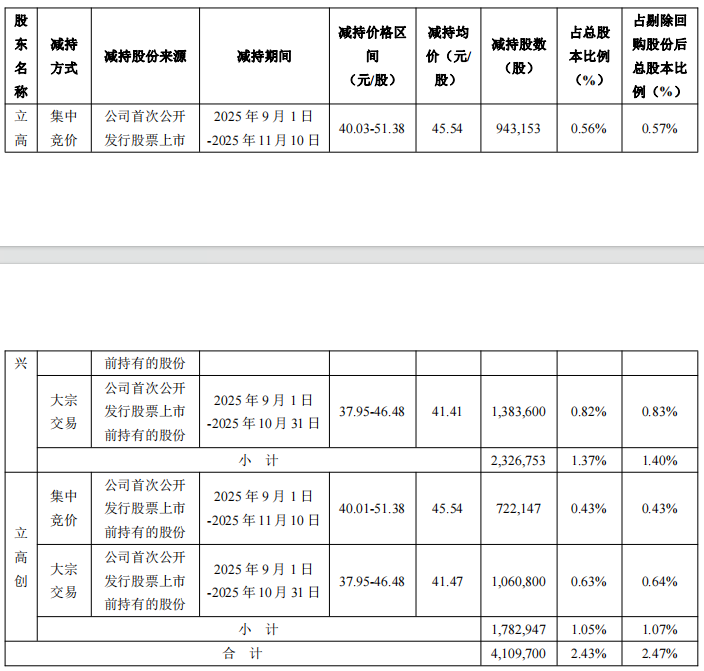
立高食品(300973) - 关于股东减持计划实施完成的公告
2025-11-11 10:34
立高食品股份有限公司 关于股东减持计划实施完成的公告 股东上海立高兴企业管理咨询合伙企业(有限合伙)、上海立高创企业管理咨询合伙 企业(有限合伙)保证向本公司提供的信息内容真实、准确、完整,没有虚假记载、误 导性陈述或重大遗漏。 | 证券代码:300973 | 证券简称:立高食品 | 公告编号:2025-072 | | --- | --- | --- | | 债券代码:123179 | 债券简称:立高转债 | | 注 2:本公告表格若出现总数与各分项数值之和尾数不符的情况,均为四舍五入原因造成。 本公司及董事会全体成员保证公告内容与信息披露义务人提供的信息一致。 立高食品股份有限公司(以下简称"公司")于 2025 年 8 月 6 日在巨潮资讯网披露 了《关于股东减持股份预披露公告》(公告编号:2025-042),股东上海立高兴企业管理 咨询合伙企业(有限合伙)(以下简称"立高兴")、上海立高创企业管理咨询合伙企业(有 限合伙)(以下简称"立高创")计划于减持计划公告之日起 15 个交易日后的三个月内以 集中竞价交易、大宗交易的方式减持公司股份。其中,立高兴计划减持公司股份不超过 2,326,800 股(含本 ...
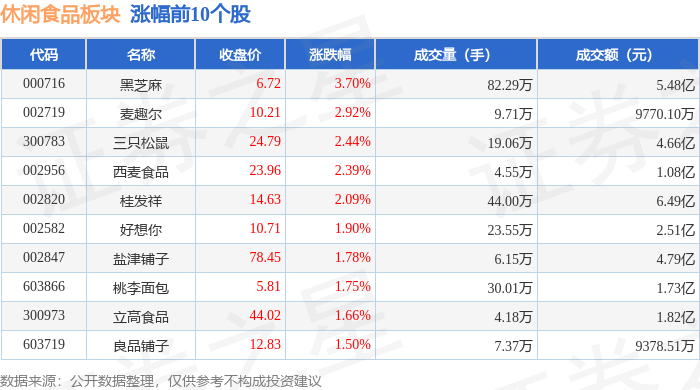
休闲食品板块11月11日涨0.93%,黑芝麻领涨,主力资金净流入3460.97万元
Zheng Xing Xing Ye Ri Bao· 2025-11-11 08:37
Market Overview - The leisure food sector increased by 0.93% on November 11, with Hei Zhima leading the gains [1] - The Shanghai Composite Index closed at 4002.76, down 0.39%, while the Shenzhen Component Index closed at 13289.0, down 1.03% [1] Stock Performance - Hei Zhima (000716) closed at 6.72, up 3.70% with a trading volume of 822,900 shares and a transaction value of 548 million [1] - Other notable performers include: - Mai Jiao Er (002719) at 10.21, up 2.92% [1] - San Zhi Song Shu (300783) at 24.79, up 2.44% [1] - Xi Mai Food (002956) at 23.96, up 2.39% [1] - Gui You Xiang (002820) at 14.63, up 2.09% [1] Capital Flow - The leisure food sector saw a net inflow of 34.61 million from main funds, while retail funds experienced a net outflow of 25.13 million [2] - The main funds' net inflow for Hei Zhima was 39.29 million, representing 7.17% of its total trading volume [3] - San Zhi Song Shu had a main fund net inflow of 30.52 million, accounting for 6.55% of its trading volume [3] Individual Stock Analysis - Hei Zhima experienced a significant net outflow from retail investors of 42.06 million, indicating a divergence in investor sentiment [3] - San Zhi Song Shu also faced a retail net outflow of 26.17 million, suggesting potential concerns among smaller investors [3] - Other stocks like Yan Jin Pu Zi (002847) and Xi Mai Food (002956) showed mixed capital flows, with Yan Jin Pu Zi having a net inflow from main funds of 13.91 million [3]

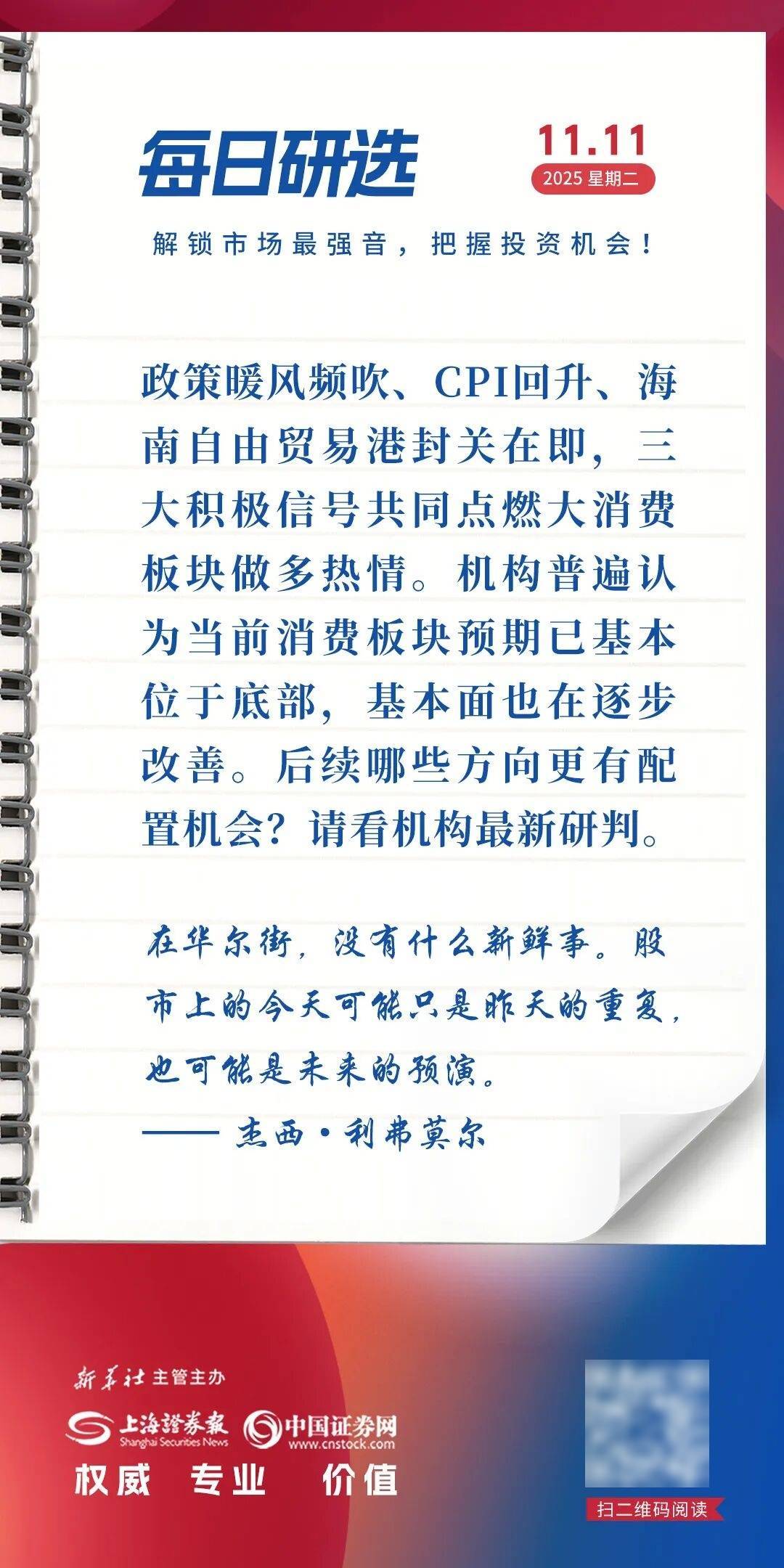
大消费反攻!布局时点到了?丨每日研选
Sou Hu Cai Jing· 2025-11-11 01:05
Core Viewpoint - The consumer sector is showing signs of recovery, driven by favorable policies, rising CPI, and the imminent closure of Hainan Free Trade Port, leading to increased investment enthusiasm in the sector [2][4]. Group 1: Consumer Sector Analysis - The consumer sector is believed to be at the bottom, with fundamentals gradually improving, as indicated by the third-quarter reports [4]. - The "14th Five-Year Plan" emphasizes the importance of consumption, suggesting a positive outlook for the sector [4]. - Key investment opportunities include the restaurant chain sector, which is nearing the end of price wars, and companies like Anjiexin Foods and Lihai Foods are seeing improved net profit margins [4]. Group 2: Duty-Free Industry Insights - Hainan's duty-free sales data shows a significant recovery in Q3 2025, with a notable increase in average transaction value, and a stable outlook for Q4 [5]. - Continuous policy support, including a clear timeline for the island's closure and an expanded range of duty-free products, is expected to enhance the operational conditions for companies like China Duty Free Group and Hainan Development [5]. Group 3: Structural Upgrades in Consumption - The toy industry is evolving with IP incubation and category innovation, favoring leading companies with strong design and supply chain capabilities [6]. - The beauty industry is integrating medical, beauty, and health services, which is expected to enhance customer spending and repeat purchases [6]. - The consumer industry is transitioning from "functional supply" to "scenario value supply," indicating a structural upgrade in brand consumer goods [6]. Group 4: New Consumption Trends - Four new consumption themes are emerging: 1. Brand globalization 2.0, focusing on pricing power and emerging markets [7]. 2. Emotional value sectors like trendy toys and pet products are expected to benefit from rising GDP per capita [7]. 3. AI-driven consumption in service sectors is showing potential for profitability [7]. 4. Channel transformation emphasizing user experience and operational efficiency, particularly in instant retail and cost-effective dining [7]. Group 5: High-Growth Opportunities in Emotional Consumption - The gold and jewelry sector is undergoing significant changes, with rising gold prices and a shift towards emotional consumption, suggesting opportunities in high-end and trendy gold segments [8]. - Retail e-commerce is focusing on offline retail transformation and AI-enabled cross-border e-commerce leaders [8]. - The cosmetics sector is seeing growth in domestic brands that meet emotional value and safety ingredient innovation [8]. - The medical beauty sector remains resilient, with opportunities in differentiated products and mergers in downstream medical beauty institutions [8].



A股异动丨食品饮料股走强,三元股份、惠发食品、巴比食品涨停
Ge Long Hui A P P· 2025-11-10 03:23
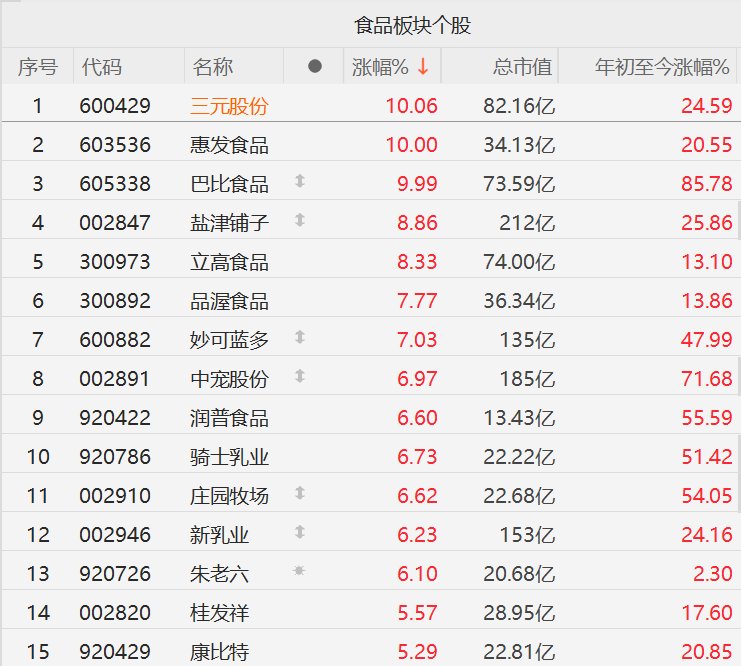
Core Insights - The A-share market has seen a strong performance in the food and beverage sector, with several stocks hitting the daily limit up [1] - The Ministry of Finance has released a report on the execution of China's fiscal policy for the first half of 2025, indicating continued efforts to boost consumer spending [1] Company Performance - **Sanyuan Foods**: Increased by 10.06%, with a total market value of 8.216 billion and a year-to-date increase of 24.59% [2] - **Huifa Foods**: Rose by 10.00%, with a market capitalization of 3.413 billion and a year-to-date increase of 20.55% [2] - **Babi Foods**: Gained 66.6%, with a market value of 7.359 billion and a year-to-date increase of 85.78% [2] - **Yanjin Puzhi**: Increased by 8.86%, with a market capitalization of 21.2 billion and a year-to-date increase of 25.86% [2] - **Lihai Foods**: Rose by 8.33%, with a market value of 7.4 billion and a year-to-date increase of 13.10% [2] - **Miaokelando**: Increased by 7.03%, with a market capitalization of 13.5 billion and a year-to-date increase of 47.99% [2] - **Zhongchong Co.**: Gained 6.97%, with a market value of 18.5 billion and a year-to-date increase of 71.68% [2] - **Runpu Foods**: Increased by 6.60%, with a market capitalization of 1.343 billion and a year-to-date increase of 55.59% [2] - **Knight Dairy**: Rose by 6.73%, with a market value of 2.222 billion and a year-to-date increase of 51.42% [2] - **Zhuangyuan Pasture**: Increased by 6.62%, with a market capitalization of 2.268 billion and a year-to-date increase of 54.05% [2] - **New Dairy**: Gained 6.23%, with a market value of 15.3 billion and a year-to-date increase of 24.16% [2] - **Zhu Laoliu**: Increased by 6.10%, with a market capitalization of 2.068 billion and a year-to-date increase of 2.30% [2] - **Guifaxiang**: Rose by 5.57%, with a market value of 2.895 billion and a year-to-date increase of 17.60% [2] - **Kangbiter**: Increased by 5.29%, with a market capitalization of 2.281 billion and a year-to-date increase of 20.85% [2] Market Trends - The MACD golden cross signal has formed, indicating a positive trend in these stocks [1]



立高食品股价涨5.23%,交银施罗德基金旗下1只基金重仓,持有4.79万股浮盈赚取10.11万元
Xin Lang Cai Jing· 2025-11-10 03:02
Group 1 - The core viewpoint of the news is that Lihigh Food has seen a stock price increase of 5.23%, reaching 42.45 CNY per share, with a trading volume of 1.09 billion CNY and a turnover rate of 2.27%, resulting in a total market capitalization of 7.189 billion CNY [1] - Lihigh Food Co., Ltd. is located in Zengcheng District, Guangzhou, Guangdong Province, and was established on May 11, 2000. The company was listed on April 15, 2021, and its main business involves the research, production, and sales of baking food ingredients and frozen baked goods [1] - The revenue composition of Lihigh Food includes frozen baked goods at 54.35%, cream at 26.94%, other products at 7.85%, sauces at 6.85%, and fruit products at 4.02% [1] Group 2 - From the perspective of major fund holdings, data shows that one fund under Jiao Yin Shi Luo De has a significant position in Lihigh Food. The Jiao Yin An Xiang Stable Pension One Year A (006880) held 47,900 shares in the third quarter, accounting for 0.09% of the fund's net value, ranking as the fourth-largest holding [2] - The Jiao Yin An Xiang Stable Pension One Year A (006880) was established on May 30, 2019, with a latest scale of 2.13 billion CNY. Year-to-date returns are 6.04%, ranking 802 out of 1,039 in its category; the one-year return is 6.72%, ranking 769 out of 1,013; and the cumulative return since inception is 27.36% [2] Group 3 - The fund manager of Jiao Yin An Xiang Stable Pension One Year A (006880) is Liu Di, who has been in the position for 1 year and 11 days. The total asset scale of the fund is 3.459 billion CNY, with the best fund return during the tenure being 16.6% and the worst being 3.61% [3]
餐饮供应链专题报告:经营拐点渐现,价值重估在即
CAITONG SECURITIES· 2025-11-08 14:30
Investment Rating - The report maintains a "Positive" investment rating for the food and beverage industry [1] Core Insights - Supply and demand are rebalancing, with capital expenditure peaks passing and demand gradually recovering under policy and consumption recovery [5][10] - New growth drivers are emerging through product innovation and channel expansion, breaking the price competition [5][36] - The industry logic is strengthening, with the standardization of prepared dishes and an increase in chain rates driving industry concentration [5][36] - Investment recommendations focus on the supply chain opportunities in the restaurant sector, highlighting major companies and smaller firms with growth potential [5][36] Summary by Sections Supply and Demand Rebalancing - Capital expenditure in the industry has significantly declined after 2023, with a focus on improving capacity utilization [5][10] - The price war is gradually coming to an end, and the third quarter of 2025 may mark an operational turning point for the industry [5][22] - Demand is stabilizing, with restaurant openings and closures balancing out, and consumption showing resilience during peak holiday periods [5][26][27] New Growth Drivers - Companies are shifting focus from price competition to product innovation and channel expansion, with retail trends becoming more pronounced [5][36] - Major companies are launching new products and optimizing channels to adapt to the changing market landscape [5][44] Strengthening Industry Logic - Recent regulatory developments in prepared dishes are expected to raise industry entry barriers, benefiting compliant leading companies [5][36] - The chain rate in the restaurant sector is projected to increase from 19% in 2021 to 23% in 2024, indicating a trend towards consolidation [5][36] Investment Recommendations - The report suggests focusing on major companies like Anjuke Food, Angel Yeast, and Haitian Flavoring, as well as smaller firms like Baoli Food and Lihigh Food for potential growth [5][36] - The overall market is expected to improve with a favorable chip structure and policy expectations [5][36]

食品饮料行业10月月报:个股表现好于板块整体,关注新消费-20251107
Zhongyuan Securities· 2025-11-07 09:00
Investment Rating - The industry investment rating is "In line with the market," indicating that the industry index is expected to fluctuate between -10% to 10% relative to the CSI 300 over the next six months [58]. Core Insights - The food and beverage sector recorded a decline in October 2025, with a component index drop of -0.58%. The performance of the liquor segment significantly dragged down the overall results, while sectors like prepared foods, health products, and baking showed positive growth [6][7]. - From January to October 2025, the food and beverage sector's cumulative performance was -0.97%, underperforming the market benchmark index, with significant contributions from the weak performance of major segments like liquor and beer [11][14]. - The valuation of the food and beverage sector is at a relative low point historically, with a current valuation of 20.06 times earnings, down 6.27% from the previous month. This is the lowest in ten years, with liquor valuations also below the sector average [17]. - In October 2025, 60.16% of individual stocks in the sector saw price increases, indicating that individual stock performance was better than the overall sector [23][29]. Summary by Sections 1. Market Performance of the Food and Beverage Sector - The food and beverage sector experienced a decline in October 2025, with a component index drop of -0.58%. The total trading volume for the sector was 20.352 billion shares, a significant decrease from September [6][7]. - The cumulative performance from January to October 2025 was -0.97%, with the sector ranking last among 31 primary industries [11][14]. 2. Valuation of the Food and Beverage Sector - As of October 31, 2025, the sector's valuation stood at 20.06 times earnings, marking a 6.27% decrease from the previous month. This valuation is lower than 20 other industries, placing it in the lower tier of industry valuations [17]. 3. Individual Stock Performance - In October 2025, 60.16% of individual stocks in the food and beverage sector increased in value, with notable performances from composite seasoning, dairy, health products, and prepared foods [23][29]. - Specific stocks that performed well included Hai Xin Foods (+12.65%), Tang Chen Bei Jian (+8.85%), and others across various sub-sectors [24][25]. 4. Industry Output and Price Factors - The food and beverage manufacturing sector saw a fixed asset investment increase of 22.9% year-on-year in 2024, with a continued high growth level into 2025 [31]. - Production trends showed a decline in liquor and wine output, while fresh meat and edible oil production maintained growth [35][37]. 5. Investment Strategy - The report recommends focusing on investment opportunities in soft drinks, health products, baking, yeast, composite seasoning, and snacks for November 2025 [54][55]. - The suggested stock portfolio includes companies like Bao Li Foods, Li Gao Foods, and Xian Le Health, all rated for potential growth [56].
休闲食品板块11月6日跌0.13%,ST绝味领跌,主力资金净流出1.26亿元
Zheng Xing Xing Ye Ri Bao· 2025-11-06 08:51
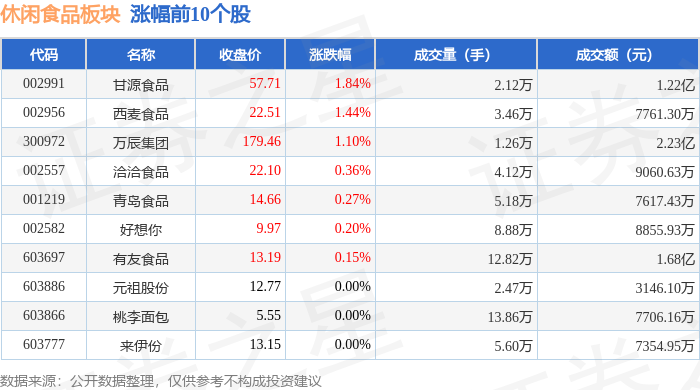
Market Overview - The leisure food sector experienced a slight decline of 0.13% on November 6, with ST Juewei leading the drop [1] - The Shanghai Composite Index closed at 4007.76, up 0.97%, while the Shenzhen Component Index closed at 13452.42, up 1.73% [1] Individual Stock Performance - Notable gainers in the leisure food sector included: - Ganyuan Food (002991) with a closing price of 57.71, up 1.84% and a trading volume of 21,200 lots [1] - Ximai Food (002956) closed at 22.51, up 1.44% with a trading volume of 34,600 lots [1] - Wancheng Group (300972) closed at 179.46, up 1.10% with a trading volume of 12,600 lots [1] - Conversely, ST Juewei (603517) saw a decline of 1.52%, closing at 13.64 with a trading volume of 91,600 lots [2] - Other notable decliners included: - Yanjinpuzi (002847) down 1.38% to 71.33 [2] - Three Squirrels (300783) down 1.02% to 23.32 [2] Capital Flow Analysis - The leisure food sector saw a net outflow of 126 million yuan from institutional investors, while retail investors contributed a net inflow of 100 million yuan [2] - The overall capital flow for individual stocks showed mixed results, with Ganyuan Food experiencing a net inflow of over 3.89 million yuan from institutional investors [3] - Other stocks like Ziyan Food (603057) had a net inflow of 1.55 million yuan from institutional investors, while stocks like ST Juewei and Lihai Food (300973) faced significant net outflows [3]




食品饮料2025年三季报总结:白酒主动释放压力,速冻迎来行业拐点,软饮、零食量贩高景气维持
China Post Securities· 2025-11-06 05:06
Industry Investment Rating - The investment rating for the food and beverage industry is "Outperform" [1] Core Insights - The report highlights that the liquor sector is actively releasing pressure on financial statements, with the industry gradually bottoming out. The frozen food sector is witnessing a turning point, while the soft drink and snack sectors maintain high levels of prosperity [3][4][30] Summary by Sections 1. Liquor - The liquor sector's total revenue for the first three quarters of 2025 was CNY 319.23 billion, a year-on-year decrease of 5.76%, with net profit down 6.85% to CNY 122.67 billion. In Q3 alone, revenue fell 18.38% to CNY 78.48 billion, and net profit dropped 22.00% to CNY 28.09 billion [14][28] - High-end liquor brands like Moutai showed stable growth, while others like Wuliangye and Luzhou Laojiao faced significant declines. Moutai's revenue grew by 9.28% year-on-year, while Wuliangye's fell by 10.26% [17][19] - The second-tier liquor brands, such as Fenjiu, showed resilience with a revenue increase of 5.00%, while others like Shui Jing Fang and Shede experienced declines [26][22] 2. Soft Drinks - The soft drink sector saw significant growth, with companies like Dongpeng Beverage reporting a 34.13% increase in revenue year-on-year. The energy drink segment, particularly, showed robust growth [30][31] - The introduction of new flavors and products, such as Dongpeng's summer limited edition, contributed to the sustained high growth rates in this sector [30] 3. Dairy Products - The dairy sector, led by Yili, maintained stable performance despite high base effects, with significant growth in milk powder and cold drink products. New Dairy's low-temperature products continued to show double-digit growth [4][31] 4. Frozen Foods - The frozen food industry is experiencing a turning point, with companies noting that the price war has peaked. The focus is shifting towards rational competition and value [7][30] 5. Snacks - The snack sector is undergoing strategic adjustments, with member stores and instant retail becoming key growth channels. The overall consumption environment remains weak, but the snack sector is adapting with targeted strategies [7][30]




