
餐饮供应链

Search documents
瑞银:升颐海国际(01579)目标价至18.2港元 重申“买入”评级
智通财经网· 2026-02-23 07:14
Core Viewpoint - UBS has raised its revenue forecasts for Yihai International (01579) by 1% for both last year and this year, and increased net profit forecasts by 3% and 6% respectively, indicating a positive outlook for the company's growth prospects [1] Group 1: Financial Projections - The new forecasts imply a compound annual growth rate (CAGR) for revenue and net profit of 5% and 11% respectively from 2025 to 2026 [1] - UBS has adjusted its target price for Yihai from HKD 15.9 to HKD 18.2, maintaining a "Buy" rating [1] Group 2: Growth Drivers - The positive outlook for restaurant demand in 2026 is expected to benefit Yihai and other companies in the restaurant supply chain [1] - A turning point in sales from related parties is noted, with Haidilao's operations stabilizing from a low base [1] - Following a price increase in Q4 2025, Yihai's profit margins are anticipated to improve [1]
晨会聚焦:食品饮料何长天:餐饮细分精耕效率,餐供定制扩容可期-20260128
ZHONGTAI SECURITIES· 2026-01-28 14:29
Core Insights - The report highlights the slowdown in overall revenue growth in the restaurant industry, particularly in first-tier cities, while still identifying structural opportunities within the sector [3] - It emphasizes the need for the restaurant industry to adapt to changing consumer preferences, moving from premium brands to value-for-money options, and focusing on health and emotional value in dining experiences [4] Industry Overview - The current state of China's restaurant industry is characterized by a decline in revenue growth, primarily due to uneven wealth distribution and lower overall consumer spending compared to developed countries [3] - The labor force participation rate is decreasing, leading to a higher dependency ratio, with population migration favoring economically vibrant first-tier cities, which may benefit chain restaurants with a strong presence in these areas [3] Future Development Paths - The report suggests three potential development paths for the restaurant industry in China, inspired by Japan's consumption evolution: 1. High-quality and affordable dining options that leverage scale to reduce costs [4] 2. Automation and smart technology in kitchens to mitigate talent shortages [4] 3. Focusing on niche markets to cater to diverse consumer needs, such as single-person meals and aging populations [4] Supply Chain Dynamics - The upstream raw materials sector is fragmented, resulting in weak bargaining power and lower profitability, while the downstream restaurant sector is experiencing high closure rates, indicating a rapid industry reshuffle [4] - Midstream catering supply companies are encouraged to innovate and provide comprehensive solutions to enhance their profit margins and support the growth of restaurant brands, with specific opportunities in frozen baked goods and cold chain logistics [4]
2026,谁会成为餐饮业的“超级链接者”?
Sou Hu Cai Jing· 2026-01-24 02:11
Core Insights - The Chinese meat consumption landscape is evolving, with pork consumption expected to reach 58 million tons by 2025, reflecting a growth rate of 1.5% from 2024, primarily due to declining consumer willingness and slower recovery in dining consumption [2] - Beef and poultry consumption are on the rise, with beef gaining popularity due to its high protein and low-fat content, while chicken remains favored for its economic and nutritional advantages [3][4] - The meat supply chain is undergoing significant changes driven by market forces and policy adjustments, with a notable decline in the breeding sow population and a potential recovery in pork prices by Q3 2026 [5] Industry Trends - The integration of smart technology in the food supply chain is advancing, with automation being implemented across various stages from farming to restaurant operations, driven by rising labor costs [7][9] - The average monthly salary for restaurant staff has increased, with waitstaff and chefs earning approximately 4,851 yuan and 6,696 yuan respectively as of Q3 2025, prompting a shift towards automation to manage costs [8] - Companies are increasingly adopting intelligent devices to enhance operational efficiency, with the cost of automation technology decreasing significantly over the past five years [9][10] Supply Chain Transparency - Food safety and traceability are becoming critical competitive factors in the restaurant industry, with leading brands implementing comprehensive transparency measures to build consumer trust [12][14] - The trend towards transparency is pushing the industry to establish new benchmarks, as consumers begin to demand visibility into the supply chain from other restaurants [14][16] - Technological advancements in traceability, such as blockchain and IoT, are expected to lower costs and make these systems accessible to smaller enterprises, potentially leading to a future where every food item has a digital identity [16][17] Conclusion - The competitive landscape of the Chinese restaurant industry is shifting towards supply chain resilience, data transparency, and operational efficiency, which will be crucial for long-term sustainability [17]


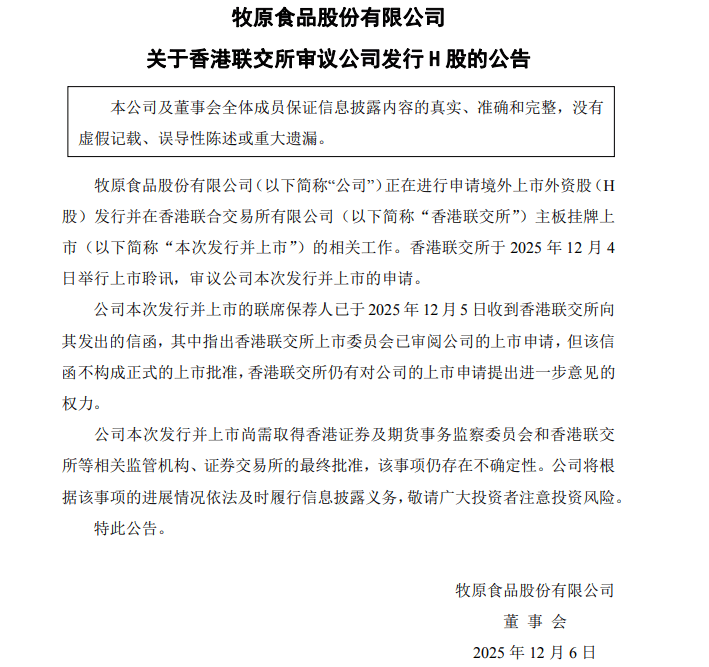
牧原股份H股上市已举行聆讯;涪陵榨菜餐饮渠道增速达20%
Sou Hu Cai Jing· 2025-12-15 01:01
Group 1: Company Developments - Muyuan Foods has initiated the process for its H-share listing on the Hong Kong Stock Exchange, with a potential issuance of approximately 546 million shares [1][4] - Fuling Zhacai reported a 20% growth in its restaurant channel, attributed to the establishment of an independent sales team and targeted product development [1][4] - Anjoy Foods announced that its shrimp products have become the strongest growth category among its new offerings, achieving high double-digit growth [1][5] - Jiamei Packaging is planning a change in control, which may lead to a shift in its major shareholder and actual controller [1][5] - Dayao Beverage has announced the cancellation of its Inner Mongolia subsidiary as part of a routine business adjustment [1][6] - Yuexiu Agricultural and Animal Husbandry Foods signed a memorandum of cooperation with Hendrix Genetics for joint breeding and resource sharing [1][8] - Kudi Coffee's global supply chain base has achieved a monthly production milestone of over 10,000 tons [1][8] Group 2: Product Innovations - Meixin Food launched a new turmeric ginger hot pot base, designed for versatility across various culinary applications [1][10] - Guolian Aquatic Products introduced a new Dai-style lemongrass grilled fish product, featuring fresh tilapia and a unique seasoning blend [1][10] - Sanquan Foods released a low GI blueberry and mulberry glutinous rice ball, incorporating real fruit and a slow sugar formula [1][10] - Nanjiao Foods announced the launch of its YiPure cream, which meets new national standards and boasts a high milk content [1][10] Group 3: Market Trends - The USDA has revised its beef price forecasts downward for 2026 due to anticipated declines in slaughterhouse capacity and recent unfavorable price data [1][11] - Food prices have driven the CPI to its highest year-on-year increase in nearly 21 months, with significant rises in fresh vegetable and meat prices [1][13]





中国银河证券:食品饮料行业新消费仍具持续性 传统消费有望迎来底部改善
智通财经网· 2025-12-01 03:57
Core Viewpoint - The food and beverage index in November shows continued recovery, outperforming the broader market due to a shift in market style and a positive CPI growth rate, with pre-processed foods, baked goods, and dairy products leading the gains [1] Group 1: Market Trends - The food and beverage sector experienced a 0.8% increase in November, with an excess return of 3.1% compared to the Wind All A index, ranking 11th among 31 sub-industries [4] - Five out of ten sub-sectors achieved positive monthly returns, with pre-processed foods, dairy, and baked goods showing significant increases of +9.1%, +6.6%, and +4.2% respectively [4] Group 2: Investment Opportunities - The report highlights opportunities in the retail and dining supply chain, with a focus on developing private labels in supermarkets, which could see a growth potential of 2-3 times, translating to a market increment of approximately 100 billion [2] - The dining channel is expected to recover as competition stabilizes, with pre-processed food net profit growth showing improvement in Q3 2025, driven by the easing of price competition and the gradual lifting of alcohol bans [2] Group 3: Price Tracking - As of November 30, 2025, the price of premium liquor has decreased compared to the previous month and year, with specific prices for various brands noted [3] - Packaging material prices have shown mixed trends, with glass and PET prices down year-on-year, while aluminum and cardboard prices have increased [3] - Raw material prices for sugar, flour, palm oil, and pork have decreased significantly year-on-year, while quail eggs and soybean prices have increased [3]

宝立食品再遭原始股东减持 C端业务谋求向线下布局
Zhong Guo Jing Ying Bao· 2025-11-19 09:51
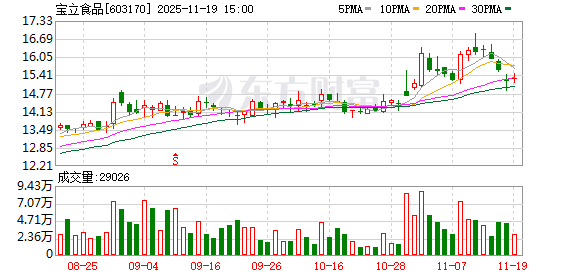
Core Viewpoint - Shanghai Houxu Asset Management Co., Ltd. plans to reduce its stake in Baoli Food by up to 12,000,300 shares, representing no more than 3% of the total share capital, due to its own funding needs [2][3] Group 1: Shareholder Actions - This is the fourth time Shanghai Houxu has reduced its stake in Baoli Food, having previously completed a reduction of 1,316,400 shares in February 2024 [2][3] - After the current reduction, Shanghai Houxu will hold 6.25% of Baoli Food's shares, which may drop below 5% if the reduction is successful [3] Group 2: Company Performance - Baoli Food reported a revenue of 2.133 billion yuan for the first three quarters of the year, a year-on-year increase of 10.50%, with a net profit of 192 million yuan, also up by 10.59% [5] - The company’s net profit margin for the first three quarters was 10.03%, a slight decrease from the previous year [6] Group 3: Market Position and Strategy - Baoli Food has expanded its business from a restaurant supply chain to include beverage and dessert ingredients, serving major clients like KFC and McDonald's [6] - The company aims to deepen its presence in the C-end market through its brand "Kongke Yimian," which is positioned as a leading product in the light cooking segment [7][8] - The competitive landscape in the C-end market is intensifying, necessitating Baoli Food to innovate in marketing and product offerings [8]

餐饮供应链专题报告:需求触底改善,重启成长价值
CMS· 2025-11-17 07:06
Investment Rating - The report maintains a positive investment rating for the restaurant supply chain sector, suggesting increased attention due to signs of demand recovery and growth potential for quality companies [2][38]. Core Insights - The restaurant supply chain sector is experiencing a shift where companies are transitioning from being mere supporters to active drivers of innovation and demand, highlighting the importance of R&D and innovation capabilities [10][22]. - The industry is witnessing a structural opportunity as the chain restaurant rate continues to rise, with expectations for further growth in the coming years [18][10]. - Current valuations in the sector are at historically low levels, indicating potential for recovery as demand improves [30][34]. - The report emphasizes the importance of mergers and acquisitions as companies seek to enhance their competitive positions and bind key customers [22][24]. Summary by Sections Industry Status - Overall demand in the restaurant sector remains weak, but signs of recovery are evident, particularly during holiday periods [10][11]. - The restaurant supply chain industry is projected to maintain a compound annual growth rate of over 15% in the next three years, outperforming the broader restaurant market [14][10]. Company Changes - Companies are increasingly focusing on R&D and innovation to meet the evolving demands of chain restaurants, which require standardized and stable supply [22][10]. - Mergers and acquisitions are being utilized to strengthen customer relationships and enhance resource capabilities [24][22]. - New retail channels are being explored to drive growth, with companies expanding into high-end and online markets [25][10]. Valuation Analysis - The current valuation of the sector is below the 20th percentile of the past decade, suggesting significant upside potential as demand recovers [34][30]. - The report notes that the valuation decline over the past five years has been primarily due to reduced demand and high initial valuations [30][34]. Investment Recommendations - The report suggests increasing focus on specific companies such as Haidilao, Angel Yeast, and others, which are expected to benefit from demand recovery and improved operational performance [38][39].




千味央厨(001215):经营环比改善,关注新渠道发展
Changjiang Securities· 2025-11-10 14:43
Investment Rating - The investment rating for the company is "Buy" and is maintained [6] Core Insights - The company's total revenue for Q1-Q3 2025 is 1.378 billion yuan, showing a year-on-year increase of 1.00%. However, the net profit attributable to the parent company is 53.7755 million yuan, a decrease of 34.06% year-on-year. The Q3 2025 revenue is 492 million yuan, reflecting a year-on-year growth of 4.27%, while the net profit for Q3 is 17.9855 million yuan, down 19.08% year-on-year [2][4] Summary by Sections Financial Performance - For Q1-Q3 2025, the company reported total revenue of 1.378 billion yuan, with a net profit of 53.7755 million yuan and a non-recurring net profit of 53.599 million yuan, both showing significant declines year-on-year [2][4] - In Q3 2025, the revenue reached 492 million yuan, marking a 4.27% increase year-on-year, while the net profit was 17.9855 million yuan, down 19.08% year-on-year [2][4] Market and Competitive Landscape - Revenue performance has shown a quarter-on-quarter improvement, indicating that the operational bottom has been reached. The revenue growth rates for Q1 to Q4 2025 are projected to be +1.50%, -3.12%, and +4.27%, respectively, with expectations for continued recovery in Q4 due to a lower comparative base [10] - The competitive landscape remains intense, with the company's net profit margin declining by 2.08 percentage points to 3.9% for Q1-Q3 2025, and gross margin decreasing by 1.52 percentage points to 22.73% [10] Investment Projects and Future Outlook - Some investment projects have been delayed to adapt to new market trends. The company has adjusted the construction timeline for the "Wuhu Baifuyuan Project" and "Hebi Baishun Project" to January 2027 due to changes in market demand and economic conditions [10] - Profit forecasts for the company indicate net profits of 72 million yuan, 97 million yuan, and 111 million yuan for 2025, 2026, and 2027, respectively, with corresponding EPS of 0.74, 1.00, and 1.14 yuan, suggesting a PE ratio of 57, 42, and 36 times at the current stock price [10]
餐饮供应链专题报告:经营拐点渐现,价值重估在即
CAITONG SECURITIES· 2025-11-08 14:30
Investment Rating - The report maintains a "Positive" investment rating for the food and beverage industry [1] Core Insights - Supply and demand are rebalancing, with capital expenditure peaks passing and demand gradually recovering under policy and consumption recovery [5][10] - New growth drivers are emerging through product innovation and channel expansion, breaking the price competition [5][36] - The industry logic is strengthening, with the standardization of prepared dishes and an increase in chain rates driving industry concentration [5][36] - Investment recommendations focus on the supply chain opportunities in the restaurant sector, highlighting major companies and smaller firms with growth potential [5][36] Summary by Sections Supply and Demand Rebalancing - Capital expenditure in the industry has significantly declined after 2023, with a focus on improving capacity utilization [5][10] - The price war is gradually coming to an end, and the third quarter of 2025 may mark an operational turning point for the industry [5][22] - Demand is stabilizing, with restaurant openings and closures balancing out, and consumption showing resilience during peak holiday periods [5][26][27] New Growth Drivers - Companies are shifting focus from price competition to product innovation and channel expansion, with retail trends becoming more pronounced [5][36] - Major companies are launching new products and optimizing channels to adapt to the changing market landscape [5][44] Strengthening Industry Logic - Recent regulatory developments in prepared dishes are expected to raise industry entry barriers, benefiting compliant leading companies [5][36] - The chain rate in the restaurant sector is projected to increase from 19% in 2021 to 23% in 2024, indicating a trend towards consolidation [5][36] Investment Recommendations - The report suggests focusing on major companies like Anjuke Food, Angel Yeast, and Haitian Flavoring, as well as smaller firms like Baoli Food and Lihigh Food for potential growth [5][36] - The overall market is expected to improve with a favorable chip structure and policy expectations [5][36]
国信证券:基本面磨底信号明显 关注食饮板块向上弹性
Zhi Tong Cai Jing· 2025-10-21 03:23
Industry Overview - The consumption policies' impact is gradually weakening, leading to a recovery phase in the restaurant supply chain demand, with positive signals emerging from the supply side, such as frequent mergers and acquisitions among leading companies, which enhance industry concentration [1] - The competition in the industry has not intensified further, and market spending is becoming more rational, indicating a potential improvement in the industry outlook [1] - Historical experience suggests that the fourth quarter will see concentrated macro policies, and any changes in supply and demand could catalyze stock price increases due to low baseline fundamentals and low institutional holdings [1] Market Performance - As of October 17, 2023, the condiment index has decreased by 6.1% since the beginning of 2025, underperforming the CSI 300 index by 24.3 percentage points and the food and beverage sector by 3.5 percentage points [1] - The pre-processed food index has dropped by 6.4%, also underperforming the CSI 300 index by 24.6 percentage points and the food and beverage sector by 3.8 percentage points [1] - Since August, the food and beverage sector has risen by 3.0%, with the condiment sector showing similar trends, primarily driven by large-cap stocks like Haitian Flavoring and Food [1] Key Companies - Haitian Flavoring and Food (603288): Demonstrates self-innovation and highlights its leading advantages [2] - Baba Food (605338): Driven by both store expansion and group meal services, enhancing its operational capabilities [2] - Anjuke Food (603345): Maintains stable core operational capabilities with clear product and channel strategies [2] - Qianwei Central Kitchen (001215): Optimizes channel structure, with new channel potential expected to drive growth [2] - Yihai International: Maintains a solid foundation with related parties and a high dividend rate, with clear new growth points [2]
