翰森制药

Search documents
胡润:一张财富排行榜里的二十五年|我们的四分之一世纪
经济观察报· 2025-12-31 09:34
Core Viewpoint - The article reflects on the evolution of wealth in China over the past 25 years, highlighting the transformation of the "rich list" from a curiosity to a significant indicator of the vitality of the private economy in China [6][26]. Group 1: Historical Context - In 1999, the first Chinese rich list was created by Hu Run, initially featuring 50 individuals, with the first being Rong Yiren of CITIC Group [5][6]. - The list has grown significantly, with the 2025 edition featuring 1,434 individuals, and the entry threshold rising to 5 billion RMB [6][27]. - The early years of the list were marked by a lack of transparency regarding wealth, with many entrepreneurs being sensitive about their financial status and personal information [19][22]. Group 2: Changes in Wealth Accumulation - The past 25 years have seen the fastest and largest accumulation of wealth in Chinese history, shifting from land appreciation to wealth generated through technological breakthroughs and global markets [8][36]. - The composition of the rich list has changed, with a significant decline in the number of real estate moguls, from 50% in the first list to only one in the top 100 by 2025 [30][32]. Group 3: New Wealth Dynamics - The current wealthy individuals are often referred to as "super wealth creators" or "super entrepreneurs," reflecting their contributions beyond mere financial accumulation [36]. - The rise of technology-driven entrepreneurs like Lei Jun and the growth of sectors such as biomedicine and renewable energy indicate a shift in the sources of wealth [36][37]. - The new generation of entrepreneurs is characterized by a global perspective, with many targeting international markets from the outset [43][44]. Group 4: Cultural and Behavioral Shifts - There is a notable cultural shift among Chinese entrepreneurs, who are increasingly embracing transparency and public discussion of wealth, contrasting with the previous generation's tendency to remain low-profile [25][26]. - The new generation of entrepreneurs often pursue further education to enhance their knowledge and networks, reflecting a commitment to continuous learning [38]. Group 5: Future Outlook - The article suggests optimism regarding the next generation of business leaders, who have been exposed to their parents' struggles and are likely to uphold the values of their family businesses [46]. - The ongoing transition in wealth dynamics and the emergence of new industries indicate a robust future for China's economy, with capital moving away from real estate towards innovation-driven sectors [37].


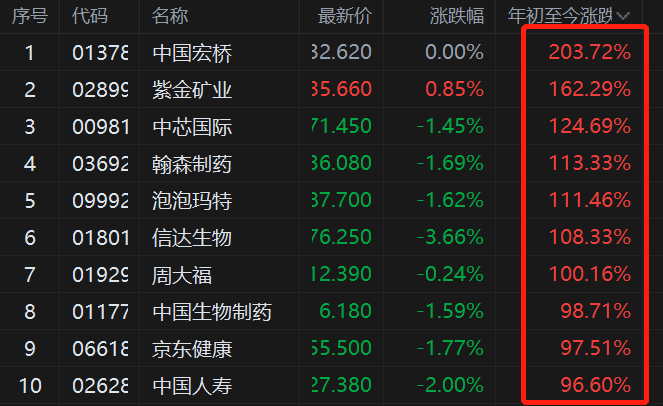
25年恒指累涨近28%:中国宏桥暴涨203.72%居成份股榜首,近10只个股翻倍
Ge Long Hui A P P· 2025-12-31 06:39
Core Insights - The Hong Kong stock market closed 2025 with the Hang Seng Index rising by 27.77%, marking its best annual performance since 2017 [1] - Among the constituents of the Hang Seng Index, China Hongqiao surged by 203.72%, leading the gains, followed by Zijin Mining at 162.29%, and SMIC at 124.69% [1][2] Group 1: Performance Highlights - China Hongqiao's stock price reached 32.620 with a year-to-date increase of 203.72% [2] - Zijin Mining's stock price was 35.660, reflecting a year-to-date rise of 162.29% [2] - SMIC's stock price stood at 71.450, with a year-to-date increase of 124.69% [2] - Hansoh Pharmaceutical increased by 113.33% year-to-date, with a stock price of 36.080 [2] - Pop Mart's stock price was 37.700, showing a year-to-date rise of 111.46% [2] - Innovent Biologics saw a year-to-date increase of 108.33%, with a stock price of 76.250 [2] - Chow Tai Fook's stock price was 12.390, reflecting a year-to-date increase of 100.16% [2] - China Biologic Products had a stock price of 6.180, with a year-to-date rise of 98.71% [2] - JD Health's stock price was 55.500, showing a year-to-date increase of 97.51% [2] - China Life's stock price stood at 27.380, with a year-to-date increase of 96.60% [2] Group 2: Sector Analysis - The performance of the top stocks reflects four main themes: cyclical resources, hard technology, innovative pharmaceuticals, and niche consumption [1] - Stocks like China Hongqiao and Zijin Mining benefited from global inflation and industrial demand [1] - SMIC represents the core of domestic substitution and technological self-reliance [1] - Companies like Hansoh and Innovent are being valued for genuine innovation and international pricing [1] - Niche consumption sectors, represented by Pop Mart, Chow Tai Fook, and JD Health, demonstrate strong vitality even in a weak recovery environment [1]



中国癌症新药研发数量全球居首
3 6 Ke· 2025-12-31 03:52
Core Insights - Chinese companies are projected to conduct approximately 39% of global cancer clinical trials in 2024, surpassing the United States at about 32% [2][8] - The number of clinical trials in China has increased significantly, from around 2% in 2009 to approximately 35% in 2023, indicating a growing dominance in the cancer research field [2][8] - The Chinese government is providing strong support for new drug research, designating it as a key national focus and investing substantial resources [4][8] Clinical Trials and Market Dynamics - In 2024, Chinese enterprises are expected to conduct 896 cancer clinical trials, leading globally, while the U.S. will conduct 720 trials [2][8] - The total number of clinical trials globally is projected to be 5,318, with Chinese companies accounting for 1,669 trials, approximately 30% of the total [7][8] - The increase in patient numbers in China facilitates easier clinical trial execution and drug development [5] Collaborations and Partnerships - Japanese pharmaceutical companies are increasingly collaborating with Chinese firms, with notable agreements in cancer treatment and autoimmune disease therapies [6][7] - In 2023, Takeda Pharmaceutical signed an agreement with a Chinese company for cancer drug licensing, highlighting the advantages of conducting research in China [6][7] - By mid-2025, contracts between Chinese and global pharmaceutical companies are expected to exceed $48.5 billion, indicating a robust partnership trend [7] Intellectual Property and Globalization - China filed over 188,000 drug patents in 2024, significantly outpacing the U.S. with about 53,000 patents, reflecting a rapid enhancement in research capabilities [7][8] - For Chinese drugs to enter international markets, they must undergo rigorous clinical trials and secure regulatory approvals, emphasizing the importance of intellectual property protection [10] - The potential for innovative Chinese drugs to be utilized globally is increasing, necessitating careful management of economic and geopolitical risks [10]
中国癌症新药研发数量全球居首
日经中文网· 2025-12-31 03:02
Core Viewpoint - Chinese companies are leading the world in cancer clinical trials, with a projected 39% share in 2024, surpassing the United States at 32% and indicating a significant shift in the global pharmaceutical landscape [1][3]. Group 1: Clinical Trials and Market Position - In 2024, Chinese enterprises are expected to conduct 896 cancer clinical trials, representing 39% of the global total, while the U.S. will account for approximately 32% [3]. - The number of clinical trials conducted by Chinese companies has increased from about 2% in 2009 to 35% in 2023, marking a substantial growth trajectory [3]. - The global market for pharmaceuticals is projected to see China’s drug expenditure reach $166 billion in 2024, constituting 10% of the global market [9]. Group 2: Government Support and R&D Investment - The Chinese government has prioritized new drug research as a key area, providing substantial funding and talent, particularly in the biopharmaceutical sector [7]. - The "Made in China 2025" initiative has identified biomedicine as a critical industry for national revitalization [7]. Group 3: Collaborations and Partnerships - Japanese pharmaceutical companies are increasingly collaborating with Chinese firms, with notable agreements for cancer treatments and other therapeutic areas [8]. - In the first half of 2025, contracts between Chinese and global pharmaceutical companies reached 61, totaling $48.5 billion, indicating a growing trend in international partnerships [9]. Group 4: Innovation and Patent Applications - China applied for over 188,000 drug patents in 2024, significantly outpacing the U.S. with approximately 53,000 applications, showcasing an increase in R&D capabilities [9]. - The quality of drug development in China is improving, with expectations for the emergence of blockbuster drugs and major pharmaceutical companies in the future [9]. Group 5: Global Market Challenges - Despite advancements, Chinese drugs primarily remain within the domestic market, with challenges in gaining approval for international sales [11]. - The need for transparent clinical trial data and intellectual property protection is crucial for Chinese companies aiming for global market entry [12].


年内最大港股Biotech IPO!港股通创新药ETF(159570)跌超1%再创阶段新低,昨日净流入超1100万元!JPM大会有哪些值得关注?
Xin Lang Cai Jing· 2025-12-30 09:56
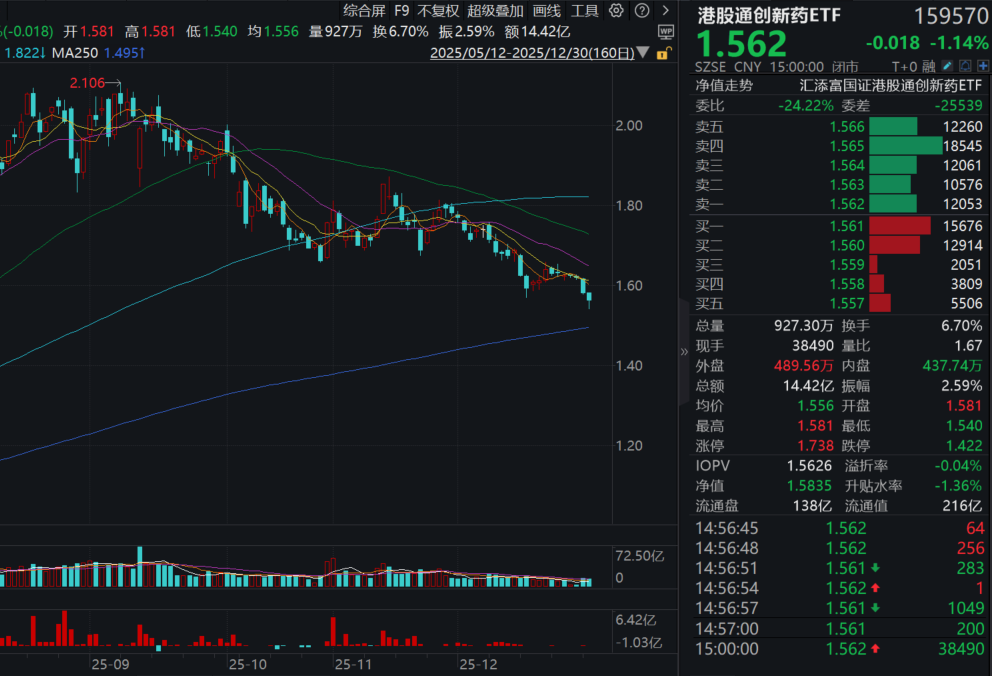
Core Viewpoint - The Hong Kong pharmaceutical market is experiencing a downturn, with the Hong Kong Stock Connect Innovation Drug ETF (159570) declining by 1.14% and over 25% from its previous high, despite a significant trading volume of over 1.44 billion yuan [1][4]. Group 1: Market Performance - The Hong Kong Stock Connect Innovation Drug ETF (159570) has seen a three-day decline, reaching a new low, with a total trading volume exceeding 14.4 billion yuan [1]. - As of December 29, the latest scale of the Hong Kong Stock Connect Innovation Drug ETF (159570) is over 21.9 billion yuan, leading among its peers [1]. - Major stocks within the ETF, such as King’s Bio and Kelun-Bio, have experienced declines, with King’s Bio dropping over 3% [4][5]. Group 2: IPO Activity - On December 30, Insilico Medicine, a generative AI-driven biopharmaceutical company, successfully listed on the Hong Kong Stock Exchange, marking it as the first AI biopharmaceutical company to do so under the main board listing rules [3]. - The IPO raised a total of 2.277 billion Hong Kong dollars, making it the highest fundraising biopharmaceutical IPO in Hong Kong for the year [3]. Group 3: Industry Trends - The upcoming J.P. Morgan Healthcare Conference in January 2026 is expected to attract over 8,000 global participants, featuring more than 500 listed companies and thousands of startups, focusing on "capital + strategy" discussions [6]. - Key trends highlighted for the industry include the continued rise of gene and cell therapies, deep integration of AI in pharmaceuticals, and the emergence of new market forces from China [7]. Group 4: Investment Insights - Multinational corporations (MNCs) are willing to pay higher prices for innovative drugs and technology platforms from China, with average total deals from China reaching 2.756 billion USD compared to 1.289 billion USD from overseas [8]. - The pressure from patent expirations, estimated at around 300 billion USD in sales, is driving MNCs to seek high-potential assets in China, particularly in advanced fields like ADCs and cell therapies [9]. - MNCs are shifting their focus from merely acquiring products to obtaining platforms and technologies that can yield new molecules, indicating a strategic evolution in their investment approach [10]. Group 5: Key Investment Areas - Key investment areas include ADCs, GLP-1 for metabolic diseases, bispecific antibodies, and neuroscience, with a focus on companies that can deliver competitive clinical data and innovative platforms [12][13].
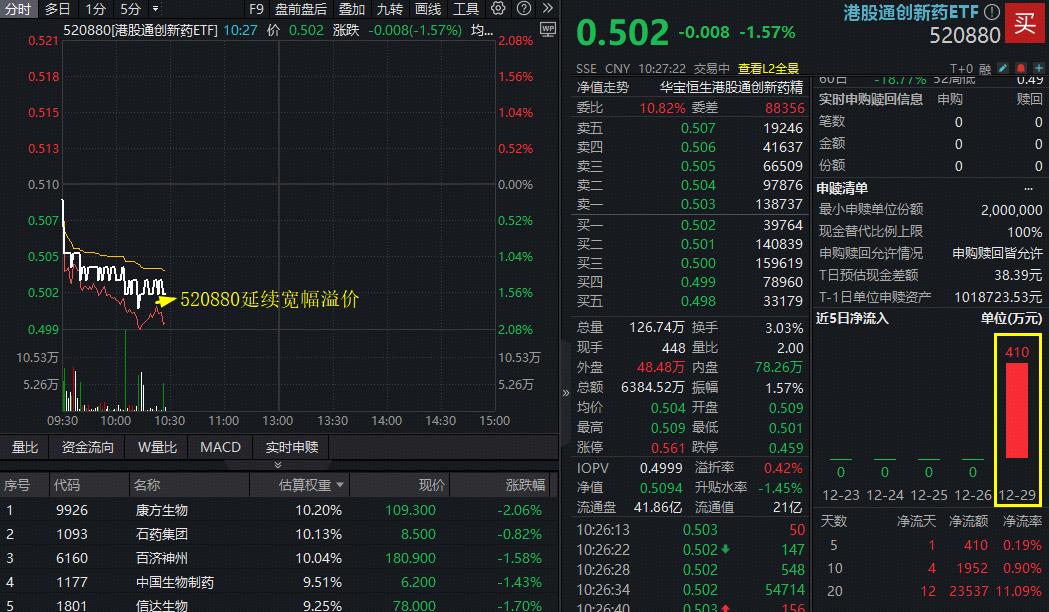
ETF盘中资讯|乐观BD预期退潮?港股通创新药ETF(520880)创5个半月新低!场内延续宽幅溢价,机构:基本面无虞
Jin Rong Jie· 2025-12-30 02:53
权重龙头股呈普跌态势,康方生物、科伦博泰生物-B跌超2%,百济神州、中国生物制药、信达生物、三生制药等集体跌逾1%。 1、纯粹,全面。不含CXO,纯正创新药!全面覆盖创新药研发类公司。 2、龙头占比大。前十大创新药龙头权重超72%,表征创新药硬核力量。 3、风险更可控。对流动性较差的成份股强制降权,有力管控尾部风险。 | | | 港股通创新药ETF (520880) 标的指数 | | | --- | --- | --- | --- | | | | 前十成份股权重高达72.57%,龙头优势显著 | | | 代码 | 简称 | 权重(%) | 总市值(亿港元) | | 6160.HK | 百济神州 | 11.51 | 3,070 | | 1801.HK | 信达生物 | 10.19 | 1,613 | | 1177.HK | 中国生物制药 | 9.47 | 1,323 | | 9926.HK | 康方生物 | 8.99 | 1,132 | | 1093.HK | 石药集团 | 8.39 | 911 | | 1530.HK | 三生制药 | 8.32 | 760 | | 3692.HK | 翰森制药 | 6.63 ...
中泰国际每日晨讯-20251230
ZHONGTAI INTERNATIONAL SECURITIES· 2025-12-30 01:52
Market Overview - The Hang Seng Index opened high post-Christmas, briefly surpassing 26,000 points, but closed at 25,635 points, down 0.7%[1] - The total trading volume was HKD 224.5 billion, a 142.7% increase from HKD 92.5 billion on the previous trading day[1] - The Energy Index rose by 0.4%, while Materials, Conglomerates, and Consumer Staples fell by 2.2%, 2.0%, and 2.0% respectively[1] Stock Performance - BYD (1211 HK) and Geely Auto (175 HK) led the blue-chip gainers, rising by 3.7% and 3.4% respectively[1] - Sands China (1928 HK) and JD Health (6618 HK) were the biggest losers, falling by 4.5% and 3.4% respectively[1] Oil and Commodity Trends - WTI crude oil prices rebounded to USD 58, but remain below the six-month high of USD 70[2] - Gold, silver, and copper prices dropped by approximately 4%-10%, likely due to profit-taking[2] Macroeconomic Data - Hong Kong's export value in November increased by 18.8% year-on-year, surpassing October's growth of 17.5%[3] Industry Insights - MGM China (2282 HK) faces a significant increase in licensing fees from 1.75% to 3.5% of monthly gross revenue, leading to a 17.1% drop in its stock price[4] - The automotive sector saw gains, with NIO (9866 HK) up 4.9% and Xpeng Motors (9868 HK) up 3.9%[4] Healthcare Sector - The Hang Seng Healthcare Index fell by 1.5%, with Hengrui Medicine (1276 HK) entering a licensing agreement with Hansoh Pharmaceutical (3692 HK) for a project valued at up to RMB 1.9 billion[5] Energy Sector - Power generation stocks, including Huaneng International (902 HK) and Datang Power (991 HK), experienced declines of 6.5% and 4.7% respectively due to unfavorable long-term electricity pricing announcements[5] - Goldwind Technology (2208 HK) surged by 13.7% following reports of its investment in the commercial space industry[5]
东兴证券晨报-20251229
Dongxing Securities· 2025-12-29 10:33
东 兴 晨 报 东兴晨报 P1 经济要闻 1. 市场监管总局:市场监管总局对光伏行业开展价格竞争秩序合规指导。 通报了光伏行业价格违法问题和风险,指出当前光伏行业存在的低质竞争、 同质化重复建设等"内卷式"竞争行为。(资料来源:同花顺) 2. 国家发改委:"十五五"时期,要综合整治"内卷式"竞争,维护公平 竞争环境,提高行业集中度。规范市场竞争秩序,深入实施公平竞争审查制 度,加强价格监测、质量检查。(资料来源:同花顺) 3. 国家统计局:经最终核实,2024 年,GDP 现价总量为 1348066 亿元,比 初步核算数减少 1018 亿元;按不变价格计算,比上年增长 5.0%,与初步核 算数持平。(资料来源:同花顺) 4. 辽宁省:拟于 2026 年一季度发行 798.5 亿元地方政府债券,包括 191.5 亿元新增债券和 607 亿元再融资债券。(资料来源:同花顺) 5. 财政部:2026 年继续实施更加积极的财政政策。一是扩大财政支出盘 子,确保必要支出力度。二是优化政府债券工具组合,更好发挥债券效益。 三是提高转移支付资金效能,增强地方自主可用财力。四是持续优化支出结 构,强化重点领域保障。五是加强财 ...
麓鹏制药闯关港股IPO,证监会要求补充架构合规等,研发投入已“刹车”
Sou Hu Cai Jing· 2025-12-29 10:16
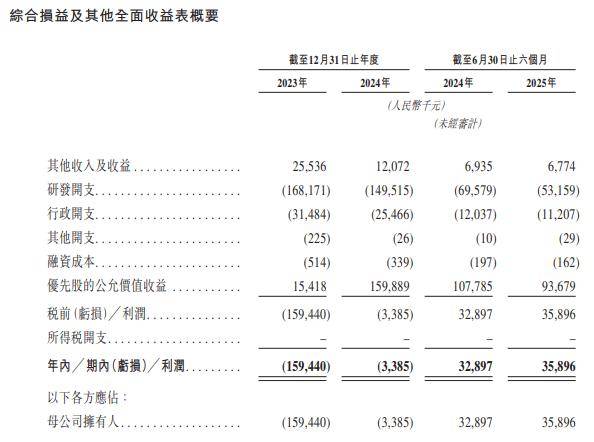
Core Viewpoint - The China Securities Regulatory Commission (CSRC) has issued supplementary material requirements for 19 companies, including LUPENG Pharmaceutical, which is preparing for an IPO in Hong Kong. The CSRC has requested clarifications on the company's offshore structure compliance, shareholder transparency, and the arrangements of the actual controller's trust [1][2]. Group 1: Regulatory Requirements - The CSRC requires LUPENG Pharmaceutical to clarify the compliance of its offshore structure and reverse mergers, including details on foreign exchange management, offshore investment, and tax management [1]. - The company must provide a complete transparency report on its controlling shareholders and any shareholders holding more than 5%, including the rationale for recent share prices and any potential conflicts of interest [2]. - The company is also required to verify its stock option incentive plan in accordance with regulatory guidelines before its IPO [2]. Group 2: Company Overview - LUPENG Pharmaceutical is a biopharmaceutical company focused on developing high bioavailability oral drugs for cancer and autoimmune diseases, with a proprietary drug development platform [4]. - The company has established a product pipeline with six major candidates, three of which are in the new drug application and clinical stages [4]. - As of June 30, 2025, the company reported cash and cash equivalents of 66.7 million yuan, with no commercial revenue generated to date [4]. Group 3: Financial Performance - The company reported net losses of 1.59 billion yuan in 2023, 338.5 million yuan in 2024, and a projected profit of 35.9 million yuan in the first half of 2025 [5]. - Research and development expenses accounted for over 80% of total operating expenses, with a decreasing trend observed in 2024 and the first half of 2025 [5][6]. - The increase in fair value gains from preferred shares contributed to the company's profitability in 2024, despite overall losses in previous years [6]. Group 4: Shareholder Structure - The largest single shareholder group, including Dr. Tan, Ms. Li, and Dr. Chen, holds a combined 22.27% of the company, with other significant shareholders including Kaita Capital (16.15%) and Eli Lilly Asia (9.03%) [6]. - The company plans to use the funds raised from the IPO primarily for clinical development of core products, pipeline expansion, and operational funding [9].
从“借船出海”到“造船远航”:2025药企出海十大关键词
Xi Niu Cai Jing· 2025-12-29 09:34
Core Insights - The article discusses the transformation of Chinese pharmaceutical companies from merely selling products to actively participating in global value chains, with a significant increase in outbound licensing deals reaching over $100 billion by November 2025, a 75% increase year-on-year [3][4]. Group 1: Major Transactions - In 2024, major deals like Hengrui's $5 billion GLP-1 product and a $12.5 billion upfront payment from Pfizer to 3SBio for a dual antibody drug highlight the trend of billion-dollar collaborations becoming standard [4][6]. - Hengrui's partnership with GSK for $12.5 billion includes not only current products but also options for 11 early-stage projects, indicating a shift towards long-term strategic partnerships [4][10]. Group 2: Licensing Strategies - Chinese companies are moving from "one-off sales" to retaining rights in core markets while sharing rights in other regions, allowing them to benefit from both local and global markets [5][6]. - The new strategy involves keeping rights for the Greater China region while sharing development costs and rights for other markets, enhancing long-term revenue potential [6][10]. Group 3: Innovative Drug Categories - Antibody-drug conjugates (ADCs) and dual antibodies are emerging as key areas for Chinese companies, with significant deals reflecting their growing importance in the global market [6][7]. - The shift from traditional cancer drugs to innovative metabolic drugs like GLP-1 is notable, with companies like FOSUN and Hansoh making substantial deals in this area [14][15]. Group 4: Independent Global Expansion - Companies are increasingly opting for "self-driven" global expansion rather than simply licensing out, as seen with Kangfang Biopharma's approach to leading its own global clinical trials [8][9]. - This strategy, while riskier, offers higher potential returns compared to traditional licensing agreements [9]. Group 5: Platform-Based Collaborations - The trend is shifting from selling individual products to offering entire R&D platforms, as demonstrated by Hengrui's collaboration with GSK, which includes options for future projects [10][11]. - This model allows companies to monetize their ongoing research capabilities, enhancing their value proposition to partners [10][11]. Group 6: Regulatory and Pricing Developments - The introduction of a drug pricing registration system by China's National Healthcare Security Administration is expected to alleviate concerns about domestic pricing affecting global pricing strategies [12][13]. - This regulatory change has led to increased foreign investment in Chinese R&D, with a 28% year-on-year growth in 2025 [13]. Group 7: Market Valuation Changes - The market's evaluation criteria for Chinese innovative drug companies have shifted from focusing on generic drug revenues to assessing the value of outbound pipelines and global clinical progress [19][21]. - The average price-to-earnings ratio for innovative drug companies in China has risen significantly, reflecting a revaluation of their market potential [21].