鸿海

Search documents
英伟达新品 获台积电、鸿海采用
Jing Ji Ri Bao· 2025-08-27 23:45
Core Insights - Nvidia has announced that several companies, including Disney, Foxconn, Hitachi, Hyundai, Eli Lilly, SAP, and TSMC, have adopted its RTX PRO servers to accelerate AI, design, and simulation applications [1] Group 1: Adoption of RTX PRO Servers - Multiple enterprises are utilizing Nvidia's RTX PRO servers to enhance their AI capabilities and operational efficiency [1] - The RTX PRO servers are designed to support both current IT workloads and drive AI applications, indicating a shift in infrastructure needs for businesses [1] Group 2: Technical Specifications - RTX PRO servers are equipped with the RTX PRO 6000 Blackwell GPU and utilize the Blackwell architecture, providing general acceleration for AI workloads [1] - The applications of the RTX PRO servers span across agent-based AI, physical AI, advanced design, scientific computing, simulation, graphics, and video applications [1] Group 3: Industry Impact - Foxconn's Chairman Liu Yangwei stated that the integration of RTX PRO servers is redefining the boundaries of AI-driven automation across various sectors, including precision robotics and smart logistics [1] - TSMC's Chairman Wei Zhejia emphasized that semiconductors are the backbone of AI, and their collaboration with Nvidia is advancing semiconductor manufacturing and optimizing wafer plant operations [1]


生成式 AI 无过热迹象!小摩:明年AI 资本支出增速至少 20%!
贝塔投资智库· 2025-08-27 04:00
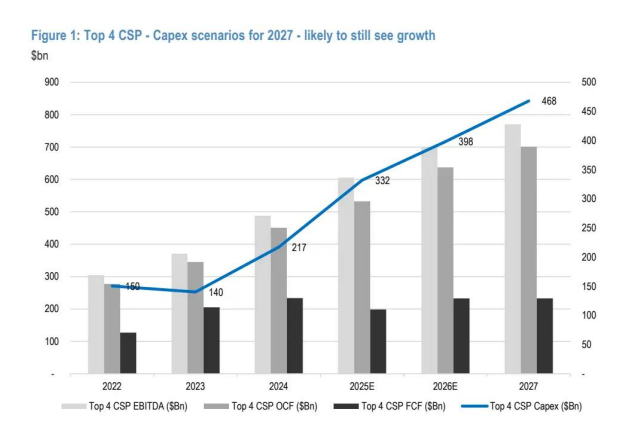
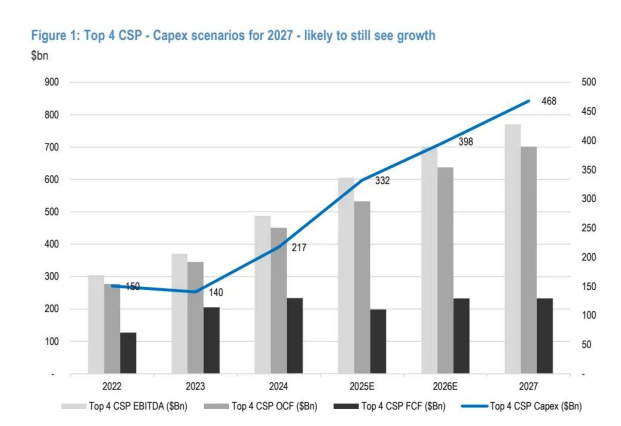
Core Viewpoints - Concerns about AI capital expenditure (capex) peaking in 2026 are overstated, with strong growth certainty expected in 2026-2027 [1][2] - Major cloud service providers (CSPs) are well-positioned to sustain capital expenditure growth due to increasing operating cash flow [4][6] - The entry of new investment players and the expansion of AI application scenarios are driving continued investment in AI [2][9] AI Capital Expenditure Growth - Morgan Stanley predicts a minimum growth rate of 20% for AI capex in 2026, with potential for further growth in 2027 if enterprise-level AI adoption increases [2][8] - The top four CSPs (Google, Amazon, Meta, Microsoft) are expected to see a compound annual growth rate (CAGR) of 23% in EBITDA and operating cash flow from 2022 to 2026 [6][8] - Capital expenditure for these CSPs is projected to rise from $150 billion in 2022 to $398 billion in 2026, while free cash flow is expected to maintain a CAGR of 16% [6][8] Investment Opportunities - The Chinese market for AI capex is still in its early stages, with significant potential for growth driven by companies like ByteDance and Alibaba [12] - Data center companies and server manufacturers are positioned to benefit from both NVIDIA and domestic chip supply growth [12] - The semiconductor supply chain, particularly for Google TPU and NVIDIA, is expected to see robust growth, with Google leading in 2026 [13][14] Pricing Trends and Earnings Adjustments - Price increases in non-AI sectors are becoming widespread, which could drive the next round of earnings per share (EPS) adjustments [18] - Areas experiencing price increases include DRAM, BT substrates, and power ICs, while some sectors may still face downward pricing pressure [18] - The valuation of Asian tech stocks remains reasonable, with expectations for further EPS adjustments driven by rising prices and sustained AI demand [19][20]


生成式AI无过热迹象!小摩:明年AI资本支出增速至少 20%!
智通财经网· 2025-08-26 08:59
Core Viewpoint - Market concerns about AI capital expenditure (capex) potentially peaking in 2026 are prevalent, but JPMorgan presents a counterargument based on four key points: no signs of overheating in generative AI, continuous entry of new investment players, significant expansion of AI application scenarios, and the potential demand release in the Chinese market [1][2]. Group 1: AI Capital Expenditure Insights - JPMorgan predicts that AI capex growth will reach at least 20% in 2026, with further growth expected in 2027 if the penetration rate of reasoning models continues to rise [3]. - The top four cloud service providers (CSPs) are expected to maintain strong capital expenditure supported by robust operating cash flow, with a projected cumulative EBITDA and operating cash flow CAGR of 23% from 2022 to 2026 [5][4]. - The capital expenditure of the top four CSPs is anticipated to increase from $150 billion in 2022 to a projected $398 billion in 2026, with a consensus forecast showing a cumulative free cash flow CAGR of 16% [7]. Group 2: New Investment Players and Market Dynamics - New players, including private AI labs and sovereign funds, are entering the AI capex space, enhancing investment capabilities despite concerns about spending stability [9]. - The Chinese CSP market is just beginning its AI investment journey, with significant spending intentions from companies like ByteDance and Alibaba, although supply constraints from GPU availability pose challenges [10]. Group 3: Supply Chain and Growth Projections - The Google TPU supply chain is expected to experience the fastest growth in 2026, driven by strong internal demand and recovery from previous supply issues [11]. - NVIDIA's supply chain is projected to maintain robust growth in 2026, with no significant delays anticipated in production schedules [13]. - The ODM sector is showing strong performance, particularly with companies like Hon Hai, which have seen significant stock price increases due to strong demand for NVIDIA products [15]. Group 4: Pricing Trends and Earnings Adjustments - Discussions of price increases across various non-AI sectors are emerging, which could drive the next round of earnings per share (EPS) adjustments [16]. - The Asian technology sector is experiencing a pause in earnings revisions, but future price increases and sustained AI demand are expected to be key drivers for further EPS adjustments [17][18].
生成式AI无过热迹象!小摩:明年AI资本支出增速至少20%!
Sou Hu Cai Jing· 2025-08-26 08:34
Core Viewpoints - Concerns about AI capital expenditure (capex) peaking in 2026 are overstated, with strong growth certainty expected in 2026-2027 [1][2] - Major cloud service providers (CSPs) can sustain capital expenditure through increasing operating cash flow, with no signs of overheating in generative AI [2][4] - New investment players, including private AI labs and sovereign funds, are entering the market, further driving AI investment [2][9] AI Capital Expenditure Growth - Morgan Stanley predicts at least 20% growth in AI capex for 2026, with potential for further increases in 2027 if enterprise-level AI adoption continues [2][8] - The top four CSPs (Google, Amazon, Meta, Microsoft) are expected to see a compound annual growth rate (CAGR) of 23% in EBITDA and operating cash flow from 2022 to 2026 [6][7] - Capital expenditure for these CSPs is projected to rise from $150 billion in 2022 to $398 billion in 2026, with a CAGR of 16% in free cash flow [7][8] Investment Opportunities - The AI supply chain growth ranking for 2026 shows Google TPU leading, followed by NVIDIA, AMD, and AWS [3][11] - Non-AI sectors are experiencing price increases, which could drive the next round of earnings per share (EPS) adjustments in the tech sector [17] - Chinese CSPs are just beginning their AI investments, with significant potential for growth despite supply constraints [10][19] Supply Chain Dynamics - The supply chain for NVIDIA is expected to maintain strong growth in 2026, with no significant delays in production plans [13][14] - ODMs are experiencing a catch-up trend, with companies like Hon Hai (Foxconn) showing strong stock performance [15] - The Asian AI supply chain is benefiting from increased demand for Google TPU and other components, with PCB and CCL suppliers positioned to gain [11][12] Valuation and Earnings Adjustments - The recent stagnation in earnings adjustments for Asian tech stocks is attributed to currency fluctuations and preemptive demand ahead of tariffs [18][19] - Future price increases and sustained AI demand are expected to drive further EPS adjustments [18][21] - The valuation of Asian tech stocks remains reasonable, with no bubble expectations in most large tech segments [18][21]
鸿海子公司向FII AMC MEXICO投资1.68亿美元
Jin Rong Jie· 2025-08-25 10:54
本文源自:金融界AI电报 鸿海8月25日公告称,子公司Cloud Network Technology Singapore将向FII AMC MEXICO S. DE R.L. DE C.V.投资1.68亿美元。 ...
英伟达即将推出人形机器人产品!
Jing Ji Ri Bao· 2025-08-23 22:43
Core Viewpoint - NVIDIA is set to launch a new product referred to as the "robot brain" on the 25th, indicating advancements in humanoid robotics, which is expected to benefit various companies in the ecosystem [1] Group 1 - NVIDIA's CEO Jensen Huang shared a message on social media stating, "Give robots, enjoy your new brain!" suggesting significant progress in their robotics products [1] - The market is optimistic about NVIDIA's new robotics product, with companies such as Advantech, New H3C, Solomon, TSMC, Hon Hai, and Dongyuan expected to benefit [1] - Huang emphasized Taiwan's role as a major electronic manufacturing ecosystem center, highlighting the potential benefits for local companies from the next generation of AI revolution, particularly in robotics technology [1] Group 2 - On the 12th, NVIDIA introduced the Cosmos Reason reasoning visual language model at the SIGGRAPH 2025 event, which aims to enable robots to act based on existing knowledge and concepts, mimicking human-like reasoning [1] - The robot planning and reasoning technology, such as the Visual Language Action (VLA) model, allows robots to make thoughtful and organized decisions [1] - Cosmos Reason enables robots to interpret their environment and break down complex instructions into manageable tasks, even in unfamiliar settings, utilizing common sense to execute these tasks [1]

黄仁勋盛赞台积 看好AI产业
Jing Ji Ri Bao· 2025-08-22 23:43
Group 1 - NVIDIA's CEO Jensen Huang praised TSMC as a great company that will continue to grow at an astonishing speed in the AI era, indicating a new industry called "AI factories" will emerge in Taiwan, presenting significant opportunities for the region [1][2] - Huang announced that the Blackwell Ultra GB300 has entered full production with successful output increases, and TSMC along with NVIDIA's ecosystem partners, including Foxconn, Quanta, Wistron, and ASUS, are performing exceptionally well in this regard [2] - NVIDIA is the global leader in AI chips, and Huang mentioned the upcoming advanced Rubin platform with six product designs already ordered from TSMC, including CPU, GPU, NVLINK switch chips, and optical switch chips [2] Group 2 - Huang expressed excitement for more factories in Taiwan, noting that NVIDIA has already begun its first factory with Foxconn and hopes to establish more [3] - Huang highlighted the potential for U.S. government initiatives to support chip manufacturing, suggesting that TSMC could also benefit from such measures, and he regards TSMC as one of the greatest companies in human history and a smart investment target [3]
英伟达下周财报再超预期?聚焦三大关键——AI需求、Blackwell产能与中国市场
美股IPO· 2025-08-21 15:15
Core Viewpoint - Morgan Stanley raised Nvidia's Q2 revenue forecast from $45.2 billion to $46.6 billion, exceeding Wall Street consensus expectations, driven by improving supply and demand dynamics, particularly in AI chip demand and Blackwell chip production capacity [1][3][6]. Group 1: AI Chip Demand Structure - The demand for Nvidia's products has shifted from "supply constraints" to "sustained growth," with major companies like Amazon, Google, and Meta indicating that even with increased data center investments, they cannot fully meet their computing needs, creating a solid foundation for Nvidia's revenue growth [8]. - Secondary cloud vendors and sovereign customers are emerging as significant demand sources, with companies like CoreWeave planning substantial capital expenditures, indicating a broader customer base for Nvidia [8]. Group 2: Blackwell Chip Production Capacity - The ramp-up of Blackwell chip production is a key variable affecting Nvidia's short-term performance, with ODM manufacturers expected to double their rack shipments within the year [10]. - Deutsche Bank reported that Blackwell chip revenue could reach $24 billion in Q1, nearly doubling from $11 billion in Q4 of the previous year, compensating for revenue losses due to issues in the Chinese market [10]. - The easing of back-end testing bottlenecks is also supporting capacity release, with significant increases in testing unit deliveries expected [10]. Group 3: Market Share and Competitive Position - Morgan Stanley projects Nvidia will maintain approximately 85% market share in 2026, significantly ahead of competitors like AMD, due to its hardware performance and over $5 billion annual R&D investment creating a robust software ecosystem [11]. - Companies that previously relied on ASICs, such as Google, are expected to increase spending on Nvidia by over three times this year, highlighting Nvidia's irreplaceable position in mainstream AI workloads [11]. Group 4: China Market Recovery - The market is closely watching Nvidia's ability to resume shipments to China, with Deutsche Bank estimating that if permissions are granted, Nvidia's Q3 revenue could increase by $50 billion [12]. - The approval for Nvidia to sell H20 chips to China could enhance earnings per share by 10%, even after accounting for a 15% licensing fee to the U.S. government [12].
台股电子2025年7月报:AI需求续旺,消费性产品转冷-20250821
Guohai Securities· 2025-08-21 13:47
Investment Rating - The report maintains an investment rating of "Recommended" for the industry [1] Core Insights - Demand for AI hardware remains strong, while consumer electronics are experiencing a cooling trend [1][5] - The semiconductor sector is seeing cautious ordering behavior from customers in consumer products [15][20] - The PCB manufacturing sector is benefiting from increased demand for ASIC AI servers [22][24] - Optical components are experiencing a boost due to new iPhone launches [25] - The storage sector may face structural shortages in DDR4 and LPDDR4 in the second half of 2025, leading to rising contract prices [26][27] Summary by Sections Semiconductor - IC design companies in Taiwan are showing signs of revenue fatigue, with MediaTek's July revenue at 432 billion NTD, down 23.4% month-over-month and 5.2% year-over-year [15][16] - TSMC's July revenue reached 3,232 billion NTD, up 22.5% month-over-month and 25.8% year-over-year, with a 37.6% increase in cumulative revenue for the first seven months [16][17] PC/Server - July revenues for PC manufacturers declined after a peak in Q2, with Hon Hai's revenue at 6,139 billion NTD, up 13.6% year-over-year [20][21] - AI server demand is expected to grow significantly, with Hon Hai projecting a 170% year-over-year increase in related revenue [21] PCB - Overall revenue for PCB manufacturers in Taiwan increased by 6.6% month-over-month and 9.3% year-over-year in July [22] - Companies like Zhen Ding are seeing a significant portion of their revenue coming from AI applications, with expectations to exceed 70% in 2025 [24] Optical Components - Largan Precision's July revenue was 54 billion NTD, up 30.6% month-over-month, driven by new product launches [25] Storage - Most storage supply chain companies in Taiwan reported varying degrees of year-over-year revenue growth in July, with a potential structural shortage in DDR4 expected in the second half of 2025 [26][27]
GB200出货量上修,但NVL72目前尚未大规模训练
傅里叶的猫· 2025-08-20 11:32
Core Viewpoint - The article discusses the performance and cost comparison between NVIDIA's H100 and GB200 NVL72 GPUs, highlighting the potential advantages and challenges of the GB200 NVL72 in AI training environments [30][37]. Group 1: Market Predictions and Performance - After the ODM performance announcement, institutions raised the forecast for GB200/300 rack shipments in 2025 from 30,000 to 34,000, with expected shipments of 11,600 in Q3 and 15,700 in Q4 [3]. - Foxconn anticipates a 300% quarter-over-quarter increase in AI rack shipments, projecting a total of 19,500 units for the year, capturing approximately 57% of the market [3]. - By 2026, even with stable production of NVIDIA chips, downstream assemblers could potentially assemble over 60,000 racks due to an estimated 2 million Blackwell chips carried over [3]. Group 2: Cost Analysis - The total capital expenditure (Capex) for H100 servers is approximately $250,866, while for GB200 NVL72, it is around $3,916,824, making GB200 NVL72 about 1.6 to 1.7 times more expensive per GPU [12][13]. - The operational expenditure (Opex) for GB200 NVL72 is slightly higher than H100, primarily due to higher power consumption (1200W vs. 700W) [14][15]. - The total cost of ownership (TCO) for GB200 NVL72 is about 1.6 times that of H100, necessitating at least a 1.6 times performance advantage for GB200 NVL72 to be attractive for AI training [15][30]. Group 3: Reliability and Software Improvements - As of May 2025, GB200 NVL72 has not yet been widely adopted for large-scale training due to software maturity and reliability issues, with H100 and Google TPU remaining the mainstream options [11]. - The reliability of GB200 NVL72 is a significant concern, with early operators facing numerous XID 149 errors, which complicates diagnostics and maintenance [34][36]. - Software optimizations, particularly in the CUDA stack, are expected to enhance GB200 NVL72's performance significantly, but reliability remains a bottleneck [37]. Group 4: Future Outlook - By July 2025, GB200 NVL72's performance/TCO is projected to reach 1.5 times that of H100, with further improvements expected to make it a more favorable option [30][32]. - The GB200 NVL72's architecture allows for faster operations in certain scenarios, such as MoE (Mixture of Experts) models, which could enhance its competitive edge in the market [33].