
长安汽车

Search documents
【政策综述】2026年国家汽车相关政策取向分析
乘联分会· 2026-02-10 08:37
Core Viewpoint - The article emphasizes the importance of implementing new automotive policies in 2026 to promote high-quality development in the automotive industry, focusing on energy consumption standards, tax incentives for new energy vehicles, and the promotion of green consumption [4][5][15]. Summary by Sections 1. New Fuel Consumption Standards - Starting January 1, 2026, three mandatory national standards regarding fuel consumption for passenger cars and light commercial vehicles will be implemented, tightening requirements by approximately 18% for traditional and hybrid vehicles, with specific targets set for 2030 [7][8]. 2. Tax Incentives for New Energy Vehicles - The Ministry of Industry and Information Technology, along with other departments, will continue to implement tax exemptions for new energy vehicles from January 1, 2026, with specific technical requirements for vehicles to qualify for the tax exemption [9][10]. 3. Export License Management for Electric Vehicles - From January 1, 2026, a new export license management system for pure electric passenger vehicles will be established to promote healthy trade in new energy vehicles [10]. 4. Vehicle Tax Exemption Adjustments - New technical requirements for energy-saving and new energy vehicles to enjoy vehicle and vessel tax exemptions will be effective from January 1, 2026, aligning with updated fuel consumption standards [11]. 5. Average Fuel Consumption and New Energy Vehicle Points Management - For the years 2026 and 2027, the required proportion of new energy vehicle points will be 48% and 58%, respectively, with specific allowances for companies meeting fuel consumption reduction targets [11][12]. 6. Large-Scale Equipment Update and Trade-In Policies - A notification issued on December 29, 2025, outlines policies for supporting the replacement of old vehicles with new energy vehicles, including subsidies for consumers who trade in old cars for new ones [12][18]. 7. Green Consumption Promotion - A joint notification from multiple ministries aims to promote green consumption in the automotive sector, encouraging the purchase of new energy vehicles and the development of related services [16][17]. 8. Continued Implementation of Automotive Industry Growth Plans - The automotive industry growth plan for 2025-2026 will continue to emphasize the application of smart and connected technologies, with specific measures to enhance domestic consumption and improve supply quality [18][19]. 9. Financial Policies to Enhance Automotive Consumption - Financial and fiscal policies will be optimized to further promote automotive consumption, with a focus on enhancing the quality and efficiency of financial services to support the real economy [20].


【新能源周报】新能源汽车行业信息周报(2026年2月2日-2月8日)
乘联分会· 2026-02-10 08:37
Industry Information - Beijing Economic and Technological Development Zone implements intelligent connected vehicle initiatives to enhance AI's role in data-driven technology [2] - Shenzhen releases a three-year consumption action plan focusing on green electricity consumption and charging infrastructure [2] - The largest high-speed supercharging station in China is operational in Hangzhou [2] - NIO achieves a milestone of 100 million battery swaps, with a network covering 8,627 stations nationwide [39] - CATL signs a comprehensive strategic agreement with Yunnan to promote green energy and transportation [10] Policy Information - The 2026 Central Document No. 1 emphasizes expanding rural consumption and supporting the adoption of new energy vehicles [26] - The Ministry of Transport plans to build over 10,000 charging guns in national highway service areas by 2026 [14] - The 2026 action plan for Beijing's traffic governance includes increasing the coverage of charging facilities [25] - Canada plans to abolish mandatory electric vehicle regulations and reintroduce consumer subsidies for electric vehicles [12] Company Information - BYD launches a new brand "Linghui" focused on the mobility market, aiming to provide affordable and advanced electric vehicles [33] - Xpeng Motors announces the launch of its AIOS 6.0 OTA update, featuring the industry's first proactive service cockpit [35] - Li Auto is set to open its 4,000th supercharging station, enhancing its charging network [39] - Xiaomi Motors updates its city driving assistance feature, lowering the mileage threshold for users [37] - NIO collaborates with a local company to enhance battery swapping services during the Spring Festival [39]



博世中国的选择题
Xin Lang Cai Jing· 2026-02-10 08:02
Core Viewpoint - Bosch China is reallocating resources in its power systems business amid the automotive industry's transformation, leading to rumors of layoffs, which the company clarifies as normal business adjustments rather than mass layoffs [1][2]. Group 1: Resource Allocation and Adjustments - Bosch has made personnel adjustments in its Wuxi operations since October last year, affecting over a hundred frontline and technical staff, primarily through negotiated contract terminations with enhanced compensation [1][2]. - The adjustments are mainly focused on traditional fuel and hydrogen fuel cell-related businesses, reflecting Bosch's response to declining demand for fuel vehicles and slow commercialization of hydrogen technology [2][3]. - Bosch's powertrain division in Wuxi is a significant manufacturing and R&D base for traditional fuel and hydrogen fuel cell businesses, indicating the strategic importance of these adjustments [2][3]. Group 2: Market Trends and Business Impact - The demand for fuel vehicles is declining, with the penetration rate of new energy vehicles expected to reach 54.07% by 2025, putting pressure on traditional fuel vehicle manufacturers [3][4]. - Bosch's fuel injection and related products are primarily supplied to major automotive clients, and the decline in fuel vehicle orders is prompting Bosch to adjust its production capacity accordingly [3][5]. - The shift in market dynamics is also reflected in the performance of Bosch's partners, such as Weifu High-Tech, which reported an 8.52% decline in revenue from fuel injection systems in 2024 [5]. Group 3: Hydrogen Fuel Cell Developments - Bosch has invested in hydrogen fuel cell technology, with plans for local production of key components, including a planned investment of 1.133 billion yuan for a new production facility in Wuxi [6][7]. - Despite the initial enthusiasm for hydrogen energy, the commercialization of hydrogen fuel cells remains uncertain, with infrastructure and demand still in early stages [7][8]. - Bosch is adjusting its resource allocation towards more immediate and clear-return technologies, such as electric and intelligent driving solutions, while still maintaining some presence in traditional fuel and hydrogen sectors [8][9]. Group 4: Future Directions - Bosch China aims to increase its business investment in the Chinese market, shifting focus from traditional power routes to smart driving, electrification, and control technologies [8][9]. - The company anticipates a 4.9% year-on-year growth in sales to 149.8 billion yuan by 2025, with smart mobility being a core growth driver [8]. - Current job openings at Bosch China are increasingly concentrated in digital manufacturing and AI applications, indicating a strategic pivot towards advanced technologies [9].
中国汽车,满电出发!
Jing Ji Ri Bao· 2026-02-10 08:02
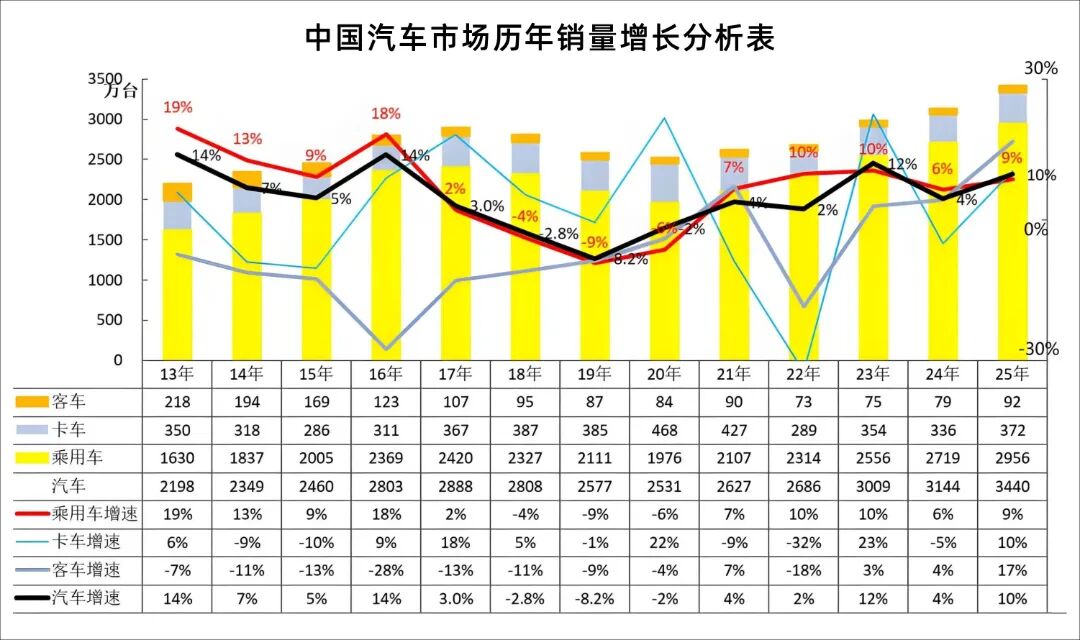
2025年12月15日,工信部公布我国首批L3级有条件自动驾驶车型准入许可,重庆长安汽车股份有限公 司与北汽蓝谷麦格纳汽车有限公司旗下两款纯电动轿车率先获准。我国自动驾驶汽车产业从技术验证, 稳步迈向量产应用新阶段。 同样让人振奋的是,2025年我国汽车业在价格战博弈、产业链重构和国际贸易保护压力中,顶压前行、 向新攀高,交出一份超预期答卷。 中汽协数据显示,2025年,我国汽车产销分别完成3453.1万辆和3440万辆,同比分别增长10.4%和 9.4%,再创历史新高,展现出超强韧性与活力。其中,新能源汽车国内新车销量占比跨越50%临界点, 从曾经的边缘产品跃升为市场主流;汽车出口突破700万辆,核心市场份额不断提升,海外市场成新增 长极。 跃马新程,聚力前行。2026年是我国汽车产业从"规模扩张"驶向"提质增效"关键之年。 面对电动化和智能化变革浪潮,我国汽车产业将在总量高位运行与结构深度调整中,奋力迈向高质量发 展。在国家政策引导和企业集体反思下,单纯以降价为核心的"内卷"有望缓解,而以技术创新、产品迭 代、品质提升、体验优化为核心的"价值战"将全面加剧。 激烈的市场竞争,既是企业创新活力的生动体现,也 ...
威迈斯:公司信息更新报告业绩符合预期,海外市场持续放量-20260210
KAIYUAN SECURITIES· 2026-02-10 04:25
Investment Rating - The investment rating for the company is "Buy" (maintained) [1] Core Insights - The company achieved a net profit attributable to shareholders of 557 million yuan in 2025, representing a year-on-year growth of 39.2%, which is in line with expectations. The total revenue for 2025 was 6.34 billion yuan, showing a slight year-on-year decline of 0.5% [6] - The company is a leading player in the domestic vehicle-mounted power supply market and is benefiting significantly from the growth of the European new energy vehicle market. The company has adjusted its strategic focus towards global expansion, allocating more resources to faster-growing overseas markets [7] - The company has established deep cooperation with various domestic and international clients, including Stellantis Group, Li Auto, Changan Automobile, and others. The installed capacity of the company's OBC (On-Board Charger) in 2025 was 1.821 million units, accounting for 14.9% of the market share [7] Financial Summary - The company reported total revenue of 5.523 billion yuan in 2023, with a year-on-year growth of 44.1%. The projected revenue for 2024 is 6.372 billion yuan, with a growth rate of 15.4%. The expected revenue for 2025 is 6.342 billion yuan, indicating a slight decline [9] - The gross profit margin is expected to improve from 21.9% in 2025 to 25.0% by 2027, while the net profit margin is projected to increase from 8.8% in 2025 to 12.0% in 2027 [9] - The company's earnings per share (EPS) is projected to be 1.33 yuan in 2025, increasing to 2.03 yuan by 2027, with corresponding P/E ratios of 23.4 and 15.4 respectively [9]

威迈斯(688612):公司信息更新报告:业绩符合预期,海外市场持续放量
KAIYUAN SECURITIES· 2026-02-10 02:45
Investment Rating - The investment rating for the company is "Buy" (maintained) [1] Core Views - The company achieved a net profit attributable to shareholders of 557 million yuan in 2025, representing a year-on-year growth of 39.2%, which is in line with expectations. The operating revenue for 2025 was 6.34 billion yuan, showing a slight decline of 0.5% year-on-year. The company is benefiting from the steady growth in domestic new energy vehicle sales and increasing penetration rates, with a focus on high-value products [6][7] - The company is a leading player in the domestic vehicle power supply market and is making significant progress in overseas markets, particularly benefiting from the expansion of the European new energy vehicle market. The company has established deep cooperation with various domestic and international clients, including Stellantis Group and several major Chinese automakers [7] Financial Summary - In 2025, the company reported operating revenue of 6.34 billion yuan, with a year-on-year change of -0.5%. The net profit attributable to shareholders was 557 million yuan, with a year-on-year increase of 39.2% [6][9] - The projected net profits for 2025-2027 are 557 million yuan, 673 million yuan, and 850 million yuan respectively, with corresponding P/E ratios of 23.4, 19.4, and 15.4 times [6][9] - The gross margin is expected to improve from 21.9% in 2025 to 25.0% in 2027, while the net margin is projected to increase from 8.8% to 12.0% over the same period [9][10]
长安汽车天枢智能:冰面淬炼,锻造“天生安全”的终极好车
Nan Fang Du Shi Bao· 2026-02-10 02:42
Core Insights - Changan Automobile's Tian Shu intelligent system has demonstrated impressive performance in extreme cold conditions, achieving significant milestones in safety and technology [1][8] - The company emphasizes that true safety must withstand the harshest natural tests, showcasing its confidence in the Tian Shu system's capabilities [2] Technical Advancements - The Tian Shu system was rigorously tested in extreme environments, proving its reliability under conditions where traditional technologies might fail [2] - The system's all-domain perception capabilities were optimized for low temperatures, ensuring accurate obstacle detection even in challenging weather [3] Performance Metrics - The Tian Shu system achieved a record speed of 92.3 km/h for lane changes on icy surfaces without deviation, and maintained stability at 95 km/h during a tire blowout [4][8] - The low-temperature endurance rate for the Avita 07 model reached 61.2%, the highest in the industry, addressing a critical issue for electric vehicles [6][8] Safety Innovations - The distributed electric drive system showcased revolutionary control capabilities, allowing for independent torque control at each wheel, enhancing stability during adverse conditions [4] - The intelligent chassis demonstrated full-chain crisis response capabilities, effectively managing low-traction scenarios and optimizing torque distribution for safe navigation [5] Broader Implications - The technology developed for extreme conditions is being adapted for everyday driving scenarios, ensuring that safety features are applicable across various environments [7] - Changan's commitment to safety is reflected in its comprehensive approach to integrating safety technologies from the design phase, rather than as an afterthought [8]

全球首款钠电量产乘用车亮相
Zhong Guo Hua Gong Bao· 2026-02-10 02:05
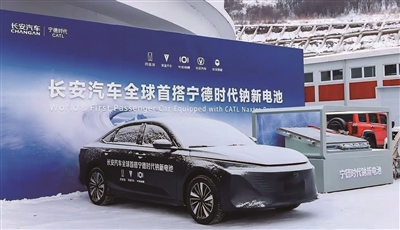
中化新网讯 2月5日,长安汽车携手宁德时代在牙克石举办"长安汽车天枢智能新安全成果发布暨钠电战 略全球发布会",长安汽车正式发布全球钠电战略,全球首款钠电量产乘用车也正式亮相。同时,长安 汽车旗下阿维塔、深蓝、启源、引力等多品牌,未来都将搭载宁德时代钠新电池。 图为发布会现场。(企业供图) 该乘用车在-30℃条件下,整车放电功率比同电量常规铁锂车型提升近3倍,-40℃极寒下容量保持率超 90%,甚至在-50℃的极端环境下还能稳定放电。该电池还具备远超国标的安全性能。 早在2016年,宁德时代便启动了钠离子电池技术的研发,截至2025年,累计投入近百亿元,研发测试电 芯近30万颗,超过300名研发人员及20名以上博士参与研发。 目前,全球首款钠电量产乘用车已经在牙克石通过冬季标定,其续航、低温性、安全性、放电性能等均 已完全满足用户使用需求。根据实测数据,宁德时代钠电池搭配其第三代CTP系统成组技术,纯电续航 可达400千米以上,再通过宁德时代BMS智能管理策略的精准控制,可以实现"表显即所得",而电芯的 最高能量密度达175瓦时/千克,为行业最高水平。未来随着钠电产业链的高速发展,纯电续航可以升级 到500千 ...

2026格局与趋势 |(上):天黑请睁眼
3 6 Ke· 2026-02-10 01:20
Core Viewpoint - The Chinese automotive market is facing significant challenges in 2026, with predictions of a decline in sales due to economic pressures and changing consumer behavior, despite some optimistic forecasts for growth in exports and specific segments like new energy vehicles [1][3][4]. Group 1: Market Trends and Predictions - In 2026, the overall automotive sales in China are expected to range between 34.5 million to 35 million units, with a potential decline in domestic retail sales by over 5% if no significant policy changes occur [3][7]. - January 2026 data shows a dramatic decline in retail sales, with a 28% year-on-year drop, indicating a challenging start to the year [6]. - Various institutions predict a range of outcomes for 2026, with the most pessimistic forecasts suggesting a 7% decline in sales, while the most optimistic predict only a 1% increase [4][7][8]. Group 2: Policy and Economic Influences - Key factors affecting the market include adjustments to subsidy policies for new energy vehicles, which have shifted from full exemptions to partial reductions, impacting consumer purchasing behavior [6][9]. - The decline in consumer confidence and shrinking middle-class income due to economic downturns are expected to further suppress automotive sales [6][9]. Group 3: Competitive Landscape - The automotive industry is experiencing intense competition, with a shift from price wars to a focus on technological advancements and value creation as companies seek to stabilize their market positions [12][16]. - Major players are adjusting their sales targets, with some aiming for significant growth while others adopt more conservative strategies in response to market conditions [18][19]. Group 4: Export Opportunities - Exports are projected to be a key growth area, with expectations of a 12-15% increase, potentially reaching 8 million units, which could help offset domestic market declines [22][26]. - The global supply chain dynamics are pushing Chinese automotive companies to enhance their international presence, with a focus on building global production and R&D capabilities [26][28]. Group 5: Segment-Specific Insights - The new energy vehicle segment is anticipated to grow, with retail sales expected to increase by 12-15%, driven by favorable policies for mid-range models [9][10]. - The large six-seat SUV market is projected to maintain strong growth, with expectations of a 30-50% increase in sales, despite overall market challenges [31][32].


乾崑智驾跨越百万丰碑,高楼引望迈向千万瀚海
NORTHEAST SECURITIES· 2026-02-10 01:15
Investment Rating - The report maintains an "Outperform" rating for the industry [4] Core Insights - The commercialization of L3 autonomous driving has reached a turning point, transitioning from "optional" to "preferred" [1][14] - The approval of L3 licenses marks a significant shift from technical validation to operational readiness, establishing a clear regulatory framework [14] - The competitive landscape has evolved from hardware specifications to a focus on end-to-end models driven by data and algorithms, enhancing industry concentration [1][20] Summary by Sections 1. Commercialization of L3 Autonomous Driving - The dual approval of operational licenses and road rights has established a commercial closure for L3 autonomous driving, with clear responsibilities defined [14] - User perception of intelligent driving has matured, with advanced features becoming a key factor in purchasing decisions, as 60% of consumers view autonomous driving as the most anticipated technological breakthrough [16][17] - The paradigm of intelligent driving is shifting towards an end-to-end model, where the core competitive logic is now based on data quality, computational power, and model iteration efficiency [20][21] 2. Huawei's QianKun Intelligent Driving - Huawei's QianKun Intelligent Driving has evolved from a single supplier to a public technology platform, enhancing its market position [30][45] - The company has developed a multi-tiered cooperation model, including component supply, HI mode, and Harmony Intelligent Driving, to cover various market segments [31][32] - The QianKun Intelligent Driving system has undergone significant iterations, establishing a technological moat centered around end-to-end models [36] 3. Independent Entity "Yinwang" - The establishment of Yinwang as an independent entity has alleviated concerns among automakers regarding technology control, allowing for broader collaboration [41][42] - The strategic partnership with automakers has led to a valuation of 115 billion RMB, positioning Yinwang as a unicorn in the industry [45] - Yinwang aims to become a neutral public platform for the smart electric vehicle industry, similar to Bosch's role in the traditional automotive sector [48][49] 4. Hardware Cost Breakdown - The cost of intelligent driving hardware per vehicle exceeds 10,000 RMB, with significant portions attributed to chips and PCB components [2][3] - The potential market space for various components in the intelligent driving supply chain is substantial, with estimates reaching billions in growth opportunities [2] 5. Investment Opportunities - The report identifies potential investment opportunities in advanced process wafer fabs, packaging and testing companies, and PCB manufacturers, highlighting the growth potential in the intelligent driving sector [3]