奔驰

Search documents
盼提振德国汽车业,德国启动电动车补贴并对中企开放
Huan Qiu Wang· 2026-01-20 22:56
Group 1 - The German government announced a new subsidy policy for electric vehicles (EVs) amounting to €3 billion, aimed at improving the climate and boosting the struggling automotive industry [1] - The subsidies will be available to all manufacturers, including Chinese brands, with amounts ranging from €1,500 to €6,000 depending on vehicle type, income level, and family size [1][2] - The funding is expected to benefit approximately 800,000 electric vehicles over the next 3 to 4 years, helping to reduce reliance on gasoline and diesel [1] Group 2 - The inclusive nature of the subsidy plan distinguishes Germany from other European countries like France and the UK, which have excluded many Chinese vehicles from their subsidy programs [2] - The new policy is anticipated to significantly benefit affordable electric vehicle brands like BYD, which are expanding their market share in Europe [2] - Data indicates that the top 11 newly registered pure electric vehicles in 2025 will predominantly come from Volkswagen or BMW, while Chinese manufacturers are gaining traction in the small car segment [2] Group 3 - A recent consensus between China and Europe regarding electric vehicle tariffs signals a welcoming stance towards Chinese manufacturers, despite existing tariffs [3] - Chinese brands like BYD are reportedly selling at higher prices in Europe compared to their domestic market, indicating a lack of dumping practices [3] - The new EU minimum price guidelines are viewed positively by the German automotive industry, as they are expected to stabilize the market amidst previous tariff-induced price confusion [3]
从第一台到第100万台,ES8为蔚来兜住了底
Tai Mei Ti A P P· 2026-01-20 12:25
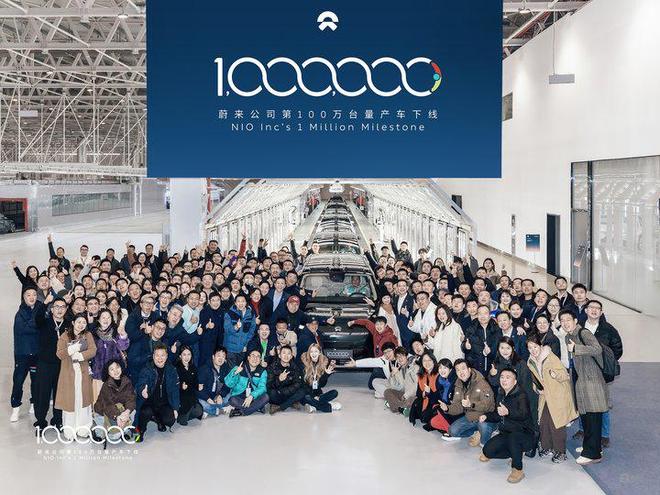
Core Insights - NIO has achieved a significant milestone by producing its one millionth vehicle, specifically the ES8, which symbolizes a turning point for the company and the electric vehicle market [2][3] - The ES8 has set new sales records in the high-end SUV segment, demonstrating a shift in consumer preferences from traditional luxury brands to electric vehicles [4][6] Group 1: Sales Performance - The new ES8 delivered 50,000 units within 120 days, achieving a monthly retail sales record of 22,258 units, surpassing previous records for vehicles priced over 400,000 yuan [3][4] - NIO's one million vehicles sold have an average price exceeding 300,000 yuan, indicating a strong brand premium compared to competitors who often rely on lower-priced models to reach similar sales figures [3][4] Group 2: Market Dynamics - A notable 62.4% of new ES8 orders come from customers replacing traditional luxury fuel vehicles, indicating a shift in consumer behavior towards electric vehicles [6] - The transition from fuel vehicles to electric vehicles is gaining momentum, with the market for large electric SUVs expected to grow significantly [7][8] Group 3: Competitive Landscape - NIO's success with the ES8 is causing traditional luxury brands, such as BMW and Mercedes-Benz, to reassess their market positions as they face increased competition from electric vehicles [6][12] - The company maintains a premium pricing strategy, which allows it to avoid engaging in price wars while still achieving high sales volumes [6][12] Group 4: Future Outlook - NIO aims to achieve a growth rate of 40% to 50% annually in the coming years, despite the challenges of maintaining brand loyalty and addressing consumer price sensitivity [14] - The company is under pressure to achieve profitability by 2026, as it navigates a complex multi-brand strategy and seeks to solidify its position in the high-end market [12][14][15]


天津云传递破局汽车供应链难题
Zhong Guo Qi Che Bao Wang· 2026-01-20 09:26
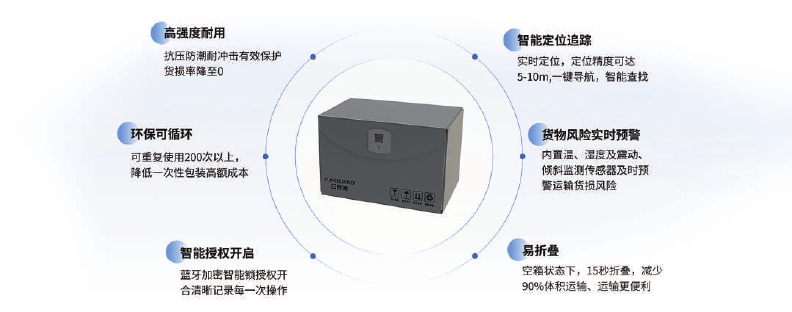
随着全球汽车产业向电动化、智能化、绿色化加速转型,供应链效能与可持续性已成为决定企 业竞争力的关键。在物流环节,传统一次性包装长期存在成本高、污染大、货损难控、全程无法追 溯等痛点,已成为制约汽车产业特别是售后配件流通领域的重要环节,降本增效和绿色升级已是当 务之急。 当前,一批以物联网、大数据与新材料技术为核心的科技企业正悄然崛起,试图以"循环包装+数字 化"模式重塑供应链底层基础设施。天津云传递技术有限公司(以下简称"云传递")便是其中的先行 者。作为一家聚焦物联网、智能算法及数字化系统研发的供应链科技企业,云传递通过自主研发的 智能循环包装及全链路数字监测解决方案,为汽车行业提供了一套"可循环、可追溯、可降本"的全 新物流包装新思路。 正如云传递董事长魏永君所言:"中国在共享包装和物流安全领域正迎来黄金发展期,这是时代赋予 我们的机遇。云传递就是要深耕技术创新,打造行业标杆,用数智化驱动循环包装,用云计算推动 碳循环,助力客户供应链安全、降本增效、低碳转型。" 技术+模式+网络 三位一体破局创新 从传统包装之痛,到行业转型升级,云传递有着怎样的逻辑? 汽车供应链传统包装的成本、安全与环保困局 汽车产业供 ...
美国关税施压,欧洲汽车制造商股价集体下滑
Xin Lang Cai Jing· 2026-01-20 06:32
Group 1 - The European automotive sector experienced a collective sell-off due to the threat of new tariffs from the U.S., with major automakers' stock prices declining significantly during early trading [1][3] - President Trump announced a plan to impose a 10% tariff on goods from Denmark, Norway, Sweden, France, Germany, the UK, the Netherlands, and Finland starting February 1, with a potential increase to 25% on June 1 [3] - Following the announcement, stocks of major automotive companies such as BMW, Mercedes-Benz, and Porsche fell by over 3%, while Volkswagen and Ferrari saw declines exceeding 2% [3] Group 2 - The market is concerned that the new tariffs will increase operational uncertainty for European automakers in the North American market, putting long-term pressure on their profit expectations [3] - Previously, the Trump administration had announced a 25% tariff on EU automobiles, which was later adjusted to 15% under certain conditions, reflecting a history of fluctuating trade policies affecting the automotive industry [3] - The UK has implemented a tiered tariff system, with the first 100,000 cars subject to a 10% tariff and any additional units incurring a 27.5% tariff [3]


英媒:特朗普羡慕死中国了!欧美乱作一团之际,我国收到大好消息
Sou Hu Cai Jing· 2026-01-20 05:08
Group 1 - The core issue revolves around the escalating trade tensions between the US and Europe, initiated by Trump's threat to impose tariffs on eight European countries due to their opposition to his Greenland purchase plan [1][3][5] - The European Union is preparing a countermeasure against the US, proposing tariffs on $930 billion worth of American goods and considering restrictions on US companies in Europe [3][5] - The ongoing trade conflict has strained transatlantic relations, transforming former allies into adversaries, with significant implications for the global economic landscape [3][5] Group 2 - Amidst the US-Europe tensions, China is experiencing positive trade developments, with bilateral trade with the EU projected to reach $785.8 billion in 2024, and a significant increase in trade volume continuing into 2025 [7][8] - Chinese exports, particularly in electric vehicles and solar panels, are gaining traction in the European market, highlighting a growing economic interdependence [8][10] - China's cooperative trade model, based on mutual benefit, is contrasted with the US's coercive approach, leading to a shift in European sentiment towards China [5][10] Group 3 - Trump's envy towards China's industrial strength and cooperative model is evident, as he attempts to replicate aspects of China's economic strategy, albeit with limited success [12][14] - A significant decline in the perception of the US as an ally among Europeans is noted, with only 16% viewing the US positively, indicating a shift in geopolitical alliances [12][14] - The essence of the US's failure to emulate China's success lies in its inability to adopt a genuinely cooperative approach, which is rooted in respect for sovereignty and mutual benefit [14]
价值竞争取代“价格战”,2026年中国汽车消费向高端化转型
Xin Hua Cai Jing· 2026-01-20 05:00
Core Insights - The adjustment of the new energy vehicle purchase tax policy in 2026 marks a shift in competition within the Chinese automotive market from price competition to value competition [1][4] - The new policy encourages consumers to opt for higher-end models to receive full subsidies, indicating a trend towards market premiumization [1][2] Group 1: Policy Changes - The 2026 policy modifies the subsidy structure for scrapping and replacing vehicles, changing from fixed amounts to a percentage of the vehicle price, with new energy vehicle scrapping subsidies adjusted from 30,000 yuan to 12% of the vehicle price (capped at 20,000 yuan) [2] - The replacement subsidy is also changed to a percentage basis, with new energy vehicles receiving 5% of the vehicle price (capped at 15,000 yuan), requiring higher-priced vehicles to qualify for full subsidies [2] Group 2: Market Trends - The average retail price of domestic passenger cars has increased from 151,000 yuan in 2019 to 184,000 yuan in 2024, indicating a resilient consumer structure [1] - Over 30% of consumers are setting their next vehicle budget at over 300,000 yuan, reflecting a growing sensitivity to "value" rather than "low price" [1][3] Group 3: Consumer Behavior - Data shows that the market share of vehicles priced between 200,000 and 300,000 yuan increased from 18% in 2024 to 19% in December 2025, with the 300,000 to 400,000 yuan segment also showing stable growth [3] - More than 63% of consumers are budgeting for their next vehicle at over 300,000 yuan, indicating a shift in focus from brand prestige to genuine value [3] Group 4: Industry Response - Traditional luxury brands like Mercedes-Benz and Audi are now including features such as heated seats and OTA upgrades as standard to enhance practical value [4] - The industry is experiencing a shift where product strength is becoming the core of competition, moving away from price wars, with a focus on providing solid technology and superior configurations in mainstream price ranges [4]
被特朗普用格陵兰拿捏,德国工业界怒了
Xin Lang Cai Jing· 2026-01-20 04:32
欧盟议会贸易委员会主席贝恩德·朗格(Bernd Lange)称,特朗普的做法体现了"美国总统帝国主义的新维度",对欧洲是"难以置信的冒犯"。他强调欧盟现 在必须明确立场,并认为欧盟可能会动用所谓的"反强制措施法"进行反制措施,包括关税、暂停专利许可、禁止参与公共招标以及其他措施。 德国机械设备制造业联合会(VDMA)主席伯特伦·卡瓦拉斯(Bertram Kawlath)表示,如果欧盟在此事上让步,只会促使特朗普提出"下一个荒谬的要 求"。他还强调,只要华盛顿方面继续通过新的惩罚性关税向欧盟施压,欧洲议会就不可能就削减对美国的关税做出决定。 德国工商总会(DIHK)对外贸易专家沃尔克·特雷尔(Volker Treier)表示,特朗普"极具争议的政治目标",正以一种"不可接受"的方式与经济制裁挂钩。 【文/观察者网 潘昱辰 编辑/高莘】据德意志广播电台、北德广播电台、路透社等媒体报道,对美国总统特朗普计划利用关税向丹麦施压、迫使其出售格陵 兰岛的做法,欧洲最大经济体德国的政界和工商界普遍表示愤怒,并呼吁欧洲不要屈服于他的要求。 政工商界集体抗议 1月17日,特朗普宣布从2月开始对反对其控制格陵兰岛的国家征收10% ...
奔驰宝马,销量目标退回十年前
3 6 Ke· 2026-01-20 03:32
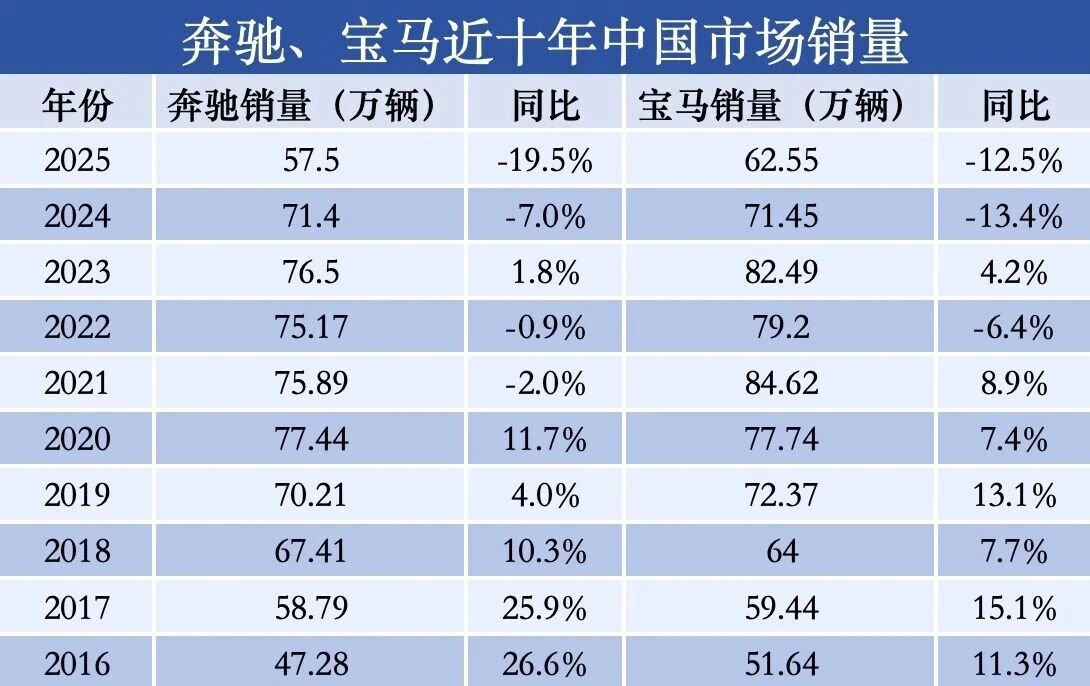
Core Insights - Mercedes-Benz and BMW are projected to have annual sales in China below 500,000 units by 2026, a level comparable to their sales in 2016 [2] - Both companies are experiencing a decline in sales for the second consecutive year, with Mercedes-Benz expected to sell 551,900 units in 2025, down 19%, and BMW 625,500 units, down 12.5% [2] - The competitive landscape is shifting, with domestic electric vehicle brands increasingly encroaching on the luxury segment, affecting traditional luxury brands [2][4] Sales Performance - Mercedes-Benz and BMW's sales in China have fluctuated over the past decade, with a notable decline in recent years [1] - In 2023, Mercedes-Benz sold 765,000 units, a slight increase of 1.8%, while BMW sold 824,900 units, up 4.2% [1] - The sales figures for 2025 indicate a significant drop compared to previous years, highlighting a concerning trend for both brands [2] Market Dynamics - The Chinese luxury car market is witnessing a resurgence in domestic brands, with several setting ambitious sales targets for 2026, such as Aito aiming for 500,000 units and Xpeng targeting 550,000 to 600,000 units [4] - The overall passenger car market in China is projected to reach 24.065 million units in 2025, reflecting a recovery from previous years [4] Strategic Initiatives - Mercedes-Benz plans to launch over 15 new models in 2026, focusing on both traditional and electric vehicles, while also enhancing collaborations with local tech companies [4][6] - BMW aims to introduce around 20 new products, including the iX3 long-wheelbase model, leveraging new electric platforms and advanced technologies [6] - Both companies face challenges in adapting to the rapidly changing market, as new domestic competitors continuously innovate [6]
英伟达-特斯拉FSD深度体验交流
2026-01-20 01:50
Summary of Conference Call on Robotaxi Developments Industry Overview - The conference discusses the developments in the Robotaxi industry, focusing on key players such as Waymo, Tesla, and Nvidia, along with their respective technologies and market strategies [1][2][3][4][5][6][7][8][9][10][11][12][13][14][15][16][17][18][19][20][21][22][23][24][25][26]. Key Players and Their Developments Waymo - Waymo is currently the largest Robotaxi operator globally with a fleet of 2,500 vehicles, although this number is significantly lower than expected [2]. - The company excels in software application, response speed, and supply matching, providing a comprehensive user experience [2]. - Waymo's system is based on rules and high-definition maps, which limits its scalability outside designated areas [1][5]. - The transition to an end-to-end model poses challenges, including regulatory pressures and the complexity of changing its existing technology stack [10]. Tesla - Tesla's Robotaxi does not rely on high-definition maps but uses open-source map data, allowing it to cover more routes and provide a more complete end-user experience [4][5]. - Currently, Tesla operates a limited number of vehicles (150) in Texas and has begun testing fully autonomous operations [4][11][12]. - The cost of Tesla's Robotaxi service is significantly lower than competitors like Uber, with fares from San Francisco to Nvidia headquarters costing under $30 compared to Uber's $50-$60 [4]. - Tesla faces challenges with software stability and low failure rates, which are critical for the success of its Robotaxi operations [13][14]. Nvidia - Nvidia showcased an end-to-end autonomous driving model using the Mercedes CLA, which exceeded expectations during testing [9]. - The company plans to cover all of California by Q1 2026 and gradually expand across North America, although it has decided not to enter the Chinese market for autonomous driving [3][9][23]. - Nvidia continues to offer lidar technology options to clients but has not released a formal Robotaxi solution [3][20]. Competitive Landscape - Other notable competitors in the North American market include Amazon's Zoox, which, despite being a significant player, is lagging in progress compared to Waymo and Tesla [6]. - The performance of competitors like Lucid and Pony.ai is also mentioned, with Waymo being favored due to its strong AI integration and operational experience [8]. Regulatory and Market Challenges - The regulatory environment in the U.S. and China is described as aggressive, with both countries making significant strides in autonomous driving regulations [3][26]. - Local government support varies, with some regions in China showing superficial support for Robotaxi initiatives, while the U.S. faces challenges due to the autonomy of individual states [24]. User Experience and Technology Differences - Waymo offers a more polished user experience, including features like music integration and user onboarding, while Tesla leverages its existing ecosystem for a familiar experience [15]. - Differences in remote takeover capabilities between Waymo and Tesla are noted, with Waymo allowing remote monitoring and control of vehicles [16]. Conclusion - The Robotaxi industry is rapidly evolving, with key players like Waymo and Tesla leading the charge. However, challenges related to scalability, regulatory compliance, and technology integration remain significant hurdles for all companies involved in this space [1][2][3][4][5][6][7][8][9][10][11][12][13][14][15][16][17][18][19][20][21][22][23][24][25][26].


93岁华伦天奴创始人去世
21世纪经济报道· 2026-01-20 00:46
Group 1 - Valentino Garavani, a renowned Italian fashion designer, passed away at the age of 93, significantly impacting the global fashion industry [1] - The Italian President and Prime Minister expressed condolences, highlighting Garavani's inspirational contributions to fashion [1] Group 2 - European stocks experienced a collective decline, with U.S. stock futures also dropping, indicating a bearish market sentiment [2] - Major automotive brands such as Mercedes-Benz, BMW, and Audi reported a decline in sales in China, prompting them to initiate self-rescue measures [2]