
湖南裕能

Search documents
2025年11月新能源车销量高景气延续,碳酸锂价格快速上行
Zhong Guo Neng Yuan Wang· 2026-01-14 02:05
Core Viewpoint - The lithium battery industry is experiencing significant growth in production and demand, with notable increases in both battery and phosphoric iron lithium cathode material output in November 2025 compared to the same period in 2024 [1][2]. Production - In November 2025, domestic battery production reached 176.3 GWh, marking a year-on-year increase of 49.66% and a month-on-month increase of 3.34% [1][2]. - The production of phosphoric iron lithium cathode materials in December 2025 was 26.93 million tons, reflecting a year-on-year growth of 32.48% and a month-on-month growth of 0.16%, with a capacity utilization rate of 59.85% [1][2]. Pricing - As of January 9, 2026, the price of industrial-grade lithium carbonate rose to 138,000 yuan per ton, with a weekly increase of 17.92% [3]. - The price of phosphoric iron lithium (for power) was reported at 47,100 yuan per ton on January 9, 2026, up 4.43% from January 4 [3]. - The price of lithium hexafluorophosphate slightly decreased to 160,700 yuan per ton on January 10, 2026, down 10.72% from January 3 [3]. Demand - In November 2025, the monthly shipment volume of phosphoric iron lithium batteries reached 75.3 GWh, a year-on-year increase of 43.62% and a month-on-month increase of 11.56%, setting a new high for the year [4]. - The monthly shipment volume of ternary power batteries was 18.2 GWh, reflecting a year-on-year increase of 33.82% and a month-on-month increase of 10.30% [4]. - The new bidding capacity for domestic new energy storage projects in January to October 2025 was higher than in the same period of 2024, with a total new bidding scale of 21.8 GW/64 GWh in November, marking a month-on-month increase of 65% [4]. - In November 2025, China's battery exports were 21.2 GWh, a year-on-year increase of 69.60% and a month-on-month increase of 9.28% [4]. - Global sales of new energy vehicles reached 2 million units in November 2025, a year-on-year increase of 8.53% and a month-on-month increase of 4.63% [4]. Investment Recommendations - The domestic production of batteries and phosphoric iron lithium cathode materials in January to November 2025 exceeded that of 2024, with stable raw material and cell prices, and an increase in monthly battery shipments and new energy storage bidding capacity [5]. - The rising demand for lithium batteries suggests a focus on companies involved in lithium battery materials [5]. - Recommended companies include CATL (300750), Yiwei Lithium Energy (300014), Xinwanda (300207), Hunan Youneng (301358), Rongbai Technology (688005), Tianci Materials (002709), and Duofluoride (002407) [5].






锂电行业跟踪:2025年11月新能源车销量高景气延续,碳酸锂价格快速上行
Shanghai Aijian Securities· 2026-01-13 10:34
Investment Rating - The industry is rated as "Outperform" [3] Core Insights - The production of positive electrode materials has increased significantly, with domestic battery production reaching 176.3 GWh in November 2025, a year-on-year growth of 49.66% [3] - Lithium carbonate prices have risen sharply, reaching 138,000 CNY per ton as of January 9, 2026, with a weekly increase of 17.92% [3] - The demand for lithium iron phosphate batteries has shown strong growth, with a monthly loading volume of 75.3 GWh in November 2025, marking a year-on-year increase of 43.62% [3] Summary by Sections Production - In November 2025, the production of lithium iron phosphate positive electrode materials was 26.93 million tons, a year-on-year increase of 32.48% [3] Prices - As of January 9, 2026, the price of lithium iron phosphate (power type) was reported at 47,100 CNY per ton, up 4.43% from January 4, 2026 [3] - The average price of square lithium iron phosphate energy storage batteries remained stable, with slight increases noted for various capacities [3] Domestic Demand - The monthly loading volume for lithium iron phosphate batteries reached a new high in November 2025, with significant increases in both domestic and new energy storage project bidding capacities [3] Overseas Demand - In November 2025, China's power battery exports reached 21.2 GWh, a year-on-year increase of 69.60% [3] - Global new energy vehicle sales reached 2 million units in November 2025, reflecting a year-on-year growth of 8.53% [3]
突破15万元大关!碳酸锂价格迎来“开门红”
Zhong Guo Hua Gong Bao· 2026-01-13 09:02
Core Viewpoint - The price of lithium carbonate has surged at the beginning of 2026, driven by international expectations, policy disruptions, and industry behaviors, with battery-grade lithium carbonate reaching 154,100 yuan/ton, a nearly 29.17% increase from December 31, 2025 [2] Group 1: Price Trends - As of January 12, 2026, both battery-grade and industrial-grade lithium carbonate prices have surpassed 150,000 yuan per ton, with industrial-grade at 151,250 yuan/ton, reflecting a 29.94% increase from the end of 2025 [2] - The rebound in lithium carbonate prices is attributed to geopolitical tensions and resource policy adjustments that heighten supply concerns [2] Group 2: Supply Factors - The Brazilian government's decision to freeze new mining rights auctions has intensified market fears regarding lithium resource supply tightening [2] - Domestic supply is constrained due to increased environmental requirements for lithium mining, which may raise operational costs and affect future production capacity [3] - A significant supply gap of 5,000 to 8,000 tons per month has emerged due to the delayed resumption of production at the Jiangxi lithium mine and seasonal maintenance of older production lines [3] Group 3: Demand Dynamics - The demand for lithium carbonate remains strong, particularly from the booming electric vehicle market, with battery manufacturers actively procuring lithium to meet production needs [4] - Some downstream companies have announced production line maintenance, which may impact the overall demand for lithium carbonate [4] Group 4: Market Outlook - Industry experts suggest that the fundamentals supporting lithium carbonate prices remain robust, indicating a sustained strong price environment with increased volatility expected [5]


两家磷酸铁锂企业宣布提价 一家提价1500—2000元/吨 产线检修或加剧涨势
Xi Niu Cai Jing· 2026-01-13 08:45
Group 1 - The core point of the article is that lithium iron phosphate (LFP) companies have raised prices for downstream customers due to tight supply, driven by strong demand in energy storage and better-than-expected sales forecasts for electric vehicles [2] - One company has increased prices for major customers by 1500 to 2000 yuan per ton, indicating a significant price adjustment in the market [2] - Despite January typically being a slow season for the industry, recent positive developments in the lithium battery sector, including rising raw material prices and news of production halts, have stimulated market sentiment [2] Group 2 - Multiple LFP production companies, including Hunan Youneng, Deyang Nano, Wanrun New Energy, and Anda Technology, have announced production halts for maintenance, which is expected to have a short-term impact on supply and is interpreted as a contraction signal by the market [4] - Wanrun New Energy has stated that its LFP production lines have been operating beyond capacity since Q4 2025, and it will conduct maintenance starting December 28, 2025, which is expected to reduce LFP output by 5,000 to 20,000 tons [4] - Hunan Youneng's production capacity utilization exceeded 100% in 2025, and it will also conduct maintenance on some production lines starting January 1, 2026, with an expected reduction in output of 15,000 to 35,000 tons of phosphate cathode materials [4] - The first price increase for LFP has been accepted by most customers, with processing fees rising by 1,000 yuan per ton, although some major customers are still in negotiations [4]

碳酸锂价格迎来“开门红”
Zhong Guo Hua Gong Bao· 2026-01-13 03:30
Group 1 - Lithium carbonate prices have surged to over 140,000 yuan per ton in early 2026, marking a 19% increase from the end of 2025 and an 83% rise compared to the same date in 2025 [1] - The rapid price increase is attributed to a combination of international expectations, policy disruptions, and industry behaviors, with geopolitical tensions raising concerns about supply chain stability [1] - Brazil's recent decision to freeze new mining rights auctions has heightened market fears regarding lithium resource supply tightening, further influencing price expectations [1] Group 2 - Domestic policies and capacity factors are tightening supply, with the State Council's action plan aimed at promoting sustainable development potentially increasing environmental costs for lithium mining [2] - Short-term supply of lithium is significantly constrained, with production delays from key mines leading to a monthly supply gap of 5,000 to 8,000 tons [2] - The overall inventory of lithium ore in domestic main ports has slightly decreased to 142,000 tons, supporting upward price movement despite some production increases in lithium spodumene and recycling [2] Group 3 - The demand for lithium carbonate remains strong due to the booming electric vehicle market, with battery manufacturers actively procuring lithium to meet production needs [3] - Some downstream companies have announced production line maintenance, which may impact lithium carbonate prices to varying degrees [3] - The short-term fundamentals for lithium carbonate are expected to support prices, with a strong upward trend likely to continue [3]
兴业证券:需求双轮驱动+供给刚性约束 锂电材料行业景气上行
智通财经网· 2026-01-13 02:53
Group 1 - The core viewpoint of the report is that global lithium battery demand is expected to grow at a rate of 26% year-on-year by 2026, driven by both power storage and electric vehicle sectors [1][4] - In the electric vehicle sector, the registration of global electric vehicles reached 17.1 million units from January to October 2025, representing a year-on-year increase of 25.5%, primarily due to the resumption of subsidies in Europe and vehicle replacement policies in China [1][4] - The global energy storage battery shipments reached 428 GWh from January to September 2025, showing a significant year-on-year increase of 90.7%, supported by the scaling of independent storage projects in China and market demand in the U.S. [1][4] Group 2 - The lithium battery materials supply side is undergoing optimization due to previous overcapacity leading to low-price competition, resulting in many companies facing continuous losses and high debt levels [2][3] - Companies are focusing on improving existing production efficiency and cost optimization rather than blind expansion, leading to a significant weakening of expansion capabilities and intentions among lithium battery material companies [2][3] - The tightening of environmental policies and energy consumption controls is raising industry entry barriers, causing smaller companies to exit the market, thus enhancing the rigidity of supply constraints [2][3] Group 3 - Technological upgrades are driving supply-side optimization, with advancements in high-pressure lithium iron phosphate and high-strength separators, which require higher production precision and R&D investment [3][4] - Leading companies are leveraging continuous R&D investment to scale up high-end product capacity, while smaller firms struggle to upgrade their products and processes, leading to market elimination [3][4] - The supply structure is evolving towards a "few but excellent" model, with resources concentrating on leading enterprises, which is expected to restore market share and profitability for these companies [3][4] Group 4 - The report indicates a strong certainty of profit recovery in lithium battery materials, driven by supply-side constraints, high demand growth, and industry restructuring [4] - The consensus among companies to scientifically release capacity has led to a continued limitation of supply over the next 1-2 years, while demand is experiencing rapid growth from both power storage and electric vehicle sectors [4] - Core material prices, such as lithium hexafluorophosphate, have started to rebound, and the overall capacity utilization rate in the industry is expected to continue its upward trend in 2026 [4] Group 5 - Investment recommendations suggest prioritizing attention on lithium hexafluorophosphate and lithium iron phosphate sectors, with specific companies like Tianqi Materials and Hunan Youneng being highlighted [5] - Other companies to watch include Duofu Technology, Fulian Precision, Longpan Technology, Defang Nano, Tianji Co., Shida Shenghua, and Wanrun New Energy, particularly in the context of price recovery [5] - For long-cycle, heavy-asset sectors like copper foil and separators, companies such as Enjie, Xingyuan Materials, Fusheng Technology, Defu Technology, Jiayuan Technology, and Nord are recommended for attention [5]


光伏锂电出口退税新政出台 一季度产能释放“淡季不淡”
2 1 Shi Ji Jing Ji Bao Dao· 2026-01-12 14:40
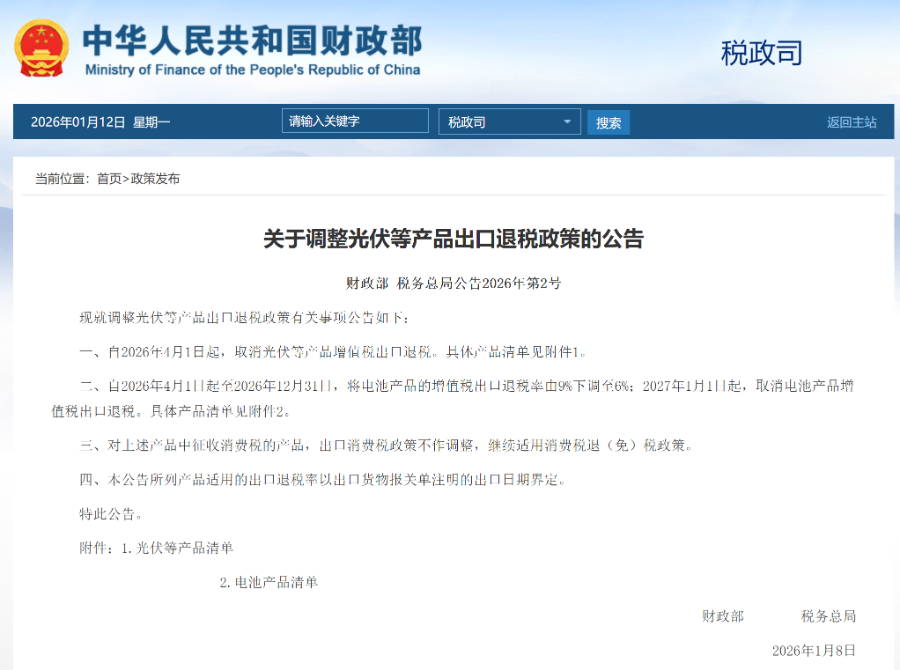
Core Viewpoint - The recent announcement by the Ministry of Finance and the State Taxation Administration to cancel export VAT rebates for photovoltaic and battery products is seen as a significant measure in the "anti-involution" actions within the new energy sectors, aimed at addressing the industry's profitability issues and promoting higher value-added products [5][6][8]. Industry Overview - The new energy photovoltaic and lithium battery industries have been facing challenges due to mismatched supply and demand and intense price competition, leading to weak profitability across the sector [3]. - Since 2025, there have been ongoing calls within the lithium battery sector to resist vicious competition, control capacity growth, and enhance technological innovation [3]. Policy Changes - Starting from April 1, 2026, the export VAT rebate for photovoltaic products will be canceled, and the rebate rate for battery products will be reduced from 9% to 6% until the end of 2026, after which it will be completely eliminated [1][5]. - The Ministry of Industry and Information Technology and other regulatory bodies have proposed 20 measures to regulate industry competition, including tightening approvals for low-capacity projects and establishing a cost-based price monitoring mechanism [4]. Market Reactions - Following the announcement, the stock performance of key players in the lithium battery sector showed significant volatility, with leading companies like CATL experiencing declines, while some photovoltaic companies saw substantial gains [1]. - The cancellation of export VAT rebates is expected to lead to an increase in the cost and price of Chinese photovoltaic components in overseas markets, which may help clear out low-end production capacity [8]. Price Trends - The prices of lithium carbonate futures have surged to over 160,000 yuan per ton, compared to 60,000 yuan per ton in June 2025, indicating a significant recovery in the battery materials market [6]. - The demand for upstream materials remains strong, with companies reporting full production capacity and no immediate adjustments in order volumes from downstream clients [7]. Future Outlook - The upcoming policy changes are anticipated to drive a surge in orders for photovoltaic components before the new VAT regulations take effect, although this demand may be temporary [7]. - Long-term, the cancellation of export VAT rebates is expected to facilitate industry consolidation and price normalization, benefiting the overall market structure [8].

光伏锂电出口退税将取消 ,有代理商称现货5分钟被抢光
2 1 Shi Ji Jing Ji Bao Dao· 2026-01-12 14:28
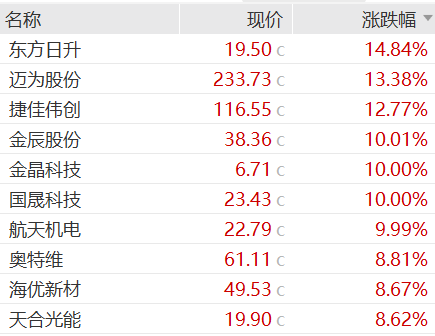
Core Viewpoint - The recent changes in export tax policies for photovoltaic and lithium battery products are seen as a significant move to combat excessive competition and improve profitability in the renewable energy sectors [4][8][9]. Group 1: Market Performance - On January 12, the opening saw fluctuations in the new energy photovoltaic and lithium battery sectors, with notable divergences in individual stock performances [1]. - Leading lithium battery company CATL (宁德时代) saw its H-shares drop by 3% and A-shares decline by over 4%, while companies like Deyang Nano (德方纳米) and Hunan Youneng (湖南裕能) experienced mixed results [1]. - In the photovoltaic sector, companies such as Maiwei (迈为股份) and Jiejia Weichuang (捷佳伟创) surged over 10%, while Trina Solar (天合光能) and Haiyou New Materials (海优新材) rose over 8% [1]. Group 2: Export Tax Policy Changes - Starting April 1, 2026, the export tax rebate for photovoltaic products will be eliminated, and the rebate rate for battery products will be reduced from 9% to 6% until the end of 2026, after which it will be completely removed [2]. - This policy change is part of a broader "anti-involution" initiative aimed at addressing the supply-demand mismatch and intense price competition that have weakened profitability in the photovoltaic and lithium battery industries [4][5][8]. Group 3: Industry Response and Measures - Since 2025, there have been ongoing calls within the lithium battery sector to resist harmful competition and control capacity growth, with various industry meetings held to discuss these issues [7]. - The Ministry of Industry and Information Technology has organized discussions with leading battery companies to establish measures for regulating competition and ensuring sustainable growth [7]. - A total of 20 measures were proposed, including monitoring production capacity and implementing penalties for non-compliant companies, which may affect financing and tax rebates [8]. Group 4: Market Dynamics and Future Outlook - Despite the seasonal downturn typically seen in the first quarter, demand for power and energy storage batteries remains strong, with companies reporting full order books and saturated production capacity [11]. - The anticipated increase in costs due to the export tax policy is prompting overseas buyers to adjust their purchasing schedules, potentially leading to a robust first quarter for lithium battery sales [11][12]. - Analysts predict that the cancellation of export tax rebates will ultimately raise the costs and prices of Chinese photovoltaic components in overseas markets, which could help clear out excess capacity and stabilize prices in the long run [13].
光伏锂电出口退税将取消 ,有代理商称现货5分钟被抢光
21世纪经济报道· 2026-01-12 14:21
Core Viewpoint - The article discusses the recent fluctuations in the new energy photovoltaic and lithium battery sectors, highlighting the impact of changes in export tax policies on these industries and the ongoing "anti-involution" actions aimed at stabilizing prices and production capacity [1][5][6]. Summary by Sections Market Performance - On January 12, the lithium battery leader CATL saw its H-shares drop by 3% and A-shares fall over 4%, while companies like Deyang Nano and Hunan Yueneng experienced mixed results with increases and decreases in their stock prices [1]. Export Tax Policy Changes - The Ministry of Finance announced that starting April 1, 2026, the export VAT refund for photovoltaic products will be canceled, and the VAT refund rate for battery products will be reduced from 9% to 6% until the end of 2026, after which it will be completely eliminated [2][3]. Industry Response and Actions - The lithium battery and photovoltaic industries have been facing challenges due to mismatched supply and demand and intense price competition, leading to a series of "anti-involution" initiatives aimed at expanding demand, adjusting prices, and controlling production capacity [3][5]. - Since 2025, there have been calls within the lithium battery sector to resist vicious competition and control the disorderly growth of production capacity, with various companies announcing price adjustments to stabilize the market [5][6]. Price Trends and Market Dynamics - Despite the seasonal downturn typically seen in the first quarter, the demand for power and energy storage batteries remains strong, with companies reporting sufficient orders and saturated production capacity [8]. - The export tax policy changes are expected to lead to an increase in battery prices, as overseas buyers adjust their purchasing strategies to avoid higher costs after the policy takes effect [8][10]. Future Outlook - Analysts predict that the cancellation of export tax refunds will increase the costs and prices of Chinese photovoltaic components in overseas markets, which may lead to industry consolidation and a return to more rational pricing in the long term [7][10].
湖南裕能股价连续4天下跌累计跌幅8.47%,方正富邦基金旗下1只基金持2.97万股,浮亏损失17.05万元
Xin Lang Cai Jing· 2026-01-12 07:48
1月12日,湖南裕能跌2.37%,截至发稿,报62.08元/股,成交17.74亿元,换手率7.38%,总市值472.31 亿元。湖南裕能股价已经连续4天下跌,区间累计跌幅8.47%。 资料显示,湖南裕能新能源电池材料股份有限公司位于湖南省湘潭市雨湖区鹤岭镇日丽路18号,成立日 期2016年6月23日,上市日期2023年2月9日,公司主营业务涉及公司是国内主要的锂离子电池正极材料 供应商,专注于锂离子电池正极材料研发、生产和销售。公司的主要产品包括磷酸铁锂、三元材料等锂 离子电池正极材料,目前以磷酸铁锂为主,主要应用于动力电池、储能电池等锂离子电池的制造,最终应用 于新能源汽车、储能领域等。主营业务收入构成为:磷酸盐正极材料98.04%,其他(补充)1.96%。 从基金十大重仓股角度 数据显示,方正富邦基金旗下1只基金重仓湖南裕能。方正富邦致盛混合A(020424)三季度持有股数 2.97万股,占基金净值比例为5.29%,位居第一大重仓股。根据测算,今日浮亏损失约4.48万元。连续4 天下跌期间浮亏损失17.05万元。 方正富邦致盛混合A(020424)基金经理为汤戈。 截至发稿,汤戈累计任职时间4年161天, ...