
茶百道

Search documents
海南生态软件园中国企业出海基地启动
Hai Nan Ri Bao· 2025-12-12 01:20
Core Insights - The China Enterprises Going Global Base was officially launched at the Hainan Ecological Software Park, aiming to leverage the advantages of the Hainan Free Trade Port to create a comprehensive ecosystem for companies going abroad [1][2] - The base integrates policy, service, and resource elements to provide full-cycle support for enterprises looking to expand internationally, focusing on sectors such as consumer electronics, medical devices, and financial technology [1][2] Group 1 - The launch event attracted over 300 participants, including executives from more than 200 listed companies and representatives from international organizations, discussing cross-border development opportunities in twelve key industries [1] - A roundtable discussion titled "New Forces Going Global Reshaping the Landscape" featured representatives from various sectors, including technology, automotive, finance, and consulting, exploring opportunities and innovative paradigms for the new economy [1] Group 2 - The base aims to provide a full-chain service ecosystem, including one-stop entry assistance, a "Going Global Service Resource Pool," and a green channel for government services [2] - It connects capital resources with professional institutions like brokerages and accounting firms to offer services such as equity financing and listing path planning, facilitating the capital process for enterprises [2] - Eight companies, including Langjiu Co., Dongfang Yuhong, and Yuyuan Co., signed agreements with the base, representing various sectors such as new consumption, commercial retail, medical health, and financial investment [2]
跟风抢“联名”“贪杯”不可取
Bei Jing Wan Bao· 2025-12-11 07:13
Core Insights - The release of the movie "Zootopia 2" has significantly boosted the sales of co-branded products, particularly among teenagers who are engaging in excessive consumption to collect merchandise [1][4][12] - The phenomenon of "social currency" is driving demand for these co-branded items, as children seek to showcase their collections on social media [12][13] Group 1: Market Trends - Co-branded products, especially in the food and beverage sector, are becoming increasingly common, with many brands collaborating with popular IPs to attract younger consumers [1][12] - The collaboration between Luckin Coffee and "Zootopia 2" has led to a rapid sell-out of products within days of their launch, indicating strong market demand [14] Group 2: Consumer Behavior - Many teenagers are purchasing excessive quantities of drinks and food items to obtain promotional items, often leading to waste, as they do not consume all the products bought [5][8][9] - The trend of collecting co-branded merchandise is driven by peer influence, with children feeling pressured to participate in order to fit in socially [12][13] Group 3: Marketing Strategies - Companies are using promotional strategies that require consumers to purchase multiple items to receive free gifts, which has been effective in driving sales but raises concerns about waste [14][15] - The scarcity of co-branded items has led to a secondary market where these products are being resold at high prices, indicating a strong demand for limited-edition merchandise [16]


净利跌近四成,狂奔的霸王茶姬急需谋变
虎嗅APP· 2025-12-11 06:00
Core Viewpoint - The article discusses the current challenges and strategies of the tea brand Bawang Chaji, highlighting its rapid expansion, declining profitability, and the need for product innovation to maintain market relevance [4][10][40]. Group 1: Financial Performance - Bawang Chaji reported a global store count of 7,338 and a quarterly GMV of 7.93 billion yuan, but faced a net profit decline of 38.5% year-on-year [4]. - The net profit margin decreased from 18.3% to 12.4%, while the operating profit margin fell from 22.4% to 14.2% [4]. - GMV in the Greater China region dropped by 6.2% to 7.63 billion yuan, with average monthly GMV per store declining by 28.3% to 378,500 yuan [5]. Group 2: Product and Innovation Strategy - Bawang Chaji launched a new product, the Boya Juexian Flower Fragrance, after a long wait, but consumer feedback was mixed [2]. - The company aims to enhance product offerings and has plans for a new menu and special tea products, while also maintaining existing popular items [6]. - The brand's reliance on the successful Boya Juexian product, which has generated over 12.5 billion cups sold, poses a challenge for future innovation [25][27]. Group 3: Franchise and Market Dynamics - Franchisees are experiencing profit pressures due to increased competition and a price war in the tea market, with some reporting longer payback periods for their investments [15][19]. - Bawang Chaji has introduced a new revenue-sharing model for franchisees, transitioning from fixed fees to a commission-based structure to improve profitability [17][19]. - The company is facing challenges in securing prime locations for new stores, leading to a competitive environment among franchisees [16]. Group 4: Organizational Changes and Leadership - The arrival of CFO Huang Hongfei marks a significant shift towards a more structured and disciplined financial approach, aiming for a public listing and improved financial models [37]. - The company is undergoing organizational adjustments to balance traditional management with modern operational practices, focusing on product innovation and team collaboration [38][39]. - Founder Zhang Junjie is adapting to the challenges of scaling the business while maintaining a strong focus on product quality and brand identity [40][41].

茶百道(02555.HK):运营提质增效 26年有望持续改善
Ge Long Hui· 2025-12-10 01:31
Company Dynamics - The company is currently undergoing a deep adjustment period from 2024 to 2025, with initial positive results expected to improve further in 2026 [1] - In the second half of 2025, the company is actively restructuring its R&D organization and new product launch mechanisms, shifting from a traditional structure to an integrated product research center focused on data analysis and consumer insights [1] - The new market-driven product decision-making mechanism is expected to better meet consumer needs, as demonstrated by the recent launch of solid mango sago, leading to a double-digit growth in same-store sales in November [1] Sales Channel Exploration - The company plans to enhance store operating quality by exploring multiple sales channels, with a focus on the coffee category in 2026, utilizing fresh milk and fruits to boost morning sales [2] - Currently, 200 stores have coffee machines installed, averaging over 30 cups sold daily without promotion, with plans to add coffee machines to an additional 1,500 to 2,000 stores next year [2] - The company aims to expand its price range downward to meet the demand for water priced between 6-10 yuan in lower-tier markets, with a target of 11-15% growth in 3-4 tier cities and 6-10% in cities below the 4th tier in 2026 [2] Profitability and Forecast - The company is restructuring its membership pricing system to guide consumers towards online orders while tightening online activities and increasing offline promotions to encourage in-store visits [2] - Due to previous negative media impact, franchisee gross margins were affected, leading to lower net profit margins; however, the company plans to recover franchisee subsidies and improve profitability through standardization and automation [2] - The company expects to achieve a dividend payout ratio of 60-80% over the next three years, corresponding to a current dividend yield of 5.4-7.2%, highlighting its investment value [2] Earnings Forecast and Valuation - The company maintains net profit forecasts of 870 million yuan for 2025 and 1.06 billion yuan for 2026, currently trading at 11x and 9x P/E for 2025 and 2026 respectively [2] - Considering the sector's valuation decline, the target price has been reduced by 23% to 9.3 HKD, reflecting a 14x and 12x P/E for 2025 and 2026, with a potential upside of 31% [2] - The company maintains an outperform rating in the industry despite the competitive landscape and challenges in store expansion and single-store efficiency [2]
“暖经济”来了:火锅店客流上升,暖饮销量大增
Di Yi Cai Jing· 2025-12-09 09:38
Core Insights - The "warm economy" is driving consumer spending in winter, with hot pot and warm beverages becoming popular choices as temperatures drop across the country [1][4]. Group 1: Hot Pot Consumption - Hot pot has emerged as the leading dining choice this winter, with online transaction volumes for hot pot restaurants ranking first across all categories [2]. - Since the start of winter, the number of group purchase orders for hot pot on Meituan has increased by over 330% compared to the same period last year [2]. - Popular hot pot flavors this year include nourishing and health-focused options, with online transaction volumes for black goat hot pot, mushroom hot pot, and hot pot chicken each growing by over 70% year-on-year [2][3]. - Customer traffic at Ba Nu Mao Du hot pot has significantly increased, with peak wait times exceeding 2 hours during weekends [2]. Group 2: Beverage Trends - The demand for warm beverages has doubled since the onset of winter, with tea brands prominently displaying their new winter hot drink offerings [3][4]. - Tea Baidao reported that the sales proportion of hot drinks has doubled in the past month, with their new product "Bean Milk Black Qilin" selling nearly 200,000 cups on its first day [3]. - The trend towards health-conscious consumption is reflected in the increased sales of tea drinks containing grains, nuts, and seasonal fresh fruits [3]. Group 3: Market Dynamics - The winter tea drink market is showing diverse changes, driven by the "warm economy" and a growing focus on light health concepts [4]. - Tea brands are innovating products and creating engaging consumption scenarios to meet consumer demands, thereby energizing the winter consumption market [4].

冬日经济|“暖经济”来了:火锅店客流上升,暖饮销量大增
Di Yi Cai Jing· 2025-12-09 09:23
Group 1 - The "warm economy" is driving consumer preferences towards hot pot and hot beverages as winter approaches, significantly boosting the winter consumption market [1] - Data from Meituan and Dianping indicates that hot pot has become the leading category in winter dining, with online transaction volume for hot pot dining increasing over 330% compared to the same period last year [2] - Popular hot pot flavors this winter include nourishing and health-focused options, with online transaction volumes for black goat hot pot, mushroom hot pot, and hot pot chicken all increasing by over 70% [2] Group 2 - The customer traffic and sales for hot pot restaurants have seen a notable increase since the start of winter, with some locations experiencing wait times exceeding 2 hours during peak hours [2][3] - New winter products from Hai Di Lao, such as the "Double Flavor True Fragrance Pot," reflect consumer preferences for fresh and healthy ingredients, emphasizing the emotional value of dining experiences [3] - The sales of hot beverages have doubled as consumers seek warm drinks during the cold winter months, with tea brands prominently displaying their winter offerings [5] Group 3 - The demand for health-conscious tea drinks has surged, with brands like Cha Bai Dao reporting a doubling in hot drink sales and the successful launch of new products like "Soy Milk Black Qilin" [5] - The trend towards "warm and nourishing" food and drink options indicates a shift in consumer preferences, with tea brands innovating to meet these demands and enhance the winter consumption experience [6]
2025新中式审美内容消费报告
Sou Hu Cai Jing· 2025-12-09 07:20
Group 1 - The emergence of the new Chinese aesthetic is driven by economic growth, policy support, and cultural confidence, with young people exploring traditional cultural elements in a "guarding and innovating" manner, leading to its transition from niche to mainstream appeal [1][10] - The new Chinese aesthetic has penetrated various aspects of daily life, including food, fashion, home decor, and cultural tourism, with traditional ingredients and modern health concepts becoming popular choices [1][15] - The commercial value of the new Chinese aesthetic is being realized, serving as a key marketing tool for brands and becoming a cultural symbol for Chinese brands going global, as seen with stores like Paris Cha Ba Dao and Zhou Dafu [1] Group 2 - The integration of technologies like AI and AR has revitalized the new Chinese aesthetic, particularly in traditional and modern contexts, as demonstrated by innovative presentations during events like the CCTV Spring Festival Gala [2] - The new Chinese aesthetic has gained significant traction on social media, with topics related to it generating billions of views, indicating its widespread acceptance and influence across various demographics [1][15][36] - The popularity of modified Hanfu has made it easier for the general public to experience the beauty of the new Chinese aesthetic in daily life, contributing to its mainstream adoption [20][21]

港股新消费概念午后持续走弱 泡泡玛特跌近5%
Zheng Quan Shi Bao Wang· 2025-12-09 05:56
Group 1 - The Hong Kong stock market's new consumption concept is experiencing a decline in the afternoon session [1] - Pop Mart has dropped nearly 5%, indicating a significant downturn in its stock performance [1] - Other companies such as Blukoo, Cha Bai Dao, and Lao Pu Gold are also seeing declines alongside Pop Mart [1]
港股新消费概念股持续低迷,泡泡玛特跌超5%

Mei Ri Jing Ji Xin Wen· 2025-12-09 05:50
Group 1 - The new consumption concept stocks in the Hong Kong market are experiencing a continued downturn, with significant declines observed in various companies [2] - Pop Mart has seen a drop of over 5%, while Brucan has decreased by 4.3% [2] - Other companies such as Guoquan, Xiaomi Group, and Laopu Gold have also reported declines exceeding 3%, with Cha Baidao down by 2.8% [2]
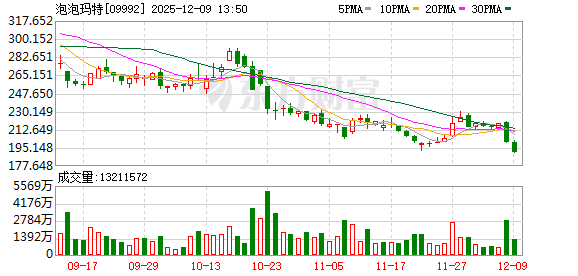
港股新消费概念股连续第二日集体走低
Jin Rong Jie· 2025-12-09 05:50
Group 1 - The Hong Kong stock market continues to experience a decline, particularly in the new consumption sector, with multiple companies showing significant drops in their stock prices [1] - Pop Mart and Blukoo both fell over 4%, while Dasin Holdings, Laopuhuangjin, and Guoquan dropped over 3% [1] - Other companies such as Cha Baidao and Weilon Meishi saw declines of over 2%, and Nayuki Tea, Guming, Mixue Group, and Miniso all fell by more than 1% [1]