
国泰基金

Search documents
FOF业绩谁执牛耳 重仓资源品种成“胜负手”
Zhong Guo Zheng Quan Bao· 2026-01-27 20:57
Core Insights - The latest holdings of Fund of Funds (FOF) reveal a shift in investment preferences, with a notable increase in bond ETFs and a decline in gold ETFs [1][2] - The macro environment for the equity market in Q1 2026 is expected to be favorable due to liquidity easing and performance improvement expectations [1][3] Fund Holdings - As of the end of Q4 2025, the Hai Fu Tong Zhong Zheng Short Bond ETF became the most held fund by FOFs, with 119 FOFs holding a total market value of 5.98 billion [1][2] - Other top bond ETFs included Peng Yang Zhong Dai-30 Year Government Bond ETF and Ping An Zhong Dai-High Grade Corporate Bond Spread Factor ETF, indicating a strong preference for bond investments [2] Gold and Resource Funds - Despite a decrease in holdings of the Hua An Gold ETF, several gold stock ETFs saw significant increases in FOF holdings, with over 50 million shares added for the Yong Ying Zhong Zheng Hu Shen Gang Gold Industry Stock ETF [2] - FOFs showed a strong focus on resource-related funds, particularly in gold, non-ferrous metals, and cyclical themes, reflecting a strategic shift towards these sectors [2][3] Performance and Strategy - The CITIC Jiantou Rui Xuan 6-Month Holding Mixed Fund (FOF) achieved the highest return in the FOF market at 6.41% in Q4 2025, heavily investing in resource-focused funds [3] - Fund managers are optimistic about the stock market, favoring value and blue-chip stocks, particularly in the resource sector, as they anticipate a market rebound in the latter half of 2026 [4] Tactical Approaches - The Bohai Huijin Preferred Progress 6-Month Holding Mixed Fund (FOF) will maintain a "barbell and rebalancing" strategy, locking in profits from previously high-performing assets while focusing on technology sectors benefiting from the AI boom [4][5] - The investment strategy for Q1 2026 will prioritize high-certainty industries, including gold and silver stocks, rare earths, and the recovering tourism sector [4][5]
公募加大布局港股力度 首只千亿级份额港股主题ETF诞生
Shang Hai Zheng Quan Bao· 2026-01-27 18:36
◎记者 赵明超 开年以来,港股科技板块持续震荡,但基金布局热情不减,众多新品密集上报。Choice数据显示,今年 以来,截至1月27日,有26只港股主题基金上报。其中,广发基金上报了5只港股主题基金,富国基金上 报了3只港股主题基金。 从这些上报的港股主题基金来看,不仅有主动权益类基金,还有各细分行业指数基金。从科技主题基金 看,包括富国港股通科技混合基金、富国恒生科技指数基金、国泰中证港股通互联网ETF联接基金、国 泰港股通互联网精选混合基金。 多只主题ETF份额创新高 公募新品密集上报的背后,同资金持续看好港股市场有关。 港股市场已然成为公募基金重要的发力方向。2026年以来,港股主题基金布局热度显著攀升,26只新品 密集上报。从投向看,主要聚焦港股科技、医药、周期板块。此外,大量资金借道ETF南下布局,港股 主题ETF净流入近300亿元。随着资金的持续涌入,富国港股通互联网ETF份额突破千亿份,这也是首 只份额突破千亿份的港股主题ETF。 据Choice测算,2025年,港股主题ETF净流入3673.54亿元。2026年以来,截至1月26日,港股主题ETF 净流入达到298.51亿元。从港股主题ETF的 ...
六只黄金股票ETF月内涨近四成
Xin Lang Cai Jing· 2026-01-27 17:52
证券时报记者 李明珠 此前,世界黄金协会表示,2025年金价共计53次刷新历史纪录,推动全球投资者以前所未有的资金规模配置实物 黄金ETF,北美地区为主要驱动力;全年的全球黄金ETF流入规模激增至890亿美元;全球黄金ETF资产管理总规 模(AUM)增长至5590亿美元,双双刷新历史纪录。总持仓攀升至4025吨的历史峰值。 申万宏源最新研报认为,从宏微观维度来看,金价牛市尚未结束,短期需关注地缘政治事件的变化。宏观上,黄 金四大定价因素的乐观态势均未改变,中长期仍有向上空间;短期市场情绪的变数主要来自地缘冲突,需警惕事 件平息引发的乐观情绪回落。微观层面来看,量价方面,黄金价格均线偏离度处于高位,但RSI指标相对健康,无 明显超买;衍生品方面,波动率虽居历史高位但未达极值,认沽认购成交量比仍有下行空间;资金面方面,黄金 ETF资金流入额持续增长,整体微观指标暂未给出金价明确走向。 长城基金基金经理陈子扬同样对黄金后续走势持乐观态度,他认为,各国央行购金以及居民资产配置的需求两大 趋势均未出现逆转,黄金的长期配置逻辑依然牢固。 国际现货黄金价格接连刷新历史高点,近两个交易日在5000美元/盎司上方大幅震荡,并一 ...


1/27财经夜宵:得知基金净值排名及选基策略,赶紧告知大家
Sou Hu Cai Jing· 2026-01-27 15:51
写在文章前的声明:在本文之前的说明:本文中所列的投资信息,只是一个对基金资产净值进行排行的客观描述,并无主观倾向性,也不是投资建议,纯属 娱乐性质。 一顿操作猛如虎,基金净值已更新,谁是基金中的王者,谁又垫底,请看数据: | 基金简称 PK | | | 最新净体 !! = 2 N = 2 x = 2 = | | | --- | --- | --- | --- | --- | | 1 | 方正富邦核 ... C | 1.4854 | 6.62% | 8 | | | 018816 | 2026-1-27 | | | | 2 | 方正富邦核...A | 1.5055 | 6.61% | 8 | | | 018815 | 2026-1-27 | | | | 3 | 广发远见智 ... A | 1.3800 | 5.68% | 7 | | | 016873 | 2026-1-27 | | | | 4 | 广发远见智 ... C | 1.3586 | 5.68% | 7 | | | 016874 | 2026-1-27 | | | | 5 | 华夏磐晟混...F) | 2.2141 | 5.19% | 8 | | | 1 ...

黄金不香了?FOF头号重仓生变
Zhong Guo Zheng Quan Bao· 2026-01-27 14:22
Group 1 - The core point of the news is the shift in FOF holdings, with the Hai Fu Tong Zhong Zheng Short-term Bond ETF becoming the most held fund by FOFs in Q4 2025, replacing the Hua An Gold ETF [1][2] - As of the end of Q4 2025, the Hai Fu Tong Zhong Zheng Short-term Bond ETF was held by 119 FOFs, with a total market value of 5.98 billion [2] - Several bond ETFs, including Peng Yang Zhong Dai-30 Year Government Bond ETF and Ping An Zhong Dai-Medium to High Grade Corporate Bond Spread Factor ETF, were among the top holdings by FOFs [2] Group 2 - In Q4 2025, FOFs increased their holdings in resource-related funds, particularly in gold and cyclical themes, with notable performance from the CITIC Securities Rui Xuan 6-Month Holding Mixed Fund [3] - The CITIC Securities Rui Xuan 6-Month Holding Mixed Fund achieved a return of 6.41% in Q4 2025, leading the FOF market [3] - The South China Zhong Zheng Shen Wan Nonferrous Metal ETF became the largest holding for a specific FOF by the end of Q4 2025, indicating a strong interest in nonferrous metals [3] Group 3 - The outlook for the second half of 2026 suggests a potential strengthening of value and blue-chip stocks, with a focus on resource upstream varieties [4] - Fund managers are optimistic about the stock market, expecting a shift from valuation expansion to profit expansion, with strategies including profit-taking and rebalancing [4] - There is a focus on sectors with high certainty, such as cyclical industries and the tourism sector, which are expected to rebound after recent declines [4]
2025年公募最大意外背后的生存逻辑
Sou Hu Cai Jing· 2026-01-27 14:08
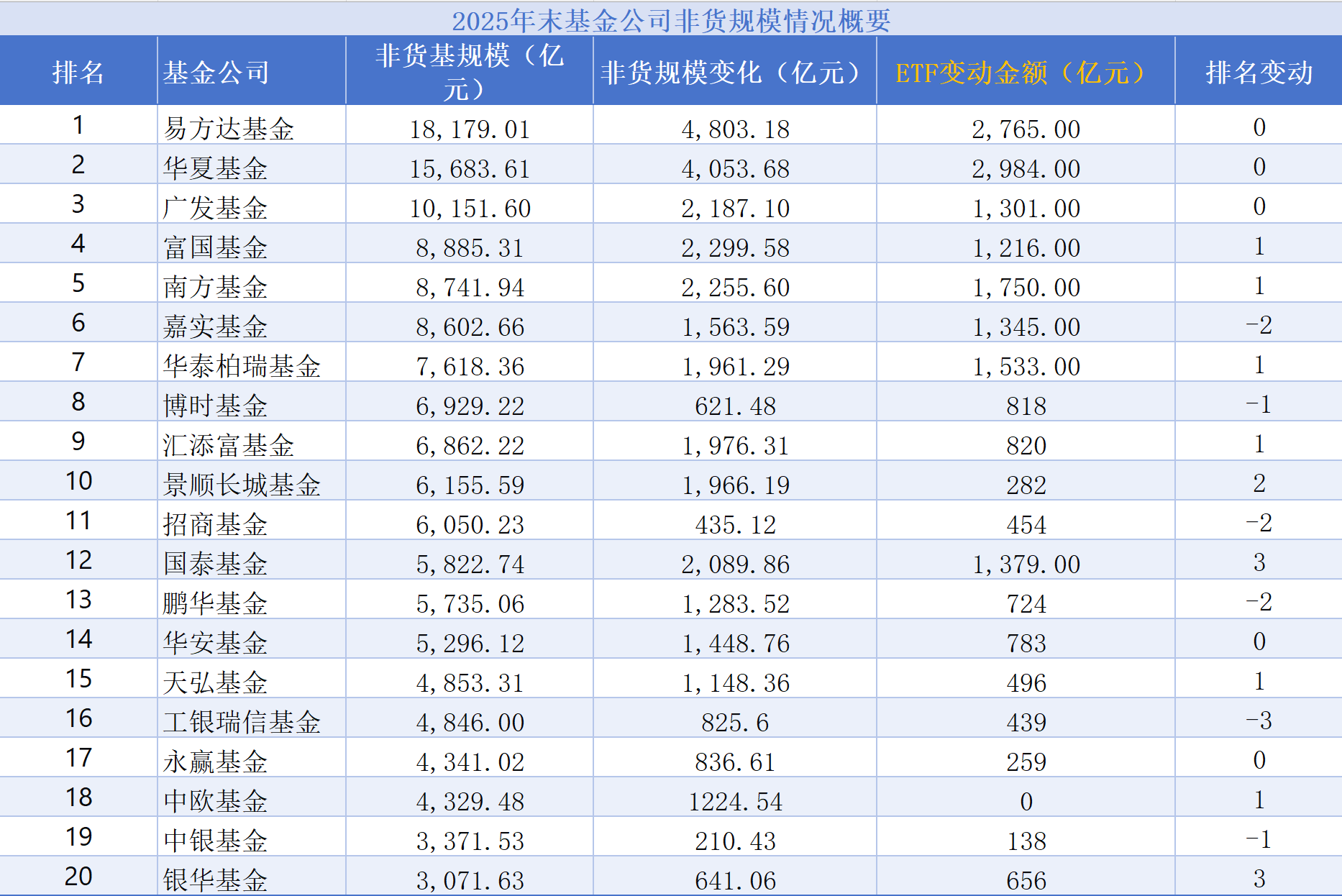
Core Insights - The public fund industry in 2025 experienced significant growth, with total management scale reaching 37.64 trillion yuan, a 16.13% increase from the end of Q4 2024 [1] - The top ten fund managers accounted for 40.48% of the total market scale, indicating a pronounced Matthew effect in the industry [1][2] - Equity funds, particularly ETFs, were the main growth drivers, although active equity funds faced net redemptions despite improved performance [1] Group 1: Fund Management Scale - By the end of 2025, the top ten fund managers had a combined management scale of 15.24 trillion yuan, with 14 companies each adding over 100 billion yuan in non-monetary scale [2][3] - The "ten trillion club" expanded to ten companies, with E Fund leading at 2.42 trillion yuan and Huaxia Fund at 2.16 trillion yuan [4] - E Fund and Huaxia Fund established a "dual leader" position in non-monetary scale, with 1.82 trillion yuan and 1.57 trillion yuan respectively [5] Group 2: ETF Growth and Market Dynamics - ETFs emerged as the brightest growth engine in the public fund industry, with total stock-type ETF scale nearing 3.8 trillion yuan, marking a historical high [6] - The market saw a significant structural change, with some ETFs having over 80% of their holdings concentrated among single institutions, raising concerns about stability [7][10] - A notable outflow of 407.12 billion yuan from stock-type ETFs occurred in January 2026, highlighting the risks associated with concentrated holdings [8][9] Group 3: Competitive Landscape - E Fund and Huaxia Fund are leading players across various sectors, maintaining their positions through strong growth in non-monetary scale [12][13] - Zhongou Fund achieved remarkable growth without ETFs, increasing its non-monetary scale by over 120 billion yuan, showcasing a unique strategy [15][17] - Other notable competitors include GF Fund, which excelled in the FOF sector, and Yongying Fund and Invesco Great Wall, which emerged as dark horses in 2025 [19][20] Group 4: Future Challenges and Industry Trends - The public fund industry is shifting from pure scale expansion to structural optimization and quality enhancement, emphasizing the need for active management capabilities [21][26] - The challenge for leading firms is to maintain flexibility and innovation while managing large scales, avoiding the pitfalls of becoming too rigid [22] - For niche players like Zhongou Fund, the focus will be on balancing specialization with diversification to sustain competitive advantages [23]
争夺“天量存款”下一站,FOF新发份额连续4个月破百亿份
Di Yi Cai Jing Zi Xun· 2026-01-27 13:41
Core Viewpoint - In January 2026, FOFs (Fund of Funds) emerged as a significant product in the public offering market, accounting for 20.07% of the total issuance volume, indicating a strong growth trend in this investment vehicle [1][11]. Group 1: FOF Market Performance - As of January 26, 2026, there were 78 newly issued funds with a total issuance of 765.46 billion units, of which 11 were FOFs, totaling 153.62 billion units [1]. - The total issuance of FOFs has exceeded 100 billion units for four consecutive months, reflecting a robust demand in the market [2][11]. - By the end of 2025, the total number of public FOFs reached 545, with a record total scale of 2,440 billion yuan, marking a historical high [3]. Group 2: Factors Driving FOF Growth - The growth of FOFs is attributed to multiple factors, including a low-interest-rate environment leading to a shift in savings, the effectiveness of multi-asset strategies, and strong promotion by distribution channels [2][5]. - Demand for stable investment alternatives has surged due to declining yields on deposits and wealth management products, creating a "deposit migration" trend [5]. - The supply side has seen enhancements through customized FOFs, holding period designs, and multi-asset strategies, improving product competitiveness [5][9]. Group 3: Investment Strategies and Trends - The investment methodology for FOFs has evolved from a focus on selecting individual fund managers to a multi-asset allocation approach, which is now a prevailing trend in the industry [9]. - The diversification of asset allocation has been evident, with significant increases in the proportion of commodity funds and QDII funds in FOF portfolios, aligning with market trends [9]. - FOFs recorded a return of 12.8% in 2025, significantly outperforming the previous year's return of 4.06%, indicating a recovery in performance [9]. Group 4: Future Outlook - FOFs are expected to continue their growth trajectory into 2026, with a potential to absorb a substantial amount of maturing fixed-term deposits estimated at 45 trillion to 50 trillion yuan [11]. - The characteristics of stable FOFs align well with the demand for deposit replacements, and their design can help manage liquidity and stability for banks [11]. - The expansion of ETFs may lead to the emergence of ETF-FOFs as a core innovation direction, while customized FOFs are likely to gain traction to meet diverse investor needs [11].
股票ETF成交活跃 行业主题产品“吸金”显著
2 1 Shi Ji Jing Ji Bao Dao· 2026-01-27 13:18
Core Viewpoint - The A-share market is experiencing a cooling trend, leading to a significant shift in ETF investments from broad-based ETFs to sector-specific ETFs, with substantial net outflows from major broad-based ETFs and inflows into thematic ETFs [1][2][3] Summary by Sections ETF Market Dynamics - As of January 23, 2026, the total net outflow from the CSI 300 ETF and the CSI 1000 ETF reached 336.9 billion and 78 billion respectively since the beginning of the year, while thematic ETFs, particularly in resources and technology, attracted a total of 158.5 billion in net inflows [1][4] - The week of January 12-16 saw a net outflow of 141.6 billion from stock ETFs, which increased to 333.1 billion in the following week, marking a historically significant outflow [1][2] Performance of Broad-based vs. Thematic ETFs - From January 19-23, the CSI 300 ETF experienced a net outflow of 237.3 billion, while the CSI 1000 ETF and the SSE 50 ETF saw outflows of 71.7 billion and 36.1 billion respectively [2] - The net outflows for the CSI 300 ETF, CSI 1000 ETF, and SSE 50 ETF from January 5-23 were approximately 336.9 billion, 78 billion, and 56.2 billion respectively [2] Institutional Investor Behavior - Institutional investors hold a significant portion of ETFs, with over 1.5 trillion in ETF holdings reported as of the end of Q4 2025, primarily in the CSI 300 ETF [3] - Despite the outflows, the CSI 300 ETF remains a major holding for institutional investors, with an estimated 1 trillion still held in ETFs by these investors [3] Sector-specific ETF Inflows - Thematic ETFs, particularly in sectors like non-ferrous metals and chemicals, have seen strong inflows, with 50 ETFs collectively attracting 158.5 billion from January 5-23 [4][5] - Notably, three ETFs exceeded 10 billion in net inflows, including the Southern Non-ferrous Metals ETF (12.6 billion), Huaxia Power Grid Equipment ETF (11.9 billion), and Penghua Chemical ETF (10.3 billion) [5] Market Outlook - Analysts suggest that the shift in ETF investments indicates a structural rebalancing rather than a complete exit from the market, which may lead to deeper market trends and structural opportunities [7][8] - The current market dynamics suggest a transition from valuation recovery to a phase driven by fundamentals, with a focus on sectors with clear industry trends and performance support [8]
2026年度固收类基金经理TOP50
点拾投资· 2026-01-27 11:38
Core Viewpoint - The article discusses the launch of the 2026 TOP50 fixed income fund manager ranking, highlighting the growth and stability of fixed income products, particularly in the "fixed income +" category, which is expected to see significant expansion in 2025 [1]. Summary by Sections Performance Metrics - The average performance of various fund categories for 2025 shows that the "Point Pick & Zero City" funds outperformed their respective benchmarks across different categories, with notable figures such as: - Money Market Average: 1.61% vs. 1.30% benchmark [2] - Short-Debt Average: 1.29% vs. 1.40% benchmark [2] - Conservative Income Average: 1.86% vs. 0.83% benchmark [2] - Steady "Fixed Income +" Average: 4.75% vs. 4.58% benchmark [2] - Active "Fixed Income +" Average: 7.78% vs. 6.53% benchmark [2] - Equity-Debt Balanced Average: 20.41% vs. 16.77% benchmark [2] Fund Manager Selection Criteria - The selection of fund managers for the ranking is based on multiple factors including: - Performance since inception, five-year performance, excess return stability, maximum drawdown, Sharpe ratio, Calmar ratio, volatility, and qualitative analysis [3]. - Consideration of fund manager's management scale, holder structure, strategy capacity, management fees, number of funds managed, position, and influence [3]. Fund Classification Methodology - A unique classification method for fixed income funds is introduced, categorizing them into: 1. Cash Alternative 2. Conservative Income 3. Steady "Fixed Income +" 4. Active "Fixed Income +" 5. Equity-Debt Balanced [5]. Ranking Characteristics - The ranking focuses on experienced fund managers, excluding those with less than five years of tenure, emphasizing risk control over aggressive yield chasing [7]. - The average management tenure of selected fund managers is 10.43 years, with an average management scale of 32.38 billion [7]. - Only 50 fund managers are selected to avoid excessive homogeneity, with rankings not indicating preference [7]. Fund Manager Diversity - The ranking includes multi-manager configurations to leverage diverse asset classes, recognizing that single managers may not excel across all areas [7]. - The list excludes dollar-denominated bond funds and money market funds, while including mixed-asset FOFs due to the increasing importance of asset allocation [8]. Conclusion - The article acknowledges the dynamic nature of the fund management industry, inviting feedback and suggestions for potential fund managers to consider for future rankings [19].

有色板块高位震荡 资金持续加仓ETF
Zhong Guo Jing Ying Bao· 2026-01-27 08:37
Core Viewpoint - The recent strong performance of the non-ferrous metal sector in A-shares is attributed to the resonance of global macroeconomic and industrial trends, with a focus on long-term benefits rather than short-term price fluctuations [1][2]. Group 1: Market Performance - The non-ferrous metal sector has become one of the most prominent sectors in A-shares since 2026, with related ETFs recording significant gains, most exceeding 25% [2]. - On January 26, 2026, several ETFs, including the China Securities Non-ferrous Metal Mining Theme ETF, saw increases of over 6% [2]. - Despite some fluctuations on January 27, the sector did not experience significant declines that would erase previous gains [2]. Group 2: Driving Factors - Two main factors are driving the strength of the non-ferrous sector: a recovery in manufacturing and a long-term demand reshaping due to green and technological trends [2][3]. - The recovery in manufacturing, particularly in the U.S. and emerging economies, has led to increased demand for traditional industrial metals, while low inventory levels have amplified price elasticity [2]. - The demand for metals like copper and aluminum is being supported by stable needs from sectors such as electric vehicles, photovoltaics, and wind power, alongside new growth opportunities from AI infrastructure [3]. Group 3: Investment Strategy - Investors are advised to view industrial non-ferrous metals as strategic resource assets benefiting from global liquidity easing and future electrification and digitalization, rather than merely as cyclical commodities [4]. - Fund managers have identified key metals for 2026, including copper, aluminum, lithium carbonate, gold, and minor metals like tungsten, while also considering opportunities in sectors like chemicals and steel [4]. - Adjustments in portfolio allocations are being made based on industry conditions, with a focus on maintaining high positions in precious metals and copper while reducing exposure to overvalued sectors [4]. Group 4: Supply and Demand Dynamics - The current tight supply-demand balance in the non-ferrous sector necessitates close attention to the supply-demand balance sheet and macroeconomic influences on metal prices, including monetary policy and geopolitical factors [5].