星展银行

Search documents
人民币汇率韧性显现 中国资产吸引力持续提升
Xin Hua Wang· 2025-08-12 06:19
Core Viewpoint - The recent fluctuations in the RMB exchange rate are influenced by multiple factors, but the RMB remains resilient and stable against a basket of currencies, staying above the index level of 100 [1][2]. Exchange Rate Dynamics - As of August 30, the RMB to USD central parity rate was reported at 6.8802, a depreciation of 104 basis points from the previous trading day, with the closing price at 6.8980 [2]. - The USD index has risen approximately 4% since August 12, reaching around 109, marking a 20-year high, which has affected the RMB as a non-USD currency [2]. - The RMB's fluctuation against the USD is about 2%, which is less than the depreciation of major non-USD currencies like the Euro (down 3.84%), Yen (down 4.37%), and Pound (down 4.43%) [2]. Economic Fundamentals - China's economy is stabilizing, with key economic indicators improving, and the stability of the industrial and supply chains is expected to support the RMB exchange rate [3]. - The RMB's long-term outlook is expected to be influenced by both domestic and international factors, with a tendency for two-way fluctuations while maintaining basic stability at a reasonable equilibrium level [3]. - The "five protections" including basic balance of payments surplus and macro-prudential measures are expected to help maintain the RMB's stability [3]. Foreign Investment Sentiment - Despite short-term fluctuations in the RMB, foreign investors have continued to net buy Chinese securities since August, indicating confidence in the long-term investment value of Chinese assets [4][5]. - The resilience of China's foreign exchange market is highlighted by a high trade surplus and continued growth in actual foreign investment [4]. - The RMB's relative strength against the backdrop of global currencies depreciating against the USD is noted, with foreign investors maintaining a long-term perspective on Chinese equities [5]. Market Opportunities - Analysts suggest that the recent undervaluation of the Chinese stock market presents an opportunity for investors to increase their positions [5]. - The ongoing economic recovery and the emergence of new industries such as electric vehicles and renewable energy are expected to drive future growth [5]. - The bond market is also seeing a return of global funds, particularly in Chinese government bonds, indicating a positive outlook for the bond market as capital market opening progresses [6].
中联发展控股股东将股票由嬴控金融证券转入星展银行 转仓市值1.83亿港元
Zhi Tong Cai Jing· 2025-08-12 00:24
Group 1 - Hong Kong Stock Exchange data shows that on August 11, shareholders of China United Development Holdings (00264) transferred shares from Ying Kong Financial Securities to DBS Bank, with a transfer market value of HKD 183 million, accounting for 30.20% [1] - The company announced the appointment of Ms. Ye Duan and Mr. Peng Zuoqian as independent non-executive directors, effective from July 8, 2025 [1] - On May 19, China United Development Holdings disclosed a non-binding strategic cooperation framework agreement with CIMC Electric (Guangdong) Technology Development Co., Ltd. regarding the potential establishment of a joint venture in hydrogen production-related business, set for April 22, 2025 [1]
外资银行调整零售布局:压缩在华普通网点规模,发力高端财富管理
第一财经· 2025-08-10 14:04
Core Viewpoint - Foreign banks in China are rapidly adjusting their retail business strategies, focusing on high-end retail and cross-border wealth management as new growth engines while closing numerous traditional branches [3][4][8]. Group 1: Structural Adjustments - Over 10 foreign banks have closed branches in mainland China since the beginning of 2025, indicating a trend of reducing physical network presence [4][5]. - HSBC and Standard Chartered have opened flagship branches and private wealth management centers in major cities, emphasizing high-net-worth clients and wealth management as primary business directions [5][6]. - The shift from standard branches to flagship outlets highlights a focus on privacy, professionalism, and brand representation, which are crucial for building competitive advantages in the Chinese market [5][6]. Group 2: Market Opportunities - The wealth management market in China is experiencing structural growth, driven by the expansion of the middle-income group and increasing demand for diversified financial services [8][9]. - The total scale of entrusted assets in various financial products reached 154 trillion yuan by 2024, with an annual growth rate of approximately 10.4% [8]. - Foreign banks are capitalizing on the growing demand for comprehensive wealth management services, including family trusts and global asset allocation [8][9]. Group 3: Competitive Landscape - Despite the potential in the wealth management market, foreign banks face significant competition from domestic banks, which have extensive networks and customer bases [11][12]. - As of the end of 2023, there were only 888 operational foreign bank branches in China, limiting their brand recognition and market coverage [11]. - Some foreign banks, like Dah Sing Bank and Citibank, have divested their personal banking operations, focusing instead on corporate and cross-border services [11][12]. Group 4: Future Outlook - The future growth of foreign banks in China’s wealth management sector is expected to be characterized by differentiation and specialization, focusing on high-end and cross-border services [12]. - Digital transformation is a priority, with foreign banks leveraging technology to enhance service efficiency and compensate for the reduction in physical branches [12]. - The ongoing structural changes in the Chinese financial market are prompting foreign banks to adapt by concentrating on their strengths and transitioning from broad coverage to deep specialization [12].




外资银行调整零售布局:压缩在华普通网点规模,发力高端财富管理
Di Yi Cai Jing· 2025-08-10 12:34
Core Insights - Foreign banks in China are rapidly adjusting their retail business strategies, closing over 10 branches while opening flagship branches and wealth management centers in major cities [1][2][4] - The shift towards high-end retail and cross-border wealth management is seen as a new growth engine for foreign banks amid increasing competition in the local market [1][4] Group 1: Branch Adjustments - More than 10 foreign banks have closed branches in mainland China since the beginning of the year, indicating a trend of continuous network contraction [2] - HSBC China has closed 9 branches this year, with over half located in Guangdong province, while Standard Chartered has also reduced its traditional physical branch scale [2][5] - In contrast, foreign banks are accelerating the establishment of flagship branches and private wealth management centers in core cities, focusing on high-net-worth clients [2][3] Group 2: Wealth Management Focus - Standard Chartered plans to invest $1.5 billion over the next five years to expand its wealth management services, targeting affluent clients' needs for diversified investments and wealth inheritance [3][5] - The wealth management market in China is experiencing structural growth, driven by the expansion of the middle-income group and increasing demand for wealth management services [4][5] - As of mid-2024, foreign banks in China had total assets of 3.87 trillion yuan, with a net profit of 14.9 billion yuan, reflecting a 28.4% year-on-year increase, largely driven by wealth management contributions [5] Group 3: Competitive Landscape - Despite the potential of the wealth management market, foreign banks face significant competition from local banks, which dominate basic services like savings and wealth management due to their extensive networks and customer bases [7] - As of the end of 2023, there were only 888 operating foreign banks in China, leading to limited brand recognition and coverage [7] - Some foreign banks have opted to shrink their personal business layouts, with examples including the transfer of personal business by Dah Sing Bank and Citibank's sale of its personal wealth management business to HSBC [7] Group 4: Future Outlook - The wealth management business of foreign banks in China is expected to continue growing, with a focus on differentiation and specialization [8] - Foreign banks will deepen their high-end and cross-border services, leveraging global networks to meet the complex needs of high-net-worth clients [8] - Digital transformation will be accelerated to enhance service efficiency and compensate for the limitations of physical branch networks [8]
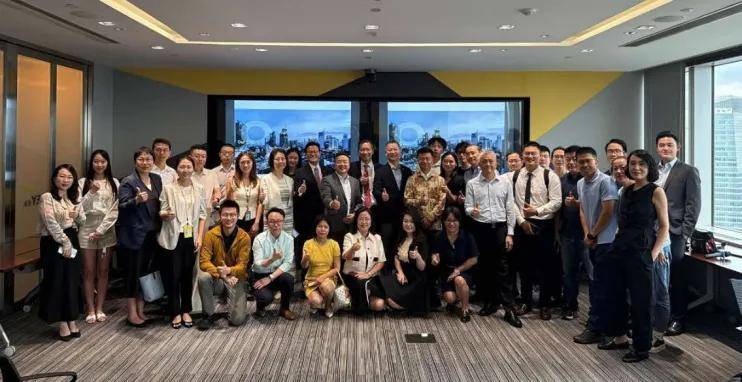
“掌握先机 出海印尼”——印尼主权基金访华交流会
Sou Hu Cai Jing· 2025-08-06 08:20
Core Insights - Indonesia is emerging as a strategic choice for Chinese enterprises looking to globalize, driven by its market potential and favorable policies [2][4] - The "Seizing Opportunities in Indonesia" seminar, co-hosted by Ernst & Young (EY) and DBS Bank, aimed to assist companies in exploring the Indonesian market [2][4] Group 1: Seminar Overview - The seminar featured experts from EY, the Indonesian Investment Authority (INA), and DBS Bank, focusing on the unique values and development opportunities in Indonesia [2][4] - Opening remarks were made by senior executives from EY and DBS, emphasizing the importance of supporting enterprises in their international expansion [4] Group 2: Investment Opportunities - Professor Hu Jie from Shanghai Jiao Tong University discussed the historical ties between China and Indonesia, highlighting current investment opportunities for Chinese companies in Indonesia [6] - Andry Setiawan, Chief Investment Officer of INA, provided insights into the fund's establishment, operational model, and key investment sectors [7] Group 3: Tax Incentives - EY's tax consultant Li Cunjuan outlined three tax incentive scenarios for Chinese enterprises in Indonesia, including pioneer enterprise tax incentives, special economic zone benefits, and new capital city tax incentives [9] - The discussion emphasized the importance of understanding industry requirements, investment amounts, and application processes to maximize the chances of obtaining tax benefits [9] Group 4: Roundtable Discussion - A roundtable discussion allowed participants to explore trends in Southeast Asia, focusing on cultural integration, financing exit mechanisms, and tax incentives in Indonesia [12] - The session fostered deep discussions and shared insights from various industry experiences, receiving positive feedback from attendees [12][14]
黄金还要涨?多家机构上调金价预期
Zhong Guo Jing Ying Bao· 2025-08-06 07:57
Core Viewpoint - The recent weak U.S. non-farm employment data has led to a rebound in gold prices, with market expectations for gold rising significantly due to deteriorating economic growth and inflation outlooks in the U.S. [1][2] Group 1: Gold Price Movement - On August 6, COMEX gold futures opened at $3434.9 per ounce, reflecting a market shift towards bullish sentiment for gold [1] - Citibank raised its three-month gold price forecast from $3300 to $3500 per ounce, adjusting the trading range from $3100-$3500 to $3300-$3600 [1] - The chief commodity analyst at Industrial Bank Research noted that the probability of gold price increases is rising as previous high valuations are being digested and seasonal volatility in U.S. stocks may intensify [1] Group 2: Factors Influencing Gold Prices - The U.S. non-farm payrolls for July added only 73,000 jobs, falling short of the expected 110,000, while June's figures were revised down from 147,000 to 14,000, a downward adjustment of 90% [2] - Concerns over a slowing U.S. labor market have spurred gold price increases following the data release [2] - ICBC Credit Suisse Fund highlighted that the recent rise in gold prices is partly due to heightened expectations for interest rate cuts, as U.S. stock indices typically perform poorly before such cuts, supporting gold prices [2] Group 3: Institutional Outlook on Gold - Following Citibank's upward revision, several institutions expressed optimism about gold prices, with Goldman Sachs maintaining a target price of $3700 per ounce by the end of 2025, citing global central bank gold purchases, recession risks, and weakening dollar credibility as key drivers [3] - DBS Bank's Chief Investment Officer stated a positive outlook for alternative asset investments, particularly in gold, setting a target price of $3765 per ounce for Q4 2025 [3] - The increasing risks and uncertainties, along with ongoing central bank reserve diversification and strong investor demand, are expected to support the gold market [3]
深夜突发!香港金管局一周内第三次出手护盘,港元汇率咋了?
智通财经网· 2025-08-05 14:39
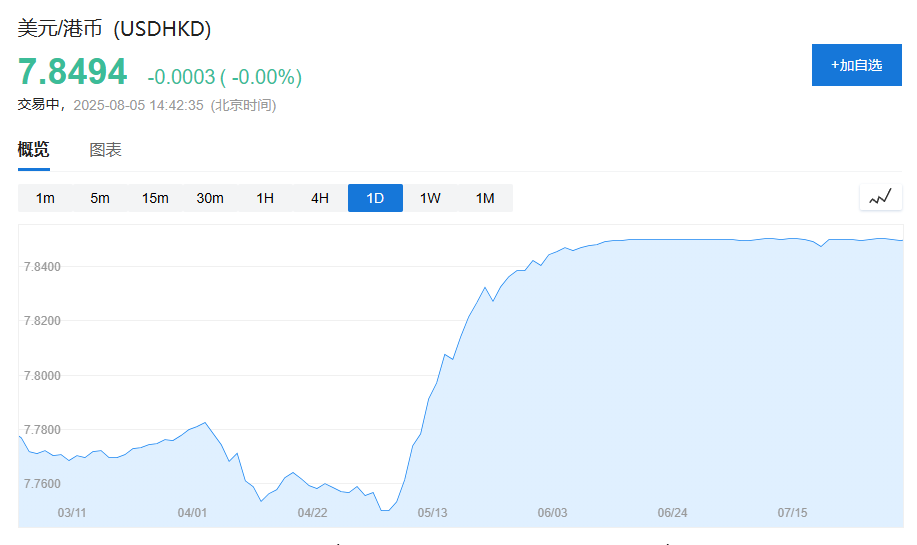
Group 1 - The Hong Kong Monetary Authority (HKMA) intervened in the market for the third time in a week due to the Hong Kong dollar (HKD) hitting the weak end of its peg at 7.85 against the US dollar, buying HKD 64.29 billion and selling USD [1] - The HKMA's actions are aimed at maintaining the HKD within the 7.75-7.85 range, with the banking system's liquidity expected to drop to HKD 72.461 billion following the intervention [1][7] - The continuous pressure on the HKD is attributed to a combination of low interest rates and capital outflows from the Hong Kong stock market [2][4] Group 2 - The interest rate differential between Hong Kong and the US has created an environment where investors are shorting the HKD to capitalize on the interest rate spread, leading to further depreciation of the currency [2] - Recent data indicates significant capital outflows from the Hong Kong stock market, with a notable increase in selling activity, particularly in healthcare, consumer, and real estate sectors [3][4] - The ongoing capital outflows exacerbate the demand for HKD, contributing to the depreciation pressure [4] Group 3 - Experts suggest that the duration of the HKMA's intervention will depend on the Federal Reserve's actions and the performance of the Hong Kong stock market [6] - If the US Federal Reserve initiates interest rate cuts due to weak employment data, the pressure on the HKD may ease as the interest rate differential narrows [6] - The situation reflects broader trends in emerging markets, with other currencies like the Indian Rupee also facing depreciation pressures due to external factors [6] Group 4 - The HKMA's interventions aim to stabilize HKD assets for ordinary citizens, but long-term attention is needed on interest rate differentials and capital flows [7] - While interventions may tighten liquidity and theoretically increase interest rates, the fragile state of the Hong Kong economy suggests that rates will remain low for the time being [8] - Investors in HKD assets should closely monitor the Federal Reserve's policies and capital flows in the Hong Kong stock market, as ongoing high interest rate differentials and capital outflows may lead to continued volatility [9]

南向流出与套利夹击,香港金管局一周三次出手稳汇市
Hua Er Jie Jian Wen· 2025-08-05 06:48
Core Viewpoint - The Hong Kong Monetary Authority (HKMA) has intervened in the currency market by purchasing HKD 64.29 billion (approximately USD 8.19 billion) to maintain the stability of the Hong Kong dollar against the US dollar, following previous interventions in late July and early August [1][4]. Group 1: Currency Intervention - The HKMA's recent market intervention is part of a series of actions since June aimed at curbing the depreciation of the Hong Kong dollar, which has been pressured by significant interest rate differentials between Hong Kong and the US [4][5]. - In total, the HKMA has withdrawn HKD 138.9 billion from the market through currency purchases over the past week to keep the exchange rate within the 7.75-7.85 range [1]. Group 2: Market Dynamics - Southbound capital outflows reached approximately HKD 181 billion on Monday, marking the largest single-day net outflow since May 12, which has intensified downward pressure on the Hong Kong dollar [1][4]. - Seasonal demand reduction and the outflow of southbound funds are contributing to the prevailing selling pressure on the Hong Kong dollar, as noted by DBS Bank's strategist Carie Li [4]. Group 3: Interest Rate Expectations - Recent US employment data has led to expectations of potential interest rate cuts by the Federal Reserve, which could alleviate some pressure on the HKMA if the interest rate differential narrows [5]. - The ongoing arbitrage trading driven by the interest rate gap is expected to remain active, with further interventions from the HKMA likely in the future [4][5].
外资涌入 上半年前海实际使用外资同比增长15.9%
2 1 Shi Ji Jing Ji Bao Dao· 2025-08-04 09:04
Core Insights - Foreign investment in Shenzhen is increasing, with a focus on the Qianhai area as a strategic point for foreign enterprises [1][3] - Qianhai has attracted over 12,000 foreign companies, with a significant rise in foreign investment and new enterprises established [1][3] Investment Trends - In the first half of the year, Shenzhen established 5,581 new foreign-invested enterprises, ranking first among major cities in China [1] - Qianhai's actual foreign investment reached 12.326 billion yuan, a year-on-year increase of 15.9%, accounting for nearly 60% of Shenzhen's total [1][3] - The number of new foreign-invested enterprises in Qianhai increased by 99.6% [1] Sector Performance - The top three sectors for foreign investment in Qianhai were finance (29.5%), business services (29.4%), and software and information technology services (17.5%) [3] - Foreign investment in the financial sector grew by 19.5%, while high-tech services saw a remarkable increase of 72.4% [3] Business Environment - Over 52% of members of the American Chamber of Commerce in South China plan to establish new offices in Qianhai, citing a favorable business environment [3] - Qianhai has implemented AI review policies that reduce application materials by 70% and compress review times significantly [3] Financial Policies - Qianhai is a pioneer in policies such as QFLP and cross-border wealth management, with QFLP fund sizes accounting for over 90% of Shenzhen's total [3] - Foreign enterprises benefit from a 15% corporate income tax rate and can reduce operational costs by over 40% through cross-border cash pools [3] Internationalization Efforts - DBS Bank from Singapore increased its investment in Shenzhen Rural Commercial Bank by nearly 1.6 billion yuan, raising its stake to 19.4% [4] - Qianhai is enhancing its international living and working conditions, with the establishment of international districts and schools [4] Future Outlook - Qianhai plans to deepen institutional openness in finance, data cross-border, and healthcare sectors to stabilize foreign investment confidence [4]
财经聚焦|迈向更高能级!上海国际金融中心加速建设
Xin Hua Wang· 2025-07-31 01:25
Group 1: Offshore Financial Development - The successful issuance of offshore bonds in Shanghai Free Trade Zone, with a scale of 500 million yuan, supports overseas entities in raising funds in international markets, marking a significant step in the development of offshore RMB bonds [2] - The new pilot scheme for offshore trade finance aims to streamline the settlement process from 2-3 days to "second-level," enhancing competitiveness with established offshore centers like Hong Kong and Singapore [2] - As of July 18, participating offshore trade companies completed 22 transactions with a total cross-border payment of 648 million yuan [2] Group 2: Growth in Offshore Trade - In Q1 2025, the offshore trading volume in the Lingang New Area reached approximately 8.15 billion USD, reflecting a year-on-year growth of 56.67% [3] - The Lingang New Area plans to leverage its offshore trade platform and financial pilot to create a model for global order reception, overseas processing, and settlement in Lingang [3] Group 3: Financial Market Infrastructure - Shanghai is recognized as one of the cities with the most comprehensive global financial factor markets, including stocks, bonds, futures, and gold markets, alongside essential financial infrastructure [4] - Recent regulatory measures have further strengthened Shanghai's position as an international financial center [4] Group 4: Cross-Border RMB Payment System - The CIPS (Cross-Border Interbank Payment System) has launched RMB international letter of credit services, enhancing convenience for enterprises in RMB trade settlements [7] - In the first half of the year, Shanghai's cross-border RMB payment totaled 16.2 trillion yuan, a year-on-year increase of 15%, maintaining its leading position nationally [7] Group 5: Foreign Investment and QDII Expansion - A new batch of QDII (Qualified Domestic Institutional Investor) quotas totaling 3.08 billion USD has been approved, allowing foreign banks to support clients in global asset allocation [8][10] - The expansion of QDII quotas is expected to enhance the ecosystem for capital market flows and inject long-term confidence into the market [10] - Foreign financial institutions are accelerating their presence in Shanghai, with significant investments in various sectors, including insurance and asset management [10]