阳光电源

Search documents
氢能行业2026年度投资策略
2026-02-04 02:27
而从目前的氢气的需求来看的话,整个氢能的应用,目前主要还是集中在一些工业领域当 中。先以 2024 年的氢能利用结构来占比来看,合成氨占比大概在 26%。合成甲醇占比 27%,液化 17%,煤化工占比 11%。这些基本上都是偏向于工业领域当中的。而剩下的 这 99%的氢能占比,是分布在交通、供热,还有冶金等这些方向。所以整个的氢能,在工 业领域当中还是个最主要的一个战战场。但是,未来交通和建筑,也是一个相对来说比较 明显的一个增量市场,发展潜力也是相对比较大的。 然后我们之前在也写过一些深度报告,对远期的绿氢的需求,做了一个测算。那目前的话 整个氢气的存量替代主要是用在合成氨,还有甲醇制备的这些领域当中。增量的话主要是 在交通领域、清洁能源,还有建筑用能。我们之前测算整个沥青在远期的话,应该是可以 需需求量达到 9400 万吨以上的一个水平。基本上分散在各个行业当中。所以氢能的话, 其实是一个应用场景非常宽泛、非常灵活的一个能源。那第二个就是来介绍一下整个氢能 的一个政策上的情况。 其实最近最近这些年的话,习总书记也在多次将多次举风电光伏并列提及到氢能整个产业 链的一个发展。而且青岛的话,在过去 5 年其实是 ...
2/3财经夜宵:得知基金净值排名及选基策略,赶紧告知大家
Sou Hu Cai Jing· 2026-02-03 17:01
一顿操作猛如虎,基金净值已更新,谁是基金中的王者,谁又垫底,请看数据: | 基金简称 PK | | | 最新净使 !! 手의则面原因人 | | | | --- | --- | --- | --- | --- | --- | | 1 | 银河核心优 ... C | 1.1329 | | 9.86% | 8 | | | 016981 | 2026-2-3 | | | | | 2 | 银河核心优 ... A | 1.1458 | | 9.86% | 8 | | | 011629 | 2026-2-3 | | | | | 3 | 银华成长智... A | 1.3371 | | 8.96% | 8 | | | 024455 | 2026-2-3 | | | | | 4 | 银华成长智 ... C | 1.3328 | | 8.96% | 27 | | | 024456 | 2026-2-3 | | | | | 5 | 广发上海金E ... C | 2.3002 | | 8.40% | 7 | | | 008987 | 2026-2-3 | | | | | 6 | 广发上海金E ... A | 2.3448 | 8.40 ...


航天+AI跨界整合引爆赛道,SpaceX合并xAI打开太空光伏增量,中国企业凭硬核实力扩份额,出海提速筑牢2026增长根基
Xin Lang Cai Jing· 2026-02-03 12:52
Group 1 - Company Sunlight Power (300274) is a leading domestic enterprise in photovoltaic inverters, covering the entire industry chain including energy storage systems and photovoltaic power station development [1][43] - The company has strong technical capabilities in power electronics and system integration, with products suitable for various applications including residential, commercial, and large-scale ground power stations [1][43] - In the space photovoltaic and computing power sector, Sunlight Power's technology can be adapted for space applications, providing stable power support for space computing centers [1][43][44] Group 2 - Longi Green Energy (601012) is a leading domestic photovoltaic company focusing on the research and production of monocrystalline silicon rods and wafers, with a complete vertical integration in the industry chain [2][45] - The company excels in new generation high-efficiency battery technologies such as N-type TOPCon and HJT, with significant cost control and technical advantages [2][45] - Longi's ultra-thin silicon wafer technology meets the stringent requirements for space photovoltaic components, enabling reduced weight and improved energy efficiency for space computing centers [2][45] Group 3 - Tongwei Co., Ltd. (600438) is a dual leader in photovoltaic silicon materials and battery production, with a strong focus on high-purity crystalline silicon and photovoltaic battery manufacturing [3][46] - The company has a high market share in high-purity silicon production and is well-positioned to meet the rigorous standards required for space photovoltaic components [3][46] - Tongwei's efficient battery technology can enhance power generation in space photovoltaic applications, positioning the company as a key supplier in the space photovoltaic supply chain [3][46] Group 4 - Deye Technology (605117) is a quality enterprise with core businesses in dehumidification equipment and photovoltaic energy storage systems, excelling in household and commercial energy storage solutions [4][43] - The company's energy storage technology is crucial for providing stable energy supply in space photovoltaic applications, addressing intermittent power generation issues [4][43][44] - Deye's experience in developing equipment for extreme environments positions it well to adapt products for space applications [4][43] Group 5 - Jingcheng Machinery (300316) is a leading domestic enterprise in photovoltaic crystal growth equipment, focusing on high-end equipment for photovoltaic manufacturing [5][6] - The company's technology supports the production of high-purity silicon crystals and ultra-thin silicon wafers, essential for space photovoltaic components [5][6] - As the space photovoltaic industry matures, Jingcheng is expected to provide core manufacturing equipment for the space photovoltaic supply chain [5][6] Group 6 - Maiwei Co., Ltd. (300751) is a leading enterprise in photovoltaic battery equipment, specializing in HJT and perovskite tandem battery technologies [7][41] - The company's equipment is crucial for the mass production of high-efficiency batteries that meet the stringent requirements of space photovoltaic applications [7][41] - Maiwei's technology can support the development of space-specific battery manufacturing equipment, enhancing energy system efficiency for space computing centers [7][41] Group 7 - Foster (603806) is a global leader in photovoltaic packaging materials, focusing on EVA and POE films, with a strong market presence [8][43] - The company's packaging materials are essential for ensuring the durability and performance of photovoltaic components in extreme space environments [8][43] - Foster aims to develop specialized packaging materials for space applications, enhancing the reliability of space photovoltaic systems [8][43] Group 8 - JinkoSolar (002459) is a global leader in photovoltaic modules, with a comprehensive business model covering silicon wafers, battery cells, and modules [10][43] - The company has a strong technical foundation and global production capabilities, allowing it to meet diverse application needs [10][43] - JinkoSolar's module manufacturing technology is well-suited for space applications, with the potential to become a core supplier for space photovoltaic systems [10][43] Group 9 - TCL Zhonghuan (002129) is a core enterprise in the silicon wafer sector, focusing on monocrystalline silicon materials and semiconductor materials [12][43] - The company's high-purity silicon technology is critical for space photovoltaic components, meeting the stringent requirements for purity and performance [12][43] - TCL Zhonghuan is positioned to develop space-specific silicon products, enhancing its role in the space photovoltaic supply chain [12][43] Group 10 - Aerospace Electromechanical (600151) is a leading enterprise in the integration of aerospace and photovoltaic technologies, covering the entire industry chain from component manufacturing to power station operation [19][43] - The company's aerospace power technology can be directly applied to space photovoltaic systems, providing essential energy management solutions [19][43] - With its experience in satellite systems, Aerospace Electromechanical is well-positioned to participate in the development of space computing centers [19][43]





数据中心供配电设备行业跟踪:甲骨文资本开支环比高增,DRAM价格小幅回落
Shanghai Aijian Securities· 2026-02-03 11:19
Investment Rating - The report rates the industry as "stronger than the market" [2] Core Insights - The data center industry has become a core incremental application scenario for the power equipment sector, directly driving demand growth and technological iteration [2][5] - The report emphasizes the need to incorporate AI industry multidimensional indicators to accurately gauge the demand for power distribution equipment, given the capital expenditure characteristics of the data center sector [2][5] - The report outlines a three-pronged indicator system: demand side, supply chain, and AI application side to support investment decisions in the data center power distribution equipment sector [2][5] Summary by Sections Demand Side - Capital expenditures from overseas cloud giants reached $99.617 billion in Q3 2025, a year-on-year increase of 80.39% and a quarter-on-quarter increase of 9.54% [7] - Alibaba's capital expenditure was 31.5 billion yuan in Q3 2025, a year-on-year increase of 80.10% but a quarter-on-quarter decrease of 18.55% [12] - Tencent's capital expenditure was 13 billion yuan, down 24.05% year-on-year and 32.05% quarter-on-quarter [12] Supply Chain - NVIDIA's total revenue in Q3 2025 was $57.006 billion, with data center product revenue reaching $51.215 billion, marking a historical peak [18] - TSMC's revenue in December 2025 was 335 billion New Taiwan dollars, a year-on-year increase of 20.4% [24] - The CPU price index rose slightly to 99.04 in November 2025, while DRAM spot prices decreased from $71.25 to $71.00 [27] AI Application Side - The number of AI models is steadily increasing, with API call volumes reaching 7.73 trillion tokens from January 20 to January 26, 2026, a quarter-on-quarter increase of 3.07% [30] - The price of tokens for models scoring over 40 on the Artificial Analysis Intelligence Index dropped by over 50% in Q3 2025 [46] - The report highlights the importance of AI application development in determining the strength and sustainability of capital expenditure cycles in data centers [30]
光储行业跟踪:电网侧独立新型储能容量电价机制建立,光伏组件价格持续上涨
Shanghai Aijian Securities· 2026-02-03 10:24
Investment Rating - The industry is rated as "Strongly Outperforming the Market" [2][34]. Core Insights - The report highlights a significant increase in the price of photovoltaic components and a decrease in lithium battery production in February 2026. The overall production of photovoltaic components is expected to decline by 13.58% month-on-month, while the production of lithium batteries is projected to decrease by 10.5% in China [2][3]. - The report emphasizes the establishment of a new pricing mechanism for independent energy storage capacity, which is expected to provide stable revenue for new energy storage solutions. This is part of a broader trend towards optimizing capacity structures in the renewable energy sector [2][32]. Summary by Sections Production - Photovoltaic component production is forecasted to decrease by 13.58% month-on-month in December 2025. The lithium battery production in China is expected to be 188 GWh, reflecting a 10.5% month-on-month decline [2][3][10]. Prices - As of January 28, 2026, the price of polysilicon remains stable at 54.00 CNY/kg, while the average price of TOPCon double-glass components has increased by 3.07% to 0.74 CNY/W. The average price of lithium battery storage systems has risen by 2.82% to 0.5882 CNY/Wh [2][11][17]. Domestic Demand - In November 2025, the domestic photovoltaic installation capacity reached 22.02 GW, a month-on-month increase of 74.76%. The cumulative installed capacity for the year reached 274.89 GW, marking a year-on-year growth of 33.25% [2][23]. Overseas Demand - In December 2025, the export value of photovoltaic components was approximately 2.314 billion USD, representing a year-on-year increase of 18.22%. The inverter export value reached 839 million USD, showing a year-on-year increase of 26.12% [2][27][25].




完善容量电价政策发布 碳减排明确成为发展主线 | 投研报告
Zhong Guo Neng Yuan Wang· 2026-02-03 09:51
Group 1: Energy Sector Overview - As of the end of 2025, the cumulative installed power generation capacity in the country reached 3.89 billion kilowatts, with a total of 434 GW of new energy capacity added throughout the year, exceeding market expectations. This includes 119 GW from wind power and 315 GW from solar power. Notably, thermal power added 95 GW [1][4]. - In December alone, solar power saw an addition of 41 GW and wind power added 38 GW, significantly higher than the monthly figures from June to November, likely due to the grid connection of large wind and solar projects at year-end [1][4]. Group 2: Storage and Pricing Mechanisms - The National Development and Reform Commission and the National Energy Administration issued a notice to improve the capacity pricing mechanism for power generation, which is expected to accelerate the introduction of independent storage capacity pricing policies at the provincial level. This is anticipated to expand the domestic independent storage market, benefiting storage integrators, upstream component manufacturers, and battery companies [2][3]. - The notice is seen as a significant step in establishing a unified framework for pricing and profitability for gas-fired power plants, which may enhance their construction enthusiasm and profitability [3]. Group 3: Investment Recommendations - Companies to watch in the storage sector include integrators such as Haibo Shichuang, Sunshine Power, and Canadian Solar, as well as battery manufacturers like CATL, EVE Energy, and others [2]. - In the power generation sector, companies with significant natural gas generation capacity such as Huadian International and Guangdong Power Development are recommended, along with those offering a combination of dividend yield and growth potential like Gui Guan Power [4][5]. Group 4: Carbon Market Developments - The "14th Five-Year Plan" emphasizes carbon reduction as a key development line, with stricter carbon emission controls expected. The carbon market is projected to expand, with additional industries being incorporated by 2027 [5][6]. - New methodologies for CCER (China Certified Emission Reduction) are being introduced, expanding the market's support to various sectors, including oil and gas recovery and green hydrogen, which may create new investment opportunities [6].
全国性储能容量电价出台,独立储能盈利模式重构 | 投研报告
Zhong Guo Neng Yuan Wang· 2026-02-03 09:51
实行清单制管理、加速储能项目建设进度。项目具体清单由省级能源主管部门会同价格主管部门制定, 管理要求由国家能源局另行明确。我们预计对储能电站的申报、考核、建设周期等明显要求,一定程度 上推动一部分暂停项目的建设进度。 明确容量电价承担方、电费结算与市场参与。1)明确新型储能容量补偿费用,纳入当地系统运行费 用,成为电价构成部分,由终端用户承担。2)充放电:有现货市场的,充放电均按照现货实时价格; 无现货市场时,充电执行工商业用户购电价格,放电价格由省级确定。3)输配电费:充电时需缴纳输 配电费,放电时退减已缴纳费用。4)未来衔接"可靠容量补偿机制",与煤电、气电等共用同一补偿机 制,实现公平竞争。 影响:后续多省将出台对应储能容量电价政策、需求爆发。1)参考甘肃标准,330元/kw*(1-厂用店率 1.74%)(配储时长/6h)*供需系数(25年为89.5%),对应4h配储的补贴标准193元/kw,若按照电芯价 格0.35元/wh(碳酸锂价格12万/吨),价差0.26元/wh,对应irr是8~9%,满足资金方收益率要求。2)我 们预计后续多省将出台相关补贴,25年新型储能并网183GWh,我们预计26年仍可实 ...
光伏设备板块2月3日涨6.68%,泽润新能领涨,主力资金净流入21.73亿元
Zheng Xing Xing Ye Ri Bao· 2026-02-03 09:03
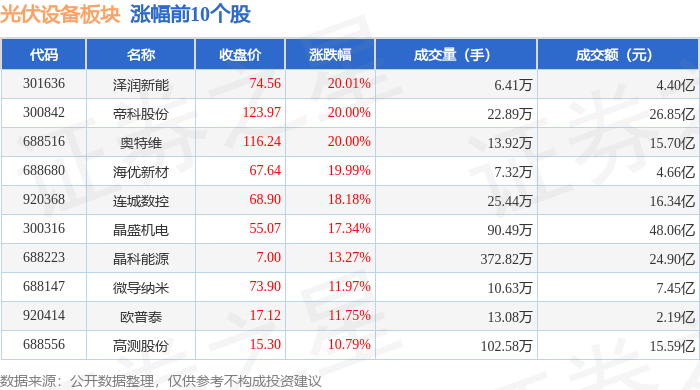
Core Viewpoint - The photovoltaic equipment sector experienced a significant increase, with a 6.68% rise on February 3, led by Zairun New Energy, amidst a broader market uptrend in major indices [1]. Group 1: Market Performance - The Shanghai Composite Index closed at 4067.74, up 1.29%, while the Shenzhen Component Index closed at 14127.1, up 2.19% [1]. - The photovoltaic equipment sector saw notable individual stock performances, with Zairun New Energy leading with a closing price of 74.56, reflecting a 20.01% increase [1]. Group 2: Stock Performance - Key stocks in the photovoltaic equipment sector included: - Zairun New Energy: 74.56, +20.01%, volume 64,100, turnover 440 million [1] - Jingke Co., Ltd.: 123.97, +20.00%, volume 228,900, turnover 2.685 billion [1] - Aotwei: 116.24, +20.00%, volume 139,200, turnover 1.570 billion [1] - Haiyou New Materials: 67.64, +19.99%, volume 73,200, turnover 466 million [1] - Liancheng CNC: 68.90, +18.18%, volume 254,400, turnover 1.634 billion [1] - Jingcheng Machinery: 55.07, +17.34%, volume 904,900, turnover 4.806 billion [1]. Group 3: Capital Flow - The photovoltaic equipment sector saw a net inflow of 2.173 billion in main funds, while retail funds experienced a net outflow of 209 million [2]. - The capital flow for key stocks indicated: - Longi Green Energy: 429 million net inflow from main funds, with a 8.29% share [3]. - Junda Co.: 416 million net inflow from main funds, with a 12.03% share [3]. - Foster: 323 million net inflow from main funds, with a 17.51% share [3].


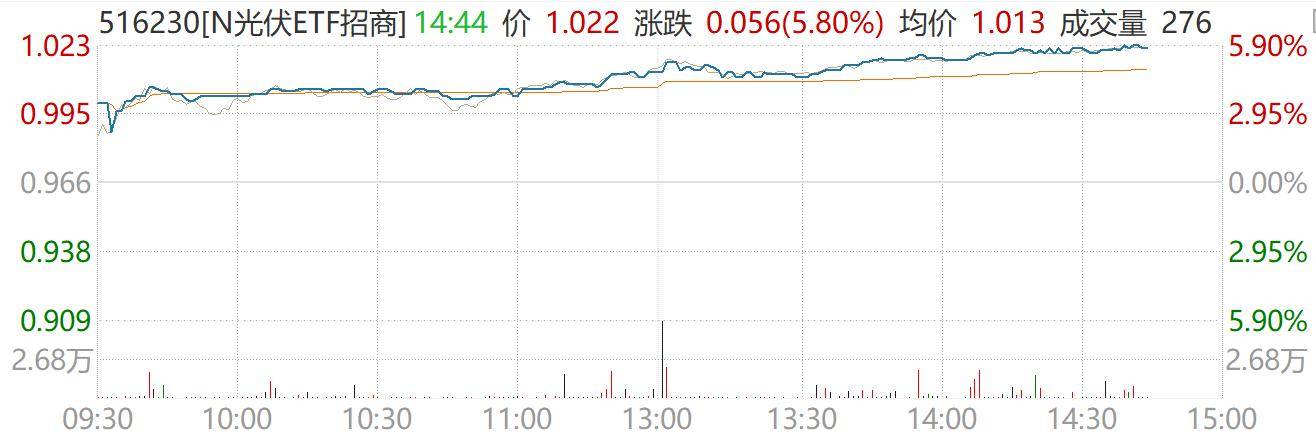
罗博特科、迈为股份涨停!光伏ETF招商(516230)上市首日涨近6%,算力卫星引领太空光伏新蓝海
Sou Hu Cai Jing· 2026-02-03 07:06
2月3日午后,三大指数大幅上攻。盘面上,受太空算力与卫星产业多方提振,太空光伏概念多股拉升。光伏ETF招商(516230)上市首日大涨5.7%,成份 股罗博特科、迈为股份强势涨停,捷伟佳创、德业股份涨超6%,隆基绿能、正泰电器涨超5%,特变电工、阳光电源、TCL科技等多股走强。 消息面上,SpaceX昨日正式收购其旗下的人工智能公司 xAI,合并后实体估值高达1.25 万亿美元。分析指出,此项合并旨在利用 SpaceX 的发射能力,将 AI 数据中心部署到太空轨道上,或标志着其太空AI数据中心计划从构想进入实操阶段,引领太空光伏新蓝海。 一、什么是太空光伏? 太空光伏,简言之,就是将光伏发电系统部署于太空轨道;其核心价值在于彻底突破地面光伏的固有瓶颈,有望成为太空能源的最优供能选择,堪称目前太 空能源的"唯一解"。 | 对比维度 | 太空光伏 | | --- | --- | | 大气质量条件 | AMO | | 太阳辐照强度 | 约 1360 W/m | | | 地面的 5-10 | | 光路长度 | 无大气层 | | 光谱类型 | 太空光谱 | | 有效发电时长 | 地球同步轨道 | | | 时间可接受光 ...
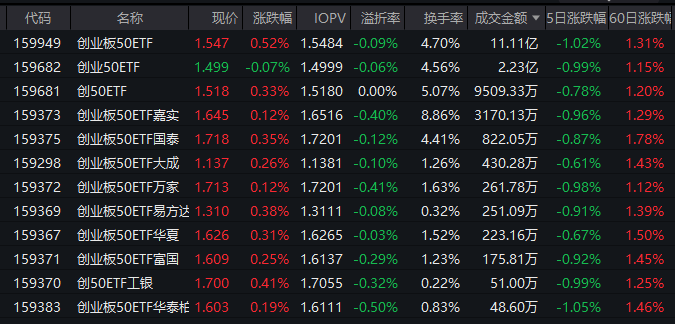
储能迎来全国性容量电价机制,创业板50ETF(159949)半日成交超11亿元领跑同类
Xin Lang Cai Jing· 2026-02-03 04:27
Core Viewpoint - The latest quarterly report indicates a mixed performance among the top ten holdings of the ChiNext 50 ETF (159949), with significant fluctuations in stock prices and a new national capacity pricing mechanism for energy storage expected to boost investment in the sector [1][2][8]. Group 1: Stock Performance - The top ten holdings of the ChiNext 50 ETF showed varied performance, with notable declines in stocks like Ningde Times (down 1.04%) and Xinyi Technology (down 4.13%), while Tianfu Communication surged by 9.14% [1][4]. - The total market value of the top ten holdings is approximately 21.08 billion yuan, accounting for 69.05% of the ETF's net value [2][8]. Group 2: Policy Impact - The National Development and Reform Commission and the National Energy Administration have introduced a national capacity pricing mechanism for new energy storage, which is expected to shift the revenue model from solely energy trading to a combination of capacity pricing and spot trading [2][8]. - The internal rate of return (IRR) for projects is projected to increase from 6%-8% to 12%-15% following the implementation of this mechanism, which is anticipated to accelerate investment in energy storage projects [2][8]. Group 3: Industry Trends - Sodium batteries are gaining traction due to their advantages in low-temperature performance, safety, and cost potential, with predictions that they will replace or supplement lead-acid and some lithium batteries by 2026 [3][9]. - The market is expected to see a recovery in performance as policy catalysts emerge, particularly with the upcoming Two Sessions, while the semiconductor and AI industry chains remain key areas of focus for growth [3][9]. Group 4: ETF Overview - The ChiNext 50 ETF tracks the ChiNext 50 Index, which consists of 50 stocks selected for their large scale, good liquidity, and technology growth characteristics, achieving a return rate of 34.36% over the past three years [10]. - Investors can trade the ETF directly or through linked funds, with recommendations for dollar-cost averaging to mitigate short-term volatility [10].