中国财险

Search documents
港股异动丨保险股走强,新华保险、中国太保创历史新高
Ge Long Hui· 2026-01-05 03:55
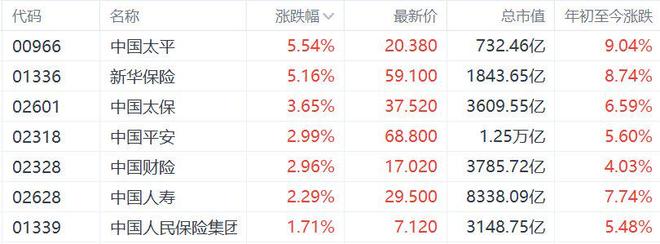
Core Viewpoint - The strong performance of insurance stocks in the A-share market has positively influenced the Hong Kong market, with several major insurance companies reaching new highs in stock prices [1]. Group 1: Stock Performance - China Taiping, New China Life, and China Pacific Insurance saw stock increases of over 5%, while China Ping An and China Property & Casualty Insurance rose nearly 3% [1]. - New China Life and China Pacific Insurance reached historical highs, while China Ping An achieved a nearly five-year high [1]. - The year-to-date performance of major insurance stocks includes: - China Taiping: 9.04% increase - New China Life: 8.74% increase - China Pacific Insurance: 6.59% increase - China Ping An: 5.60% increase - China Property & Casualty Insurance: 4.03% increase - China Life: 7.74% increase - People's Insurance Group: 5.48% increase [2]. Group 2: Industry Trends - The report by CICC highlights five key trends in the life insurance industry for 2026: 1. Continued rapid growth of new business, embracing "deposit migration" and a "new era of health insurance" 2. Further decline in the rigid costs of new business, enhancing the persuasive power of new business value 3. Diversification of new business product structures, with quality companies showing more significant optimization in business structure and differentiation in new business quality compared to peers 4. An upward migration of customer tiers in the industry, with opportunities for upgrading and optimizing operational models and talent 5. A competitive landscape concentrating on companies with strong life insurance operational capabilities [1].




低空经济共保体风险减量实验室在重庆揭牌
Zheng Quan Ri Bao Wang· 2026-01-05 03:48
Core Viewpoint - The establishment of the risk reduction laboratory in Chongqing marks a significant milestone for the low-altitude economy mutual insurance body, which was founded by 19 local commercial insurance companies in August 2025 [1] Group 1: Laboratory Establishment - The risk reduction laboratory is led by the chairman unit of the low-altitude economy mutual insurance body, focusing on risk governance throughout the entire lifecycle of the low-altitude industry [1] - The laboratory aims to conduct theoretical research, trace risk mechanisms, establish industry standards, explore data value, and innovate intelligent risk reduction services [1] Group 2: Future Development Directions - The laboratory will focus on four development directions: 1. Standard leadership, tracing risk mechanisms to create a "Chongqing standard, nationally applicable" governance model [1] 2. Data integration, developing exclusive risk control models to enhance pricing precision and assist companies in reducing costs and increasing efficiency [1] 3. Technology empowerment, utilizing AI to construct a full-process closed loop for risk management, enhancing proactive risk avoidance [1] 4. Ecological co-construction, building an open platform for government, enterprises, academia, and research to consolidate industry efforts and support the high-quality development of the low-altitude economy [1]
守牢安全底线 护航高质量发展 人保财险各级党组织深入贯彻落实党的二十届四中全会精神
Jin Rong Jie Zi Xun· 2026-01-05 03:37
Core Viewpoint - The 20th Central Committee of the Communist Party of China emphasizes "building a safe China" as a crucial aspect of Chinese-style modernization, guiding the direction for security development in the new era [1] Group 1: Emergency Management and Community Support - The company has implemented an integrated work mechanism of "insurance, prevention, reduction, rescue, and compensation" to enhance its role as an economic stabilizer and social stabilizer [3] - During the first major snowfall of winter 2025, the company's claims specialists provided timely and professional services, receiving positive feedback from clients [3] - The company has mobilized party organizations to activate emergency plans and deploy teams to assist communities during disasters, effectively translating organizational advantages into disaster risk reduction [3][5] Group 2: Innovation and Technology Integration - The company is actively promoting the "Party Building + Innovation" model, establishing technology insurance centers to support local businesses with tailored insurance solutions [10] - A customized insurance plan for a humanoid robot was developed, showcasing the company's commitment to integrating financial tools with technological advancements [8][10] - The company has created a service network that includes a technology insurance center and specialized teams to enhance risk management in the tech sector [10] Group 3: Agricultural and Rural Support - The company has provided over 4.5 billion yuan in risk protection to more than 24,000 farmers and agricultural entities in Xinjiang, equating to nearly 180,000 yuan per household [13] - Innovative insurance products for agricultural sectors, such as tea oil insurance, have been introduced to support rural modernization [13][15] - The company is focused on ensuring food security and enhancing the welfare of rural communities through tailored insurance solutions [13] Group 4: Social Responsibility and Community Engagement - The company has launched initiatives to provide occupational injury insurance for gig economy workers, ensuring that policy benefits reach flexible workers [11] - In Tibet, the company has facilitated public liability insurance for disaster-affected areas, demonstrating its commitment to community welfare [8] - The company emphasizes the importance of integrating party policies with community needs to foster social stability and safety [11][15]

非银金融行业周报:公募费率改革收官,非银板块向上突破动能充盈-20260105
Shenwan Hongyuan Securities· 2026-01-05 02:05
Investment Rating - The report maintains a "Positive" outlook on the non-bank financial sector for 2026, indicating strong upward momentum for the industry [3][4]. Core Insights - The brokerage sector is expected to experience a significant upward breakthrough in 2026, driven by improved chip structure, reduced turnover rates, and a favorable valuation environment. The sector is currently undervalued compared to its earnings potential [4]. - The insurance sector shows signs of stabilization post the interest rate switch, with premium growth expected to improve in 2026, particularly in the life insurance segment [4]. - Regulatory changes, including the completion of public fund fee reforms, are anticipated to benefit the non-bank financial sector by reducing costs for investors and enhancing market participation [4][22]. Summary by Sections Market Review - The Shanghai Composite Index closed at 4,629.94 with a decline of 0.59% over the week. The non-bank index fell by 1.84%, with brokerages and insurance indices declining by 1.37% and 3.33%, respectively [8][10]. Non-Bank Financial Insights - The brokerage sector's index underperformed the Shanghai Composite Index by 0.78 percentage points in 2025, with a total decline of 2.05% for the year. In contrast, major A-share indices saw significant gains [4]. - The insurance sector's original premium income reached 5.76 trillion yuan from January to November 2025, reflecting a year-on-year growth of 7.6%. The life insurance segment grew by 9.2% during the same period [4][31]. Investment Analysis - For brokerages, the report recommends focusing on leading firms with strong competitive advantages, such as Guotai Junan and CITIC Securities, as well as those with high earnings elasticity like Huatai Securities [4]. - In the insurance sector, companies like China Life and Ping An are highlighted for their potential in the upcoming market revaluation, with a focus on the growth of new business premiums [4]. Regulatory Developments - The China Securities Regulatory Commission (CSRC) has implemented new rules for public real estate investment trusts (REITs), expanding financing options for commercial properties [21]. - The completion of the public fund fee reform is expected to lower overall fund costs by approximately 20%, saving investors around 51 billion yuan annually [22].




近期港股保险上涨点评:保费开门红或超预期,资负共振推动股价上行
EBSCN· 2026-01-04 12:55
Investment Rating - The report maintains an "Overweight" rating for the insurance sector [1]. Core Views - The insurance sector is expected to benefit from strong premium growth, particularly in the context of the "opening red" performance, which may exceed expectations [2][3]. - The competitive advantage of savings-type insurance products remains strong against other wealth management products, especially as traditional and participating insurance rates decline [3]. - The agency channel is anticipated to see a rebound in new business growth, while the bancassurance channel is expected to become a significant growth driver [4]. - The stable performance of the capital market is likely to continue driving profit releases for insurance companies [5]. - The report recommends specific insurance stocks that are expected to benefit from asset-driven growth, including China Life Insurance and New China Life Insurance [6]. Summary by Sections Premium Growth - The Hong Kong insurance index rose by 3.0%, outperforming the Hang Seng Index by 0.2 percentage points, with major insurers like China Life and PICC showing significant gains [2]. Product Competitiveness - Savings-type insurance products are positioned favorably due to lower bank deposit rates and a high willingness to save among residents, with a projected internal rate of return (IRR) of "1.75% guaranteed + floating" making them competitive in the wealth management market [3]. Distribution Channels - The agency channel is expected to recover in new business growth, while the bancassurance channel is set to expand due to the easing of restrictions on cooperation between banks and insurance companies [4]. Investment Performance - The investment asset scale of listed insurance companies is steadily growing, with a high stock allocation expected to enhance investment returns and profit releases [5]. Stock Recommendations - The report recommends stocks such as China Life (A+H), New China Life (A+H), and China Pacific Insurance (A+H) for their strong performance and stable operations [6].



政策推动行业高质量发展,看好板块景气度上行
Changjiang Securities· 2026-01-04 12:22
Investment Rating - The report maintains a positive outlook on the investment banking and brokerage industry, indicating a "Look Favorably" rating [8] Core Insights - The non-bank financial sector has shown weak overall performance this week, with the China Securities Regulatory Commission (CSRC) implementing multiple measures to promote high-quality development in the capital market, including new regulations on fund sales and the introduction of commercial real estate investment trusts (REITs) [2][4] - The insurance sector is expected to see improved return on equity (ROE) and valuation recovery, supported by trends such as the migration of deposits and increased equity allocation [4] - The report recommends focusing on companies with stable profit growth and dividend rates, such as Jiangsu Jinzhong, China Ping An, and China Pacific Insurance, while also highlighting the potential of New China Life, China Life, Hong Kong Exchanges and Clearing, CITIC Securities, Dongfang Caifu, Tonghuashun, and Jiufang Zhitu Holdings based on performance elasticity and valuation [4] Summary by Sections Market Performance - The non-bank financial index decreased by 1.8% this week, underperforming the CSI 300 by 1.3%, ranking 27th out of 31 sectors [5] - Year-to-date, the non-bank financial index has increased by 10.1%, but still lags behind the CSI 300 by 7.6%, ranking 20th out of 31 sectors [5] Key Industry News & Company Announcements - The CSRC has issued several important announcements, including the launch of commercial real estate REITs and revisions to fund sales regulations, aimed at enhancing the capital market [6] - Notable company announcements include Nanjing Securities completing a private placement of approximately 713 million A-shares, increasing its total share capital, and Guoyuan Securities planning to transfer its stake in Anyuan Fund to related parties [6] Insurance Sector Insights - In November 2025, the insurance industry achieved a cumulative premium income of 57,629 billion, reflecting a year-on-year increase of 7.56%, with life insurance premiums growing by 9.06% [22][23] - The total assets of the insurance sector reached 40.65 trillion, with life insurance companies holding 35.75 trillion, indicating a stable asset allocation [26][27] Brokerage and Investment Business - The brokerage sector has seen a recovery in trading activity, with average daily trading volume reaching 21,283.16 billion, up 8.30% week-on-week [41] - Equity market performance has been declining, with the CSI 300 index down 0.59% and the ChiNext index down 1.25% [45] - Margin financing has increased, with a balance of 2.56 trillion, reflecting a 0.39% week-on-week rise [49] Capital Market Financing - In December 2025, equity financing reached 663.12 billion, a 30.9% increase, while bond financing totaled 7.34 trillion, up 4.0% [53] - The report anticipates an increase in stock underwriting volumes due to new refinancing regulations, while bond underwriting will be influenced by interest rate changes [53]
公募费改收官且险企开门红向好,关注春季躁动机遇
GF SECURITIES· 2026-01-04 10:05
Core Insights - The report highlights that the public fund fee reform has concluded, and insurance companies are expected to perform well, indicating potential investment opportunities in the spring market [1][6]. Group 1: Industry Performance - As of December 31, 2025, the Shanghai Composite Index closed at 3968.84 points, up 0.13%, while the Shenzhen Component Index fell by 0.58% [11]. - The average daily trading volume in the Shanghai and Shenzhen markets reached 2.13 trillion yuan, an increase of 8.30% week-on-week [6]. Group 2: Insurance Sector - Insurance companies are anticipated to maintain high growth in performance, with short-term results expected to exceed expectations and long-term interest rate spreads likely to improve [17]. - The Ministry of Finance released a draft revision of the accounting standards, enhancing the clarity of profit sources for insurance companies and improving comparability across industries [17]. - Key stocks to watch in the insurance sector include China Ping An, China Life, and New China Life, among others [17]. Group 3: Securities Sector - The public fund fee reform is expected to save investors approximately 51 billion yuan annually, with a fee reduction of about 20% [18]. - The reform includes differentiated redemption fee structures aimed at promoting long-term investment and reducing short-term trading behaviors [19]. - The introduction of new REITs regulations is expected to enhance the market's quality and expand opportunities for securities firms [24][28]. Group 4: Valuation and Financial Analysis - China Ping An (601318.SH) has a target price of 85.17 yuan, with an estimated EPS of 8.91 yuan for 2025, reflecting a PE ratio of 7.68 [7]. - New China Life (601336.SH) has a target price of 94.21 yuan, with an estimated EPS of 14.04 yuan for 2025, indicating a PE ratio of 4.96 [7]. - The report suggests that the valuation metrics for various companies in the sector indicate potential upside, with several stocks rated as "Buy" [7].
低空经济共保体风险减量实验室在渝揭牌
Jin Rong Jie Zi Xun· 2026-01-04 06:59
Core Insights - The establishment of the Risk Reduction Laboratory in Chongqing marks a significant milestone for the low-altitude economy mutual insurance body, which was formed by 19 local commercial insurance companies [1] - The laboratory aims to focus on risk management throughout the entire lifecycle of the low-altitude industry, conducting theoretical research, risk mechanism tracing, industry standard formulation, data value exploration, and innovative intelligent risk reduction services [1] Group 1 - The laboratory is led by the chairman unit of the low-altitude economy mutual insurance body, PICC Property and Casualty [1] - It aims to create a nationally influential source for low-altitude safety governance and an industrial development booster [1] - The opening ceremony was attended by representatives from member units, industry associations, academic institutions, technology companies, and industry experts [1] Group 2 - The laboratory will focus on four main directions: 1. Standard leadership to develop risk mechanism tracing and create a governance model that is "Chongqing standard, nationally applicable" [2] 2. Data integration to develop exclusive risk control models, enhancing pricing precision to "one machine, one strategy" [2] 3. Technology empowerment using AI to establish a full-process closed loop of "pre-event profiling, in-event warning, and post-event handling" [2] 4. Ecological co-construction to build an open platform for government, enterprises, academia, and research, fostering industry collaboration for high-quality development of the low-altitude economy [2]
高盛列出2026年推荐股名单 包含联想、华虹半导体等26只股
Ge Long Hui· 2026-01-02 14:19
Group 1 - Major investment banks like Goldman Sachs, Morgan Stanley, and UBS are optimistic about the global stock market outlook for 2026, expecting double-digit gains in both developed and emerging markets due to strong earnings growth, declining interest rates, and reduced policy headwinds [1] - The United States is projected to maintain its position as the global growth engine, driven by a resilient economy and an AI-driven supercycle that is leading to record capital expenditures and rapid earnings expansion [1] - The momentum of the AI industry is spreading globally across various sectors including technology, utilities, banking, healthcare, and logistics, creating both winners and losers amid an already imbalanced K-shaped economy [1] Group 2 - Goldman Sachs has released a list of recommended stocks for investment based on the Earnings Revision Leading Indicator (ERLI), which includes companies such as AIA Group (01299.HK), Xiaomi Group-W (01810.HK), Lenovo Group (00992.HK), and Hong Kong Exchanges and Clearing (00388.HK) [1] - Other notable stocks on the list include China Ping An (02318.HK), Zijin Mining (02899.HK), Techtronic Industries (00669.HK), and China Pacific Insurance (02601.HK) [1] - Additional companies mentioned are ZTO Express-W (02057.HK), Luoyang Molybdenum (03993.HK), Hua Hong Semiconductor (01347.HK), and China Aluminum (02600.HK) [1]


China’s PICC P&C enters into reinsurance agreements with PICC Re & PICC HK
ReinsuranceNe.ws· 2025-12-31 16:00
Core Viewpoint - PICC Property and Casualty Company Limited has entered into reinsurance agreements with its sister entities, PICC Reinsurance and PICC HK, to enhance operational stability and support the "Belt and Road" initiative [1][3][4]. Group 1: Reinsurance Agreements - The agreements are effective from January 1 to December 31, 2026, and cover both outward and inward reinsurance [3]. - The annual cap for premiums ceded to PICC Reinsurance is estimated at RMB 6,500 million, with commissions capped at RMB 2,925 million [4]. - The annual cap for premiums assumed from PICC HK is set at RMB 3,500 million for 2026, reflecting a 15% growth in "China-overseas interest" business [5]. Group 2: Risk Management and Compliance - Cession ratios in the agreements range from 0.1% to 80%, with commission rates capped at 45%, determined through actuarial models and market-based negotiations [6]. - Outward reinsurance transactions are classified as continuing connected transactions under Hong Kong Listing Rules, requiring reporting and annual review, but are exempt from independent shareholders' approval [7]. - The company emphasizes internal control and compliance through detailed policies, early-warning mechanisms, and yearly internal audits [7][8]. Group 3: Oversight and Transparency - Oversight is provided by independent directors and external auditors, ensuring transparency in transaction terms disclosed via the reinsurance trading platform [8].