
中联重科

Search documents
工程机械板块1月14日跌2.3%,邵阳液压领跌,主力资金净流出2.51亿元
Zheng Xing Xing Ye Ri Bao· 2026-01-14 08:58
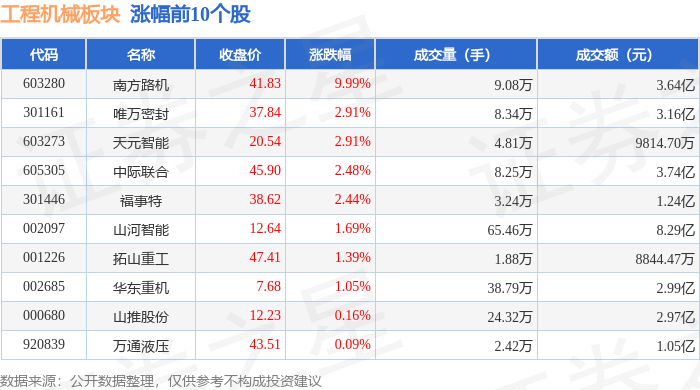
Group 1 - The engineering machinery sector experienced a decline of 2.3% on January 14, with Shaoyang Hydraulic leading the drop [1] - The Shanghai Composite Index closed at 4126.09, down 0.31%, while the Shenzhen Component Index rose 0.56% to 14248.6 [1] - Notable gainers in the engineering machinery sector included Southern Road Machinery, which rose by 9.99% to a closing price of 41.83, and Weiman Sealing, which increased by 2.91% to 37.84 [1] Group 2 - Shaoyang Hydraulic saw a significant drop of 9.64%, closing at 54.85, with a trading volume of 238,600 shares and a transaction value of 1.336 billion [2] - Other notable declines included Hengli Hydraulic, down 5.06% to 114.20, and Jinzhite Technology, down 3.32% to 34.34 [2] - The engineering machinery sector experienced a net outflow of 251 million in main funds, while retail investors saw a net inflow of 183 million [2] Group 3 - Southern Road Machinery had a net inflow of 74.4815 million from main funds, while retail investors had a net outflow of 54.935 million [3] - Other companies like Shanhai Intelligent and LiuGong also experienced varying levels of net inflows and outflows from different investor categories [3] - The overall trend indicates a mixed sentiment among investors, with main funds showing a net outflow while retail investors are more active in the market [3]




镰刀妹AI智能写作 | 1月14日湘股涨跌TOP5
Chang Sha Wan Bao· 2026-01-14 08:17
恒立退开盘价0.160,收盘报0.150元,当日跌-11.76%,当日最高价为0.170元,最低价为0.150元,成交量 61.1606万手。 *ST景峰开盘价8.050,收盘报7.800元,当日跌-4.65%,当日最高价为8.230元,最低价为7.790元,成交量 28.8617万手。 长沙晚报掌上长沙1月14日讯 截至1月14日收盘:沪指跌0.31%,报4126.0932点;深证成指涨0.56%,报 14248.599点。 湘股1月14日涨幅TOP5 长缆科技开盘价20.760,收盘报20.760元,当日涨10.02%,当日最高价为20.760元,最低价为20.750元,成 交量14.4887万手。 湖南白银开盘价9.300,收盘报9.920元,当日涨9.98%,当日最高价为9.920元,最低价为9.300元,成交量 389.7003万手。 *ST高斯开盘价11.090,收盘报11.390元,当日涨4.98%,当日最高价为11.390元,最低价为11.090元,成交 量2.2546万手。 拓维信息开盘价34.560,收盘报35.680元,当日涨3.24%,当日最高价为36.550元,最低价为34.560元 ...

湖南自贸试验区:借势琼岛封关东风 铺就内陆开放新路径
Zhong Guo Fa Zhan Wang· 2026-01-14 03:41
Core Viewpoint - The establishment of the Hainan Free Trade Port and its full island closure operation on December 18, 2025, marks a significant step in China's commitment to high-level opening-up and the construction of an open world economy, providing new opportunities for inland provinces like Hunan to connect globally [1] Group 1: Strategic Development - Hunan's Free Trade Zone is focusing on a "one industry, one park, one corridor" strategy, leveraging the Hainan Free Trade Port's policy advantages to drive industrial upgrades in Hunan through a complementary model of "Hunan manufacturing + Hainan channel" [1][2] - The Hunan Free Trade Zone aims to create a comprehensive docking system across four dimensions: industry, logistics, finance, and systems, to capitalize on the opportunities presented by Hainan's closure [2] Group 2: Infrastructure and Investment - The Hunan advanced manufacturing industrial park has attracted 31 enterprises with a total investment of 13.972 billion yuan, with a long-term goal of achieving an output value of 100 billion yuan and tax revenue of 5 billion yuan [3] - The first phase of the high-capacity port area in Dongfang City, part of the industrial park, has begun construction with a total investment of 3.65 billion yuan, expected to meet an annual freight demand of 6.7 million tons [2][3] Group 3: Sectoral Collaboration - Hunan's Free Trade Zone is establishing differentiated collaborative mechanisms among the three major areas of Changsha, Yueyang, and Chenzhou to align with Hainan's tourism, modern services, and high-tech industries [4] - The Changsha area focuses on high-end equipment manufacturing and has published global standards for the re-manufacturing of construction machinery, filling a gap in industry standards [4] Group 4: Innovation and Regulation - Hunan's Free Trade Zone has introduced innovative regulatory measures, such as the "no customs duty on inland river freight" mechanism and the "cross-border one-lock" customs model, to facilitate trade and reduce costs [5] - The zone plans to build a comprehensive risk prevention mechanism to address potential regulatory challenges and ensure safe development while promoting open trade [5][6]
对近期重要经济金融新闻、行业事件、公司公告等进行点评:晨会纪要-20260114
Xiangcai Securities· 2026-01-14 01:54
Group 1: Machinery Industry - In December 2025, the total sales of excavators in China increased by 19.2% year-on-year, with domestic sales and exports growing by 10.9% and 26.9% respectively. For the entire year of 2025, total excavator sales rose by 17.0%, with domestic and export sales increasing by 17.9% and 16.1% respectively [2] - In December 2025, total sales of loaders in China grew by 30.0% year-on-year, with domestic sales and exports increasing by 17.6% and 41.5% respectively. For the full year of 2025, total loader sales increased by 18.4%, with domestic and export sales rising by 22.1% and 14.6% respectively [2] - The growth in excavator and loader sales is attributed to the peak construction season and overseas channel restocking. The demand for machinery is expected to continue growing in 2026 due to ongoing replacement needs, contributions from projects, and trends towards electrification [2] Group 2: Robotics Industry - According to Omdia, Zhiyuan Robotics topped the global humanoid robot shipment rankings with over 5,100 units shipped, capturing 39% of the global market share. The top six companies in humanoid robot shipments in 2025 are all Chinese, accounting for 86.9% of global shipments [3] - Recent financing activities in the robotics sector include Qiangna Technology raising approximately 2 billion RMB, and Mobileye announcing a $900 million acquisition of the humanoid startup Mentee Robotic. Other companies like Lingxin Qiaoshou and Xingjiguan also completed new financing rounds [3] - New product launches include Boston Dynamics' new generation Atlas humanoid robot, which has entered production, and Xiaopeng Motors announcing the mass production of its humanoid robot in 2026 [5] Group 3: Investment Recommendations - The manufacturing PMI in China rose by 0.9 percentage points to 50.1% in December 2025, indicating a return to expansion. This improvement is driven by the effects of policy implementation and pre-holiday inventory preparations [6] - The report maintains a "buy" rating for the machinery industry, highlighting the potential for sustained growth in performance for major machinery manufacturers due to resonating domestic and international demand [6] - The report suggests focusing on the engineering machinery sector (e.g., XCMG, SANY Heavy Industry) and the rapidly growing humanoid robotics sector (e.g., Estun, Greentech) as areas of significant investment opportunity [6]


国内卷产能,海外卷江山!
Xin Lang Cai Jing· 2026-01-13 11:28
Core Viewpoint - The Chinese construction machinery giants are increasingly shifting their focus from domestic markets to international expansion, effectively replicating the Chinese market abroad through significant overseas revenue contributions [2][3][5]. Group 1: Overseas Revenue Growth - Sany Heavy Industry's overseas sales revenue reached 26.302 billion yuan in the first half of 2025, accounting for 60.26% of its main business income [3][20]. - Zoomlion followed closely with overseas revenue of 13.815 billion yuan, representing 55.58% of its total income [3][20]. - XCMG and LiuGong also reported overseas revenue contributions of 46.61% and 46.88%, respectively, indicating that nearly half of the revenue for leading companies comes from international markets [5][22]. Group 2: Shift in Business Strategy - The logic of Chinese companies going abroad is evolving from simple product exports to a comprehensive localization strategy that includes R&D, manufacturing, marketing, and financial services [5][22]. - XCMG has established internationalization as its main strategy, focusing on building a localized ecosystem that integrates the entire value chain [5][22]. - Zoomlion has created a dense global physical network with 13 R&D and manufacturing bases and over 30 primary business airports worldwide, allowing for rapid market response and customer loyalty [7][24]. Group 3: Technological Innovation - The focus on electrification and intelligent technology serves as a "technological moat" for Chinese construction machinery companies to penetrate high-end global markets [7][26]. - In 2025, the cumulative sales of electric loaders in China surged by 165.34%, with a market penetration rate of 23.25% [9][26]. - XCMG delivered 100 electric unmanned mining trucks capable of continuous operation in extreme conditions, showcasing advancements in safety and efficiency [9][26]. Group 4: Global Competitive Landscape - Chinese equipment manufacturers are transitioning from a volume-based strategy to a value-based competition, shedding the "low-cost" label [9][26]. - In the 2025 global top 50 construction machinery manufacturers list, 13 Chinese companies had an average overseas sales ratio of approximately 41.94%, with the highest exceeding 77% [9][26]. - The competition is shifting towards quality and value, reflecting a broader trend in the globalization of Chinese enterprises [9][26]. Group 5: Global Ecosystem Development - Chinese construction machinery companies are building a global industrial ecosystem that includes talent development, capital collaboration, and standardization [11][28]. - XCMG has innovated a "school-enterprise" model to cultivate skilled workers in markets like Uzbekistan [11][30]. - Zoomlion has established the "Zoomlion Overseas Academy" to implement global employee training programs and career development pathways for local staff [11][30].
打造世界级标杆!“领航级”工厂如何实现“领跑”中国智造?
Yang Shi Wang· 2026-01-13 08:42
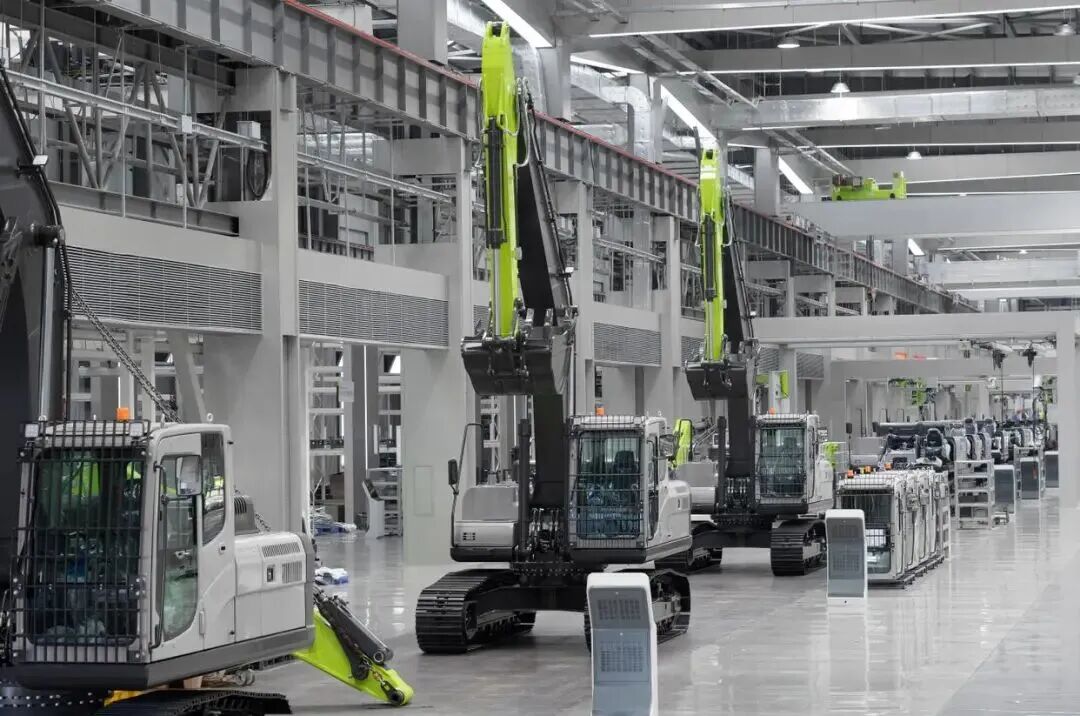
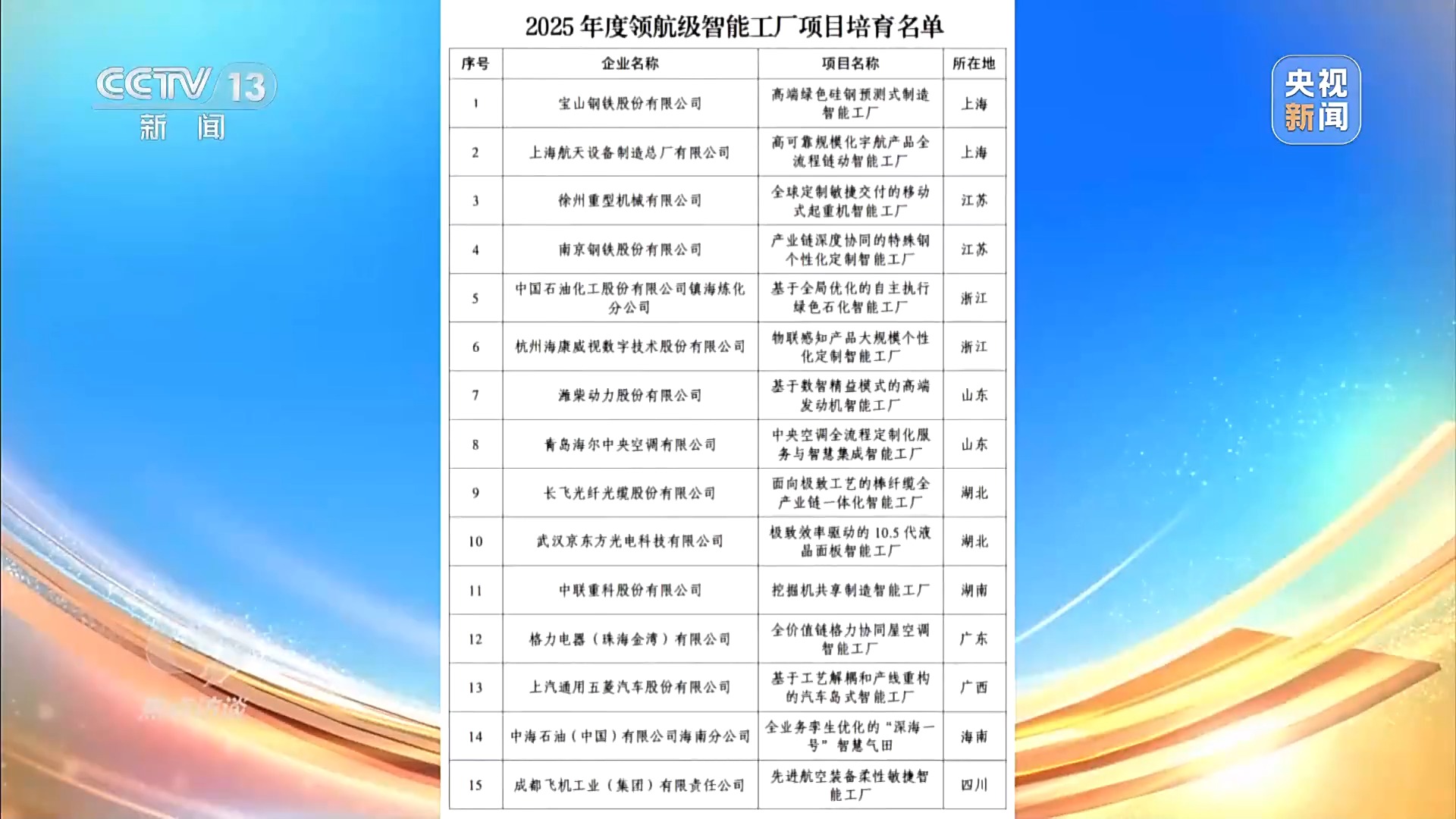
Core Viewpoint - "Smart" manufacturing is the core engine for high-quality development in the manufacturing industry, marking a critical leap from digitalization and networking to intelligence in China's manufacturing sector [1][3]. Group 1: Overview of Leading Smart Factories - The Ministry of Industry and Information Technology and five other departments announced the first batch of 15 leading smart factories, covering key industries such as equipment manufacturing, raw materials, and electronic information [1][2]. - These factories represent the highest level of "intelligent" manufacturing in China and signify a transition towards a more advanced manufacturing model [1][3]. Group 2: Characteristics of Leading Smart Factories - Leading smart factories are characterized by the integration of advanced manufacturing technologies, next-generation information technologies, and lean management concepts, forming the pinnacle of China's manufacturing intelligence pyramid [3][5]. - They aim to be "hexagonal warriors" with six leading identities, focusing on industry, application of AI technology, innovation in smart manufacturing models, performance, replication, and cultivation plans [5]. Group 3: Notable Examples - Changfei Fiber Optic, recognized as a benchmark for intelligent transformation in the electronic information sector, has integrated AI algorithms throughout its production process, achieving a drawing speed of 3,500 meters per minute, the highest globally, without human intervention [7]. - The company has mastered three major mainstream technologies for fiber optic preform preparation, leading to the largest diameter of preforms globally and maintaining the top market share in the fiber optic industry for nine consecutive years [7]. Group 4: Strategic Alignment - The development of leading smart factories aligns with the "14th Five-Year Plan" for intelligent manufacturing and the "15th Five-Year Plan" for building a modern industrial system centered on advanced manufacturing [5][9]. - These factories facilitate collaborative innovation across the industry chain, connecting with national strategic deployments such as "Artificial Intelligence+" and promoting the replication of successful models [9].

瞄准全球领先、深化AI融合,领航级工厂领跑中国“智造”
Bei Jing Wan Bao· 2026-01-13 06:16
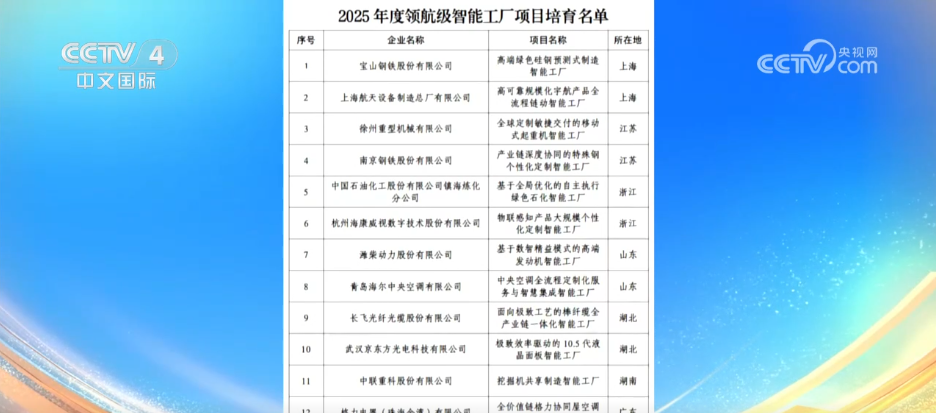
Core Viewpoint - Smart manufacturing is the core engine for high-quality development in the manufacturing industry, marking a critical leap from digitalization and networking to intelligence in China's manufacturing sector [1][5]. Group 1: Overview of Leading Smart Factories - The Ministry of Industry and Information Technology and five other departments announced the first batch of 15 leading smart factories, covering key industries such as equipment manufacturing, raw materials, and electronic information [1][4]. - These leading factories represent the highest level of smart manufacturing in China and showcase the breadth and depth of the country's intelligent manufacturing development [4][5]. Group 2: Classification and Development of Smart Factories - A four-tier system for smart factory cultivation has been established: foundational, advanced, excellent, and leading levels, with 35,000 foundational, over 7,300 advanced, 500 excellent, and 15 leading smart factories built to date [7]. - The leading level aims for global leadership and deep integration of AI, while the excellent level requires at least 20% AI application scenarios [7]. Group 3: Key Elements for Leading Smart Factories - Six key elements define a leading smart factory: industry leadership, AI technology application, innovative smart manufacturing models, performance leadership, replication leadership, and nurturing plans [10][12]. - Longfei Optical Fiber exemplifies these elements by integrating AI throughout its production process, achieving a global record in fiber drawing speed and precision [12][13]. Group 4: Case Studies of Leading Smart Factories - Weichai Power has implemented a digital twin technology that reduces R&D cycles by 20% and enhances production flexibility through AI-driven systems [20][21]. - Baosteel is innovating with AI-driven predictive manufacturing, aiming to establish 1,200 AI scenarios and 25 benchmark production lines by 2027, while also investing in talent development [25][27]. Group 5: Future Manufacturing Models - The exploration of future manufacturing models focuses on high customization, complex product production, and efficient supply chain organization, aiming to enhance China's position in the global supply chain [17][29]. - The emergence of these leading smart factories not only represents individual breakthroughs but also reflects a systemic transformation in China's manufacturing industry, providing replicable and scalable models for industry upgrades [29].


重组入列:最新443家全国重点实验室名单
仪器信息网· 2026-01-13 03:56
Core Viewpoint - By December 2025, over 500 national key laboratories have completed restructuring into a new sequence, with nearly 110 "Double First-Class" universities participating in about 80% (nearly 400) of the national key laboratories [1][2]. Group 1: National Key Laboratories Overview - National key laboratories are scientific research and development institutions planned by the state to support the national laboratory system, focusing on major technological innovation areas related to national security and socio-economic development [2]. - The restructuring of the national key laboratory system was first proposed at the Central Economic Work Conference in 2018 and established as a component of national strategic scientific and technological forces in the revised "Science and Technology Progress Law" in 2021 [2]. Group 2: Participation of Universities - The leading or co-building universities for the laboratories are primarily "Double First-Class" universities, indicating a strong involvement of top-tier educational institutions in the research initiatives [1][2]. - Nearly 110 "Double First-Class" universities are involved in the establishment and support of approximately 400 national key laboratories [1][2]. Group 3: List of Key Laboratories - A variety of national key laboratories have been established across different fields, including: - Dark Matter Physics National Key Laboratory led by Shanghai Jiao Tong University [3] - Explosive Science and Safety Protection National Key Laboratory led by Beijing Institute of Technology [3] - Materials Chemistry Engineering National Key Laboratory led by Nanjing University of Technology [3] - The list includes laboratories focusing on diverse areas such as intelligent transportation, infectious disease research, and advanced manufacturing technologies [3][4][5].

“未来氢能贺岁杯・中国(宁波)氢能足球友谊赛”圆满举办
势银能链· 2026-01-13 03:00
Core Viewpoint - The event "Future Hydrogen New Year Cup - China (Ningbo) Hydrogen Energy Football Friendship Match" served as a prelude to the 2025 Hydrogen Energy and Fuel Cell Industry Conference, promoting networking and collaboration within the hydrogen energy industry through a friendly football match [2][3]. Group 1 - The event was organized by TrendBank, with support from Beijing Future Hydrogen Technology Co., Ltd. and Haizhuojian New Energy Materials (Shanghai) Co., Ltd., bringing together representatives from the entire hydrogen energy and fuel cell industry chain [2]. - Participants from various sectors of the hydrogen energy supply chain engaged in teamwork and collaboration during the match, showcasing the industry's enthusiasm and vitality [2][4]. - The event featured two teams and over 30 participating companies, laying the groundwork for deeper connections between upstream and downstream players in the industry [5]. Group 2 - The friendly match was not solely focused on competition but aimed to foster relationships among industry peers, breaking down business barriers and enhancing cooperation [4]. - Attendees noted that the football interaction prior to the event allowed for rapid aggregation of industry resources, effectively addressing the limitations of time and shallow communication during the main conference [7]. - The successful conclusion of the match and the award ceremony marked the beginning of ongoing collaboration within the hydrogen energy sector, extending communication beyond the event [9].

东海证券晨会纪要-20260113
Donghai Securities· 2026-01-13 02:40
Key Insights - The report highlights the launch of NVIDIA's Rubin platform, which significantly reduces the cost of generating tokens to about one-tenth of the previous generation, Blackwell, and is now in full production. This development is expected to drive demand in the semiconductor industry, with TSMC reporting a record revenue growth of 31.6% year-on-year for 2025, indicating a robust recovery in semiconductor demand [5][6][7]. Group 1: Electronic Industry Insights - NVIDIA's Rubin platform was showcased at CES 2026, featuring six chip components that enhance AI deployment efficiency, with the platform now fully in production [5][6]. - TSMC reported a December revenue of approximately NT$335 billion, a year-on-year increase of 20.4%, contributing to a total annual revenue of NT$3.81 trillion, marking a 31.6% increase and setting a historical high [7][8]. - The electronic sector is experiencing a demand recovery, with rising prices for memory chips and a strong push for domestic production in China, suggesting structural investment opportunities in AI computing, AIOT, semiconductor equipment, and key components [5][9]. Group 2: Machinery Equipment Industry Insights - The report indicates a significant increase in excavator sales, with December 2025 sales reaching 23,095 units, a year-on-year growth of 19.2%, driven by both domestic and export markets [11][12]. - The total excavator sales for 2025 were 235,257 units, reflecting a 17% increase, with domestic sales up by 17.9% and exports up by 16.1% [13][14]. - Loader sales also saw substantial growth, with December 2025 sales of 12,236 units, a 30% increase year-on-year, and total sales for the year reaching 128,067 units, up 18.4% [12][14]. Group 3: U.S. Economic Recovery Insights - The U.S. labor market showed signs of recovery, with December 2025 non-farm payrolls increasing by 50,000, although slightly below expectations, while the unemployment rate fell to 4.4% [17][18]. - The service sector contributed significantly to job growth, particularly in leisure and hospitality, which rebounded due to the holiday season [19][20]. - The report suggests that the U.S. economy is on a recovery path, with expectations for continued job growth and a potential decrease in interest rates by the Federal Reserve [21][22].