华鲁恒升

Search documents
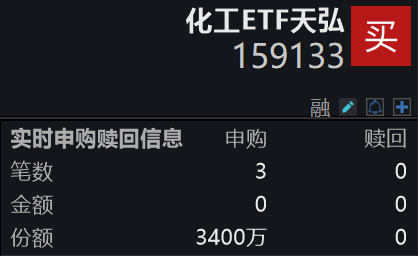
制冷剂行业高景气度持续兑现!化工ETF天弘(159133)实时净申购3400万份,标的指数盘中强势涨超2%
Xin Lang Cai Jing· 2026-01-19 02:56
Group 1 - The chemical ETF Tianhong (159133) has seen significant trading activity, with a transaction volume of 16.6868 million yuan and a peak increase of over 2% in the tracked index [1] - The net subscription for the chemical ETF Tianhong reached 34 million shares, indicating strong investor interest [1][2] - As of January 16, the latest scale of the chemical ETF Tianhong reached 889 million yuan, with a total of 769 million shares, both hitting record highs since its inception [2] Group 2 - The chemical ETF Tianhong has experienced continuous net inflows over the past 13 days, totaling 272 million yuan [2] - The ETF tracks a broad index of 50 stocks in the chemical industry, which have a large market capitalization and high liquidity, with over 93% of the index comprising basic chemicals, petroleum and petrochemicals, and power equipment [2] - The refrigerant market is currently experiencing a strong bullish trend due to supply and demand dynamics, with prices for R507 and R404 rising significantly, leading to enhanced profit expectations for companies in the fluorochemical sector [2][3] Group 3 - Citic Securities has indicated that the supply of third-generation refrigerants is tightening, while demand is being driven by the new energy vehicle sector, air conditioning, and foreign trade, suggesting a continued upward trend in industry prosperity [3]

涨超2.0%,石化ETF(159731)连续8天净流入
Sou Hu Cai Jing· 2026-01-19 02:41
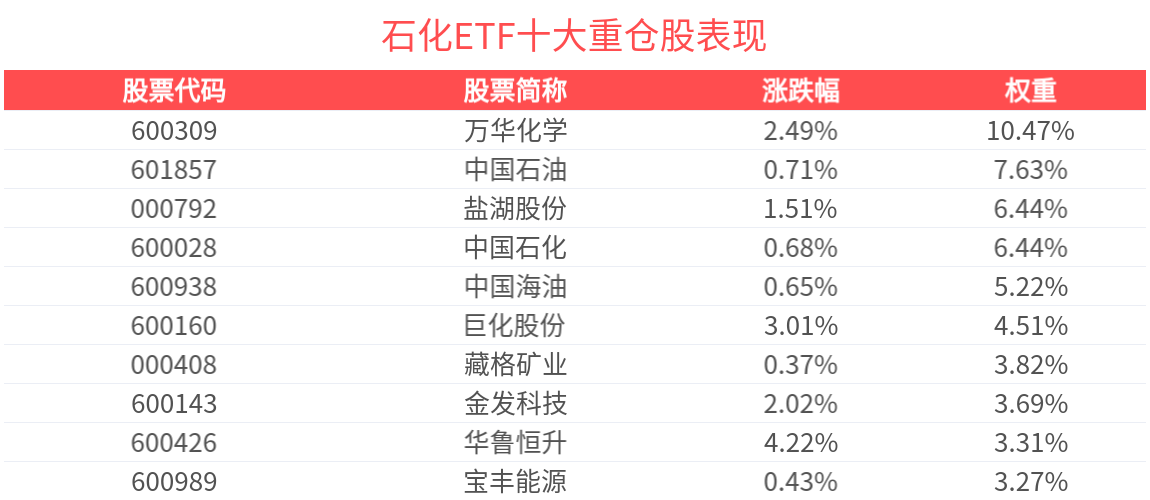
Core Insights - The petrochemical industry index has shown a strong increase of 1.88%, with significant gains in constituent stocks such as Yara International (up 4.93%) and Haohua Technology (up 4.58%) [1] - The Petrochemical ETF (159731) has experienced continuous net inflows over the past 8 days, totaling 269 million yuan, reaching a record high in both shares and scale [2] - The Petrochemical ETF has achieved a net value increase of 53.13% over the past two years, with a maximum single-month return of 15.86% since its inception [2] Fund Performance - The Petrochemical ETF's latest share count is 549 million, with a total scale of 522 million yuan [2] - The ETF has recorded an average monthly return of 5.25% during its rising months, with the longest consecutive rising streak lasting 8 months and a total increase of 41.60% [2] - The top ten weighted stocks in the index account for 56.73% of the total, including major companies like Wanhua Chemical and China Petroleum [2] Stock Performance - Notable stock performances include Wanhua Chemical (up 2.49%, weight 10.47%), China Petroleum (up 0.71%, weight 7.63%), and Salt Lake Potash (up 1.51%, weight 6.44%) [4] - Other significant stocks include China Petrochemical (up 0.68%, weight 6.44%) and Haohua Technology (up 4.22%, weight 3.31%) [4]
再论2026年化工行业投资机会
2026-01-19 02:29
Summary of Key Points from the Conference Call Industry Overview - The chemical industry is expected to recover to standard or even overweight allocation levels due to improved industry sentiment and performance indicators such as revenue, profit, and gross margin starting from Q2 2025 [1][3][4]. Core Insights and Arguments - **Current State of Chemical Sector**: The basic chemical and petrochemical sectors are currently under-allocated, although there has been a recent uptick. Historical data suggests that these sectors typically outperform the market in the first two quarters following the initiation of a five-year plan [3][4]. - **Impact of European Capacity Closures**: Europe has closed approximately 11 million tons of chemical production capacity since 2023, alleviating supply-demand pressures in both domestic and international markets [1][6]. - **Investment in Infrastructure**: The State Grid's planned investment of 4 trillion RMB over the next five years is expected to drive demand in related chemical sectors [1][6]. Subsector Highlights - **Refrigerants**: The refrigerant sector is anticipated to maintain high levels of profitability due to the ongoing implementation of quota schemes. Prices are expected to stabilize at high levels, with shorter procurement cycles for downstream air conditioning manufacturers [1][5]. - **Phosphate Chemicals**: Phosphate rock prices remain stable, supported by unexpected demand in energy storage. Recent price increases in glyphosate and other pesticide varieties indicate a positive outlook for this sector [1][7]. Oil Price Projections - Oil prices are projected to stabilize between $55 and $60 per barrel in 2026, with potential geopolitical factors causing temporary spikes. The overall sentiment regarding oil prices remains optimistic, which is crucial for the petrochemical sector [2][11]. Potential Investment Opportunities - **High-Performing Sectors**: The refrigerant and phosphate chemical sectors are highlighted as areas of sustained high sentiment and favorable market expectations for investment in 2026 [1][5][17]. - **Recovery Potential**: Sectors currently experiencing low sentiment, such as refining and polyester, organic silicon, and PVC, may see a rebound due to limited new capacity and price elasticity [17][12]. - **Traditional Chemical Stocks**: Companies with reasonable or undervalued valuations, such as Wanhua Chemical and Huayu Chemical, may present opportunities for valuation recovery if industry sentiment improves [13][17]. Emerging Trends - **New Materials**: The new materials sector is expected to see continuous demand growth driven by applications in robotics, aerospace, and biofuels. Key areas include electronic chemicals and lightweight materials [14][18]. - **AI and Semiconductor Growth**: The development of AI applications and semiconductor chips is anticipated to drive sustained demand growth in the coming years [15]. Conclusion - The chemical industry is poised for recovery, with specific subsectors like refrigerants and phosphates showing strong potential. Investment strategies should focus on both high-performing sectors and those with recovery potential, while keeping an eye on emerging trends in new materials and technology applications [1][17].
化工ETF(159870)涨超2%,制冷剂R404A、R507陆续提升报价
Xin Lang Cai Jing· 2026-01-19 02:21
Group 1 - The core viewpoint of the news is that the prices of refrigerants R404A and R507 are increasing, driven by demand from overseas markets, particularly as A5 countries approach the end of their quota baseline year, leading to a surge in imports of high GWP refrigerants and boosting exports from China [1] - The external trade price of refrigerants has risen to approximately 35,000 yuan per ton, while domestic prices have increased to around 49,000 yuan per ton, indicating a growing market atmosphere as companies actively raise prices [1] - The overall inventory in the industry is at a near two-year low, combined with production constraints due to quota limitations and high industry concentration, resulting in widespread reluctance among companies to sell, which further supports price increases [1] Group 2 - The CSI Sub-Industry Chemical Theme Index (000813) has seen a strong increase of 1.86%, with constituent stocks such as Haohua Technology rising by 5.27%, Yara International by 4.68%, and Boyuan Chemical by 4.26% [1] - The Chemical ETF (159870) has risen by 2.10%, with the latest price reported at 0.88 yuan [1] - As of December 31, 2025, the top ten weighted stocks in the CSI Sub-Industry Chemical Theme Index include Wanhua Chemical, Salt Lake Shares, and others, collectively accounting for 45.31% of the index [2]
国际油价小幅上涨,丁二烯、环氧丙烷价格上涨 | 投研报告
Sou Hu Cai Jing· 2026-01-19 01:41
Core Viewpoint - The report highlights the current trends in the chemical industry, focusing on price movements, supply-demand dynamics, and investment opportunities in undervalued leading companies amid a backdrop of strong downstream demand and geopolitical tensions [1][3][7]. Industry Dynamics - In the week of January 12-18, 49 out of 100 tracked chemical products saw price increases, while 20 experienced declines, and 31 remained stable. The average price of 49% of products rose month-on-month, while 39% fell [2]. - The average price of WTI crude oil futures increased by 0.54% to $59.44 per barrel, and Brent crude oil futures rose by 0.66% to $63.76 per barrel during the same week [3]. - As of January 9, U.S. crude oil production averaged 13.753 million barrels per day, a decrease of 58,000 barrels from the previous week but an increase of 2.72 million barrels compared to the same period last year [3]. Price Movements - The price of butadiene rose to 9,663 yuan per ton, up 4.04% week-on-week and 25.98% month-on-month, although it is down 20.8% year-on-year [4]. - Epoxy propane prices increased to 8,620 yuan per ton, reflecting an 8.84% rise week-on-week and a 9.88% increase year-on-year [5][6]. Investment Recommendations - As of January 18, the price-to-earnings (P/E) ratio for the basic chemical sector is 14.68, while the oil and petrochemical sector stands at 13.44, indicating potential investment opportunities in undervalued leading companies [7]. - The report suggests focusing on sectors benefiting from strong downstream demand, including electronic materials and certain new energy materials companies, as well as companies that are well-positioned amid supply-side reforms [7]. - Recommended stocks include Wanhua Chemical, Hualu Hengsheng, and others, with a focus on companies in emerging fields such as semiconductor materials and OLED materials [7][8].
短期EB高位震荡:BZ&EB周报-20260118
Guo Tai Jun An Qi Huo· 2026-01-18 12:02
Report Industry Investment Rating - Not provided in the content Core Viewpoints - Weak pure benzene, strong styrene, with a high price difference maintained. In the short term, styrene exports continue to exceed expectations, and the downstream replenishment cycle has started, leading to a rapid market rebound. The market will mainly fluctuate at a high level in the short term. Due to continuous maintenance of overseas styrene plants in the first quarter, export negotiations continue, bringing marginal benefits to the market. Domestic shut - down styrene plants have no short - term restart plans, and new supply is limited. The resilience of the downstream 3S products exceeds expectations. After the styrene price increase, continuous buying has led to a short - term positive feedback loop in the market. This round of rebound is driven by styrene, pulling up the price of pure benzene. Currently, pure benzene still has significant physical pressure, but the long - term outlook is gradually improving. Attention should be paid to the opportunity of short - term price reduction after the reduction of pure benzene imports is realized [3][67]. Summaries by Related Catalogs Supply - **Pure benzene domestic production**: In December, 110,000 tons of capacity was under maintenance, and the maintenance volume remained at 110,000 tons in January (assuming a reduction of 45,000 tons due to the maintenance of Zhejiang Petrochemical). Major plants with large - scale maintenance include Sinochem Quanzhou, LIDONG, and Zhejiang Petrochemical. Some Shandong local refineries will increase their operating loads after solving the quota problem to make up for part of the production loss. In January, attention should be paid to the increase in pure benzene production from the new Basf Zhanjiang plant [3][67]. - **Pure benzene imports**: Although the overseas inventory pressure is still high, the overall import volume has decreased. The average monthly import volume of pure benzene from January to March 2026 is about 430,000 tons. The US - South Korea tariff still exists, but the US - Asia aromatics logistics may continue after the Spring Festival, which is estimated to affect 30,000 - 40,000 tons of pure benzene per month [3][67]. Demand - **Styrene**: In December, 85,000 tons of capacity was under maintenance, and 65,000 tons in January. After December, the plant operation gradually recovered. Attention should be paid to the increase in production from the start - up of Shandong Guoen Chemical's plant [3][67]. - **Caprolactam**: Negative feedback from CPL has begun, and factories are gradually reducing their loads. In December, 40,000 tons of capacity was expected to be under maintenance, and 60,000 tons in January, mainly at Fujian Yongrong, Tianchen, Hualu Hengsheng, and Xuyang Cangzhou. In December, attention should be paid to the commissioning of the Hengyi Qinzhou project, and in January, the expansion of Shaanxi Yangmei. Attention should also be paid to whether the recent profit recovery of caprolactam will lead to early restart of the plants [3][67]. - **Phenol**: The operation rate is gradually rising. In December, 30,000 tons of capacity was under maintenance, and 10,000 tons in January. The commissioning of the new Shandong Ruilin plant may be postponed [3][67]. - **Aniline**: In December, 70,000 tons of capacity was under maintenance, mainly at Ningbo Wanhua, Shanghai Covestro, and Chongqing Basf, with a maintenance loss of 77,000 tons. Some plants have extended their maintenance plans, and the operation in January may be lower than expected [3][67]. - **Styrene downstream 3S products**: The demand for styrene downstream 3S products exceeded expectations. Previously, it was thought that downstream factories had high inventory pressure and limited restocking ability. However, after the rapid market rise last week, downstream factories entered the restocking cycle. Currently, home appliance manufacturers are preparing for a good start after the Spring Festival, stimulating the restocking process in the industrial chain. Attention should be paid to the sustainability of the price increase of 3S products [3][67]. Valuation - **Absolute price valuation**: Based on the crude oil price of $60 per barrel, the reasonable valuation of the BZ2603 contract is 5300 - 5500 yuan/ton [3][67]. - **EB processing fee**: The profit will expand in the short term [3][67]. Strategy - **Unilateral trading**: Pay attention to the opportunity of short - selling BZ on rallies [3][67]. - **Inter - delivery spread trading**: Pay attention to the reverse spread of EB02 - 03 [3][67]. - **Inter - commodity spread trading**: Take short - term profit on the PX - BZ spread [3][67].
化工复盘:前两轮周期牛市,阿尔法龙头表现几何?
Changjiang Securities· 2026-01-18 09:45
Investment Rating - The industry investment rating is "Positive" and maintained [8] Core Insights - In the previous two cyclical bull markets, alpha leading stocks significantly outperformed the basic chemical sector. These leaders possess both supply-demand improvements and cost advantages, leading to price elasticity and sustainable low-cost expansion. In cyclical bull markets, they exhibit performance drivers of volume and price increases, providing excess returns for investors [2][6][38]. - The report emphasizes the importance of investing in high-quality leading companies such as Wanhua Chemical, Hualu Hengsheng, Longbai Group, Yangnong Chemical, Huafeng Chemical, and Boyuan Chemical [2][6][38]. Summary by Sections Introduction: Why Focus on Leading Stocks in Cyclical Bull Markets? - The PPI (Producer Price Index) has shown a continuous narrowing of decline and is expected to turn positive by October 2025. This indicates a potential recovery in industrial product pricing and an improvement in market demand and supply conditions. The chemical industry, as a key industrial raw material, is likely to reflect these changes first, suggesting a transition from demand stagnation to a new round of inventory replenishment or capacity adjustment [4][14]. Performance of Alpha Leaders in Previous Cyclical Bull Markets - The report analyzes the stock selection and performance of alpha leaders during the last two cyclical bull markets (2016-2018 and 2020-2021). The selected stocks include Wanhua Chemical, Hualu Hengsheng, Longbai Group, and Yangnong Chemical, with the addition of Huafeng Chemical and Boyuan Chemical in the second round. The performance data shows that these leaders significantly outperformed the basic chemical index [5][18]. - In the first cycle (2016-2018), the highest stock price increases for these leaders were 488.9% for Wanhua Chemical, 281.4% for Hualu Hengsheng, 147.7% for Longbai Group, and 247.5% for Yangnong Chemical, with an average increase of 291.4%. The basic chemical index saw a maximum increase of around 39% during the same period [18][19]. - In the second cycle (2020-2021), the highest increases were 311.0% for Wanhua Chemical, 276.5% for Hualu Hengsheng, 314.2% for Longbai Group, 188.0% for Yangnong Chemical, 290.1% for Huafeng Chemical, and 728.7% for Boyuan Chemical, with an average increase of 351.4% compared to a maximum of 136% for the basic chemical index [18][19]. Investment Recommendations - The report suggests focusing on high-quality leading companies for investment opportunities, as they are expected to benefit from supply-demand improvements and cost advantages. The overall chemical sector is currently at a low point, but with anticipated global economic growth, demand for chemical products is expected to increase. The report also highlights the potential for a recovery in PPI and chemical prices in 2026 [6][38][39].



BZ、EB周报:短期EB高位震荡-20260118
Guo Tai Jun An Qi Huo· 2026-01-18 07:45
1. Report Industry Investment Rating - Not provided in the content 2. Core Viewpoints of the Report - Short - term EB will experience high - level fluctuations. There is a situation of weak pure benzene and strong styrene, with the price difference remaining at a high level. The short - term styrene export has continuously exceeded expectations, and the downstream restocking cycle has begun, leading to a rapid market rebound, which will mainly be in a high - level oscillation in the short term [3][68]. 3. Summary by Relevant Catalogs Supply Pure benzene domestic supply - In December, 110,000 tons of pure benzene production capacity were under maintenance, and the maintenance in January remained at 110,000 tons (assuming a reduction of 45,000 tons due to the maintenance of Zhejiang Petrochemical). Major plants with large - scale maintenance include Sinochem Quanzhou, LIDONG, and Zhejiang Petrochemical. Some Shandong local refineries will increase their production loads after solving quota issues to make up for part of the production losses. Attention should be paid to the new pure benzene output brought by the new production of BASF Zhanjiang in January [3][68]. Pure benzene import supply - Although the overseas inventory pressure is still high, the overall import volume has decreased. The average monthly import volume of pure benzene from January to March 2026 is about 430,000 tons. The US - South Korea tariff still exists, but the US - Asia aromatics logistics may continue after the Spring Festival, which is estimated to affect 30,000 - 40,000 tons of pure benzene per month [3][68]. Demand Styrene demand - In December, 85,000 tons of styrene production capacity were under maintenance, and in January, 65,000 tons were under maintenance. After December, the plant operation gradually recovered. Attention should be paid to the incremental output brought by the operation of Shandong Guoen Chemical's plant. The demand for the downstream 3S of styrene exceeded expectations. After the market rose rapidly last week, downstream factories entered the restocking cycle, and home appliance factories are preparing for the post - Spring Festival boom, stimulating the restocking process of the industrial chain [3][68]. Caprolactam demand - The negative feedback of CPL has begun, and factories are gradually reducing their loads. It is estimated that 40,000 tons of production capacity were under maintenance in December, and 60,000 tons will be under maintenance in January, mainly at Fujian Yongrong, Tianchen, Hualu Hengsheng, and Xuyang Cangzhou. Attention should be paid to the commissioning of the Hengyi Qinzhou project in December and the expansion of Shaanxi Yangmei in January. Also, pay attention to whether the recent profit recovery of caprolactam will lead to the early restart of the plants [3][68]. Phenol demand - The operation rate of phenol is gradually rising. In December, 30,000 tons of production capacity were under maintenance, and in January, 10,000 tons were under maintenance. The commissioning of the new Shandong Ruilin plant may be postponed [3][68]. Aniline demand - In December, 70,000 tons of aniline production capacity were under maintenance, mainly at Ningbo Wanhua, Shanghai Covestro, and Chongqing BASF, with a maintenance loss of 77,000 tons. Some plants extended their maintenance plans, and the operation rate in January may be lower than expected [3][68]. Valuation - Absolute price valuation: Based on the crude oil price of $60 per barrel, the reasonable valuation of the BZ2603 contract is 5,300 - 5,500 yuan/ton. EB processing fee: The profit will expand in the short term [3][68]. Strategy - Unilateral: Pay attention to the opportunity of short - selling BZ on rallies. - Inter - period: Pay attention to the reverse spread of EB02 - 03. - Inter - variety: Take short - term profit in PX - BZ [3][68].
基础化工周报:万华宁波MDI二期装置复产,聚氨酯价格下滑-20260118
Soochow Securities· 2026-01-18 05:11
Report Summary 1. Report Industry Investment Rating No information provided in the content. 2. Core Viewpoints of the Report - This week, the average prices of pure MDI, polymerized MDI, and TDI in the polyurethane industry were 17,843 yuan/ton, 14,014 yuan/ton, and 14,188 yuan/ton respectively, with week - on - week decreases of 200 yuan/ton, 157 yuan/ton, and 290 yuan/ton. Their respective gross profits also declined [2]. - In the oil - gas - olefin sector, prices of raw materials such as ethane, propane, etc. had different changes this week. The average prices of polyethylene and polypropylene increased, and the theoretical profits of different production routes also changed accordingly [2]. - In the coal - chemical industry, the average prices of synthetic ammonia, urea, DMF, and acetic acid had slight fluctuations, and their gross profits also changed slightly [2]. - In the animal nutrition products sector, the average prices of VA, VE, solid methionine, and liquid methionine had minor changes this week [2]. 3. Summary by Relevant Catalogs 1. Basic Chemical Weekly Data Briefing - **Related Company Performance Tracking** - The Basic Chemical Index had a weekly increase of 0.9%, a monthly increase of 12.3%, a quarterly increase of 12.9%, an annual increase of 44.7%, and a year - to - date increase of 6.0% as of 2026/1/16. Different chemical companies had different performance in terms of stock price changes and earnings. For example, Wanhua Chemical's stock price decreased by 0.8% this week, while Baofeng Energy's increased by 5.2% [8]. - The report also provided data on the total market value, net profit attributable to the parent company, PE, and PB of relevant companies from 2024A to 2027E [8]. - **Industry Chain Data** - **Polyurethane Industry Chain**: The average prices and gross profits of pure MDI, polymerized MDI, and TDI decreased this week. Their respective seven - year quantiles were 51%, 45%, and 65% for prices, and 71%, 49%, and 71% for gross profits [8]. - **Oil - Gas - Olefin Industry Chain**: - **Raw Material Prices**: The average prices of ethane, propane, NYMEX natural gas, Brent crude oil, and naphtha had different changes. Their ten - year quantiles also varied [8]. - **Profit Comparison of Different Routes**: The single - ton profits of different production routes for polyethylene and polypropylene had different changes compared to the previous week, the beginning of the year, and the same period last year [8]. - **C2 and C3 Plates**: The average prices and price differences between products and raw materials in the C2 and C3 plates had different changes, with different ten - year quantiles. For example, the price of ethylene decreased by 90 yuan/ton, and the price difference between HDPE and ethylene increased by 353 yuan/ton [10]. - **Coal - Chemical Industry Chain**: - **Coal - Coke Products**: The average prices of coking coal and coke decreased, and the gross profit of coke was - 47 yuan/ton, with a 3 - yuan decrease [10]. - **Traditional Coal - Chemical Products**: The average prices and gross profits of synthetic ammonia, methanol, urea, DMF, and acetic acid had different changes, with different seven - year quantiles [10]. - **New Materials**: The average prices and gross profits of DMC, oxalic acid, octanol, adipic acid, caprolactam, PA6, and PA66 had different changes, with different seven - year quantiles [10]. - **Animal Nutrition Products Industry Chain**: The average prices of VA, VE, solid methionine, and liquid methionine changed slightly, with different ten - year quantiles [10]. 2. Basic Chemical Weekly Report - **2.1 Basic Chemical Index Trends**: The report did not provide specific content in the text, only the title. - **2.2 Polyurethane Sector**: The report presented the price trends of pure MDI, polymerized MDI, and TDI in China, as well as their price - spread situations [16][18][20]. - **2.3 Oil - Gas - Olefin Sector**: It showed the price trends of raw materials such as MB ethane, NYMEX natural gas, East China propane, Brent crude oil, domestic steam coal, and naphtha, and the profit situations of different production routes for polyethylene and polypropylene [24][27][29]. - **2.4 Coal - Chemical Sector**: The report presented the price trends and gross profit situations of coal - coke products, traditional coal - chemical products, and new materials in the coal - chemical industry [40][46][51]. - **2.5 Animal Nutrition Products Sector**: It showed the price trends of VA, VE, solid methionine, and liquid methionine [55][59][61].


挖掘超额收益新路径!ETF申报与发行成基金布局新风向标?
券商中国· 2026-01-17 04:58
Core Viewpoint - The boundary between passive investment ETFs and actively managed funds is increasingly blurring, with ETFs becoming a key indicator for active equity funds in identifying industry trends and market turning points [1][2]. Group 1: ETF and Active Equity Fund Interaction - The direction of ETF applications is becoming a "barometer" for many active equity funds, reflecting market demand and profitability [2]. - Active equity funds are increasingly adopting ETF-like characteristics, with top-performing products in 2025 showing high concentration in specific sectors, often exceeding 90% in positions [2]. - The issuance of ETFs is often seen as a precursor to industry booms, as evidenced by the rapid rise of the robotics sector following the launch of several ETFs [2]. Group 2: Sector-Specific Trends - The commercial aerospace sector has gained attention from active equity funds following the launch of the first satellite ETF, indicating a shift in investment focus [3]. - A decrease in ETF applications for consumer sectors has led to a corresponding reduction in active equity fund allocations to these areas, demonstrating a synchronized response to market trends [3]. Group 3: ETF as a Research Tool - The logic behind ETF applications has evolved from merely capturing flows to predicting industry turning points, thereby enhancing the research capabilities of active equity funds [4]. - The recent surge in chemical ETFs reflects a strategic shift in product development, aligning with active fund managers' anticipations of market reversals [5]. Group 4: Confidence in Market Recovery - ETF applications serve as confidence anchors during industry downturns, with recent ETF launches in the solar and battery sectors signaling potential market recoveries [6]. - The issuance of ETFs during low points in the market suggests a strategic approach to capitalize on upcoming industry recoveries, supported by favorable policy changes [6]. Group 5: Collaborative Advantages - The synergy between ETF product development and research departments is becoming a significant advantage for public funds, enhancing their ability to identify and capitalize on niche opportunities [7]. - The evolving role of ETFs as precursors to active fund investments provides liquidity for sectors that are undervalued and poised for recovery, creating a closed loop of investment strategy [7].