商汤科技

Search documents
东兴证券晨报-20250616
Dongxing Securities· 2025-06-16 11:03
Group 1: Banking Industry Insights - The overall growth of social financing (社融) in May 2025 was supported by proactive fiscal policies, with a year-on-year increase of 8.7% [2][3] - The increase in social financing was primarily driven by government bond issuance, which net financed 1.46 trillion yuan, reflecting a positive fiscal stance [3] - Credit demand remains weak, with a year-on-year decrease in new RMB loans by 3.3 billion yuan in May, indicating a need for further stimulation of credit demand [4][6] Group 2: Loan Structure and Trends - In May, short-term loans for enterprises increased by 2.3 billion yuan year-on-year, while medium and long-term loans decreased by 1.7 billion yuan, influenced by debt replacement policies [4] - The residential loan sector showed a slight increase, with new loans of 540 million yuan, but short-term loans decreased, indicating weak consumer credit demand [4][6] - The weighted average interest rate for new loans remained stable at approximately 3.2% for enterprises and 3.1% for personal housing loans [6] Group 3: Market Outlook and Investment Strategy - The banking sector is expected to maintain stable growth due to the issuance of special government bonds and a shift in local government focus towards economic recovery [7][8] - The net interest margin is anticipated to narrow gradually, but the impact on profitability is expected to be manageable due to declining deposit rates [7] - The report suggests a focus on high-dividend stocks within the banking sector, particularly state-owned banks and regional banks with growth potential [8] Group 4: A-Share Market and Economic Recovery - The A-share market is positioned for a long-term slow bull phase, driven by structural economic changes and improved asset quality [9][10] - The report highlights the importance of manufacturing and the potential for growth in sectors such as semiconductors and high-end manufacturing [10][11] - The anticipated gradual economic recovery is expected to reflect positively on the stock market, with a focus on mid-cap and growth stocks [12][13] Group 5: Electronic Industry Trends - The electronic industry is entering a new development phase driven by AI advancements, with significant growth expected in wafer foundry, SoC, and thermal management materials [20][21] - The global semiconductor sales are projected to exceed 1 trillion USD by 2030, with a strong demand for chips driven by AI applications [20] - The SoC market is expected to grow at a CAGR of 8.3% from 2024 to 2029, fueled by the increasing demand for AI-optimized solutions [21] Group 6: Photovoltaic Industry Developments - The photovoltaic industry is focusing on supply-side optimization through self-regulation and technological innovation, with a recovery in Q1 2025 performance [23][24] - The report emphasizes the importance of silicon materials and battery cells in optimizing the supply structure, with a focus on reducing costs through new technologies [25][26] - The demand for energy storage solutions is expected to rise, particularly in the context of distributed energy projects [26] Group 7: Lithium Battery Industry Insights - The lithium battery sector is experiencing a recovery in demand, with solid-state and sodium batteries poised for significant growth [27][28] - The report highlights the potential for profitability improvements in the battery segment, driven by new applications and technological advancements [27] - Solid-state battery technology is expected to accelerate commercialization, benefiting companies with early-stage advantages [29]
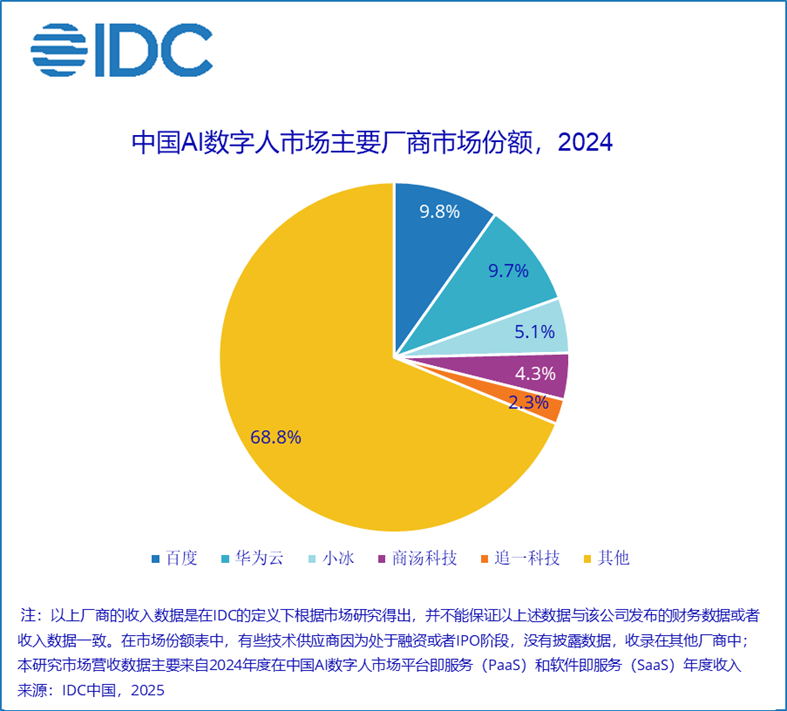
IDC:预计到2029年 中国AI数字人市场规模将达到250.5亿元
智通财经网· 2025-06-13 06:08
Core Insights - The AI digital human market in China is projected to reach approximately 4.12 billion RMB in 2024, representing a growth of 85.3% compared to 2023, with an expected market size of 25.05 billion RMB by 2029, indicating a CAGR of 43.5% from 2024 to 2029 [1] - The 2D digital human segment is expected to achieve a market size of 2.89 billion RMB in 2024, reflecting a significant growth of 101.2% from 2023, with major players including Huawei Cloud, Baidu, Xiaobing, and SenseTime [3] - The advancements in generative AI and large model technologies are driving a breakthrough in the AI digital human sector, leading to a comprehensive upgrade in technical architecture and enhancing interaction experiences in specific scenarios [5] Market Dynamics - Major participants in the AI digital human market include Baidu, Xiaobing, SenseTime, and Zhuiyi Technology [1] - The rapid development of 2D digital humans is highlighted, with key players in this segment also including Huawei Cloud, Baidu, Xiaobing, and SenseTime [3] - The ongoing evolution of multimodal capabilities, such as expression generation, motion capture, voice synthesis, and visual understanding, is pushing digital humans to new heights in image creation, intelligent interaction, and autonomous decision-making [5] Future Trends - The acceleration of the application ecosystem is noted, with the democratization of technology lowering the barriers for digital human development and usage, signaling the arrival of an "era of universal digital humans" [5] - This trend is expected to fundamentally change the paradigm of human-computer interaction and reshape the development landscape of the digital economy [5]


22.68亿元,公募密集自购;工信部发文,将加大力度抽查这些车型;000403,或迎国药集团入主→
新华网财经· 2025-06-10 00:23
Group 1: Fund Management and Investment - Fund managers have collectively purchased 2.268 billion yuan worth of their own equity funds as of June 9 this year [1] - The trend of fund managers buying back their equity funds has accelerated, with several major fund companies announcing their self-purchases [14] Group 2: Regulatory and Policy Developments - The Ministry of Industry and Information Technology announced a supervision check for vehicle production consistency, focusing on models with significant quality and safety concerns [7] - The Ministry of Industry and Information Technology and the Ministry of Civil Affairs are promoting the development of intelligent elderly care service robots, emphasizing safety and reliability standards [4] Group 3: Trade and Economic Indicators - In the first five months of 2025, China's total import and export value reached 17.94 trillion yuan, a year-on-year increase of 2.5% [3] - In May, the total import and export value was 3.81 trillion yuan, with exports growing by 7.2% year-on-year [3] Group 4: Corporate Developments - China National Pharmaceutical Group Corporation will become the new actual controller of Pailin Biotechnology after acquiring 21.03% of its shares [21] - Midea Group is recalling over one million window air conditioners in North America due to user feedback regarding mold issues [20]





大厂搞AI,谁赚到钱了?
创业邦· 2025-06-09 02:58
Core Viewpoint - The article discusses the current state of AI investments by major companies, highlighting the varying degrees of monetization and the challenges faced in achieving profitability from AI initiatives [4][21]. Group 1: AI Investment Landscape - Over the past two years, AI has become a significant focus for both domestic and international tech giants, with substantial financial investments being made [4]. - A report titled "Top Lean AI Native Companies Ranking" indicates that some startups have achieved remarkable productivity, with an average revenue of $1.66 million per employee [4]. - Major companies like Baidu, Alibaba, and Tencent have emphasized the importance of AI in their financial reports, signaling a shift from investment to potential revenue generation [4][11]. Group 2: AI Monetization Strategies - The article categorizes the monetization strategies of major companies into four types: Model as Product, Model as Service, AI as Function, and "Selling Shovels" [6]. - "Model as Product" involves creating specific applications based on self-developed large models, primarily targeting consumer markets [6][8]. - "Model as Service" targets B2B clients, offering trained AI models through cloud platforms, which has shown clearer monetization potential [8][9]. - "AI as Function" integrates AI capabilities into existing products to enhance efficiency, contributing indirectly to revenue [9]. - "Selling Shovels" refers to providing foundational infrastructure and services to other companies, which requires significant investment and has a longer return cycle [9]. Group 3: Company Performance and AI Integration - The first tier of companies, including Baidu, Alibaba, Tencent, and Huawei, have successfully integrated AI into their revenue streams, with AI becoming a crucial growth driver [11][12]. - Baidu's non-online marketing revenue, which includes AI-related services, increased from 25.9 billion in 2022 to 31.7 billion in 2024, driven by AI cloud services [12]. - Alibaba's cloud intelligence group reported a revenue of 30.1 billion in Q1 2025, with AI-related products showing consistent growth [12][13]. - Tencent has integrated AI across its business lines, contributing to a 20% year-on-year increase in advertising revenue [14]. - Huawei's AI-related revenue is primarily derived from its ICT infrastructure and cloud computing services, with significant growth in its cloud business [14]. Group 4: Emerging Players and Market Dynamics - The second tier includes companies like Kuaishou, ByteDance, and Meitu, which are beginning to see the benefits of AI in enhancing their core businesses [15][16]. - Kuaishou's AI revenue exceeded 150 million in Q1 2025, showcasing the effectiveness of its AI strategy [15]. - ByteDance has developed over 20 AI applications, focusing on both infrastructure and product efficiency [15][16]. - Meitu reported a total revenue of 3.3 billion in 2024, with significant contributions from AI-integrated products [16]. Group 5: Challenges and Future Outlook - Despite the promising developments, the article highlights the ongoing challenges in achieving profitability from AI investments, with many companies facing high R&D costs [22][24]. - Companies like Tencent and Alibaba have maintained R&D expenditures exceeding 100 billion annually, indicating a commitment to AI despite uncertain short-term returns [22][23]. - The article concludes that while AI can generate revenue, the current landscape shows that few companies have achieved positive cash flow from AI initiatives, making it a strategic investment rather than an immediate profit generator [24][25].


出走大厂的95后CEO们,已在AI赛道融资数亿
3 6 Ke· 2025-06-04 08:16
Core Insights - The article highlights the emergence of a new generation of entrepreneurs in the AI industry, particularly those born in the 1990s, who are increasingly leaving established tech giants to start their own ventures [2][3][4] - It emphasizes the significant role that major tech companies play in nurturing young talent, with 90% of AI entrepreneurs having previously worked at leading firms [2][4] - The article discusses the unique characteristics of this new generation, including their innovative mindset and willingness to challenge traditional career paths [12][14] Group 1: Young Entrepreneurs and Their Ventures - A significant number of 95 post-90s entrepreneurs are entering the AI sector, leveraging their unique perspectives to achieve rapid results [3][4] - Notable examples include Shitianhui, who founded Qingcheng Jizhi, and Guo Renjie, who established Lexiang Technology, both of whom have secured substantial funding shortly after their inception [5][10] - The average age of teams in these startups is under 30, reflecting a trend towards younger leadership in the AI space [5][10] Group 2: Investment Landscape - Major tech companies are investing in AI startups, with significant funding flowing into firms like SenseTime and Zhizhu AI, which have nurtured many young entrepreneurs [16][18] - The article notes that the AI industry is experiencing a high failure rate, with 34% of new AI companies facing closure, highlighting the challenges in securing funding and achieving sustainability [21][22] - Successful fundraising is often linked to the technical capabilities of the team, market timing, and the founder's vision and execution [27][28] Group 3: Future Outlook - The article suggests that the influence of 95 post-90s entrepreneurs in the tech industry will continue to grow, with a potential for them to lead major companies in the next decade [28] - The ongoing evolution of AI technology, including advancements in embodied intelligence and multi-modal AI, is expected to create new opportunities for these young innovators [16][20]

AI开花、科技自立,行业景气度已开始修复
Haitong Securities International· 2025-06-04 07:14
Investment Rating - The report maintains a positive outlook on the computer sector, indicating a recovery in industry prosperity driven by AI applications and technological independence [3][4]. Core Insights - 2025 is projected to be a pivotal year for AI applications, with significant advancements expected following the release of ChatGPT in late 2022. The report emphasizes that AI will become a key driver of business growth, enhancing efficiency and creating new demand [3][4]. - The report highlights the urgency for technological self-reliance in China, particularly in light of international trade tensions and tariffs that could impact the global technology supply chain [3][4]. - The computer sector is currently in its fourth bullish phase over the past decade, with a notable recovery in sentiment and performance expected [8][18]. Summary by Sections 1. Historical Overview of the Computer Sector - The computer sector has experienced four major bullish phases since 2013, with the current phase starting in September 2024 [8][18]. 2. Current Position of the Computer Sector - Institutional holdings in the computer sector remain low, with levels fluctuating around 2-6% over recent years. As of Q1 2025, holdings have slightly increased to 2.9% but are still considered low historically [15][18]. - The valuation levels of the SW computer index are at historical highs, indicating potential for further growth [18][21]. 3. Promising Sub-sectors and Logic for 2025 - The report identifies AI, technological independence, and the impact of tariffs as key areas of focus for investment in 2025. It notes that AI is transitioning from a follower to a leader in the global landscape, with domestic models closing the gap with international counterparts [38][43]. - The report anticipates that 2025 will mark the commercial rollout of AI agents, with significant advancements in AI capabilities expected [43][46]. - The report discusses the potential for mergers and acquisitions in the computer sector, driven by regulatory changes that may stimulate market activity similar to the 2013-2015 period [21][22]. 4. Company Performance Predictions and Valuations - The computer sector is expected to see a revenue increase in 2025, with a projected total revenue of 12,693.99 billion yuan in 2024, reflecting a year-on-year growth of 4.78%. However, net profits are expected to decline significantly [25][29]. - The report highlights that large-cap companies are showing more stable performance compared to small-cap companies, with significant growth in revenue and profits anticipated for large-cap firms in Q1 2025 [29][34].
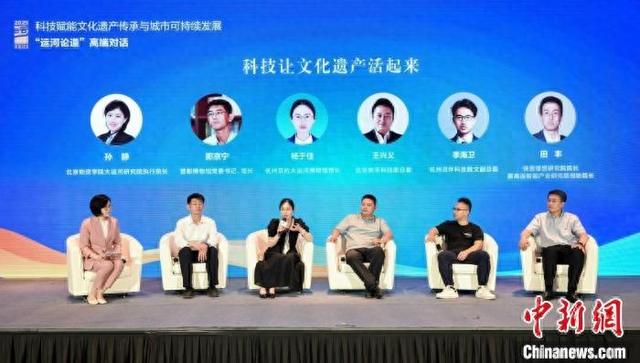
学界业界共论科技让大运河文化遗产活起来
Zhong Guo Xin Wen Wang· 2025-05-30 12:36
Group 1 - The event "Canal Dialogue" focused on the theme of "Empowering Cultural Heritage Transmission and Urban Sustainable Development" [1][3] - The event was hosted by the Beijing Municipal Publicity Department and the Zhejiang Provincial Publicity Department as part of the 2025 China Grand Canal Cultural Belt dialogue activities [1][3] Group 2 - Technology is deemed essential in the process of cultural heritage protection and transmission, as highlighted by the director of the Capital Museum [3] - The Beijing Grand Canal Museum integrates technology into its core philosophy, applying it extensively in artifact research, protection, and display [3] - The "museum fever" has led to widespread dissemination of Grand Canal stories, emphasizing the need for a deep integration of technology in museum operations [3] Group 3 - Kuaishou Technology reported that over 11 million creators are actively sharing intangible cultural heritage content on its platform [4] - The introduction of AI tools like "Keling" by Kuaishou enhances video creation methods, aiding in the recreation and dissemination of historical culture and stories [4] - Lingban Technology's AR guide glasses are being used in over 300 museums and scenic spots nationwide, including those along the Grand Canal [4] Group 4 - The integration of AI and cultural tourism is advancing rapidly, with AI technologies enhancing visitor engagement and experience [6] - AI can facilitate the connection between historical figures and tourists, creating interactive experiences that bridge online and offline environments [6] - The potential for AI to activate new consumption scenarios in cultural tourism is significant, with applications in guided tours, information access, and e-commerce [6]
TechNet中国2025:商汤科技(0020.HK)推出基础模型;拓展AI驱动的用户案例
Goldman Sachs· 2025-05-28 05:15
Investment Rating - The report does not provide a specific investment rating for SenseTime (0020.HK) [3] Core Insights - SenseTime's management is optimistic about the generative AI trend in China and has launched a new foundation model, SenseNova V6, which features competitive costs for training and inferencing [1][7] - The company signed a Memorandum of Understanding (MOU) with the Faculty of Law at the Chinese University of Hong Kong to enhance legal information accessibility through AI [4][6] - The generative AI trend is expected to benefit the broader China AI supply chain, with more companies willing to adopt generative AI technologies [2] Company Profile - SenseTime is a leading AI software company that provides capabilities in multimodal and multi-task models, covering areas such as perception intelligence, natural language processing, and AI-enabled content generation [3] - The SenseCore platform integrates computing power, algorithms, and platforms to create the SenseNova foundation model set, enabling efficient general AI tasks at low costs [3] Key Takeaways - The SenseNova V6 model introduced by SenseTime has multimodal reasoning capabilities and cost efficiency in both training and inferencing, supporting various applications such as role-playing, translation, and long-form video understanding [7] - The collaboration with the Faculty of Law aims to digitally transform legal information provision in Hong Kong, promoting broader access to legal information [6]
文博会亮点纷呈 科技创新助推文化产业高质量发展
Zhong Guo Zheng Quan Bao· 2025-05-22 20:36
Group 1 - The 21st China (Shenzhen) International Cultural Industries Fair opened with 120,000 cultural products on display and over 4,000 investment and financing projects available for transaction [1] - The fair focuses on exploring effective mechanisms for the integration of culture and technology, emphasizing the exhibition and transaction functions while enhancing internationalization, marketization, professionalism, and digitalization [1][2] - The event features a new artificial intelligence exhibition area with over 60 AI companies participating, showcasing immersive experiences through robotics, drones, and smart devices [2][3] Group 2 - Guangdong Province has been promoting the integration of culture and technology, implementing various policies to support the rapid development of digital cultural technology and new cultural business models [3] - Shenzhen's cultural industry has seen significant growth, with 3,754 cultural enterprises achieving a revenue of 1,287.51 billion yuan in 2024, accounting for 51.5% of the province's total and 9.1% of the national total [3] - Emerging cultural industries such as digital creativity, short dramas, and immersive experiences are rapidly developing, becoming new growth drivers for Shenzhen's cultural sector [3] Group 3 - The fair includes specialized exhibition areas for cultural exports and imports, helping companies with export potential to showcase their products [4] - Notable companies like Pop Mart are using unique IP strategies to promote Chinese brands internationally, while major players like Tencent and NetEase are showcasing their cultural export products [4] - The fair attracted 305 overseas exhibitors from 65 countries and regions, with an expected attendance of 35,000 overseas professionals [5] Group 4 - The fair aims to enhance the "monetization capability" of the cultural industry by creating various "super platforms" for transactions, investment, and cultural product promotion [6] - A total of 22 transaction promotion measures have been implemented to enhance the trading experience for participating companies [6][7] - The event will host nearly 200 activities, including product launches and investment meetings, and has doubled the number of release areas compared to the previous year [7]
2025第二季度全球投资指引-DeepSeek崛起改写投资格局
Sou Hu Cai Jing· 2025-05-21 09:02
今天分享的是:2025第二季度全球投资指引-DeepSeek崛起改写投资格局 报告共计:24页 《2025第二季度全球投资指引-DeepSeek崛起改写投资格局》核心内容总结 一、集团背景与投资主题 寶鉅證券金融集團成立于2001年,是亚洲领先的综合金融机构,业务涵盖资产管理、证券、保险、财富管理等,在香港、新加 坡、台湾设有办事处,持有多地监管机构牌照,服务数千高净值客户,客户平均净资产超1000万美元。本季度投资主题聚 焦"DeepSeek崛起改写投资格局",杭州公司推出的DeepSeek-R1模型以低成本实现高性能,引发全球AI投资逻辑转变,推动中港 股市科技板块估值回升,恒生指数等表现强劲。 二、上季市场表现与分析 (一)全球市场分化 2025年第一季度全球资本市场格局分化,非美市场跑赢美股。港股(尤其H股)因中国刺激政策预期及DeepSeek技术突破表现 强劲,恒生指数、恒生科技指数累计上涨超15%。美国股市受关税政策影响调整,日股因贸易摩擦下挫,美元指数创2008年以 来最差年度开局。 寶鉅證券提供多元投资工具,包括多地股票、结构式商品、债券及超1000只互惠基金,合作基金公司超60家。此外,还介 ...