亿纬锂能

Search documents
先导智能结束招股 孖展认购额达43.5亿港元 超购9.1倍
Zhi Tong Cai Jing· 2026-02-06 05:58
Group 1 - The core viewpoint of the news is that Xian Dao Intelligent, a leading supplier of lithium battery intelligent equipment, is conducting an IPO to raise up to HKD 4.29 billion, with significant oversubscription indicating strong market interest [1][2] - Xian Dao Intelligent plans to issue 93.616 million H-shares, with 10% available for public offering at a maximum price of HKD 45.8 per share, and the expected listing date is February 11 [1] - The company has attracted 10 cornerstone investors, including Oaktree and Pinpoint, with a total subscription amount of USD 275 million [1] Group 2 - According to Frost & Sullivan, the global new energy intelligent equipment market is expected to account for approximately 15% of the global intelligent equipment market by 2024, with Xian Dao Intelligent being the second-largest supplier in this sector, holding a market share of 2.9% [2] - Xian Dao Intelligent is recognized as the largest supplier of lithium battery intelligent equipment globally, with a market share of 15.5%, and also the largest in China with a market share of 19.0% [2] - The company's customer base includes leading firms in the lithium battery sector such as CATL, Tesla, Volkswagen, BMW, and BYD, indicating a strong position in the market [2]

海外动力电池装车量TOP10:两中企取代特斯拉及PPES上榜 松下份额回升
Xin Lang Cai Jing· 2026-02-06 05:05
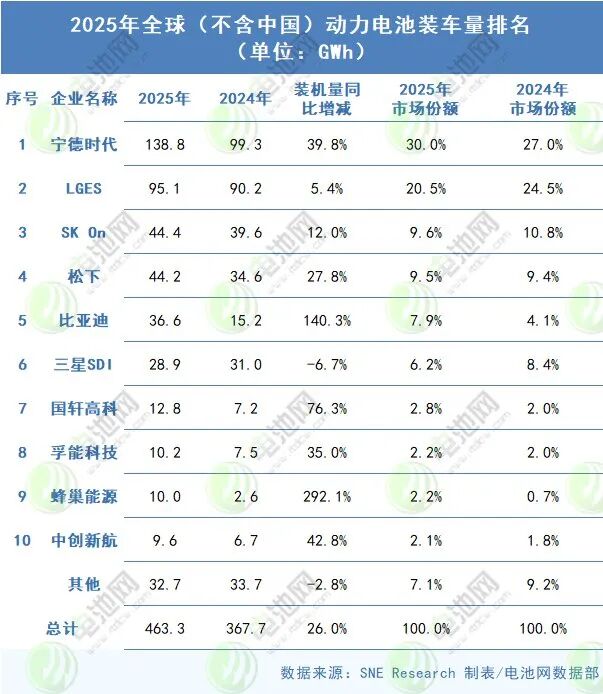
Core Insights - In 2025, global electric vehicle battery installation volume is projected to reach 1187 GWh, representing a year-on-year growth of 31.7% [10] - Excluding China, the global electric vehicle battery installation volume is expected to be 463 GWh, with a year-on-year increase of 26.0% [1] Group 1: Market Performance - The top 10 companies in global electric vehicle battery installation volume (excluding China) for 2025 are led by CATL, LGES, and SK On, with CATL achieving 138.8 GWh and a market share of 30.0% [2][4] - BYD has shown remarkable growth, with a 140.3% increase in installation volume to 36.6 GWh, elevating its market share to 7.9% [4][6] - Samsung SDI is the only company in the top 10 to experience a decline, with a 6.7% drop in installation volume [4][12] Group 2: Market Share Dynamics - In 2025, the combined installation volume of Chinese companies CATL and BYD reached 175.4 GWh, accounting for 37.9% of the market, surpassing the total of the three major Korean companies (168.4 GWh) [4][6] - Among the top 10 companies, six Chinese firms, including CATL, BYD, and Guoxuan High-Tech, saw an increase in market share, while LGES, SK On, and Samsung SDI experienced declines [6][11] - The market share of LGES decreased by 4.0%, while BYD's market share increased by 3.8% [6][9] Group 3: Ranking Changes - The rankings of the top four companies remained stable, with CATL, LGES, SK On, and Panasonic maintaining their positions [2][12] - Guoxuan High-Tech moved up to fifth place, while Samsung SDI dropped to sixth [2][12] - New entrants to the top 10 include Honeycomb Energy, which replaced PPES, and Zhongxin Innovation, which took the tenth spot [2][12]



安永2025年中国海外投资概览
EY· 2026-02-06 04:10
Investment Rating - The report indicates a positive investment outlook for Chinese overseas investments, with a focus on high-quality growth and strategic cooperation in global markets [5][12]. Core Insights - Chinese enterprises' overseas direct investment (ODI) reached USD 174.4 billion in 2025, marking a year-on-year increase of 7.1%. Non-financial ODI was USD 145.7 billion, up 1.3% [12][25]. - Investment in countries participating in the Belt and Road Initiative (BRI) saw a significant increase, with non-financial ODI amounting to USD 39.7 billion, a growth of 17.6% [25]. - The report highlights a notable recovery in overseas mergers and acquisitions (M&A), with announced transaction amounts reaching USD 43.6 billion, a nearly 40% increase year-on-year [36][39]. - The global economic landscape is characterized by resilience despite challenges, with a projected growth rate of 3.1% for 2026 [5][59]. Summary by Sections 1. Overview of Chinese Overseas Investment in 2025 - The report outlines that China's GDP grew by 5% in 2025, surpassing 140 trillion RMB for the first time [5]. - The overall ODI growth reflects a robust performance amid global economic uncertainties [5][12]. 2. Key Highlights of Chinese Enterprises Going Abroad - Direct investment in BRI countries accounted for 27% of total ODI, an increase of 4 percentage points from the previous year [25]. - New contracts signed in overseas projects reached USD 289.2 billion, up 8.2%, with completed turnover at USD 178.8 billion, a 7.7% increase [51]. 3. Analysis of Overseas M&A - The number of M&A transactions was 429, a slight decrease of 1%, but the value of large transactions (over USD 1 billion) increased significantly [36][39]. - The most active sectors for M&A included consumer goods, TMT (Technology, Media, and Telecommunications), and mining and metals [39][42]. 4. Factors Influencing Overseas Investment in 2026 - The report anticipates continued high-quality outbound investment, driven by China's strategic focus on expanding domestic demand and optimizing investment structures [5][59]. - Geopolitical dynamics and trade relations, particularly with the U.S. and European countries, are expected to shape investment strategies [5][66]. 5. Policy Support for Overseas Investment - The report emphasizes the Chinese government's commitment to enhancing support for enterprises going abroad, including the establishment of a comprehensive service system for overseas operations [17][20].
新能车ETF(515700)涨超2.2%,以旧换新补贴陆续落地
Xin Lang Cai Jing· 2026-02-06 03:37
Core Viewpoint - The news highlights a strong performance in the new energy vehicle (NEV) sector, driven by government subsidies and the ongoing transformation of car manufacturers towards AI technologies [1][2]. Group 1: Market Performance - The China Securities New Energy Vehicle Industry Index (930997) rose by 2.27%, with key stocks such as Enjie Co., Ltd. increasing by 7.14%, and other companies like Multi-Floor and Zhenyu Technology also showing significant gains [1]. - The New Energy Vehicle ETF (515700) increased by 2.24%, with the latest price reported at 2.47 yuan [1]. Group 2: Government Policies - Various regions have introduced detailed implementation rules for the 2026 vehicle trade-in subsidy policy, including Jining in Shandong, which calculates subsidies based on the new car's selling price, and Shanghai, which has initiated a vehicle scrapping and replacement subsidy program [1]. - Beijing's Shijingshan District has launched a purchase subsidy policy that increases based on the sales price of individual vehicles, while Chengdu has also started car purchase subsidy activities [1]. Group 3: Industry Trends - According to Everbright Securities, attention should be paid to the AI transformation of car manufacturers and the pressure from rising raw material prices [1]. - New energy vehicle companies are actively transitioning towards AI, with Tesla planning to modify its Model S/X production line for humanoid robots, and Xiaopeng announcing plans for large-scale production of humanoid robots starting in 2026 [1].
南方基金旗下新能源ETF(516160)强劲反弹涨近2%,政策技术双轮驱动,新能源行业发展空间进一步打开
Xin Lang Cai Jing· 2026-02-06 03:35
截至2026年2月6日 11:12,南方基金旗下新能源ETF(516160)上涨1.89%,盘中换手2.48%,成交1.67亿 元。跟踪指数中证新能源指数成分股恩捷股份上涨7.41%,协鑫集成上涨7.21%,震裕科技上涨6.98%, 天赐材料,湖南裕能等个股跟涨。 消息面上,2月5日,中国光伏行业协会于北京举办"光伏行业2025年发展回顾与2026年形势展望研讨 会"。会上了解到,"十五五"时期,全球与中国光伏新增装机增速预计均明显放缓。晶硅光伏技术在进 一步提升的同时,也将逼近极限,使得降本提效带来的边际收益减少。光伏企业须直面高质量发展挑 战,寻求新的突破点。 新能源ETF(516160),场外联接(A类:012831;C类:012832;南方中证新能源ETF联接I:021057)。 展望2026年,华泰证券重申风电光伏板块盈利修复趋势:1)风机订单价格自2024年四季度以来持续回 暖,考虑到前期低价订单交付步入尾声,涨价订单逐步交付支撑盈利修复。2)光伏需求走低预期下, 供应链或强化质量与成本把控,加速高功率产品与贱金属导入,有望驱动盈利修复。同时,太空光伏或 打造新业态,近期SpaceX宣布收购xAI ...
国海证券:2026年动储多场景共振 锂电行业需求持续向上
Zhi Tong Cai Jing· 2026-02-06 03:17
Group 1 - The core viewpoint of the report indicates that the lithium battery industry is expected to maintain high demand growth through 2026, with price recovery in key midstream materials and ongoing industrialization of new technologies [1] Group 2 - The demand for power storage is expected to continue rising due to policy support, increased energy capacity, and new market scenarios, with strong growth anticipated in 2025 and sustained support for domestic demand in 2026 [2] - The energy storage cell market is entering a tight balance driven by demand, with significant price recovery expected in 2025 and further recovery potential for key materials in 2026 [3] Group 3 - The industrialization of new technologies remains a key focus, with solid-state battery industrialization expected to accelerate as pathways become clearer and material support improves [4] Group 4 - Investment recommendations highlight leading companies in the midstream materials sector benefiting from improved supply-demand dynamics and price recovery, including Tianqi Lithium, DLG, and others in various segments [5]

电池板块强势反攻!电池ETF汇添富(159796)涨超2%,近5日吸金超1.7亿元!全固态电池催化密集落地,产业化进程提速!
Sou Hu Cai Jing· 2026-02-06 03:08
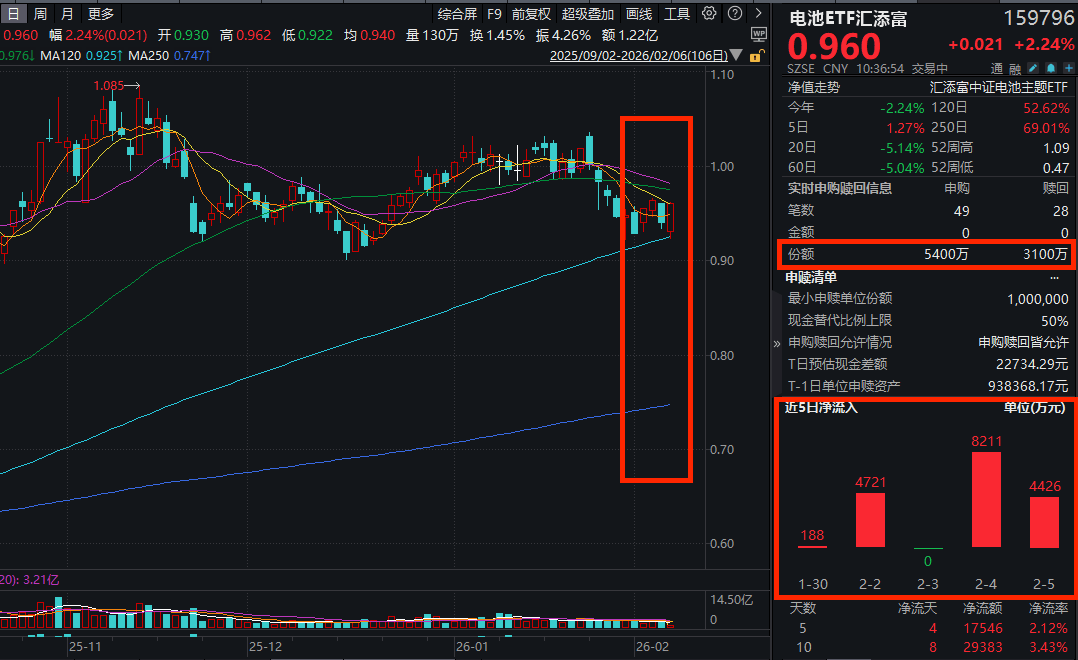
Core Viewpoint - The A-share market shows signs of recovery, particularly in the battery sector, with significant inflows into the ETF Huatai (159796), indicating strong investor interest [1][3]. Group 1: Battery Sector Performance - The battery ETF Huatai (159796) saw a rise of over 2%, with a net subscription of 23 million shares during the day and over 170 million yuan in the past five days, reflecting strong capital inflow [1]. - Major component stocks of the ETF performed well, with Tianqi Lithium rising over 6%, and other companies like Sanhua Intelligent, Yiwei Lithium Energy, and CATL also showing gains of over 2% [3]. Group 2: Global Battery Market Trends - According to SNE Research, the global power battery installation volume is expected to reach 1187 GWh by 2025, marking a year-on-year increase of 31.7%, with Chinese companies holding six of the top ten spots and capturing 70.4% of the global market share, an increase of 3.3 percentage points from the previous year [4]. - The global sodium battery market is projected to see a shipment volume of 9 GWh by 2025, representing a 150% year-on-year growth, with the market size for energy storage sodium batteries expected to reach 580 GWh by 2030 [4]. Group 3: Domestic and International Storage Demand - Nomura Orient expresses optimism about domestic storage demand exceeding expectations by 2026, driven by new pricing mechanisms for capacity and diverse revenue sources for independent storage projects [5]. - In Europe, the storage market is expected to see a 45% increase in new installations to 27.1 GWh by 2025, with a projected 50% growth in 2026, primarily due to increased renewable energy penetration [6]. - The U.S. market is also anticipated to experience significant storage demand growth, particularly from data centers seeking reliable power sources, with new installations expected to exceed 40 GW and corresponding capacity surpassing 120 GWh by 2026-2027 [6]. Group 4: Solid-State Battery Developments - Recent developments in the solid-state battery sector are accelerating, with significant policy support and advancements from major manufacturers like FAW Hongqi and GAC Group, which are moving towards mass production of solid-state batteries by 2027 [7]. Group 5: Export Tax Policy Impact - The recent reduction in export tax rates for battery products is expected to increase export costs and compress profit margins, leading to a "rush to export" before the policy takes effect [8]. - Long-term, the tax reduction may drive industry transformation and innovation, reducing reliance on price competition and enhancing the global competitiveness of China's lithium battery industry [8]. Group 6: Investment Opportunities in Battery Sector - The battery ETF Huatai (159796) has a significant focus on the storage sector, with 18.7% of its index dedicated to storage, and 45% to solid-state batteries, positioning it well to benefit from emerging technologies and market trends [9][11]. - The ETF's management fee is among the lowest in its category at 0.15% per year, making it an attractive option for investors looking to capitalize on the battery sector's growth [14].
20cm速递|2025年全球储能电池出货量中国第一!创业板新能源ETF华夏(159368)同类费率最低
Mei Ri Jing Ji Xin Wen· 2026-02-06 03:02
Group 1 - The core viewpoint of the article highlights the significant growth in the global energy storage battery market, with a projected increase in shipment volumes and a strong contribution from Chinese companies [1] - In 2025, global energy storage battery shipments are expected to reach 651.5 GWh, representing a year-on-year growth of 76.2%, with Chinese companies accounting for 614.7 GWh, or 94.4% of the total [1] - The outlook for 2026 indicates that global energy storage cell shipments will continue to grow, potentially exceeding 900 GWh, driven by new energy storage installations and surging demand from data centers [1] Group 2 - The ChiNext New Energy ETF (159368) has shown a 1.54% increase, with notable gains from holdings such as Zhenyu Technology (over 6%), Hunan Youneng (over 4%), and Yiwei Lithium Energy (over 3%) [1] - The ChiNext New Energy Index encompasses various sectors within the new energy and electric vehicle industries, including batteries and photovoltaics, and is the only index on the ChiNext with a 20% daily price fluctuation limit [1] - The ETF features a low fee structure, with a combined management and custody fee of only 0.2%, and nearly 90% of its holdings are in energy storage and solid-state batteries, aligning with current market trends [1]

中银晨会聚焦-20260206-20260206
Bank of China Securities· 2026-02-06 01:32
Core Insights - The report highlights the contradiction faced during the "14th Five-Year Plan" period, where carbon reduction pressures are increasing while the growth rate of new energy installations is slowing down. The introduction of a national capacity price policy is expected to open up space for new energy installations and support high-yield investment options for power companies during the "14th Five-Year Plan" investment intensity [5][6][9]. Group 1: Energy Storage Industry - The national capacity price policy, issued on January 30, 2026, aims to establish a mechanism that balances power supply stability, green energy transformation, and efficient resource allocation. This policy is expected to support the development of adjustable power sources and enhance the installation of new energy [7][9]. - The report estimates that the demand for energy storage will show a high growth trend, with new energy storage installations expected to reach 66.43 GW and 189.48 GWh in 2025, representing year-on-year increases of 52% and 73% respectively [8][9]. - The capacity price policy is seen as the final piece needed for energy storage development, potentially increasing project returns from approximately 6.5% to over 8% under current subsidy conditions. This is expected to stimulate investment interest from state-owned enterprises in new energy storage projects [8][9]. Group 2: Investment Recommendations - The report suggests prioritizing investments in leading companies involved in energy storage integration and upstream battery cells, recommending firms such as Sungrow Power Supply, Trina Solar, LONGi Green Energy, JinkoSolar, CATL, and Eve Energy. It also advises monitoring companies like Haisum, Sungrow Electric, Canadian Solar, and Penghui Energy [9].





英国首相访华背后,谁是最大储能赢家?
24潮· 2026-02-05 23:06
Core Viewpoint - The article highlights the significant growth of the UK energy storage market, driven by strong collaboration between the UK and China in renewable energy and low-carbon technologies, positioning the UK as a leading player in Europe’s energy storage sector [2][4]. Group 1: UK Energy Storage Market Growth - The UK has become the strongest growth area for energy storage in Europe, with a growth rate of 125% projected for the first three quarters of 2025, surpassing Germany and Italy [2][4]. - The UK aims to achieve a battery storage target of 23-27 GW by 2030, with an annual addition of 4.4 GW, translating to a demand increase of 13 GWh per year [4]. - The capital expenditure for new storage projects in the UK is expected to decrease by approximately 30% from 2022 to 2024, maintaining an internal rate of return (IRR) of over 10% for new projects [4]. Group 2: Long-Duration Energy Storage (LDES) Strategy - The UK has elevated long-duration energy storage to a national strategic level, establishing a legal framework to support its deployment through the Planning and Infrastructure Act of 2025 [5]. - The introduction of an "upper and lower limit" revenue mechanism aims to provide revenue certainty for long-duration storage projects, encouraging large-scale investments [5]. - The stringent technical and market barriers in the UK are filtering out companies with core competencies, as the market demands systems capable of withstanding high-frequency grid fluctuations [5][6]. Group 3: Chinese Companies in the UK Market - Chinese energy storage companies, such as Envision, CATL, and BYD, are emerging as key players in the UK market, with Envision leading in storage orders [6][8]. - In 2025, major Chinese companies are projected to sign energy storage orders totaling approximately 142.53 GWh globally, with Envision securing the largest contracts in the UK [9]. - The competitive landscape in the UK is characterized by a focus on understanding complex power systems and adapting to market rules, where Chinese firms are leveraging their comprehensive capabilities [6][9]. Group 4: Global Expansion of Chinese Energy Storage Companies - Chinese energy storage companies are increasingly expanding their global footprint, with a total overseas order volume of approximately 284.26 GWh expected in 2025, significantly higher than previous years [9]. - Companies like CATL and Envision are planning or have already established deep industrial layouts overseas, with disclosed projects exceeding 30 and total investment budgets surpassing 400 billion RMB [10]. - Envision is noted for its extensive global presence, with production bases in multiple countries, including a significant battery manufacturing facility in the UK [11]. Group 5: Competitive Landscape and Regulatory Challenges - The global competition in the energy storage sector is shifting from commercial competition to regulatory competition, with Western countries implementing policies to increase barriers for Chinese manufacturers [13]. - The EU's initiatives, such as the Net Zero Industry Act and the Critical Raw Materials Act, aim to reshape market dynamics and reduce dependency on external suppliers, impacting the operational landscape for Chinese firms [13]. - Future competition in the global energy storage market will increasingly focus on technological strength, globalization capabilities, and innovative business models [13][14].