
光威复材

Search documents
锂电挺价+产能出清,化工ETF(516020)午后猛拉飙涨1.81%!主力资金狂涌369亿布局景气反转
Xin Lang Cai Jing· 2025-12-24 14:09
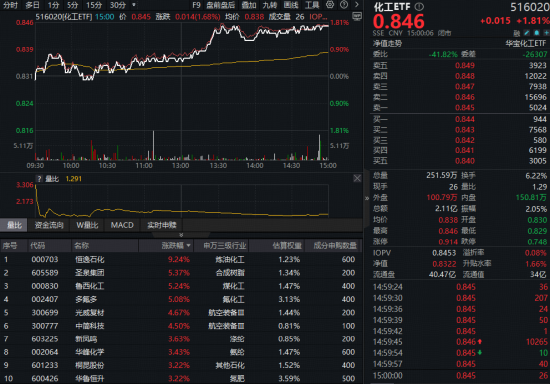
Group 1 - The chemical sector showed strong performance today, with the chemical ETF (516020) closing up 1.81% after a volatile session [1][11] - Notable stocks included Hengyi Petrochemical, which surged by 9.24%, and several others like Shengquan Group and Luxi Chemical, which rose over 5% [1][11] - The chemical ETF's underlying index has recorded a year-to-date increase of 34.27%, significantly outperforming major indices like the Shanghai Composite Index (17.58%) and the CSI 300 Index (17.77%) [12][13] Group 2 - The basic chemical sector has attracted substantial capital inflow, with a net inflow of 79.67 billion yuan today, ranking sixth among 30 major sectors [4][14] - Over the past five days, the sector saw a total net inflow of 369.22 billion yuan, leading all sectors [4][14] Group 3 - The lithium industry is experiencing a recovery, with rising prices for lithium carbonate futures and optimistic market expectations for future prices [5][16] - The chemical sector is currently viewed as having a favorable valuation, with the chemical ETF's underlying index trading at a price-to-book ratio of 2.48, which is relatively low compared to historical levels [6][16] Group 4 - Looking ahead, the chemical industry is expected to face a contraction in capital expenditure, which may lead to a supply reduction and increased demand due to policy support and economic conditions [7][17] - The "anti-involution" trend is anticipated to lead to a reevaluation of the Chinese chemical industry, potentially resulting in higher dividend yields and improved market conditions for chemical stocks [8][18] Group 5 - The chemical ETF (516020) provides an efficient way to invest in the sector, with nearly 50% of its holdings in large-cap leading stocks, allowing investors to capitalize on strong market trends [8][18]




新材料周报:碳钎维龙头宣布涨价,行业底部确认景气有望回升-20251224
Shanxi Securities· 2025-12-24 08:35
Investment Rating - The report maintains a "B" rating for the new materials sector, indicating a stable outlook with potential for recovery in the carbon fiber industry [2]. Core Insights - The carbon fiber industry is experiencing a price increase, confirming a bottoming out of the market and a potential recovery in demand. High-end carbon fiber demand is expected to rise significantly, particularly in wind power and aerospace applications, with actual consumption in China projected to reach 96,446 tons in 2025, a year-on-year increase of 71.89% [5][7]. - The new materials sector index decreased by 0.23% recently, outperforming the ChiNext index by 2.03%. Key segments such as industrial gases and biodegradable plastics showed positive growth, while semiconductor materials faced a decline [2][19]. Summary by Relevant Sections 1. Market Performance - The new materials sector index fell by 0.23%, while the ChiNext index dropped by 2.03%. Over the past five trading days, the synthetic biology index rose by 1.76%, industrial gases increased by 3.86%, and battery chemicals decreased by 2.87% [2][19]. 2. Price Tracking - Key prices include: - Valine: 13,700 CNY/ton (+4.98%) - Arginine: 20,950 CNY/ton (unchanged) - Methionine: 17,850 CNY/ton (-0.56%) - PLA (injection grade): 17,800 CNY/ton (unchanged) [3]. 3. Investment Recommendations - The report suggests focusing on leading companies in the carbon fiber sector, such as Jilin Chemical Fiber, Zhongfu Shenying, Zhongjian Technology, and Guangwei Composites, as they are expected to benefit from the recovery in high-end carbon fiber demand [7].


供给约束叠加需求改善,化工行业格局重塑,石化ETF(159731)布局价值凸显
Mei Ri Jing Ji Xin Wen· 2025-12-24 07:34
Core Viewpoint - The chemical industry is expected to experience a positive supply-demand dynamic due to strong policy constraints on new supply and the gradual elimination of high-energy-consuming capacities, leading to high-quality development in the sector [1]. Group 1: Market Performance - As of 14:00, the Petrochemical ETF (159731) rose by 0.92%, with stocks such as Hengyi Petrochemical hitting the daily limit, and companies like Luxi Chemical, Shengquan Group, and Guangwei Composites also seeing gains [1]. Group 2: Policy Impact - The policy environment imposes significant restrictions on new supply in the chemical industry, including unified approval by the National Development and Reform Commission for projects with a comprehensive energy consumption of 500,000 tons of standard coal or more, and an emphasis on the clean and efficient use of coal [1]. - The industry is also focusing on eliminating outdated capacities and processes through legal means, alongside the establishment of a carbon trading market to phase out high-energy-consuming production [1]. Group 3: Price Trends - Since the implementation of the anti-involution policy, prices for products such as silicone, caprolactam, and soda ash have increased [1]. Group 4: Industry Composition - The Petrochemical ETF and its linked funds closely track the CSI Petrochemical Industry Index, which is composed of three major sectors: refining and trading (27.33%), chemical products (22.04%), and agricultural chemical products (21.98%) [1]. - The top-level design is guiding the industry to shift from "quantity increase" to "quality improvement," with ongoing supply-demand improvements expected to sustain upward momentum in industry prosperity [1].
化工ETF(159870)涨超1.5%,PTA行业联合减产有效提振盈利
Xin Lang Cai Jing· 2025-12-24 05:43
Group 1: Chemical Sector Overview - The chemical sector is experiencing an upward trend, with Shenyin Wanguo Securities expressing optimism about the polyester industry chain driven by supply-demand improvements and production cuts that support profit recovery [1] - The supply-demand dynamics for PX (Paraxylene) are favorable, with no new capacity expected before the end of 2026, and limited domestic PX capacity growth anticipated next year [1] - The PTA (Purified Terephthalic Acid) industry is seeing effective profit boosts from coordinated production cuts among major players, with a potential reduction space of over 10 million tons, enhancing industry profitability [1] Group 2: Long Fiber Production and Market Dynamics - Leading long fiber companies have reached a consensus on production cuts, planning to reduce POY (Partially Oriented Yarn) output by 10% and FDY (Fully Drawn Yarn) by 15%, with price increases of 50 to 100 yuan per ton [2] - The current operating rate for long fibers is at 89%, with inventory levels for POY/FDY decreasing to 13-14 days, indicating strong demand [2] - The cost transmission mechanism within the polyester industry chain is functioning effectively, with rising PX/PTA prices and strong demand supporting the price stability of long fibers [2] Group 3: Index Performance and Key Stocks - As of December 24, 2025, the CSI Sub-Industry Chemical Theme Index (000813) increased by 0.90%, with significant gains in stocks such as Hengyi Petrochemical (000703) up by 6.55% and Guangwei Composites (300699) up by 4.84% [2] - The chemical ETF (159870) also saw a rise of 1.02%, marking a fourth consecutive increase [2] - The CSI Sub-Industry Chemical Theme Index comprises major companies like Wanhua Chemical (600309) and Yalake Co. (000792), reflecting the overall performance of the chemical sector [3]
光威复材股价涨5.3%,易方达基金旗下1只基金位居十大流通股东,持有1131.56万股浮盈赚取1799.19万元
Xin Lang Cai Jing· 2025-12-24 05:30
12月24日,光威复材涨5.3%,截至发稿,报31.57元/股,成交7.38亿元,换手率2.91%,总市值262.46亿 元。 资料显示,威海光威复合材料股份有限公司位于山东省威海市高区天津路-130号,成立日期1992年2月5 日,上市日期2017年9月1日,公司主营业务涉及专业从事碳纤维、碳纤维织物、碳纤维预浸料、碳纤维 复合材料制品及碳纤维核心生产设备的研发、生产与销售。主营业务收入构成为:碳纤维及织物 52.93%,碳梁30.73%,预浸料9.27%,制品及其他6.58%,其他(补充)0.49%。 从光威复材十大流通股东角度 数据显示,易方达基金旗下1只基金位居光威复材十大流通股东。易方达创业板ETF(159915)三季度 减持190.31万股,持有股数1131.56万股,占流通股的比例为1.38%。根据测算,今日浮盈赚取约1799.19 万元。 易方达创业板ETF(159915)成立日期2011年9月20日,最新规模1102亿。今年以来收益51.86%,同类 排名521/4197;近一年收益48.65%,同类排名544/4157;成立以来收益265.5%。 易方达创业板ETF(159915)基金经理 ...
“岳”章——山东企业一线调研·新质生产力篇
Shang Hai Zheng Quan Bao· 2025-12-23 19:06
Group 1 - Shandong's A-share listed companies show resilience with 251 out of 310 companies reporting profits, generating a total revenue of 2.3 trillion yuan and a net profit exceeding 141.1 billion yuan in the first three quarters of 2025 [3][1] - The province's GDP is set to enter the "ten trillion club," with industrial and investment indicators consistently outperforming the national average, highlighting Shandong's robust economic foundation [2][1] - The "Fifteen Five" planning emphasizes the construction of a modern industrial system, focusing on the transformation of traditional industries and the development of new productive forces [2][1] Group 2 - Yanzhou Coal Mining Company is transforming from a traditional coal producer to a green energy provider, integrating AI and renewable energy into its operations [5][4] - Shantui's intelligent transformation is evident in its AI-driven machinery, addressing industry challenges such as rising labor costs and efficiency bottlenecks [6][4] - Donghong's innovative composite pipes are crucial for major infrastructure projects, utilizing smart monitoring technologies to enhance safety and efficiency [7][4] Group 3 - The overall performance of Shandong's listed companies reflects a strong commitment to innovation and high-quality development, contributing to the province's strategic positioning as a key economic growth area in northern China [8][1]



中国碳纤维绝地反击:日美不卖,中国山西造
3 6 Ke· 2025-12-23 07:33
Core Viewpoint - China's advancements in high-end carbon fiber technology have transformed the country from being dependent on foreign suppliers to becoming a major player in the global market, now holding half of the world's production capacity [1][19]. Group 1: Historical Context - Carbon fiber is described as crucial as semiconductors, with properties that make it significantly lighter and stronger than steel, and capable of withstanding extreme temperatures [1][2]. - Historically, China faced significant challenges in carbon fiber production due to export restrictions imposed by Japan and the U.S., which dominated the market [3][4]. - The need for high-performance carbon fiber became critical during the development of China's domestic aircraft and defense projects, leading to a call for domestic production capabilities [3][5]. Group 2: Research and Development - The Shanxi Coal Chemical Research Institute, established in 1954, was tasked with developing aerospace-grade carbon fiber, despite initial doubts about their capability to meet the complex production requirements [4][6]. - The institute adopted an innovative "intermittent polymerization method" instead of the mainstream "continuous polymerization method," allowing for better control and quicker adjustments during the research process [7][9]. - Collaborative efforts among various research institutions were crucial, with multiple organizations contributing to the development of necessary materials and processes [9][10]. Group 3: Production Milestones - By June 2008, the Shanxi Coal Chemical Research Institute successfully achieved stable mass production of T300 carbon fiber, marking a significant milestone in breaking foreign technological monopolies [11][12]. - The production of T300 was seen as just the beginning, with ongoing efforts to develop higher-grade carbon fibers like T700, T800, and T1000 [12][18]. - The T1000 carbon fiber, representing the highest performance level, requires advanced manufacturing techniques, which posed significant challenges for large-scale production [15][17]. Group 4: Industry Collaboration and Future Prospects - The collaboration with Huayang Group, a major state-owned enterprise, aimed to leverage financial resources and industrial experience to enhance carbon fiber production capabilities [13][14]. - The establishment of a high-performance carbon fiber production base in Datong City is a strategic move to further develop the industry and meet national defense needs [14][18]. - Recent advancements have positioned China among the international leaders in high-performance carbon fiber technology, ensuring a stable supply for critical applications in aerospace and defense [17][18].

行业聚焦:全球储氢碳纤维复合储罐行业生产商排名及市场占有率(附TOP 3 企业介绍)
QYResearch· 2025-12-22 04:15
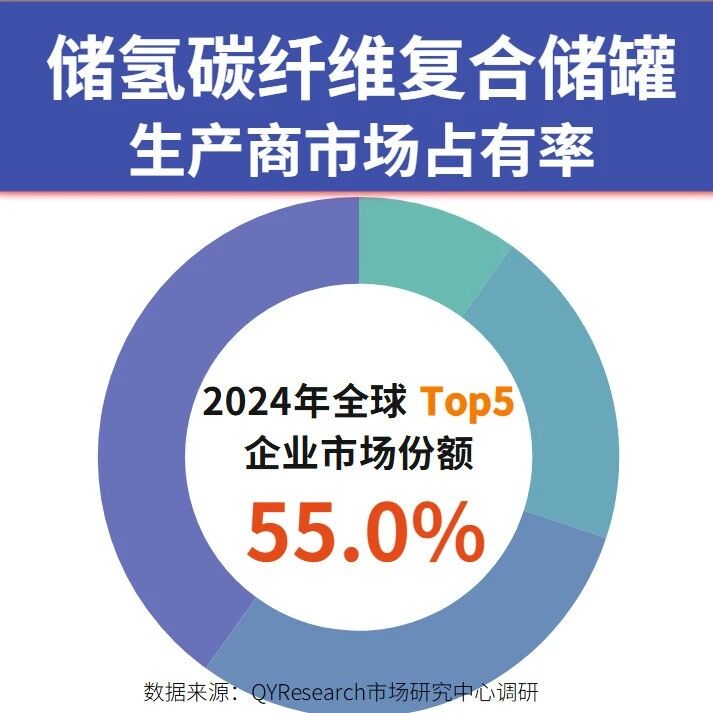
Core Viewpoint - Hydrogen storage carbon fiber composite tanks are critical equipment in the hydrogen energy industry, experiencing rapid growth amid global energy transition, with significant opportunities and challenges ahead [4][5]. Industry Development Overview - The hydrogen storage tank industry is currently dominated by Type III and Type IV tanks, primarily used in fuel cell vehicles. The industry is growing rapidly, with leading positions held by the US, Europe, Japan, and South Korea, while Chinese companies are catching up [4]. - The industry faces high technical barriers and cost pressures, with a diverse competitive landscape where international giants dominate the high-end market, and Chinese firms are gradually increasing their market share supported by government initiatives [4]. - The supply chain shows structural imbalances, particularly in high-performance carbon fiber production, which is heavily influenced by international trade policies. The manufacturing technology for hydrogen tanks is complex and requires high precision across multiple disciplines [4][9]. - Downstream applications are primarily in transportation but are expanding into fixed storage and gas distribution, with global tariff policy changes reshaping competitive dynamics and increasing uncertainty [4]. Market Demand Analysis - The demand for hydrogen storage tanks is closely linked to the sales performance of hydrogen fuel cell vehicles (FCEVs). However, the FCEV market is currently experiencing significant volatility, with global sales declining by 30.2% in 2023 and projected to drop another 21.6% in 2024 [6]. - In contrast, demand for hydrogen tanks in industrial, energy, and fixed transportation scenarios is showing a stable upward trend, indicating a shift away from reliance solely on FCEV sales [7]. Supply Chain Analysis - Key raw materials for hydrogen tanks include carbon fiber, valve components, and liner materials, with carbon fiber costs accounting for approximately 60%-70% of total production costs [9][10]. - Domestic companies in China are actively working to overcome technological barriers and accelerate the industrialization of carbon fiber to ensure supply chain security and reduce costs [10]. - The manufacturing segment is technology-intensive, with Type III and Type IV tanks being the primary products. Type IV tanks are expected to become the mainstream technology due to their advantages in lightweight and fatigue resistance [10]. Global Market Size and Company Rankings - The global hydrogen storage carbon fiber composite tank market is projected to reach $900 million by 2031, with a compound annual growth rate (CAGR) of 15.5% in the coming years [12]. - Major manufacturers in the global market include Hexagon Purus, ILJIN Hysolus, and Zhongcai Technology, with the top five companies holding approximately 55.0% of the market share [13]. - Type IV tanks currently represent about 50.2% of the market share, while commercial vehicles account for approximately 51.2% of demand [17][19].

上工申贝、光威复材成立航空器零部件公司
Zheng Quan Shi Bao Wang· 2025-12-19 03:17
人民财讯12月19日电,企查查APP显示,近日,上工飞人航空器零部件(威海)有限公司成立,法定代表 人为张雍,注册资本为8000万元,经营范围包含:民用航空器零部件设计和生产;高性能纤维及复合材 料制造;石墨及碳素制品制造;模具制造等。企查查股权穿透显示,该公司由上工申贝(600843)旗下 上工飞人通用航空(威海)有限公司、光威复材(300699)全资子公司威海光威能源新材料有限公司共同 持股。 ...

1—9月威海规上工业利润率6.9%
Qi Lu Wan Bao· 2025-12-17 09:46
Core Viewpoint - Weihai City is implementing an innovation-driven development strategy, focusing on industrial innovation as the core engine for industrial upgrading, particularly in advanced manufacturing, to enhance the quality and stability of its industrial economy [1] Group 1: Industrial Innovation and Economic Performance - Weihai's industrial revenue profit margin reached 6.9% from January to September 2025, exceeding the provincial average by 3.8 percentage points, showcasing the strong support of innovation-driven development for high-quality industrial growth [1] Group 2: Enterprise Innovation System - The city is accelerating the establishment of an enterprise-led innovation system, with 9 national-level and 40 provincial-level technology innovation demonstration enterprises, and 144 provincial-level and 415 municipal-level "one enterprise, one technology" R&D centers [2] - During the 14th Five-Year Plan period, 1,021 provincial-level enterprise technology innovation projects were implemented, leading to significant breakthroughs in key technologies, such as high-strength carbon fiber production and autonomous control of core technologies in image sensors [2] Group 3: Innovation Support Platforms - Weihai has built 229 provincial-level and above technology innovation platforms in the industrial and information sectors, achieving full coverage of 10 key industrial chains [3] - The establishment of a pilot platform for carbon fiber and composite materials has been recognized as one of the first manufacturing pilot platforms in the province, facilitating the transition of cutting-edge technologies from laboratories to production lines [3] Group 4: Regional Innovation Ecosystem - The city is fostering a collaborative innovation ecosystem by integrating government, industry, academia, research, finance, and services, breaking down resource barriers to enhance the flow of innovation elements [4] - A specialized enterprise acceleration center has been established to provide comprehensive services from technology R&D to financing support, integrating over 60 professional institutions [4] Group 5: Future Directions - Weihai's industrial and information technology bureau plans to continue deepening the innovation-driven development strategy, optimizing the innovation ecosystem, and enhancing platform support to further elevate industrial innovation capabilities [5]