
诺力股份

Search documents
2025年中国无人叉车行业发展历程、产业链图谱、销量及发展趋势研判:市场渗透率较低,呈现出多元化竞争格局,发展前景广阔 [图]
Chan Ye Xin Xi Wang· 2025-07-18 01:20
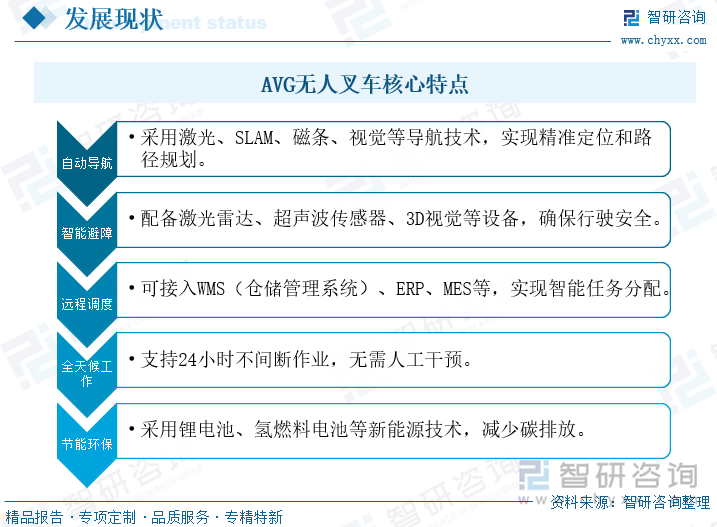
Industry Overview - The AVG (Automated Guided Vehicle) forklift operates autonomously without human intervention, utilizing navigation systems for tasks such as material handling, loading, and stacking in warehouses and logistics centers, thereby enhancing operational efficiency [1][2][18] - In 2024, the sales volume of AGV forklifts reached 4,576 units, marking a 98.61% increase from 2,304 units in the previous year, with specific sales of electric balance forklifts at 121 units, electric ride-on warehouse forklifts at 1,711 units, and electric walk-behind warehouse forklifts at 2,744 units [1][18] Industry Development History - The development of AGV technology dates back over 60 years, originating in the United States and later spreading to Europe and Japan, where it evolved towards modular and simplified designs [5][6] - China's AGV industry, despite its late start, has shown remarkable growth, with significant advancements in technology and market validation since the 1970s [6] Industry Chain - The AGV forklift industry chain consists of upstream component manufacturers (motors, reducers, controllers, sensors), midstream manufacturers and system integrators, and downstream application sectors such as warehousing and industrial manufacturing [9][11] Current Market Status - In 2024, the total sales of industrial vehicles in China reached 1.2855 million units, a year-on-year increase of 9.52%, indicating a mature stage in the forklift industry characterized by high competition and a focus on scale advantages and cost control [16] - The market is currently dominated by a duopoly between Anhui Heli and Hangcha Group, with a trend towards the development of new energy and unmanned forklifts [16] Competitive Landscape - The AGV forklift market features a diverse competitive landscape with six main types of players, including dedicated AGV developers, traditional forklift manufacturers, and logistics integrators, indicating a shift from single-manufacturer dominance to a technology-driven, collaborative industry structure [20] Future Trends - The market for AGV forklifts is expected to continue expanding, driven by factors such as labor cost increases and the need for automation in high-risk environments [23] - The integration of AI and 5G technologies is anticipated to enhance automation processes, with AI algorithms improving path optimization and 5G enabling remote operation and coordination [25][24] - Policy initiatives are promoting the intelligent and green development of forklifts, with local governments providing incentives to reduce transformation costs [26]


浙江传统产业向新突围
Xin Hua Wang· 2025-07-17 02:47
Group 1 - The 2025 Hangzhou International Humanoid Robot and Robotics Technology Exhibition showcased many companies from traditional sectors like bearings and motors, reflecting the strong development momentum of traditional industries in Zhejiang [1] - From January to May, the industrial added value of 17 key traditional manufacturing industries in Zhejiang increased by 6.6% year-on-year, accounting for 55.6% of the province's total industrial added value [1] - Zhejiang has issued measures to support the renewal and development of traditional industries, emphasizing that traditional industries can coexist and promote new productive forces [1] Group 2 - Companies like Noli Intelligent Equipment Co., Ltd. are innovating by integrating AI and automation into their products, such as advanced forklifts that can navigate autonomously [2] - Zhejiang Meixinda Textile Printing and Dyeing Technology Co., Ltd. has adopted a culture of "full staff innovation," increasing R&D investment from 3% to 6.1% of revenue, leading to significant product advancements [3][4] - Traditional industries in Zhejiang are increasingly adopting cutting-edge technologies like big data and AI to transform their production processes and business models [4] Group 3 - Zhejiang Changsheng Sliding Bearing Co., Ltd. has successfully transitioned from a traditional enterprise to a player in the emerging market of humanoid robots by developing key components [5] - Traditional enterprises face three main challenges in their transformation: breaking habitual thinking, acquiring talent, and achieving integration of new technologies [6][7] - The integration of AI and traditional manufacturing processes is crucial for enhancing productivity and competitiveness in Zhejiang's traditional industries [8] Group 4 - The average labor productivity in Zhejiang's traditional manufacturing sector is 261,000 yuan per person, lower than the overall industrial average of 291,000 yuan [9] - Companies are encouraged to leverage technological and industrial innovations to create new growth opportunities and improve their market positions [9][10] - The government has initiated reforms to enhance collaboration between enterprises and research institutions, facilitating the commercialization of innovative technologies [10] Group 5 - In Shaoxing, the local government is promoting advanced technologies in the printing and dyeing industry, resulting in a 30% increase in product added value through the adoption of digital printing [11] - Zhejiang has organized over 200 investment and financing roadshows this year, facilitating financing of over 3.4 billion yuan to support the transformation of small and medium-sized enterprises [12] - The government aims to provide long-term support and confidence to traditional industries to help them rejuvenate and thrive in the new economic landscape [12]



叉车销量数据点评报告:6月内外销高增长,关注叉车投资机会
CHINA DRAGON SECURITIES· 2025-07-16 09:14
Investment Rating - The investment rating for the forklift industry is "Recommended (Maintain)" [5] Core Viewpoints - Forklift sales in June 2025 showed significant growth, with total sales reaching 137,570 units, a year-on-year increase of 23.1%. Domestic sales were 83,892 units, up 27.3%, while exports were 53,678 units, increasing by 17.2% [7] - Cumulative forklift sales from January to June 2025 totaled 739,334 units, reflecting an 11.7% year-on-year growth. Domestic sales accounted for 476,382 units, a 9.79% increase, and exports reached 262,952 units, up 15.2% [7] - The forklift industry is expected to benefit from a low base effect in the second half of 2024, leading to a sustained increase in domestic sales growth, which will positively impact valuations [7] - The advancement of artificial intelligence and automation technologies is driving the forklift industry towards smart and unmanned upgrades, with higher-priced unmanned forklifts expected to enhance industry profitability as penetration rates increase [7] - The overall valuation of the industry is currently low, providing a safety margin for investors [7] Summary by Relevant Sections - **Sales Data**: In June 2025, excluding electric walk-behind warehouse vehicles, 53,266 forklifts were sold, marking a 14.5% year-on-year increase. Domestic sales were 34,899 units, up 15.3%, and exports were 18,367 units, increasing by 13% [7] - **Investment Recommendations**: Companies to focus on include Anhui Heli, Hangcha Group, and Noli Forklift, which are expected to perform well in the current market environment [7][8]
招商证券:无人叉车渗透率提升趋势确定性高 行业有望迎结构性机遇
智通财经网· 2025-07-15 08:21
Core Viewpoint - The traditional forklift industry is maturing, and the focus is shifting towards intelligent products, particularly unmanned forklifts, which are expected to drive structural opportunities in the sector due to reasonable costs, continuous technological upgrades, and expanding applications [1] Group 1: Market Trends - The sales of unmanned forklifts in China increased from 300 units in 2015 to 19,500 units in 2023, with a CAGR of 68.51%, indicating significant growth potential despite a current penetration rate of only 1.66% in the traditional forklift market [2] - The economic benefits of unmanned forklifts are highlighted by a price drop from 600,000 yuan per unit in 2018 to 220,000 yuan in 2023, with a payback period of 1 to 3 years and a lifespan of at least 15 years, showcasing their total cost of ownership advantages [2] Group 2: Technological Advancements - The integration of SLAM natural navigation and 5G+MEC edge computing has enhanced the intelligence and operational capabilities of unmanned forklifts, with AMR (SLAM) accounting for 75% of the market share in 2023 [3] - Future developments are expected to lead unmanned forklifts towards full flexible operational capabilities and comprehensive coverage across various industrial scenarios [3] Group 3: Competitive Landscape - Key players in the unmanned forklift industry include traditional forklift leaders like Anhui Heli and Hangcha Group, as well as AGV/AMR leaders like Hikvision and Geek+; the market is relatively fragmented with only 11 companies exceeding 100 million yuan in scale [4] - The business models differ between traditional forklift companies, which focus on product sales, and AGV/AMR companies, which emphasize intelligent logistics solutions, impacting their asset structures and cash flow cycles [4][5] Group 4: Market Applications - The warehousing and logistics sector is currently the primary application area for unmanned forklifts due to its standardization and scalability, while industrial manufacturing presents greater challenges but also larger market opportunities [6] - International markets offer better commercial logic and higher profit margins for unmanned forklifts, with companies like Geek+ expected to achieve a gross margin of 46.5% overseas in 2024, highlighting the importance of global expansion for competitive advantage [6]

上周公募调研热情显著攀升 乐鑫科技最受关注
Zhong Guo Jin Rong Xin Xi Wang· 2025-07-15 07:26
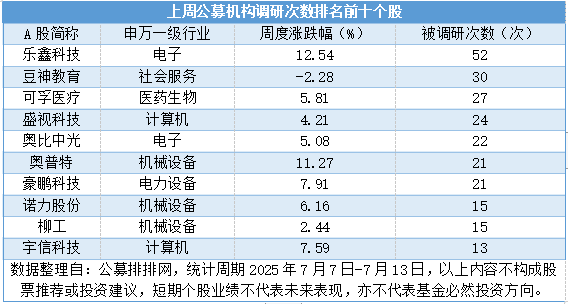
Group 1 - The A-share market has successfully broken through the 3500-point mark, leading to increased enthusiasm among investors and a rise in public fund research activities [1] - A total of 127 public fund institutions participated in A-share research activities last week, covering 116 stocks across 25 Shenwan primary industries, with a total of 618 research instances, representing a 24.35% increase from the previous week [1][2] - The electronics sector, particularly Lexin Technology, received significant attention, being researched 52 times, making it the most focused stock by public funds last week [1][2] Group 2 - The top ten stocks researched by public funds last week were concentrated in specific industries, with notable representation from the electronics, computer, and machinery equipment sectors [1][2] - The computer industry saw Shengshi Technology researched 24 times, ranking fourth, while Yuxin Technology was researched 13 times, ranking tenth [1][2] - The machinery equipment sector included three stocks in the top ten: Aopute, Noli Co., and Liugong, with research instances of 21, 15, and 15 respectively [1][2] Group 3 - The pharmaceutical and electronics industries led in research instances, with the pharmaceutical sector being researched 105 times across 16 stocks, including notable performers like Nami Technology and Kefu Medical [3] - The electronics sector was researched 103 times, covering 11 stocks, including Lexin Technology and Rijiu Optoelectronics, which also showed good performance [3] - The machinery equipment industry had 12 stocks researched a total of 72 times, including Aopute and Noli Co., which performed well in the market [3]

无人系列专题报告(一):智慧物流东风起,无人叉车晓将至
CMS· 2025-07-15 06:34
Investment Rating - The report maintains a "Buy" recommendation for the industry, highlighting the potential for significant growth in the adoption of unmanned forklifts as part of the smart logistics trend [6]. Core Insights - The rise of SLAM natural navigation technology is driving the transition from simple automation to autonomous intelligence in on-site logistics, with unmanned forklifts representing a leading product in this commercial evolution [1][2]. - The penetration rate of unmanned forklifts in traditional forklift markets is currently low at 1.66%, indicating substantial room for growth and replacement opportunities [2][42]. - The industry is characterized by a diverse competitive landscape, with major players including traditional forklift manufacturers and AGV/AMR companies, leading to a relatively fragmented market [2][6]. Summary by Sections 1. Current Development of Unmanned Forklifts - Unmanned forklifts are a fusion of forklift and AGV technologies, evolving from basic automated guided vehicles to more intelligent autonomous mobile robots (AMR) [1][13]. - The industry has a rich history of over 70 years, with significant advancements in navigation technology since 2010 [1][27]. 2. Factors Driving Penetration of Unmanned Forklifts - Economic benefits, technological advancements, and supportive policies are the three main drivers for the rapid increase in the penetration rate of unmanned forklifts [2][50]. - The sales volume of unmanned forklifts in China surged from 300 units in 2015 to 19,500 units in 2023, with a CAGR of 68.51% [2][38]. 3. Competitive Landscape - The competitive landscape features both traditional forklift companies and AGV/AMR firms, with a market concentration that remains relatively low [2][6]. - Key players include Anhui Heli, Hangcha Group, and Zhongli Group among traditional manufacturers, and Hikvision Robotics and Xian Gong Intelligent among AGV/AMR leaders [2][6]. 4. Investment Recommendations - The report suggests focusing on traditional forklift leaders and emerging AGV/AMR companies as potential investment opportunities, given the expected rise in unmanned forklift adoption [6][2].


国内机器人落地,关注无人叉车垂直应用
2025-07-15 01:58
Summary of Conference Call on Domestic Robotics Industry Industry Overview - The domestic robotics industry, particularly humanoid robots, is experiencing significant attention and investment, especially in vertical applications such as elderly care, cleaning, and companionship, indicating a rapid commercialization of humanoid robots in China [1][3] - China's manufacturing capabilities in general manufacturing, high-end equipment, and new energy technologies provide strong support for cost reduction and implementation of humanoid robots [4] - The humanoid robot sector is entering a practical application phase, as evidenced by the recent contract awarded to Zhiyuan Robotics and Yushu Robotics by China Mobile, with a total package amount of 124 million yuan [5] Key Insights and Arguments - The first half of 2023 saw a doubling of financing for humanoid robots compared to May, with a focus on projects that can establish a commercial closed loop [3] - The rise in A-share risk appetite is attributed to improved national governance, recognition of new economic drivers, and better performance in the real economy, which has positively impacted AI-related sectors, including humanoid robots [7] - Despite concerns over delays due to tariff impacts and factory inspections, the industry is transitioning from hardware to software adjustments and practical applications, marking a new phase of development [8] Important Events and Catalysts - Key upcoming events that may drive the humanoid robot sector include Tesla's shareholder meeting on July 24, where Elon Musk is expected to discuss robot development prospects, and the World Artificial Intelligence Conference in Shanghai on July 26, which will showcase humanoid robots as a significant application of AI [9] - The market's acceptance and support for humanoid robots are strong, with expectations that human-robot interaction technologies will gradually meet service requirements [6] Investment Recommendations - Investors are advised to focus on companies within the domestic humanoid robot supply chain, such as Zhiyuan and Yushu, as well as the unmanned forklift sector, which has a stable business foundation and potential for commercial closure [2][10] - The unmanned forklift market is expected to thrive, with companies like Anhui Heli and Hangcha Group making significant investments, and it is projected to benefit from economic growth and advancements in embodied intelligence technology [10]

解码传统制造业跨界跃迁“浙江样本”
Zhong Guo Zheng Quan Bao· 2025-07-14 20:55
Core Viewpoint - The entry of Zhiyuan Robotics into the Sci-Tech Innovation Board-listed company, Shuangwei New Materials, has attracted significant attention in the capital market, highlighting a collective leap of Zhejiang automotive parts companies into the humanoid robotics industry, aiming for high-quality development and a new growth curve [1][2]. Group 1: Industry Transition - Zhejiang Province has over 100 humanoid robotics-related companies, with more than 40 listed on the A-share market, indicating a robust shift from automotive manufacturing to humanoid robotics assembly [2]. - Companies like Xiash Precision and Junsheng Electronics are strategically pivoting towards humanoid robotics as a second growth curve, leveraging their existing automotive parts expertise [2][4]. - The humanoid robotics industry is seen as a new growth space, with companies like Shuanglin Co. and Wanliyang actively developing core components to tap into a market worth hundreds of billions [2][4]. Group 2: Technological Synergy - The transition of Zhejiang automotive parts companies to humanoid robotics is facilitated by the technological similarities in precision manufacturing, power control, and sensor integration, allowing for cost-effective R&D [7][11]. - Companies are utilizing existing production equipment and supply chains from the automotive sector to minimize costs and risks associated with entering the humanoid robotics market [9][11]. - The collaboration with leading automotive manufacturers enhances the supply chain and accelerates the development of humanoid robotics components [8][9]. Group 3: Market Potential - The humanoid robotics market is projected to experience explosive growth, with global sales expected to reach 1.24 million units by 2025 and over 500 million units by 2035, indicating a significant opportunity for companies in this sector [4][5]. - The aging population and labor shortages in manufacturing are driving the demand for humanoid robots, further solidifying the market's potential [6]. Group 4: Policy Support and Ecosystem - The Zhejiang government is providing targeted policy support to facilitate the transition of traditional manufacturing to future industries, emphasizing a collaborative approach between enterprises, academia, and research institutions [13][14]. - The establishment of a comprehensive ecosystem that includes supply chain collaboration and technological innovation is crucial for the successful transition of companies into the humanoid robotics sector [12][14].




A拆H继续升温,又有多家巨头子公司递表港股
2 1 Shi Ji Jing Ji Bao Dao· 2025-07-14 10:03
Core Viewpoint - The trend of A-share companies spinning off subsidiaries for listing in Hong Kong (referred to as "A拆H") is gaining momentum, driven by the cooling of the A-share IPO market and the warming of the Hong Kong market [1][2]. Group 1: Recent Developments - Weichai Power's subsidiary, Weichai Lovol, has submitted a prospectus to the Hong Kong Stock Exchange for a main board listing, following a previous unsuccessful attempt for an IPO on the Shenzhen Stock Exchange [1]. - Since the beginning of 2024, several A-share companies, including Zijin Mining, GoerTek, Noli Co., and Midea Group, have announced plans to spin off subsidiaries for listing in Hong Kong [1][2]. - As of the previous year, seven A-share companies have announced clear plans for spinning off subsidiaries to list on the Hong Kong main board [2]. Group 2: Financial Performance of Spin-off Candidates - GoerTek's subsidiary, Goer Micro, reported revenues of 3.348 billion yuan, 3.125 billion yuan, and 3.015 billion yuan from 2021 to 2023, with net profits of 329 million yuan, 326 million yuan, and 226 million yuan respectively [3]. - Midea Group's subsidiary, Ande Intelligent, achieved revenues of 14.189 billion yuan, 16.224 billion yuan, and 18.663 billion yuan from 2022 to 2024, with net profits of 215 million yuan, 288 million yuan, and 380 million yuan respectively [4]. - Zijin Mining's subsidiary, Zijin Gold International, reported revenues of approximately 1.818 billion USD, 2.262 billion USD, and 2.990 billion USD from 2022 to 2024, with net profits of approximately 290 million USD, 322 million USD, and 621 million USD respectively [4]. Group 3: Market Dynamics and Future Outlook - The trend of A拆H is seen as a combination of capital arbitrage and strategic adjustment, allowing parent companies to focus on core businesses and shed non-core assets [1][2]. - The Hong Kong market's recent relaxation of listing restrictions for unprofitable tech companies has opened financing channels for companies like GoerTek [1]. - Analysts suggest that if the A-share IPO market recovers, it may divert some demand from the Hong Kong market, but the unique advantages of the Hong Kong market will still attract high-growth tech and resource companies [6].
诺力股份(603611) - 诺力股份投资者活动记录表
2025-07-13 07:45
编号:2025-005 | 投资者关系 | □特定对象调研 □分析师会议 | | --- | --- | | 活动类别 | □媒体采访 □业绩说明会 | | | □新闻发布会 □路演活动 | | | □现场参观 | | 参与单位名称 | 投资者电话沟通会 ☑其他 国泰海通欧阳天奕、陈竟聪、中邮保险资管高远、李柯宏、 | | 及人员姓名 | 汇百川基金武娇、 江海证券王金帅、华安保险张钰楠、 | | | 招商证券高杨洋、天弘基金郭芮、上海益菁潘江、招商证券徐叶、 | | | 上汽颀臻黄杨、鹏华基金张卓然、上海勤辰郑博宏、 | | | 鸿运私募张丽青、同泰基金董万江、海南佳岳薄琳琳、 | | | 摩根基金陶雨涛、国寿安保李丹、北京清和泉赵群翊、 | | | 招商研究部高杨洋、深圳市红筹乌焕强、上海递归于良涛、 | | | 广发银行葛小川、天弘基金郭芮、辽宁三弦王总、 | | | 深圳前海李凌飞、四川资本刘惠春、中航基金郑常斌 | | 时间 | 2025 年 7 月 10 日 | | 上市公司 | 金婉怡(证券事务代表)、戴文斌 | | 接待人员姓名 | | | | 问答: | | | Q:公司的叉车板块的产能分部 ...