欧莱雅

Search documents
未来10年,最挣钱的凭什么一定是这群人?
创业家· 2026-02-16 09:32
Core Insights - Amazon's report on global e-commerce trends highlights emerging consumer preferences and market opportunities, serving as a guide for businesses in product selection and strategy [1][2]. Group 1: AI-Driven Consumer Experience - The trend of "AI Quality Space" indicates that homes are evolving into emotionally interactive environments, with over 65% of consumers in Europe and the U.S. willing to spend more on smart home products [3][4]. - Consumers are seeking personalized experiences that cater to emotional needs, such as safety and comfort, which presents significant market opportunities for businesses that understand user demands [6][7]. Group 2: Sleep Economy - The "Dream Cabin" trend addresses the growing issue of sleep quality, with 37% of U.S. adults reporting a decline in sleep quality in 2023 [10]. - The sleep economy is expanding, with consumers willing to invest in products that enhance health and quality of life, including smart sleep monitoring devices and high-quality sleep environments [11][12]. Group 3: Workplace Happiness - The "Happy Office" trend reflects a shift in expectations for workspaces, emphasizing ergonomic designs and comfort to enhance productivity and well-being [13][14]. Group 4: Subtle Technology Integration - Consumers are increasingly favoring technology that seamlessly integrates into their lives, enhancing quality of life without being intrusive, as seen in brands like Apple [15]. Group 5: Pet Economy - The global pet industry is projected to grow by 45% over the next six years, with 55% of pet owners in Europe and Japan willing to spend more on pet healthcare and wellness products [16][17]. - Pets are becoming integral family members, leading to increased demand for personalized pet products and services that foster emotional connections [19]. Group 6: Outdoor Cooking - The trend of outdoor cooking is gaining popularity, driven by a desire for unique experiences in nature, leading to demand for professional outdoor cooking equipment and related products [20][21][22]. Group 7: Mobile Living Spaces - Vehicles are transforming into multifunctional spaces, serving as mobile homes or offices, with innovations in comfort and utility becoming key selling points for automotive companies [23][27]. Group 8: Generation Z Consumers - Generation Z, as digital natives, is becoming a significant consumer force, prioritizing values such as sustainability, personalization, and emotional engagement in their purchasing decisions [28][29][30]. Group 9: Health and Fitness - The focus on health remains paramount, with modern consumers seeking scientific, efficient, and enjoyable fitness solutions, supported by the rise of smart wearable devices and personalized fitness programs [31][34]. Group 10: Esports Market - The esports market is rapidly expanding, particularly in emerging markets, with consumers seeking high-performance equipment and immersive experiences [35][36][37]. Summary of Trends - The report identifies three key drivers of these trends: accelerated technology, emotional shifts, and lifestyle changes, reflecting the complex needs of contemporary consumers [39]. - Many new opportunities lie within fundamental human desires for a better quality of life, emphasizing the importance of understanding consumer behavior [40].



滨水商业“天花板”如何炼成
Sou Hu Cai Jing· 2026-02-16 01:24
西岸梦中心冬季活动。受访者供图 长期主义的取与舍 梦中心地块在十余年前仍是一片以水泥厂、火车站、仓储码头为主的传统工业岸线。上海世博会后,徐 汇滨江确定了"规划引领、文化先导、生态优先、科创主导"的发展路径,今日已成为引导西岸每一个文 商旅体展项目开发的"长期主义坚持"。 新春佳节,上海距离黄浦江最近的滨水商业体"Gate M西岸梦中心"将于2月20日至23日举办新春非遗市 集,邀请市民游客在"逛、吃、玩、购"间感受传统文化的生命力。 2024年9月,西岸梦中心开业。2025年,全年到访这里的客流超过1100万人次。这个基于"上海西岸"十 余载城市IP积淀的水岸商业项目,运营团队道出了"开业即成爆款",且热度持续攀升的缘由:始终保持 敏锐的商业嗅觉,用真诚的心充实文化内涵,以"徐汇滨江一盘棋"的视野实践全域共治……一个商业项 目的成功,从来都不只是"商业"一家的事。 四季经济打破"魔咒" 西岸梦中心开业一年就打破了户外商业"看天吃饭"的魔咒,打出了"四季经济"的消费品牌:春季,爵士 春天音乐节、野兽派花艺装置激活了滨江漫步体验;夏季,水岸音乐节、水岸电影节将夜间消费与文化 体验叠加放大;秋季,FISE极限运动 ...

滨水商业体“Gate M西岸梦中心”将于2月20日至23日举办新春非遗市集 全年1100万人次到访西岸梦中心 运营团队达成“开业即成爆款”
Jie Fang Ri Bao· 2026-02-16 00:07
记者 舒抒 "不论品牌大小,对于每一家入驻的商户,我们都会参与经营方向的规划,使其在梦中心的门店呈 现出有别于在其他项目的特色。"陈俭说。 长期主义的取与舍 新春佳节,上海距离黄浦江最近的滨水商业体"Gate M西岸梦中心"将于2月20日至23日举办新春非 遗市集,邀请市民游客在"逛、吃、玩、购"间感受传统文化的生命力。 2024年9月,西岸梦中心开业。2025年,全年到访这里的客流超过1100万人次。这个基于"上海西 岸"十余载城市IP积淀的水岸商业项目,运营团队道出了"开业即成爆款",且热度持续攀升的缘由:始 终保持敏锐的商业嗅觉,用真诚的心充实文化内涵,以"徐汇滨江一盘棋"的视野实践全域共治……一个 商业项目的成功,从来都不只是"商业"一家的事。 四季经济打破"魔咒" 西岸梦中心开业一年就打破了户外商业"看天吃饭"的魔咒,打出了"四季经济"的消费品牌:春季, 爵士春天音乐节、野兽派花艺装置激活了滨江漫步体验;夏季,水岸音乐节、水岸电影节将夜间消费与 文化体验叠加放大;秋季,FISE极限运动赛事与西岸艺博会形成跨圈层吸引力;冬季,"奇幻水岸嘉年 华"与大型户外冰场丰富了亲子与家庭客群的消费场景。 "不是在 ...
2026年,钱从哪挣?
创业家· 2026-02-15 09:33
Core Insights - The article discusses the challenges faced by companies in 2025, particularly the issue of insufficient domestic demand and the limited market capacity, leading to increased competition and the need for companies to explore international markets [4][5][6][7]. Group 1: Value Chain Expansion - Companies are encouraged to expand their value chains overseas, moving beyond mere product exports to include brand, research and development, and business models [8][11]. - An example is provided with Miniso, which engages with its private users to understand their preferences and directly opens stores abroad to enhance brand recognition [10][12][13]. Group 2: Collaborating with Industry Leaders - Many industry leaders are beginning to venture abroad, but successful international expansion requires integrating complex supply chain systems and collaborating with local partners [14][15][16]. - Tesla's operations in Shanghai illustrate this, as it relies on a network of local suppliers to optimize production efficiency [18][20][21]. Group 3: Leveraging Unique Advantages - Companies are finding success in international markets by leveraging unique advantages such as cost efficiency and product innovation [23][25][27]. - For instance, a factory owner in Yiwu capitalizes on higher overseas prices by selling on cross-border platforms, while Mech-Mind Robotics enhances industrial robots with advanced technology for complex tasks [26][28]. Group 4: Building Long-Term Trust - The article highlights the importance of building long-term trust within communities, as exemplified by the story of Pang Donglai, who prioritizes employee welfare and customer feedback to foster loyalty [31][34][36]. Group 5: Meeting Evolving Consumer Needs - There is a shift in consumer behavior towards valuing better experiences, with examples of services like travel photography gaining popularity among retirees [39][41]. - The article suggests that businesses should focus on creating scenarios that fulfill the aspirations of ordinary people for a better life, as traditional mass-market opportunities diminish [43][46].



高端美妆又行了,上海柜姐:每天“一车车”发货|新春走基层
Xin Lang Cai Jing· 2026-02-15 02:08
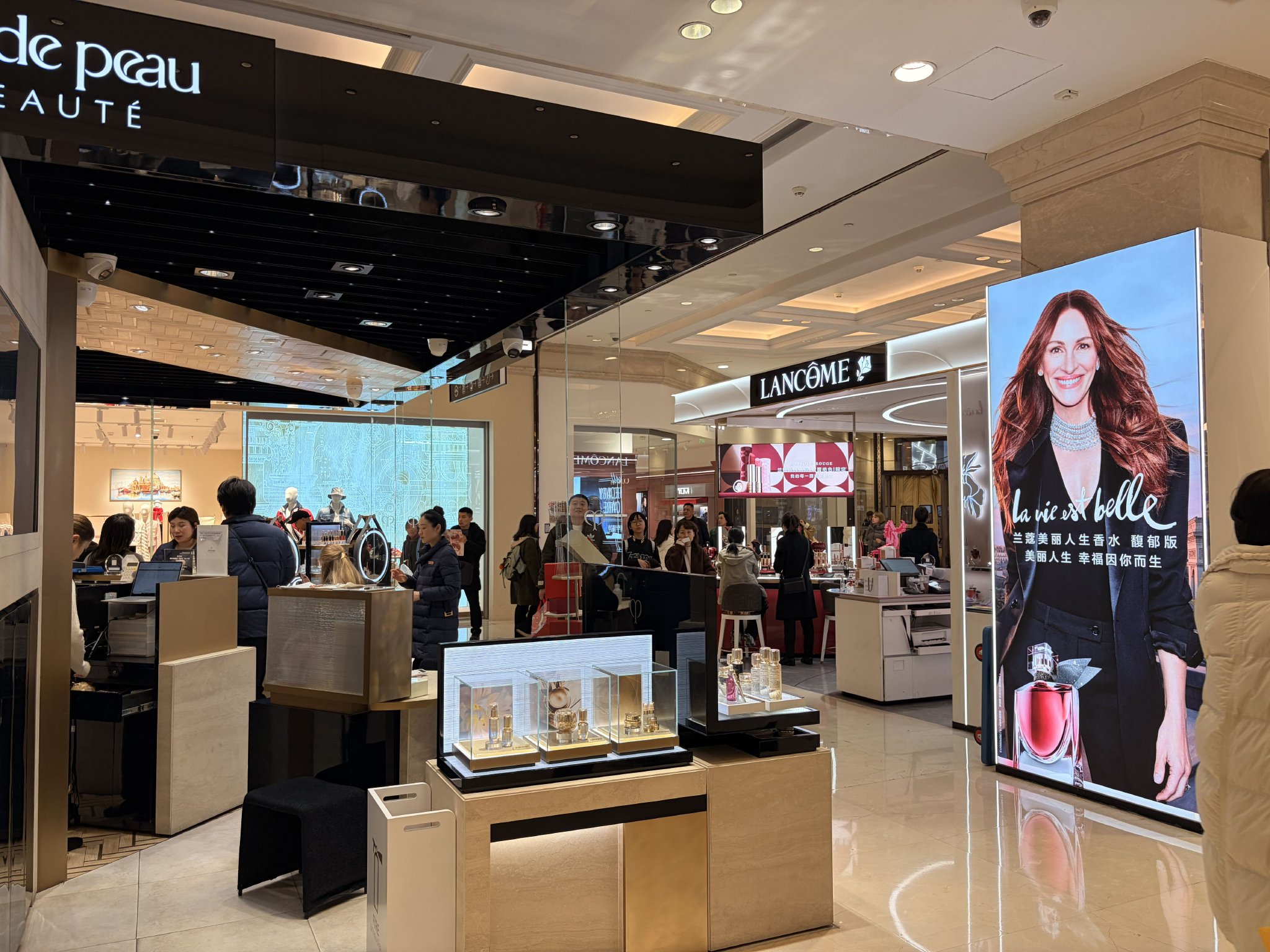
Core Viewpoint - The financial reports from major beauty groups indicate a recovery trend in China's high-end beauty market in the second half of 2025 [1] Group 1: Financial Performance and Market Trends - L'Oréal's sales growth in mainland China is projected to be 1% in the first half and 5% in the second half of 2025, contributing to growth in the North Asia region [2] - Estée Lauder and Shiseido have adjusted their financial reporting, with Estée Lauder separating mainland China from the Asia-Pacific market starting in Q2 2025, and Shiseido merging its China and travel retail businesses [2] - Estée Lauder's revenue growth in mainland China for Q2 to Q4 of 2025 is expected to be -2%, 9%, and 13% respectively, while Shiseido's comparable sales growth is projected at -14%, -7%, 8%, and 2% for the same quarters [2] - Bain & Company's report indicates that the beauty and personal care category will be the first to recover positive growth in 2025, while other luxury categories are still in a phase of decline [2] Group 2: Consumer Behavior and Market Dynamics - Increased consumer traffic in beauty sections of malls, particularly during the pre-Spring Festival period, indicates a rise in purchasing activity [3][4] - The beauty market is expected to rebound in 2025 after a slight decline in 2024, with a projected growth rate of 5.1% [7] - High-end brands are adjusting prices and inventory to facilitate recovery, with a notable shift of consumers from high-end to mass brands due to improved offerings and competitive pricing [11][17] Group 3: Product Innovation and Market Strategy - Major beauty brands are focusing on localized research and innovation in China, with L'Oréal, Estée Lauder, and Shiseido establishing R&D centers in Shanghai [19] - New product launches and collaborations, such as L'Oréal's partnership with Huashan Hospital and Shiseido's introduction of a new medical beauty brand, reflect a trend towards localized product development [20] - The market is shifting towards more specialized segments, such as scalp care and lip care, indicating a move from basic skincare to more refined personal care [12][13] Group 4: Long-term Market Outlook - The sustainability of current growth drivers, such as price reductions and niche market expansions, remains uncertain [14] - The beauty market is entering a phase of stock competition, with brands needing to enhance core competitiveness and adapt to changing consumer preferences [18] - The demand for high-end beauty products persists, but consumers are increasingly discerning, leading to a need for brands to align pricing with product value [17]


知行数据观察
知行战略咨询· 2026-02-14 06:12
DATA SPECIALITY REVIEW BENCHMARKING 知行数据观察 卸妆品类 知行合一集团 经营使命 以数为据,不让企业走弯路 尊重专业,凡是彻底 核心价值观 企业精神 对标找差距,复盘取机会 经营理念 客户的生意就是知行人的命 行业宏观市场调研 卸妆行业定义及分类 卸妆产品是专门用于清除面部及眼唇等部位彩妆、防晒霜、油脂性污染物和多余皮脂的清洁类化妆品,核心功能是通过特定配方 体系溶解或乳化附着于皮肤表面的脂溶性物质,同时兼顾温和性,避免过度刺激或损伤皮肤屏障。根据国家标准 GB/T 35914- 2018《卸妆油(液、乳、膏、霜)》,卸妆产品需具备安全、有效、温和的基本特性,适用于不同肤质与妆容类型。 配方体系 油剂体系 乳化体系 水剂体系 特殊体系 代表产品 卸妆油、卸妆膏 卸妆乳、卸妆霜 卸妆水、卸妆啫喱、 卸妆湿巾 水油分离卸妆液 (眼唇专用) 核心成分 油脂(矿物油、植物油、 合成酯)+ 乳化剂 水 + 油 + 乳化剂 水 + 表面活性剂 + 保湿剂 油相 + 水相 + 乳化剂 (不预先混合) 清洁原理 以油溶油 遇水乳化带走污垢 油溶油溶性彩妆,水溶水 溶性污垢,协同工作 表面 ...
2.14犀牛财经早报:“春躁”行情或将延续
Xi Niu Cai Jing· 2026-02-14 03:11
Group 1: Market Performance and Trends - The Shanghai Composite Index increased by 25.58% during the Year of the Snake, with the Shenzhen Component Index rising by 38.84%, the ChiNext Index by 58.73%, and the Sci-Tech Innovation Board Index by 64.20% [1] - Institutions predict that after the Spring Festival, the technology sector, particularly AI, is likely to regain its leading position in the market [1] - Historical data shows that the market generally performs well after the Spring Festival, with the Shanghai Composite Index rising in 7 out of the last 10 years during the first five trading days post-holiday [1] Group 2: Industry Developments - The precious metals market has entered a phase of consolidation after experiencing extreme volatility, with prices under pressure due to various macroeconomic factors [2] - Major automotive companies are increasingly investing in the robotics sector, with firms like Tesla and Chery transforming production lines to focus on robot manufacturing [2] - The pharmaceutical retail industry is undergoing a transformation driven by policy support, with a focus on industry consolidation and new business models [3] Group 3: Corporate News - Meituan expects a loss of approximately 23.3 billion to 24.3 billion yuan for the fiscal year 2025, a significant shift from a profit of about 35.8 billion yuan in 2024, primarily due to losses in its core local business segment [6] - Tianfeng Securities is under investigation by the China Securities Regulatory Commission for alleged violations related to financing and information disclosure [7] - Ningde Times, Luoyang Molybdenum, and Laopu Gold are set to be included in the Hong Kong Hang Seng Index, increasing the number of constituent stocks from 88 to 90 [8]
L’Oréal CEO Talks Skin Care, Travel Retail China and E-Commerce
Yahoo Finance· 2026-02-13 20:31
Core Insights - L'Oréal is focusing on innovation in skin care and aims to bridge health and beauty, with a strong emphasis on longevity science as a growth opportunity [1][6][20] - The company's skin care segment, despite being its largest category at 16.4 billion euros, showed minimal growth of 0.4% year-on-year, contrasting with stronger growth in makeup and hair care [2][5] - E-commerce has become a significant growth driver for L'Oréal, with sales reaching 13 billion euros, accounting for over 30% of total group sales, marking a substantial increase from previous years [9][11] Skin Care Performance - Skin care sales were flat in 2025, which is a concern for L'Oréal as it represents a major category [2] - The company is adjusting its strategies to enhance performance in skin care, particularly through innovation and media engagement [1][5] Regional Performance - North Asia's sales declined by 5% on a reported basis, despite a slight gain in like-for-like terms [4] - The travel retail market in Asia has been soft, particularly in Korea and mainland China, impacting overall sales [3][5] Strategic Partnerships and Acquisitions - L'Oréal announced a strategic partnership with Kering, acquiring the House of Creed and gaining exclusive licenses for Gucci, Bottega Veneta, and Balenciaga, valued at 4 billion euros [12][13] - The acquisition of a larger stake in Galderma will enhance L'Oréal's involvement in dermatology and aesthetics, allowing for better integration of strategies [18][19] Future Growth Opportunities - The company sees significant potential in the longevity market, with plans to introduce supplements and advanced beauty protocols [7][20] - L'Oréal aims to reach 2 billion consumers in the next decade, driven by trends in emerging markets and changing consumer behaviors [21]
整个社会都在喊没钱了,为什么这些公司反而年赚百亿?
创业家· 2026-02-13 10:10
Core Insights - The article discusses how certain industries are thriving despite a general perception of economic downturn, highlighting eight key sectors that present significant business opportunities in a low-desire society [3][4]. Group 1: Key Industries - **Second-Hand Economy**: The second-hand luxury market in Japan, represented by companies like Daikokuya, has seen a surge in revenue. In China, platforms like Hongbulin and Panghu are experiencing similar growth, indicating a shift in consumer spending towards second-hand goods [6][7][8][9]. - **Pet Economy**: With a decline in birth rates, young consumers are increasingly spending on pets, leading to significant growth in pet food and healthcare products. Companies like Inaba in Japan and Guobao in China are capitalizing on this trend [12][13][15][16]. - **Adult Care Products**: The adult diaper market in Japan has surpassed $10 billion, showcasing the potential of the aging population as a lucrative market segment [17][18][19]. - **Health Food and Beverages**: Changing demographics and rising health awareness have led to the growth of sugar-free beverages and functional foods in both Japan and China, with brands like Suntory and Dongpeng gaining traction [21][22]. - **Beauty and Aesthetic Products**: The demand for beauty products, including collagen supplements and at-home beauty devices, remains strong, indicating that consumers prioritize personal care even in economic downturns [23][24][26]. - **Outdoor Recreation**: Companies in the outdoor equipment sector, such as Snow Peak in Japan and various Chinese brands, are benefiting from increased interest in outdoor activities as a form of stress relief [29][31][32]. - **Convenience Economy**: The rise of frozen foods and smart home appliances reflects a shift towards convenience, with brands like Anjijia and Kewell seeing steady growth as consumers seek time-saving solutions [39][40][42]. - **Lazy Economy**: The trend of reduced cooking time among younger generations has led to a preference for ready-to-eat meals and smart appliances that automate household tasks, indicating a shift in consumer priorities [39][40][42]. Group 2: Market Dynamics - The article emphasizes that even in a low-desire economy, there are significant opportunities for those willing to invest in counter-cyclical sectors. Companies that can identify and act on these opportunities are likely to emerge as winners [44].



6天亏光90万,我劝普通人别做梦
创业家· 2026-02-13 10:10
Core Viewpoint - The article discusses the pitfalls and challenges faced by ordinary entrepreneurs in the food and beverage industry, highlighting the disparity between perceived opportunities and actual business viability [5][6][8]. Group 1: Entrepreneurial Challenges - Many entrepreneurs are drawn into the food and beverage sector by the allure of quick profits, but often find themselves in financially unsustainable situations [7][19]. - Examples include a young man who invested 1 million in a tea building but only made 800 yuan daily, leading to significant losses [19][24]. - A bakery owner in Shandong spent 20 million on equipment and renovations but only achieved a daily revenue of 1,000 yuan, resulting in substantial debt [22][24]. Group 2: Misleading Business Models - The article highlights the prevalence of "fast recruitment companies" that exploit aspiring entrepreneurs by promoting seemingly lucrative franchise opportunities without proper vetting [47][49]. - Many individuals fall victim to scams, believing in low investment and high returns, only to face financial ruin [61][49]. - The narrative includes a case where a woman lost 90 million after being misled into opening a franchise without any operational support from the headquarters [43][46]. Group 3: Cultural and Market Misalignment - The article emphasizes the disconnect between cultural aspirations and market realities, as seen in the case of a restaurant owner who focused on brand culture rather than product viability [11][13]. - Entrepreneurs often overlook essential business metrics such as gross margin and customer traffic, leading to poor decision-making [41][57]. - The rise of social media and influencer culture has exacerbated unrealistic expectations among aspiring business owners, pushing them towards high-risk ventures [61][53].