路斯股份

Search documents
宠物行业专题:2025年行业规模增长4.1%,进入高质量增长
GOLDEN SUN SECURITIES· 2026-01-21 09:20
Investment Rating - The report maintains an "Accumulate" rating for the pet industry [4] Core Insights - The pet industry is expected to grow at a rate of 4.1% in 2025, marking a transition to high-quality growth, with the market size reaching 312.6 billion yuan [9][10] - The number of pet dogs and cats is increasing, with a year-on-year growth of 1.8%, and the average annual spending per dog and cat is also rising [10][14] - The trend of younger pet owners is driving the industry towards high-quality development, with 90s and 00s generations becoming the main consumer groups [14] Summary by Sections 1. Industry Scale - The pet industry market size is projected to reach 312.6 billion yuan in 2025, growing by 4.1% compared to 2024 [9] - The dog market is expected to reach 160.6 billion yuan, while the cat market is projected to reach 152.0 billion yuan, with respective growth rates of 3.2% and 5.2% [9] - By 2028, the market size is anticipated to reach 405.0 billion yuan [9] 2. Market Dynamics - The market is characterized by a "stronger getting stronger" trend, with domestic brands gaining market share [20] - In the 2025 Double Eleven shopping festival, domestic brands accounted for over 70% of the market share, and the top 10 brands on Tmall reached a concentration ratio of 44% [20] - Online channels, particularly Tmall, remain the largest market, accounting for 29% of the total market share, while offline channels like pet stores and hospitals account for 33% [22] 3. Trends - There is a significant shift towards scientific feeding practices, with 55.3% of pet owners willing to learn about scientific feeding methods [40] - The trend of wet food consumption is accelerating, with notable growth in various categories such as cat freeze-dried food and dog baked food [40] - The demand for specialized pet food for different life stages and sizes is increasing, particularly for senior dogs, which saw a sales increase of 67% in 2024 [45]
饲料板块1月21日跌0.69%,傲农生物领跌,主力资金净流出9594.33万元
Zheng Xing Xing Ye Ri Bao· 2026-01-21 08:48
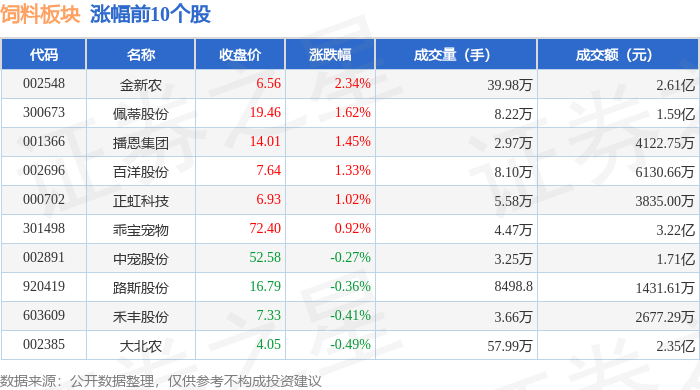
Market Overview - The feed sector experienced a decline of 0.69% on January 21, with Aonong Biological leading the drop [1] - The Shanghai Composite Index closed at 4116.94, up 0.08%, while the Shenzhen Component Index closed at 14255.12, up 0.7% [1] Individual Stock Performance - Jin Xin Nong (002548) closed at 6.56, up 2.34% with a trading volume of 399,800 shares and a transaction value of 261 million [1] - Petty Holdings (300673) closed at 19.46, up 1.62% with a trading volume of 82,200 shares and a transaction value of 159 million [1] - Aonong Biological (603363) closed at 4.27, down 1.84% with a trading volume of 430,600 shares and a transaction value of 184 million [2] - Other notable declines include Tian Kang Biological (002100) down 1.26% and Hai Da Group (002311) down 1.17% [2] Capital Flow Analysis - The feed sector saw a net outflow of 95.94 million from institutional investors, while retail investors had a net inflow of 63.31 million [2] - The capital flow for individual stocks shows Jin Xin Nong with a net inflow of 21.61 million from institutional investors, while Aonong Biological had a net outflow of 1.32 million [3] - Petty Holdings experienced a net outflow of 1.99 million from institutional investors but a net inflow of 6.27 million from retail investors [3]


北交所周报(1.12-1.16):北交所本周量能放大,指数冲高回落
ZHONGTAI SECURITIES· 2026-01-21 07:25
北交所本周量能放大,指数冲高回落 ——北交所周报(1.12-1.16) 评级: 增持(维持) 分析师:冯胜 执业证书编号:S0740519050004 Email:fengsheng@zts.com.cn 分析师:宋瀚清 执业证书编号:S0740524060001 报告摘要 北交所行情概览: 1)整体行情:截至 2026 年 1 月 16 日,北证成份股 288 个,平均市值 32.69 亿元。 本周(2026 年 1 月 12 日-2026 年 1 月 16 日,下同)北证 50 指数涨跌幅 1.58%,收 盘 1548.32 点;同期沪深 300 和上证指数涨跌幅分别为-0.57%和-0.45%。本周北交 所日均成交额为 409.81 亿元,较上周(2026 年 1 月 5 日-2025 年 1 月 9 日,下同) 上升 55.52%;本周日均换手率为 7.89%,较上周增加 2.82pcts。 Email:songhq01@zts.com.cn 北交所基本状况 | 上市公司数 | 288 | | --- | --- | | 行业总市值(亿元) | 9,285.86 | | 行业流通市值(亿元) | 5, ...
华源晨会精粹20260120-20260120
Hua Yuan Zheng Quan· 2026-01-20 12:16
Group 1: Emotional Economy and New Consumption Trends - The emotional economy in China is expected to exceed 2 trillion yuan in market size by 2024, with a projected CAGR of 21% from 2025 to 2030 for the trendy toy economy [2][7] - The pet economy is anticipated to surpass 1 trillion yuan by 2027, driven by emotional attachment and companionship needs [2][9] - The fragrance economy is projected to grow at a CAGR of 15% from 2018 to 2024, with emotional benefits outweighing functional needs [2][10] Group 2: Egg Processing Industry - The egg processing market in China is expected to exceed 50 billion yuan in 2024, with a year-on-year growth rate of 7% [2][12] - The current processing ratio of eggs in China is only 5%-7%, compared to 50% in Japan, indicating significant growth potential [2][12] - Euf Egg Industry, a leading company in the egg processing sector, reported a revenue of 674 million yuan in Q1-Q3 2025, with a net profit of 66.13 million yuan, reflecting a year-on-year increase of 29.77% [2][12] Group 3: Real Estate Market Developments - Recent policies include the extension of personal income tax incentives for housing purchases and a reduction in the down payment ratio for commercial properties to 30% [2][19] - In the week of January 10-16, new home transactions in 42 key cities increased by 6.3% compared to the previous week, while second-hand home transactions rose by 4.9% [2][18] - The real estate sector has seen a decline of 3.5% in the week, with significant fluctuations in individual stock performances [2][17] Group 4: Power Generation and Renewable Energy - China Resources Power reported a 7% year-on-year increase in electricity sales, reaching 226.8 billion kWh in 2025 [2][23] - The company expects significant growth in renewable energy installations, with a target of 10 GW for 2025, which will enhance its performance during industry downturns [2][26] - The anticipated decline in coal prices and the introduction of new market mechanisms may create challenges for the power sector in 2026 [2][25]

一文读懂中国宠物经济地图|这些地方搞定了1.2亿“毛孩子”的幸福生活
Nan Fang Nong Cun Bao· 2026-01-20 10:02
Core Insights - The pet economy in China is rapidly expanding, with the market expected to exceed 811.4 billion yuan by 2025, and the urban pet population reaching 120 million [2][6]. Group 1: Industry Overview - The pet economy has evolved from mere companionship to a lifestyle, creating a vast ecosystem around the entire lifecycle of pets [5][6]. - The geographical distribution and specialization within the pet industry have developed into a national framework, with significant contributions from various regions [6][7]. Group 2: Regional Highlights - Liaoning Anshan is emerging as a major hub for pet breeding, supplying over 60% of the national pet dog and cat population, with an industry scale exceeding 10 billion yuan [18][19][20]. - Hebei and Shandong are recognized as the primary pet food production areas, with a projected 14% increase in pet food shipment volume by 2025 [30][31]. - The Yangtze River Delta is positioned as the "universe center" for pet supplies, leveraging its supply chain advantages and manufacturing capabilities [49][50]. Group 3: Emerging Trends - The pet vaccine sector is witnessing significant growth, with companies like Princely and Jinhe Bio reporting substantial revenue increases, indicating a burgeoning market for pet health products [78][86]. - The smart pet products market is projected to surpass 10.2 billion yuan, driven by advancements in AI and e-commerce integration [91][92]. - The "pet+" trend is gaining traction, with services like pet transportation and photography experiencing exponential growth, reflecting a shift towards emotional spending in pet ownership [106][108]. Group 4: Infrastructure and Services - Guangzhou Baiyun Airport has become the first pet-friendly airport in China, facilitating easier travel for pet owners [120][129]. - The development of pet-friendly cities and services is on the rise, enhancing the overall experience for pet owners and their pets [116][118].



饲料板块1月20日跌0.59%,天马科技领跌,主力资金净流出3544.89万元
Zheng Xing Xing Ye Ri Bao· 2026-01-20 08:51
Group 1 - The feed sector experienced a decline of 0.59% on January 20, with Tianma Technology leading the drop [1] - The Shanghai Composite Index closed at 4113.65, down 0.01%, while the Shenzhen Component Index closed at 14155.63, down 0.97% [1] - Notable gainers in the feed sector included Aonong Biological, which rose by 3.08% to a closing price of 4.35, and Kesi Thought, which increased by 1.66% to 7.94 [1] Group 2 - Tianma Technology saw a significant decline of 3.57%, closing at 15.66, with a trading volume of 162,400 shares and a transaction value of 258 million [2] - Other notable decliners included Jin Xin Nong, down 2.14% to 6.41, and Peidi Co., down 1.59% to 19.15 [2] - The feed sector experienced a net outflow of 35.44 million from main funds, while retail investors saw a net inflow of 20.64 million [2] Group 3 - Aonong Biological had a net inflow of 27.32 million from main funds, representing 7.51% of its trading volume, while it faced a net outflow of 14.44 million from retail investors [3] - The net inflow for Guai Bao Pet was 9.77 million from main funds, with a net outflow of 1.67 million from retail investors [3] - The overall trend showed that while main funds were withdrawing, retail investors were actively buying into certain stocks within the feed sector [3]


北交所双周报(1.5-1.16):北交所开年持续上涨,三大交易所上调融资保证金比例
ZHONGTAI SECURITIES· 2026-01-20 07:30
Investment Rating - The report maintains an "Accumulate" rating for the industry [1] Core Insights - The overall market performance of the North Exchange shows a significant increase, with the North 50 Index rising by 7.49% during the period from January 5 to January 16, 2026, closing at 1548.33 points. In comparison, the Shanghai and Shenzhen 300, ChiNext, and Sci-Tech 50 indices increased by 2.20%, 4.93%, and 12.64%, respectively [4][10] - The average market capitalization of the 288 constituent stocks in the North Exchange is 32.69 billion yuan, with a total market value of 941.449 billion yuan and a circulating market value of 573.460 billion yuan [1][4] - The daily average trading volume during this period reached 331.61 billion yuan, representing a 67.96% increase compared to the previous period [4][12] Summary by Sections North Exchange Market Overview - As of January 16, 2026, the North Exchange has 288 listed companies, with an average market capitalization of 32.69 billion yuan. The North 50 Index increased by 7.49% during the specified period [4][10] - The daily average trading volume was 331.61 billion yuan, with a turnover rate of 6.62%, which is an increase of 2.30 percentage points from the previous period [12][13] North Exchange Sector Performance - The top five performing sectors in the North Exchange during this period were Media (45.09%), Oil and Petrochemicals (22.23%), Non-ferrous Metals (16.87%), Automotive (14.64%), and Communications (13.47%) [4][15] North Exchange New Stocks - Three new stocks were issued during this period: Kema Materials (920086.BJ), Aisheren (920050.BJ), and Guoliang New Materials (920076.BJ) [5][23] North Exchange Key News - On January 5, 2026, the company Guangdao Tui (920680) was officially delisted, marking the first forced delisting due to major violations since the establishment of the North Exchange [7][24] - On January 14, 2026, the financing margin ratio for investors was adjusted from 80% to 100%, aimed at reducing leverage and protecting investors' rights [7][24] North Exchange Investment Strategy - The report suggests focusing on sectors expected to perform well in 2026, including Data Centers, Robotics, Semiconductors, Consumer Goods, and Military Information Technology [7][26]
北交所新消费产业研究系列(五):情绪为核+消费新生,中国情绪经济有望重塑万亿消费生态
Hua Yuan Zheng Quan· 2026-01-19 14:02
Group 1: Emotional Economy - The emotional economy in China is projected to exceed 20 trillion yuan by 2024, with a significant growth trajectory expected to continue, reaching approximately 45 trillion yuan by 2029 [2][23][26] - Emotional consumption is characterized by a willingness to pay for emotional value, with over 60% of consumers viewing it as an effective way to relieve stress, and nearly half recognizing it as a means to alleviate emotions [8][20][23] - The emotional economy encompasses various sectors, including trendy toys, pets, emotional health, cultural entertainment, stress relief products, and fragrances, indicating a multi-faceted development landscape [2][24] Group 2: Trendy Toy Economy - The trendy toy market is shifting from functional to emotional consumption, with a projected CAGR of 21% from 2025 to 2030 [2][31] - The retail sales of trendy toys in China are expected to grow from 20.7 billion yuan in 2019 to 58.7 billion yuan in 2024, reflecting a compound annual growth rate of 23.2% [2][37] - The growth of the trendy toy industry is driven by increasing emotional consumption, with these products becoming vehicles for personal identity and cultural belonging [2][37] Group 3: Pet Economy - The pet economy in China is anticipated to surpass 1 trillion yuan by 2027, driven by emotional attachment and companionship needs [2][56] - The pet industry is experiencing steady growth, with the market size expected to reach 701.3 billion yuan in 2024, reflecting an 18.3% year-on-year increase [2][64] - Pet food remains the dominant segment, accounting for 52.8% of the pet consumption market in 2024, with a notable increase in the average spending per pet owner expected in the coming years [2][64][68] Group 4: Fragrance Economy - The fragrance market in China is projected to grow at a CAGR of 15% from 2018 to 2024, with the market size expected to reach approximately 32.9 billion yuan by 2025 [2][81][86] - Emotional benefits are prioritized over functional needs in fragrance consumption, with 59.7% of consumers purchasing fragrances to enhance their emotional experience [2][81][92] - The fragrance market is characterized by a blend of online and offline channels, with online sales expected to grow significantly, reflecting a shift in consumer purchasing behavior [2][88]
饲料板块1月15日涨0.13%,路德科技领涨,主力资金净流出1.16亿元
Zheng Xing Xing Ye Ri Bao· 2026-01-15 08:53
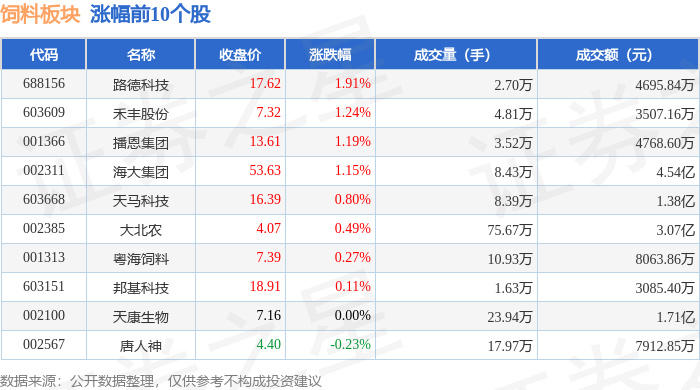
Group 1 - The feed sector experienced a slight increase of 0.13% on January 15, with Lude Technology leading the gains [1] - The Shanghai Composite Index closed at 4112.6, down 0.33%, while the Shenzhen Component Index closed at 14306.73, up 0.41% [1] - Key stocks in the feed sector showed varied performance, with Lude Technology closing at 17.62, up 1.91%, and Tangrenshen closing at 4.40, down 0.23% [1] Group 2 - The feed sector saw a net outflow of 116 million yuan from institutional investors, while retail investors contributed a net inflow of 116 million yuan [2] - The trading volume for Lude Technology was 27,000 hands, with a transaction amount of 46.9584 million yuan [1] - The stock performance of major companies included Hada Group with a closing price of 53.63, up 1.15%, and Petty Co. with a closing price of 18.75, down 2.09% [2][3] Group 3 - The net inflow from retail investors for TianKang Biological was 17.1 million yuan, while the net outflow from institutional investors was 18.4821 million yuan [3] - The net inflow for GuaiBao Pet was 6.3998 million yuan from institutional investors, while it faced a net outflow of 10.7891 million yuan from retail investors [3] - The overall sentiment in the feed sector indicates mixed investor behavior, with some stocks attracting retail interest while others faced institutional selling pressure [2][3]


“宠娃至上”的铲屎官,喂出山东百亿宠粮生意
Da Zhong Ri Bao· 2026-01-11 01:16
Core Insights - The pet food industry in China is experiencing significant growth, with a projected market size of 312.6 billion yuan by 2025, driven by an increase in pet ownership and spending on pet-related products [1][3][5]. Industry Overview - Shandong province is the leading producer of pet food in China, accounting for 35.41% of the national production with an output of 56.61 million tons in 2024, reflecting a year-on-year growth of 26.10% [7][10]. - The province has established itself as a key player in the pet food market, with major companies like Guobao Pet Food, Zhongchong Co., and Lusi Co. collectively generating over 9 billion yuan in revenue in the first three quarters of 2025 [6][8]. Market Dynamics - The pet food market is characterized by a high concentration of production in Shandong, where approximately 30% of pet food in China is produced [4][6]. - The export value of pet food from Shandong exceeded 9 billion yuan in the first eleven months of 2025, representing over 45% of the national total [8]. Competitive Landscape - Guobao Pet Food has emerged as the largest and highest-valued company in the domestic pet food sector, achieving a revenue of 4.737 billion yuan in the first three quarters of 2025, marking a year-on-year increase of 29.03% [6][12]. - The industry is witnessing increased competition as various sectors, including dairy and snack companies, are entering the pet food market, leading to challenges such as product homogenization and price wars [12][13]. Future Outlook - The global pet food market is expected to reach a size of 194.2 billion USD by 2029, with a compound annual growth rate of 5.7% from 2024 to 2029, indicating a lucrative opportunity for domestic companies to expand internationally [14][17]. - Companies are focusing on research and development to differentiate their products and enhance competitiveness, with Guobao Pet Food investing in a pet nutrition research center and increasing R&D spending by 33.39% to 531 million yuan [20][21].