
银华基金

Search documents
多元资产配置“救场”!FOF,逆袭
Xin Lang Cai Jing· 2025-12-14 12:55
Core Insights - The scale of Fund of Funds (FOF) is expected to set a new historical record, with significant growth in multi-asset allocation trends among public funds [1][7][17] - The investment boundaries for FOFs are expanding beyond A-shares and bonds to include Hong Kong stocks, commodity futures, public REITs, and overseas market products [2][12][13] Expansion of Investment Boundaries - Public funds are increasingly diversifying their asset allocation, with 82 newly established FOFs this year, over 40% of which have included gold indices as performance benchmarks [2][13] - The proportion of alternative investment funds within FOF assets has reached a historical high of 2.75% [2][13] - Among the 541 existing FOF products, only 47 have gold indices as benchmarks, indicating a significant trend towards gold in new FOFs [2][13] Overseas Asset Allocation - FOFs are utilizing benchmarks such as the MSCI World Index, MSCI Developed Markets Index, and S&P 500, with 12 products adopting these benchmarks [3][14] - Public REITs are emerging as a popular choice for FOFs, with several products beginning to include them in their investment scope [3][14] Demand for Multi-Asset Allocation - The demand for multi-asset allocation has intensified, with investors prioritizing stable absolute returns over short-term high yields [5][16][18] - A significant portion of new FOF products explicitly indicates "allocation" in their names, reflecting the growing focus on multi-asset strategies [7][17] Strategic Focus on Multi-Asset Allocation - The integration of multi-asset strategies is seen as a way to reduce the impact of single asset volatility on overall FOF returns, enhancing risk resilience and broadening revenue sources [9][19][20] - Major public funds are restructuring their teams to focus on multi-asset investment strategies, indicating a shift in industry focus [19][20]
China SIF|各界嘉宾在线热议气候风险的分析与评估
Xin Lang Cai Jing· 2025-12-12 09:09
Core Insights - The 13th China Responsible Investment Forum successfully held discussions on global responsible investment trends and ESG investment opportunities [1][25][46] Group 1: Climate Risk Analysis and Assessment - Climate risk identification and assessment have become critical issues in global financial markets, impacting financial decisions, investment portfolios, and risk management [2][26] - In North America, the focus has shifted from ESG disclosure and net-zero transitions to managing physical climate risks and enhancing climate resilience [2][26] - Regulatory bodies in Europe have mandated banks to conduct climate risk stress tests, with significant progress in China regarding climate-related information disclosure and stress testing [2][26] Group 2: ESG Governance and Green Transition - The main theme of the keynote speech by the ESG research head of Harvest Fund was driving green low-carbon transitions in listed companies through ESG governance [4][28] - A-share listed companies are making significant progress in environmental governance, information disclosure, green innovation, and climate risk response, transitioning from compliance-driven to intrinsic-driven ESG governance [4][28] Group 3: Challenges in Climate Risk Management - Companies face challenges in climate change response, including stricter regulatory requirements and the need for high-quality climate information disclosure [8][32] - There is a trend from qualitative analysis to quantitative assessment in climate risk disclosure, but accurately measuring the financial impact of climate risks remains difficult [8][32] Group 4: Financial Institutions' Role - Financial institutions must build internal capabilities for climate risk identification and management, integrating climate risks into overall strategies [6][30] - The financial impact of climate risks varies by industry, location, and risk type, with physical risks damaging assets and operations, while transition risks reshape cost and revenue through low-carbon opportunities [12][36] Group 5: Collaborative Efforts and Future Directions - Jiangsu Bank aims to deepen cooperation with UNEP FI to enhance its service capabilities and contribute to biodiversity protection and the "Beautiful China" initiative [10][34] - The Nordea Asset Management emphasizes the importance of investing in the transition process itself, not just in low-emission companies, to achieve economic growth alongside decarbonization [14][38] - Central banks have conducted climate risk stress tests, indicating that existing capital adequacy requirements can withstand climate risks, suggesting a shift in policy focus towards enhancing financial systems' support for low-carbon transitions [16][40]

让投资“可控”!拆解多资产的“银华范式”
券商中国· 2025-12-11 11:00
Core Viewpoint - Asset allocation is crucial for investment returns, as demonstrated by David Swensen's management of Yale's endowment fund, which grew from $1.3 billion to over $40 billion over 35 years, achieving an annualized return of 13.9% from 1998 to 2018, outperforming 90% of peers [1] Group 1: Market Context - As of November 26, the CSI 300 index has only increased by 19.46% over the past decade, indicating that single assets struggle to provide stable returns in a complex environment [1] - The public fund industry is seeing growth in multi-asset strategies, with "fixed income +" funds and public fund of funds (FOF) experiencing quarter-on-quarter increases of 30.63% and 20.35% respectively by the end of Q3 [1] Group 2: Team and Strategy - The team led by Yu Lei at Yinhua Fund is recognized for its platform-level investment research capabilities, focusing on asset allocation and multi-strategy alpha generation [2][4] - The multi-asset investment team has expanded to over 50 members, managing diverse products including pensions, FOFs, and "fixed income +" strategies [5] Group 3: Investment Philosophy - Yu Lei emphasizes that asset allocation is essential for survival in today's capital markets, advocating for structural diversification to mitigate risks [6] - The "fixed income +" product line is designed to meet varying risk-return profiles, combining the defensive nature of insurance investments with the agility of public funds [6] Group 4: Platform and Research Capabilities - The investment decision-making process at Yinhua is supported by a systematic framework that integrates data analysis, discipline, and cyclical understanding [9] - The team culture promotes collaboration and shared insights, enhancing the flow of investment ideas and research outcomes [11] Group 5: Risk Management - Yinhua's multi-asset team employs a comprehensive risk management system that includes monitoring portfolio risks and setting strict return and drawdown targets for different product categories [16][17] - The team focuses on maintaining a balance between risk and return, with specific strategies for low, medium, and high volatility "fixed income +" products [17] Group 6: AI Integration - Yinhua has developed an AI-driven platform that enhances investment research and decision-making processes, allowing for efficient data processing and improved decision-making outcomes [13][14] - The AI system aids in identifying investment signals and refining the team's focus on high-potential opportunities [14]

天府证券ETF日报-20251211
天府证券· 2025-12-11 09:21
Market Overview - On December 11, 2025, the Shanghai Composite Index fell 0.70% to close at 3873.32 points, the Shenzhen Component Index fell 1.27% to close at 13147.39 points, and the ChiNext Index fell 1.41% to close at 3163.67 points. The trading volume of A-shares in the two markets was 1885.4 billion yuan. The top-performing industry was banking with a 0.17% increase, while the bottom-performing industries were comprehensive (-4.31%), communication (-3.14%), and real estate (-3.06%) [2][6]. Stock ETF - The top-traded stock ETFs on this day were Huatai-PineBridge CSI A500 ETF, which fell 0.89% with a discount rate of -0.77%; ChinaAMC CSI A500 ETF, which fell 0.69% with a discount rate of -0.69%; and Southern CSI A500 ETF, which fell 0.66% with a discount rate of -0.66% [3][7]. Bond ETF - The top-traded bond ETFs were Haitong CSI Short-term Financing Bond ETF, which rose 0.00% with a discount rate of -0.01%; E Fund CSI AAA Science and Technology Innovation Corporate Bond ETF, which rose 0.05% with a discount rate of -0.21%; and ChinaAMC Shanghai Stock Exchange Benchmark Market-making Treasury Bond ETF, which rose 0.15% with a discount rate of 0.14% [4][9]. Gold ETF - Gold AU9999 rose 0.16% and Shanghai Gold rose 0.15%. The top-traded gold ETFs were HuaAn Gold ETF, which rose 0.16% with a discount rate of 0.22%; E Fund Gold ETF, which rose 0.20% with a discount rate of 0.22%; and Bosera Gold ETF, which rose 0.19% with a discount rate of 0.21% [12]. Commodity Futures ETF - Dacheng Nonferrous Metals Futures ETF had a 0.00% change with a discount rate of 0.44%; ChinaAMC Feed Soybean Meal Futures ETF fell 0.36% with a discount rate of 2.33%; and CCB YiSheng Zhengzhou Commodity Exchange Energy and Chemical Futures ETF fell 0.08% with a discount rate of -0.07% [13]. Cross - border ETF - The previous day, the Dow Jones Industrial Average rose 1.05%, the Nasdaq rose 0.33%, the S&P 500 rose 0.67%, and the German DAX fell 0.13%. On this day, the Hang Seng Index fell 0.04% and the Hang Seng China Enterprises Index fell 0.23%. The top-traded cross - border ETFs were E Fund CSI Hong Kong Securities Investment Theme ETF, which fell 1.18% with a discount rate of -1.51%; GF CSI Hong Kong Innovative Drugs ETF, which fell 0.46% with a discount rate of -0.19%; and Huatai - PineBridge Hang Seng Technology ETF, which fell 0.82% with a discount rate of -0.86% [16]. Money ETF - The top-traded money ETFs were YinHua RiLi ETF, HuaBao TianYi ETF, and Money ETF [18].
银华基金于蕾:打造“固收+”的平台生态系统
Jing Ji Guan Cha Wang· 2025-12-11 04:11
Core Insights - The article discusses the transition of Yu Lei, a veteran with over 20 years of experience in corporate pension management, to the public fund sector, specifically in the "fixed income +" space, highlighting the integration of rigorous pension management practices with innovative technology [2][3]. Investment Philosophy and Strategy - Yu Lei's investment philosophy is shaped by her extensive experience in pension management, emphasizing long-term return maximization while controlling drawdowns as a fundamental principle [3][4]. - The essence of "fixed income +" is to assist investors in asset allocation, aiming to smooth volatility and improve the holding experience, thereby avoiding emotional pitfalls in investment decisions [3][4]. Team Structure and Decision-Making - The multi-asset team led by Yu Lei consists of over 50 members, focusing on various types of assets including pensions, secondary bond funds, and funds of funds (FOF) [4]. - The investment framework prioritizes maximizing returns while controlling drawdowns, employing a comparative approach to assess the value of different asset classes dynamically [4][5]. Market Insights and Tactical Adjustments - The team demonstrated a proactive approach by identifying opportunities in the equity market during periods of pessimism and shifting focus to convertible bonds after policy rebounds, showcasing their ability to navigate market fluctuations [5][6]. - A systematic asset allocation framework is established, incorporating various dimensions such as medium to long-term cycles and safety margins, to ensure a comprehensive evaluation of asset values [5][6]. Collaborative Culture and Technology Integration - The team promotes a culture of collaboration and knowledge sharing, which is essential for maintaining stable investment strategies [6][7]. - The integration of artificial intelligence (AI) tools, such as the "Alpha replenishment system" and "fund manager DNA system," enhances decision-making by analyzing discussions and identifying high-potential investment insights [7]. Product Offering and Market Outlook - The multi-asset team categorizes "fixed income +" products into three tiers: low wave, medium wave, and medium-high wave, each targeting different risk-return profiles and investment strategies [8][9][10][11]. - The current market outlook remains optimistic for A-shares and Hong Kong stocks, driven by expectations of economic cycle evolution, real estate stabilization, and potential RMB appreciation [12]. - The team sees significant growth potential in the "fixed income +" sector, noting that bank wealth management, exceeding 32 trillion yuan, still has a low allocation ratio in this area, indicating room for expansion [12].

华源晨会精粹20251210-20251210
Hua Yuan Zheng Quan· 2025-12-10 11:54
Group 1: Corporate Pension Fund and Investment Performance - The core viewpoint indicates that in Q3 2025, corporate pension funds exhibited characteristics of "scale expansion, high investment returns, and market structure differentiation" [7][8] - The coverage and fund scale continue to expand, with a significant jump in equity investment returns driving overall performance improvement [7][9] - The number of established corporate pension plans increased by 2,770 to 175,000, and the number of participating employees rose by 275,200 to 33.32 million, with accumulated funds increasing by 24 billion to 409 billion [8][9] Group 2: Investment Management Market Dynamics - The current market for corporate pension fund trustees is dominated by insurance capital, with banks rapidly emerging, and competition strategies are diversifying, particularly towards small and micro enterprises [9][10] - As of Q3 2025, major players like China Life Pension and Ping An Pension dominate the market, holding nearly half of the management in terms of enterprises, employees, and asset amounts [9][10] - The total assets under management for corporate pension funds increased by 6.3% to 3.1 trillion, with smaller institutions experiencing faster growth [9][10] Group 3: Investment Returns and Product Performance - The investment returns for equity portfolios surged, with quarterly returns jumping from 1.02% to 4.82%, leading to an overall increase in investment returns from 1.00% to 4.26% [13][14] - The net asset value of equity products increased by 42.8% to 223.6 billion, with investment returns rising from 2.3% in Q2 to 22.9% in Q3 [14] - Fixed income products saw a slight decrease in net asset value by 5.95% to 1.596 trillion, with returns slightly declining to 0.68% [14] Group 4: Wealth Management and Market Trends - As of November 2025, the total wealth management scale reached 34 trillion, an increase of 4 trillion from the previous year, with a monthly increase of 0.35 trillion [15][16] - The average annualized yield for pure fixed income wealth management products fell to 2.42%, reflecting a downward trend in the performance benchmark since early 2022 [16][17] - The growth in wealth management scale is expected to provide strong support for credit bonds with a maturity of 3 years or less [17] Group 5: Real Estate Market Overview - The real estate sector saw a decline of 2.2% in the week, with new home transactions in 42 key cities dropping by 6.9% to 1.93 million square meters [18][19] - The macroeconomic environment is influenced by policies supporting the development of REITs and asset securitization, with the scope of underlying assets expanding to urban renewal facilities [19][20] - Local governments are implementing housing subsidies, with cities like Changzhou and Nanning introducing new policies to support homebuyers [19][20]
资金涌入!两日吸金超20亿
Xin Lang Cai Jing· 2025-12-09 11:43
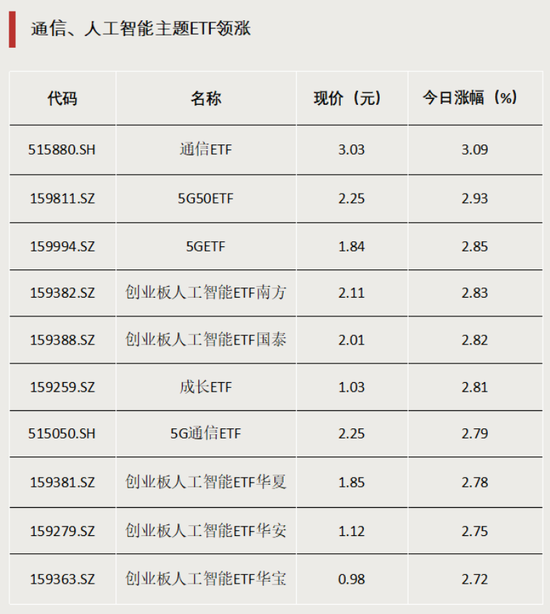
Group 1 - The technology sector showed strong performance on December 9, with multiple thematic ETFs in communication, artificial intelligence, cloud computing, and electronics experiencing significant gains. In contrast, ETFs related to non-ferrous metals and gold showed weakness, with some products declining over 3% [1][2][3] - The communication ETF (515880) led the market with a gain of over 3%, while several artificial intelligence-themed ETFs also saw increases of more than 2.5%. The A-share market is expected to remain in an upward trend, with AI being a core theme supported by policy [2][12] - Fund managers noted that while the non-ferrous metals sector has long-term investment value, short-term market volatility risks should be monitored, influenced by factors such as USD trends and global economic uncertainties [4][14] Group 2 - Recent data indicates that broad-based ETFs have become a significant direction for capital inflow, with net inflows exceeding 15 billion yuan over two trading days for products like the Southern CSI A500 ETF and Huatai-PB CSI 300 ETF [6][11][16] - The Southern CSI A500 ETF recorded the highest net inflow of 10 billion yuan on December 8, while the Huatai-PB CSI 500 ETF saw a net inflow of 19.18 billion yuan on December 5 [6][17] - The demand for optical modules is expected to benefit from high growth in computing power needs, with projections indicating that the optical module industry will grow faster than AI capital expenditure growth from 2026 to 2027 [8][18]
ETF及指数产品网格策略周报-20251209
HWABAO SECURITIES· 2025-12-09 08:34
Group 1 - The report outlines a grid trading strategy that focuses on profiting from price fluctuations rather than predicting market trends, making it suitable for volatile markets [4][13] - Characteristics of suitable grid trading targets include being exchange-traded, having stable long-term trends, low transaction costs, good liquidity, and high volatility, with equity ETFs being particularly appropriate [4][13] - The report highlights key ETFs for grid trading, including the military industry ETF, which is expected to benefit from a new procurement cycle driven by the "14th Five-Year Plan" and a projected defense budget of 1.81 trillion yuan for 2025, a 7.2% increase [4][14] Group 2 - The gaming ETF is noted for its strong growth potential due to the normalization of game license approvals, with 1,624 licenses issued from January to November 2025, significantly surpassing the previous year's total [5][17] - The software ETF is positioned to capture opportunities from domestic software replacement and AI-driven transformations, supported by policies promoting technological self-reliance and innovation [6][20] - The Hang Seng Internet ETF is expected to enhance commercial monetization through AI integration, as major internet companies are increasingly deploying AI products to improve user engagement and service capabilities [7][23]
公募基金业薪酬风暴要来了?谁站在红线边缘?
Xin Lang Cai Jing· 2025-12-09 01:56
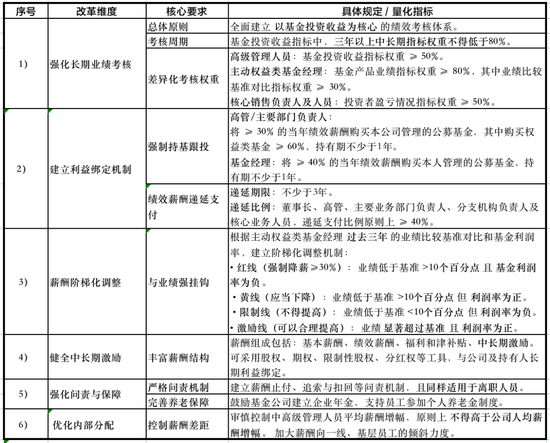
Core Viewpoint - The new performance assessment guidelines for fund management companies signify a major reform in the public fund industry, linking fund managers' compensation directly to the actual returns for investors, thereby emphasizing performance over mere management fees [1][2][31]. Group 1: Key Points of Compensation Reform - The core principle of the new guidelines is to establish a performance assessment system centered on fund investment returns, with a significant weight on long-term performance metrics [33]. - Fund managers of actively managed equity funds will face a 30% salary reduction if their performance lags the benchmark by more than 10% and the fund incurs losses over the past three years [2][32]. - The guidelines introduce quantifiable and rigid constraints to create a transparent incentive mechanism, aiming for long-term alignment of interests between fund managers and investors [2][32]. Group 2: Impact and Data Analysis - As of December 5, nearly 38.43% of 3,757 actively managed equity funds have underperformed their benchmarks by over 10% in the last three years, indicating significant challenges for fund managers [34]. - Approximately 996 fund managers are affected, managing over 1.1 trillion yuan in assets, with specific examples of funds like Guotou Ruijin's performance showing a cumulative return of -26.12%, lagging the benchmark by over 45 percentage points [35][40]. - Historical data from 2015 to 2024 shows that only 45 out of a large sample of equity funds managed to consistently outperform the benchmark by 10% over three years, suggesting that over 90% of fund managers may face salary reductions during their careers [39]. Group 3: Characteristics of Fund Managers at Risk - Fund managers at risk of salary reductions often exhibit extreme style dependence, focusing heavily on specific sectors like consumption or technology, which can lead to significant underperformance during market downturns [41][42]. - Rapid asset growth during peak performance periods has constrained the flexibility of these managers, making it difficult to adjust portfolios effectively in declining markets [43][44]. - The aggressive strategies employed by these managers conflict with the new guidelines that encourage closer tracking of benchmarks and controlled excess returns [46]. Group 4: Future Implications for Fund Managers - The new regulations are expected to shift fund managers' focus from seeking high returns to managing risks, potentially leading to a more conservative investment approach [52]. - The stringent accountability measures may result in a significant reduction in the number of top-performing fund managers remaining in the public fund sector, as many may transition to private equity or specialized accounts for better compensation opportunities [56][58]. - The industry may see an increase in trend-following strategies, which could exacerbate market volatility and lead to crowded trades, while less popular assets may receive even less attention [55].
基金回报榜:243只基金昨日回报超5%
Zheng Quan Shi Bao Wang· 2025-12-09 01:20
Core Insights - The stock and mixed funds achieved a positive return of 70.27% on December 8, with 243 funds returning over 5% and 472 funds experiencing a net value drawdown exceeding 1% [1][2] Fund Performance - The Shanghai Composite Index rose by 0.54% to close at 3924.08 points, while the Shenzhen Component Index increased by 1.39%, the ChiNext Index by 2.60%, and the STAR 50 Index by 1.86% [1] - The top-performing sectors included telecommunications, comprehensive, and electronics, with increases of 4.79%, 3.03%, and 2.60% respectively. Conversely, coal, oil and petrochemicals, and food and beverage sectors saw declines of 1.43%, 0.84%, and 0.78% respectively [1] - The average net value growth rate for stock and mixed funds on December 8 was 0.80% [1] Top Funds - The fund with the highest net value growth rate was Guorong Rongxin Consumer Select Mixed C, achieving a growth rate of 10.01%. Other notable funds included Guorong Rongxin Consumer Select Mixed A (10.00%), and Guoshou Anbao Strategy Selected Mixed A (9.14%) [2] - Among the funds with a net value growth rate exceeding 5%, 142 were equity funds, 41 were flexible allocation funds, and 34 were index equity funds [2] Drawdown Analysis - A total of 472 funds experienced a drawdown exceeding 1%, with the largest drawdown recorded by Huatai-PB Hong Kong Stock Connect Medical Selected Mixed Initiated C, which saw a decline of 2.40% [2][4] - Other funds with significant drawdowns included Huatai-PB Hong Kong Stock Connect Medical Selected Mixed Initiated A (-2.40%), and Yin Hua Fu Li Selected Mixed C (-2.32%) [4]