友邦保险

Search documents
海通国际2026年1月金股
Haitong Securities International· 2025-12-26 06:30
Investment Focus - Alphabet (GOOGL US) is expected to maintain strong advertising revenue due to AI integration in search functionalities and a significant increase in TPU orders, projecting over 30% growth in cloud business for the year [1] - Alibaba (BABA US) anticipates a cloud business growth rate of 28%-30%, driven by strong demand in China and synergies from its food delivery services, with a projected MAU growth of 20-30% for Taobao [1] - NVIDIA (NVDA US) is expected to achieve strong revenue growth, with projections indicating potential revenue exceeding $500 billion, supported by significant demand for its products [1] - Tencent (700 HK) is recommended for its robust growth in gaming and advertising, with a target price of 700, and is expected to benefit from AI trends [3] - Tencent Music (TME US) is expected to maintain double-digit growth in subscription revenue, supported by its long-term partnerships with top domestic artists [3] - New Oxygen (SY US) is positioned for rapid expansion in the light medical beauty sector, with plans to increase self-operated stores significantly by 2025 [3] - Trip.com (TCOM US) is projected to benefit from the recovery of domestic leisure travel and inbound tourism, with a revenue growth forecast of 14% to 71.1 billion yuan [4] - Kuaishou (1024 HK) is expected to see significant revenue contributions from its advertising solutions, with a target price of 93 [4] - Futu (FUTU US) is recognized for its strong user base and compliance advantages, with a projected PE of 17x for 2026, indicating significant valuation potential [4][5] - AIA (1299 HK) is expected to see steady growth in new business value due to its expansion strategy in mainland China and demand for traditional savings products [5] - Howmet Aerospace (HWM US) is positioned for stable revenue growth due to its strong market position in gas turbine components and a long order backlog [10]
年内险资向私募股权基金出资已超千亿元
Zheng Quan Ri Bao· 2025-12-26 02:01
Core Insights - Insurance capital has significantly increased its investment in private equity funds, with a total contribution of 109.76 billion yuan as of December 19, marking a 55.85% increase compared to the previous year [1] Group 1: Investment Trends - The top five insurance institutions in private equity investment for 2025 are China Pacific Life Insurance Co. (205.99 billion yuan), Ping An Life Insurance Co. (150 billion yuan), Sunshine Life Insurance Co. (114.88 billion yuan), AIA Group (106.75 billion yuan), and PICC Capital (100 billion yuan) [2] - Life insurance companies contributed the most to private equity funds, totaling 88.53 billion yuan, a year-on-year increase of 57.05%, while insurance asset management companies contributed 17.98 billion yuan, a significant increase of 231.12% [3] Group 2: Regulatory Environment - Recent regulatory changes have encouraged insurance capital to increase equity allocations, such as raising the limit on single venture capital fund investments from 20% to 30% of the fund's paid-in capital [2] - The regulatory framework has also enhanced the tolerance for short-term volatility, promoting long-term investment strategies among insurance companies [2] Group 3: Investment Strategy - Insurance companies prefer growth funds, with nine out of the top ten funds being growth-oriented, as they align with the need for stable cash flow and lower investment risk [4] - The focus on private equity funds is seen as a long-term strategic choice, particularly for life insurance companies, which are expected to continue increasing their allocations in this area [5][6] Group 4: Sector Focus - The investment strategy will likely target sectors aligned with national strategic directions, particularly in hard technology, healthcare, and green energy, reflecting a commitment to supporting high-quality economic development [6]


港股市场2025年终盘点:IPO规模冠全球,多项指标创纪录
Sou Hu Cai Jing· 2025-12-25 01:44
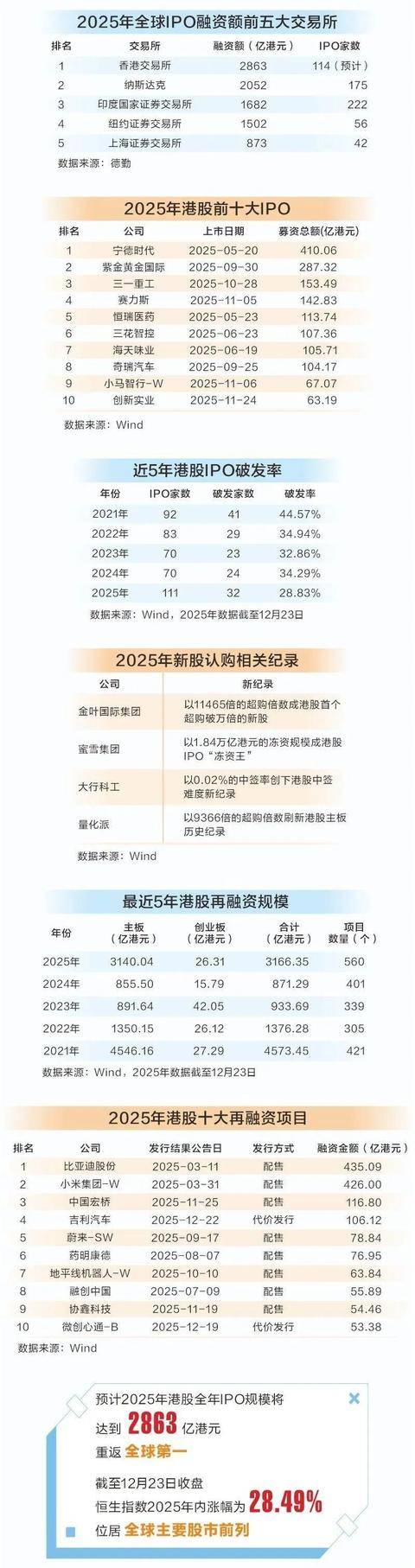
Core Viewpoint - The Hong Kong stock market is expected to fully recover in 2025 after experiencing a significant downturn from 2021 to 2024, with the Hang Seng Index dropping over 50% during that period. The market revival is driven by technological breakthroughs and a surge in IPO activities, establishing a solid foundation for a comprehensive rebound [1]. IPO Market Performance - In 2025, the Hong Kong Stock Exchange is projected to lead the global IPO market with a total financing amount of 286.3 billion HKD from approximately 114 IPOs [2]. - The top five exchanges for global IPO financing in 2025 are: Hong Kong Stock Exchange (286.3 billion HKD, 114 IPOs), Nasdaq (205.2 billion HKD, 175 IPOs), National Stock Exchange of India (168.2 billion HKD, 222 IPOs), New York Stock Exchange (150.2 billion HKD, 56 IPOs), and Shanghai Stock Exchange (87.3 billion HKD, 42 IPOs) [2]. - Eight companies in the top ten IPOs of 2025 raised over 10 billion HKD each, with notable contributions from companies like CATL and Zijin Mining [11]. IPO Quality and Market Sentiment - The IPO breakage rate in 2025 is reported at 28.83%, the lowest in five years, indicating a positive market sentiment and improved quality of IPOs [12]. - The new pricing mechanism implemented by the Hong Kong Stock Exchange has strengthened institutional investors' pricing power, contributing to the lower breakage rate [12]. Record-Breaking Subscription Metrics - The IPO market in Hong Kong has seen record-breaking subscription metrics, with companies like Jinye International Group achieving a subscription multiple of 11,465 times, setting a historical record [13]. - The "frozen capital" for the IPO of Mixue Group reached 1.84 trillion HKD, marking it as the "frozen capital king" in Hong Kong IPO history [13]. Secondary Financing Market - The total refinancing amount in Hong Kong for 2025 exceeded 316.6 billion HKD, surpassing the IPO scale and reaching a new high in project numbers with 560 projects [14]. - Major companies like BYD and Xiaomi led the top refinancing projects, raising significant amounts for business expansion and development [15]. Stock Market Performance - The Hang Seng Index recorded a year-to-date increase of 28.49%, ranking among the top global indices [16]. - Sectors such as innovative pharmaceuticals, non-ferrous metals, and semiconductors have shown significant growth, with stocks like Aijie Ankang experiencing a staggering increase of 950.95% [17]. Capital Inflows and Market Dynamics - Southbound capital inflows into the Hong Kong stock market reached a record high of approximately 1.41 trillion HKD in 2025, significantly enhancing market liquidity [18][19]. - The total buyback amount by listed companies in Hong Kong exceeded 175.9 billion HKD, indicating strong buyback enthusiasm amid market recovery [20][21]. Dividend Distribution - The total dividend distribution in the Hong Kong market for 2025 reached nearly 1.46 trillion HKD, surpassing the total for 2024 and reflecting a robust dividend environment [22]. Delisting Trends - The delisting process in Hong Kong accelerated in 2025, with 61 companies exiting the market, primarily due to privatization and forced delisting [23].

港股市场2025年终盘点:IPO规模冠全球 多项指标创纪录
证券时报· 2025-12-25 00:50
年终盘点。 2025年,是港股市场全面回暖的一年。回望2021年至2024年,港股市场堪称历经"寒冬",其间恒生指数一度下跌超50%,持续的"杀估 值"行情让市场悲观情绪蔓延。 经过2024年下半年的蓄势,"9·24"行情火爆启动,2025年初DeepSeek的横空出世更是瞬间激活了港股市场,让全球重新审视中国科技资 产的价值。这种由技术突破引发的产业景气预期,迅速传导至资本市场各环节,为港股的全面反攻奠定了坚实基础。这一轮反攻不仅推动港 股市场估值重构,更在IPO、再融资、二级市场、互联互通等多个维度创下历史纪录。 尤其是在香港交易所的交易大堂中,2025年以来锣声不断。香港交易所集团行政总裁陈翊庭评价称,2025年是全球投资者纷纷重返香港市 场的一年,中国内地和亚洲的创新发展为市场注入源源不绝的活力。一系列上市改革以及"科企专线"吸引了不少创新公司来港上市,互联互 通机制则继续为连接中国内地与国际资本市场发挥着独特的桥梁作用。 | 排名 | 交易所 | 融资额(亿港元) | IPO家数 | | --- | --- | --- | --- | | 1 | 香港交易所 | 2863 | 114(预计) | | ...
智通ADR统计 | 12月25日
智通财经网· 2025-12-24 22:22
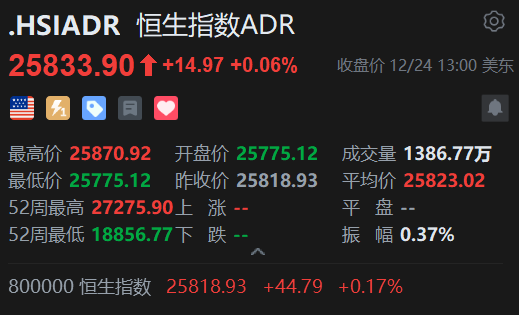
Market Overview - The Hang Seng Index (HSI) closed at 25,833.90, up by 14.97 points or 0.06% [1] - The index reached a high of 25,870.92 and a low of 25,775.12 during the trading session, with a trading volume of 13.8677 million [1] - The 52-week high for the index is 27,275.90, while the 52-week low is 18,856.77, indicating a fluctuation of 0.37% [1] Major Blue-Chip Stocks Performance - HSBC Holdings closed at 123.759 HKD, down 0.03% from the Hong Kong close [2] - Tencent Holdings closed at 602.001 HKD, down 0.17% from the Hong Kong close [2] - Alibaba Group (W) saw a decrease of 1.200 HKD, closing at 146.000 HKD, a drop of 0.82% [3] - China Construction Bank decreased by 0.050 HKD, closing at 7.560 HKD, a decline of 0.66% [3] - Xiaomi Group (W) increased slightly by 0.020 HKD, closing at 39.220 HKD, a rise of 0.05% [3] ADR Performance - Tencent's ADR closed at 602.001, down by 0.999 HKD or 0.17% compared to its Hong Kong stock price [3] - Alibaba's ADR closed at 145.796, down by 0.204 HKD or 0.14% compared to its Hong Kong stock price [3] - HSBC's ADR closed at 123.759, down by 0.041 HKD or 0.03% compared to its Hong Kong stock price [3] - AIA Group's ADR closed at 83.298, up by 0.048 HKD or 0.06% compared to its Hong Kong stock price [3]





【窩輪透視】恆指夾在兩條均線之間!低溢價窩輪成部署首選
Ge Long Hui· 2025-12-24 20:03
Core Viewpoint - The Hang Seng Index (HSI) is currently experiencing a consolidation phase, with mixed signals from various sectors, indicating potential investment opportunities and risks in the market [1][3]. Market Overview - On the previous day (23rd), the HSI closed at 25,774.14 points, a slight decrease of 0.11%, with a total turnover of HKD 157.13 billion, reflecting a general market consolidation [1]. - The short-term support levels for the HSI are at 25,448 points and 25,116 points, while resistance levels are at 26,147 points and 26,432 points, with a 53% probability of an upward movement [1]. Technical Analysis - The HSI is currently oscillating between the 10-day moving average (MA10) of 25,614.57 points and the 30-day moving average (MA30) of 25,878.94 points, indicating significant pressure from the upper moving averages [1]. - Various technical indicators are showing neutral signals, with the RSI at 52, while the VR ratio indicates a "sell" signal and the MACD shows a "buy" signal, suggesting a stalemate between bulls and bears [1]. Sector Performance - **Technology Stocks**: Tencent (00700) closed at HKD 602, down 2.03%, with technical indicators showing a "buy" signal but facing short-term resistance. Alibaba (09988) rose 0.55% to HKD 147.20, while JD.com (09618) increased by 0.45% to HKD 112.80, with resistance at HKD 116.80 [1][2]. - **Financial Stocks**: HSBC Holdings (00005) rose 0.82% to HKD 122.30 but is in the overbought zone with an RSI of 78, indicating a "strong sell" signal. AIA Group (01299) remained flat at HKD 82.65, needing to break through HKD 83.50 to confirm an upward trend [2]. - **Consumer Stocks**: Meituan (03690) rose 0.39% to HKD 103.20 but shows a "strong sell" signal, while Xiaomi (01810) fell 1.51% to HKD 39.20, indicating an oversold state [2]. - **Traditional Blue Chips**: China Mobile (00941) fell 1.02% to HKD 82.85, with a weak "buy" signal, while CNOOC (00883) decreased by 1.15% to HKD 20.56, needing to hold above HKD 20.10 [2]. Investment Opportunities - Recent performance of HSI bull certificates shows significant elasticity, with Bank of China bull certificate (68350) rising 6% and (68194) rising 8% within two days, while the HSI only increased by 0.33% [3]. - Selected high-cost performance products include UBS call warrants (19853) and Bank of China call warrants (19861), both with a strike price of 27,135 points and high leverage, suitable for investors expecting a breakout [3][4]. Bearish Instruments - For bearish strategies, JPMorgan put warrants (20889) and Bank of China put warrants (20721) offer high leverage and low premiums, suitable for short-term traders expecting a decline in the HSI [4][5].
港股市场2025年终盘点:IPO规模冠全球 多项指标创纪录
Zheng Quan Shi Bao· 2025-12-24 18:35
Core Viewpoint - The Hong Kong stock market is expected to fully recover in 2025 after experiencing a significant downturn from 2021 to 2024, with the Hang Seng Index dropping over 50% during that period. The market is now witnessing a resurgence driven by technological breakthroughs and strong IPO activity, leading to record levels in various capital market dimensions [1]. IPO Performance - The IPO scale in Hong Kong is projected to exceed 300 billion HKD in 2026, with 2025 expected to see an IPO scale of 286.3 billion HKD, reclaiming the title of the world's largest IPO market [2][3]. - Eight companies in the top ten IPOs of 2025 raised over 10 billion HKD each, with many being A-share companies listed in Hong Kong [3]. - The IPO failure rate has decreased significantly, reaching a low of 28.83% in 2025, attributed to market conditions and new pricing mechanisms implemented by the Hong Kong Stock Exchange [4]. New Share Subscription Records - The Hong Kong market has set multiple records in new share subscriptions, including a historic oversubscription of 11,465 times for the IPO of Jinye International Group, marking the highest oversubscription in Hong Kong's history [5]. Refinancing Market - The refinancing scale in Hong Kong surpassed 300 billion HKD in 2025, with a total of 3,166 billion HKD raised, significantly exceeding the total from the previous three years [6][7]. - Leading companies like Xiaomi and BYD are at the forefront of major refinancing projects, raising substantial amounts for business expansion and development [8]. Stock Index Performance - The Hang Seng Index recorded a year-to-date increase of 28.49% as of December 23, 2025, positioning it among the top global stock indices [9]. - Sectors such as innovative pharmaceuticals and non-ferrous metals have shown remarkable performance, with stocks like Yaojie Ankang experiencing a staggering increase of 950.95% [10]. Capital Inflows and Buybacks - Southbound capital inflows into the Hong Kong market reached a record high of approximately 1.41 trillion HKD in 2025, significantly enhancing market liquidity [11][12]. - Stock buybacks by listed companies totaled 1,759.36 billion HKD in 2025, with Tencent leading the buyback amounts [13][14]. - Dividends distributed by Hong Kong companies reached nearly 1.46 trillion HKD, surpassing the total for the entire year of 2024 [15]. Delisting Trends - The pace of delistings in Hong Kong accelerated in 2025, with 61 companies exiting the market, primarily due to privatization and forced delisting mechanisms [16].





2025年世界500强企业排行榜:114家中企上榜,金融与能源为支柱
Jing Ji Guan Cha Wang· 2025-12-23 11:57
具体来看,排行榜提出跻身世界500强的中企呈现出"金融筑基、能源支撑、科技突破"的特征。 首先是金融板块贡献显著。排行榜显示,共有39家金融企业上榜,占中国上榜企业总数的34%,其中13家进入榜单前100强。工商银行以595.31亿美元的利 润额位列第八。保险企业利润增幅普遍较大,表现尤其亮眼——富邦金控利润增长133%、位次上升263位;中国人保利润增长110%、位次上升139位;友邦 保险利润增长78%、位次上升133位;中国太保利润增长77%、位次上升134位。 其次,排行榜显示,17家能源与基建企业上榜,其中五家位列前100强(中国石油第15位、中国海油第20位、中国神华第66位、国家电网第88位、中国石化 第90位),该板块企业依托国内庞大市场需求形成显著规模效应。 12月22日,中国上市公司百强论坛、华东理工大学民营经济研究院和华顿经济研究院联合发布的2025年世界500强企业排行榜(下称"排行榜")显示,中国 (含港澳台地区)共有114家企业上榜,占比22.8%,位列全球第二,较去年增加7家。中国所有上榜企业上年度平均利润额为86.78亿美元,同比增长8.6%。 排行榜提出,相比于《财富》杂志以 ...

破局低利率:寿险业产品结构转型的逻辑、路径与未来
13个精算师· 2025-12-23 10:13
Core Insights - The report analyzes the core challenges and strategic choices faced by the Chinese life insurance industry under the long-term downward trend of interest rates and the regulatory push for a "dynamic interest rate adjustment mechanism" [1] - It highlights the historical shift from traditional fixed-income products to floating-income products, particularly focusing on dividend insurance as a new growth point [1] - The report emphasizes the importance of understanding the relationship between interest rates, pricing, and product structure in navigating the current transformation logic [1] Summary by Sections Interest Rate and Pricing Relationship - The pricing of life insurance products, especially long-term savings and protection products, follows the principle of actuarial balance, where premiums are calculated based on the present value of insurance payouts divided by (1 - expense ratio) [3] - The predetermined interest rate is crucial as it represents the long-term return promised to customers and the company's liability cost [3] - Historical cases show that the global insurance industry has faced significant crises due to poor management of interest rate risks, leading to regulatory caps on predetermined interest rates to prevent systemic risks [3] Product Structure Evolution - The evolution of product structure in the Chinese life insurance market is closely linked to macroeconomic interest rate cycles and regulatory policy adjustments [6] - The regulatory environment has led to cyclical changes in product structure, with dividend insurance becoming mainstream during periods of low predetermined interest rates [3][6] Market Trends and Company Strategies - As of 2023, the downward adjustment of predetermined interest rates and the establishment of a dynamic adjustment mechanism have fundamentally impacted product structures, reducing the attractiveness of traditional fixed-income products [12] - Companies like Xinhua Insurance have seen a significant increase in the proportion of dividend insurance premiums, indicating a historical shift in product structure [10] - Major listed insurance companies are transitioning from strategic consensus to tactical execution, with differentiated paths based on their resource endowments [14] Future Growth Opportunities - The recent regulatory approval for dividend-type long-term health insurance, particularly critical illness insurance, is seen as a milestone for optimizing the industry's benefit structure and stimulating demand [17] - The potential market gap for critical illness insurance is significant, with estimates indicating a health protection gap of $143 billion in China by 2024 [19] - The development of dividend critical illness insurance is expected to follow successful models from Hong Kong, focusing on low guarantees and high dividends to address inflation concerns [20] Strategic Recommendations - Insurance companies should make clear strategic choices between low-risk, high-guarantee products for the mass market and high-risk, high-flexibility products for high-net-worth clients [22] - Enhancing long-term investment capabilities and integrating health/retirement ecosystems are essential for increasing product value and customer loyalty [23] - The transformation requires a systemic approach, considering regulatory requirements, customer needs, and economic trends, to establish a competitive advantage in the evolving market landscape [25]

智通港股沽空统计|12月23日
智通财经网· 2025-12-23 00:25
Group 1 - The top short-selling ratios are led by China Resources Beer (80291) at 100.00%, Meituan (83690) at 93.03%, and CNOOC (80883) at 85.70% [1][2] - The highest short-selling amounts are recorded for Alibaba (09988) at 1.293 billion, Tencent (00700) at 1.242 billion, and Xiaomi (01810) at 1.084 billion [1][3] - The highest deviation values are noted for Far East Development (00035) at 56.81%, CNOOC (80883) at 55.68%, and Meituan (83690) at 52.53% [1][2] Group 2 - The top short-selling amount rankings show Alibaba at 1.293 billion with a short-selling ratio of 15.00%, Tencent at 1.242 billion with a ratio of 14.58%, and Xiaomi at 1.084 billion with a ratio of 16.39% [3] - The short-selling ratio rankings indicate that China Resources Beer has the highest ratio at 100.00%, followed by Meituan at 93.03%, and CNOOC at 85.70% [2] - The deviation values highlight that Far East Development has the highest deviation at 56.81%, followed by CNOOC at 55.68%, and Meituan at 52.53% [3]