
格林美

Search documents
喜提14连阳 A股再攀新巅峰
Mei Ri Shang Bao· 2026-01-07 23:03
商报讯(记者 叶晓珺)大A又上热搜,"14连阳""逼近4100点大关"可谓是将赚钱效应拉满。昨日早盘, 多个板块涨幅明显,其中,可控核聚变概念拉升冲高,中国西电、中国核建等多股涨停;金属镍震荡拉 升,中伟股份涨超10%;最为突出的就是半导体设备板块,芯源微、中微公司、北方华创、拓荆科技纷 纷创出历史新高。 截至下午收盘,三大指数集体收涨。其中,沪指报4085.77点,涨0.05%,录得14连阳。全天沪深两市成 交额2.85万亿元,较上一个交易日放量476亿元,成交额连续2个交易日超2.8万亿元。对此,有市场人士 感叹,沪指从1990年12月19日开盘以来,在8558个交易日中,第一次出现了连续14日阳线的走势,指数 也创出了2015年7月以来的新高。 沪指创10年新高,创业板指刷新阶段高点 回看全天,早盘三大指数均高走,临近午盘,沪指涨0.29%逼近4100点,且再创10年新高;深成指报 14071.35点,涨0.35%;创业板指则突破2025年10月30日的阶段高点,刷新2021年12月底以来的新高。 其中,半导体产业链相关概念股集体拉升,中微公司、北方华创续创历史新高,南大光电、芯源微、恒 坤新材20cm ...




2026年1月7日稀土主流产品价格大幅上涨 氧化铽每吨涨6.86万元
Jin Rong Jie· 2026-01-07 14:26
Core Viewpoint - The rare earth market is experiencing significant price increases for key products, driven by heightened demand and limited supply, indicating a bullish sentiment in the market [1] Price Movements - Praseodymium and neodymium oxide average price is 617,200 CNY/ton, up 9,200 CNY/ton - Praseodymium and neodymium metal average price is 746,000 CNY/ton, up 9,800 CNY/ton - Dysprosium oxide average price is 1,408,200 CNY/ton, up 53,900 CNY/ton - Terbium oxide average price is 6,075,000 CNY/ton, up 68,600 CNY/ton [1] Market Activity - There is a limited number of transactions for praseodymium oxide, neodymium oxide, lanthanum cerium oxide, and europium oxide, suggesting caution in market references - Increased trading activity in praseodymium and neodymium products is leading to further price hikes, with traders becoming more active and downstream inquiries rising significantly - The limited availability of upstream spot goods is causing sellers to hold back, despite actual transaction volumes being low, resulting in significant price fluctuations throughout the day [1] Stock Performance - A-share market performance for rare earth permanent magnet concept stocks shows notable increases: - Tongcheng New Materials (603650) latest price is 51.57 CNY, up 10.0%, with a transaction volume of 621 million CNY - Goldwind Technology (002202) latest price is 26.4 CNY, up 10.0%, with a transaction volume of 16.846 billion CNY - Yujing Co., Ltd. (002943) latest price is 49.96 CNY, up 8.61%, with a transaction volume of 994 million CNY - Jiuling Technology (920505) latest price is 49.49 CNY, up 8.29%, with a transaction volume of 278 million CNY - Green Beauty (002340) latest price is 9.33 CNY, up 7.99%, with a transaction volume of 7.146 billion CNY [1]


中国对日实施两用物项出口管制,这些行业将受影响
Xin Lang Cai Jing· 2026-01-07 10:46
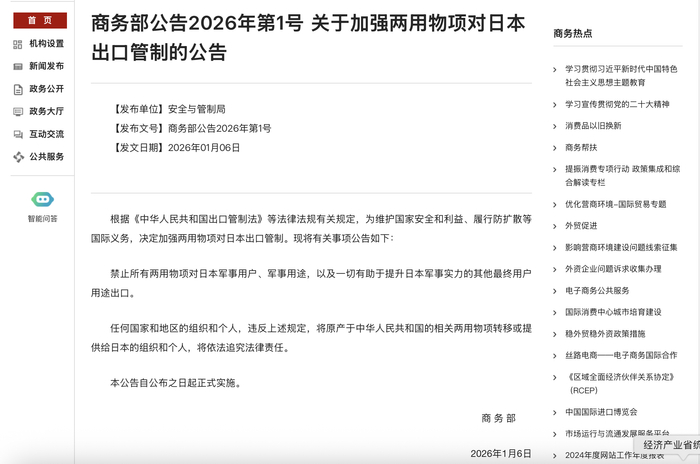
Core Viewpoint - The announcement of strengthened export controls on dual-use items to Japan by China has positively impacted the rare earth permanent magnet sector, leading to significant stock price increases in related companies [1][2]. Group 1: Market Reaction - The rare earth permanent magnet sector saw a rise of 2.26% as of January 7, with nearly 80% of stocks in the sector increasing in value [1]. - Notable stock performances included Zhong Rare Earth (600259.SH) with a 7.08% increase, Greeenmei (002340.SZ) at 7.99%, and Zhongke Magnetic (301141.SZ) at 7.13% [1]. - During trading, Zhong Rare Earth and Greeenmei briefly hit the daily limit up [1]. Group 2: Export Control Details - The Ministry of Commerce announced a ban on all dual-use items to military users in Japan, which includes materials that can enhance military capabilities [2]. - Violations of this regulation will lead to legal consequences for organizations and individuals transferring dual-use items to Japan [2]. - Dual-use items encompass a wide range of goods, including rare earth materials, which are critical for various applications [2]. Group 3: Japan's Dependency on China - Japan's overall dependence on Chinese rare earth imports has decreased from approximately 90% to 60%, but it remains highly concentrated in key categories [3]. - Critical rare earth elements like dysprosium and terbium, used in electric vehicle motors, are still nearly 100% reliant on China [3]. Group 4: Industry Impact and Future Outlook - The export of neodymium-iron-boron magnets to Japan has historically been around 5%, suggesting that even with restrictions, the overall export volume may not significantly decline due to support from other markets [5]. - Companies in the magnetic materials sector will need to reassess their development strategies and consider shifting orders to other regions [5]. - The tightening of export controls is expected to enhance the pricing power of Chinese companies in the gallium and germanium markets, with export prices significantly exceeding domestic prices [7]. - The shift in export policies is prompting a transition of downstream industries towards China, leading to an upgrade in the gallium and germanium sectors [9]. Group 5: Strategic Resource Controls - Recent export control policies have included other strategic minerals such as gallium, germanium, and tungsten, which are critical for various industries [6][10]. - The controls on graphite, a key material for lithium-ion batteries, are expected to disrupt the supply chain for Japanese battery manufacturers and accelerate the overseas expansion of China's graphite industry [10].


主力资金丨4股获主力大幅抢筹
Zheng Quan Shi Bao Wang· 2026-01-07 10:33
Group 1 - The A-share market saw a slight increase on January 7, with the Shanghai Composite Index achieving a 14-day consecutive rise. Various industry sectors experienced mixed performance, with electronic chemicals, coal, semiconductors, and power equipment leading the gains, while shipbuilding, education, securities, aerospace, and jewelry sectors faced declines [1] - Throughout the day, the main funds in the Shanghai and Shenzhen markets experienced a net outflow of 47.198 billion yuan. Seven industries saw net inflows, including telecommunications, banking, coal, and light manufacturing, with net inflows of 2.814 billion yuan, 1.243 billion yuan, 0.903 billion yuan, and 0.316 billion yuan respectively. Transportation and real estate industries also had net inflows exceeding 1 billion yuan [1] - Among the 24 industries with net outflows, the defense and military industry and the computer industry had the largest outflows, each exceeding 8 billion yuan. The automotive, electronics, power equipment, and non-bank financial sectors also saw outflows exceeding 3 billion yuan [1] Group 2 - In terms of individual stocks, 46 stocks had net inflows exceeding 200 million yuan, with 10 stocks seeing net inflows over 500 million yuan [2] - Notable stocks with significant net inflows included Aerospace Development, Greenme, Northern Huachuang, and Tongyu Communication, with net inflows of 1.933 billion yuan, 1.266 billion yuan, 1.257 billion yuan, and 1.172 billion yuan respectively. Greenme has also announced a share buyback of 137 million yuan and is progressing with its Hong Kong listing [3] - A total of 92 stocks experienced net outflows exceeding 200 million yuan, with popular stocks such as Leike Defense, Haige Communication, Sanhua Intelligent Control, Luxshare Precision, Dongfang Wealth, Tianci Materials, and Shanzigao Technology seeing outflows exceeding 1 billion yuan [3] Group 3 - At the market close, there was a net inflow of 0.831 billion yuan, with the power equipment, electronics, and telecommunications sectors seeing inflows exceeding 300 million yuan. The banking, home appliances, and pharmaceutical sectors also had inflows exceeding 100 million yuan [4] - Individual stocks with significant net inflows at the close included Goldwind Technology, Aerospace Development, and Changchuan Technology, each with inflows exceeding 300 million yuan. Other stocks like Sungrow Power Supply, Guangku Technology, CATL, and Haige Communication also saw inflows exceeding 100 million yuan [4] - Conversely, stocks such as Aerospace Electric, Xiangnong Chip, and Tianji Shares experienced net outflows exceeding 100 million yuan at the close [4]
GGII:2025年国内电池产业链投资扩产总结
高工锂电· 2026-01-07 10:11
Core Viewpoint - The article suggests that 2026 is expected to mark the beginning of a new healthy and orderly development cycle for China's lithium battery new energy industry [3][19]. Investment Overview - In 2025, over 282 public investment projects related to the lithium battery industry chain in China are anticipated, with a total investment exceeding 820 billion yuan, representing a year-on-year growth of over 74% [4]. - The investment projects are primarily concentrated in East and Central China, with regions like Fujian, Shandong, and Jiangsu leading in lithium battery and material manufacturing due to their rich chemical resources and strategic enterprise layouts [6]. Regional Distribution - The Southwest region, particularly Sichuan, is expected to dominate the investment in lithium battery positive materials, accounting for 59% of the projects, with a significant production capacity of over 350 GWh [11]. - Negative materials investment is more evenly distributed, with North and Northwest China favored due to lower electricity costs [11]. - The electrolyte projects are mainly concentrated in East China, benefiting from a robust industrial chain and proximity to downstream markets [11]. Overseas Expansion - Chinese lithium battery companies are increasingly focusing on overseas markets, with significant investments in Thailand, Spain, and Portugal, driven by favorable geopolitical conditions and local demand [7]. - Notable projects include the establishment of a zero-carbon AI super factory in Portugal and a joint venture factory in Spain by CATL and Stellantis [7]. Solid-State and Sodium Battery Development - In 2025, solid-state battery projects are expected to be concentrated in East China, with planned capacities of 74 GWh and total investments of 28 billion yuan [15]. - The sodium battery sector is projected to see significant growth, with planned capacities of 81 GWh and total investments of 32.2 billion yuan, primarily in the Southwest region [15]. Market Outlook - The lithium new energy industry is emerging from a challenging period characterized by supply-demand imbalances and declining prices, with positive signals indicating a recovery starting in 2025 [18]. - The demand for solid-state batteries and sodium batteries is expected to accelerate, with the latter projected to achieve a 100% increase in shipments by 2026 [19].



59股特大单净流入资金超2亿元
Zheng Quan Shi Bao Wang· 2026-01-07 09:55
Core Viewpoint - The stock market experienced a significant net outflow of large orders amounting to 27.98 billion yuan, with 59 stocks seeing net inflows exceeding 200 million yuan, led by Aerospace Development with a net inflow of 2.265 billion yuan [1][2]. Group 1: Market Overview - The Shanghai Composite Index closed up by 0.05% today [2]. - Throughout the day, there was a total net outflow of large orders of 27.98 billion yuan, with 1,921 stocks experiencing net inflows and 2,982 stocks facing net outflows [2]. - Seven industries saw net inflows of large orders, with the telecommunications sector leading at 5.393 billion yuan, followed by coal with 1.136 billion yuan [2]. Group 2: Sector Performance - The telecommunications sector index rose by 1.24%, while the coal sector increased by 2.47% [2]. - A total of 24 industries experienced net outflows, with the defense and military industry facing the largest outflow of 7.620 billion yuan, followed by the computer sector with 5.160 billion yuan [2]. Group 3: Individual Stock Performance - Among the 59 stocks with net inflows exceeding 200 million yuan, Aerospace Development led with a net inflow of 2.265 billion yuan, followed by Tongyu Communication with 1.463 billion yuan [2][4]. - The average increase for stocks with net inflows over 200 million yuan was 8.37%, outperforming the Shanghai Composite Index [3]. - Notable stocks that saw significant net inflows include Greenmeadow, Nanda Optoelectronics, and Yanshan Technology [2][4]. Group 4: Top Gainers and Losers - The top gainers in terms of net inflow included Aerospace Development (7.69% increase), Tongyu Communication (10.01% increase), and Greenmeadow (7.99% increase) [4]. - Conversely, the largest net outflow was seen in Dongfang Fortune with -1.31% change, followed by Sanhua Intelligent Control and China Satellite with -1.92% and 1.48% changes respectively [4][5].



两市主力资金净流出543.36亿元,国防军工行业净流出居首
Sou Hu Cai Jing· 2026-01-07 09:48
Market Overview - On January 7, the Shanghai Composite Index rose by 0.05%, the Shenzhen Component Index increased by 0.06%, and the ChiNext Index went up by 0.31%, while the CSI 300 Index fell by 0.29% [1] - Among the tradable A-shares, 2,173 stocks rose, accounting for 39.80%, while 3,190 stocks declined [1] Capital Flow - The main capital saw a net outflow of 54.336 billion yuan throughout the day [1] - The ChiNext experienced a net outflow of 15.603 billion yuan, while the STAR Market had a net outflow of 38.7137 million yuan [1] - The CSI 300 constituent stocks had a net outflow of 26.142 billion yuan [1] Industry Performance - Out of the primary industries classified by Shenwan, 17 sectors saw gains, with the top performers being the comprehensive sector and coal, which rose by 3.86% and 2.47%, respectively [1] - The sectors with the largest declines were petroleum and petrochemicals, down by 1.73%, and non-bank financials, down by 1.13% [1] Industry Capital Inflow and Outflow - Four industries had net capital inflows, with the communication sector leading at a net inflow of 4.752 billion yuan and a daily increase of 1.24% [1] - The coal industry followed with a net inflow of 1.870 billion yuan and a daily increase of 2.47% [1] - Conversely, 27 industries experienced net capital outflows, with the defense and military industry seeing the largest outflow of 11.625 billion yuan and a daily decline of 0.16% [1] - The computer industry also had significant outflows, with a net outflow of 8.122 billion yuan and a daily decline of 0.81% [1] Individual Stock Performance - A total of 2,002 stocks had net capital inflows, with 864 stocks seeing inflows exceeding 10 million yuan, and 156 stocks with inflows over 100 million yuan [2] - The stock with the highest net inflow was Aerospace Development, which rose by 7.69% with a net inflow of 2.131 billion yuan [2] - Other notable inflows were seen in Green美 and Northern Huachuang, with net inflows of 1.390 billion yuan and 1.385 billion yuan, respectively [2] - On the other hand, 227 stocks had net outflows exceeding 100 million yuan, with the largest outflows from LeiKe Defense, Haige Communication, and Dongfang Fortune, which saw outflows of 1.943 billion yuan, 1.934 billion yuan, and 1.774 billion yuan, respectively [2]


今日这些个股异动 主力加仓通信、银行板块
Di Yi Cai Jing· 2026-01-07 09:08
【振幅大】 -今日A股共有13只个股振幅超过20%; -惠同新材,天力复合、倍益康等个股振幅居前; 【换手率高】 -今日A股共有46只个股换手率超过30%; -C新广益,雷科防务、C陕旅等个股换手率居前; 【主力资金】 -主力资金今日净流入通信、银行、煤炭等板块,净流出国防军工、计算机、汽车等板块; -航天发展、格林美、北方华创、通宇通讯、南大光电资金净流入规模居前,分别净流入19.33亿元、 12.66亿元、12.57亿元、11.72亿元、8.80亿元; -雷科防务、海格通信、三花智控、立讯精密、东方财富资金净流出规模居前,分别净流出21.09亿元、 19.74亿元、19.26亿元、18.08亿元、17.91亿元。 (本文来自第一财经) ...


金属钴概念上涨2.25%,6股主力资金净流入超5000万元
Zheng Quan Shi Bao Wang· 2026-01-07 09:01
Group 1 - The metal cobalt concept increased by 2.25%, ranking 9th among concept sectors, with 24 stocks rising, led by Zhongwei Co., Greeenme, and China Tungsten High-tech, which rose by 11.97%, 7.99%, and 7.67% respectively [1] - The main funds in the metal cobalt sector experienced a net outflow of 387 million yuan, with 16 stocks seeing net inflows, and 6 stocks receiving over 50 million yuan in net inflows, led by Greeenme with a net inflow of 1.39 billion yuan [2] - Greeenme, Dadi Bear, and Huahong Technology had the highest net inflow ratios, with net inflow rates of 19.46%, 8.60%, and 7.17% respectively [3] Group 2 - The top stocks in the metal cobalt concept based on net inflow include Greeenme, which rose by 7.99% with a turnover rate of 14.93%, and a net inflow of 1.39 billion yuan [3][4] - Other notable stocks include China Tungsten High-tech, which rose by 7.67% with a net inflow of 228.13 million yuan, and Tianqi Co., which rose by 3.92% with a net inflow of 71.67 million yuan [4] - Stocks with significant declines include Rongbai Technology, which fell by 3.31%, and Zijin Mining, which decreased by 2.34% [1][6]


稀土永磁概念上涨2.26%,7股主力资金净流入超亿元
Zheng Quan Shi Bao Wang· 2026-01-07 09:01
Group 1 - The rare earth permanent magnet sector saw an increase of 2.26%, ranking 8th among concept sectors, with 47 stocks rising, including Fangbang Co., Yujing Co., and Jiuling Technology, which rose by 12.57%, 8.61%, and 8.29% respectively [1] - The main capital inflow into the rare earth permanent magnet sector was 3.316 billion yuan, with 35 stocks receiving net inflows, and 7 stocks exceeding 100 million yuan in net inflow, led by Grinmei with a net inflow of 1.390 billion yuan [2] - The top stocks by net inflow ratio included Grinmei, New Life Fortune, and Steel Research Nack, with net inflow ratios of 19.46%, 12.96%, and 11.33% respectively [3] Group 2 - The top gainers in the rare earth permanent magnet sector included Grinmei, North Rare Earth, and China Rare Earth, with daily increases of 7.99%, 4.88%, and 5.15% respectively [3][4] - The stocks with the largest declines included Chifeng Gold, Hebang Biotechnology, and China Ruilin, which fell by 3.12%, 1.69%, and 1.42% respectively [1][5] - The trading volume and turnover rates for key stocks in the sector showed significant activity, with Grinmei having a turnover rate of 14.93% and North Rare Earth at 7.51% [3][4]