
易方达基金

Search documents
ETF周报:上周科创芯片ETF规模突破680亿元,沪深300净赎回超2400亿元-20260202
Guoxin Securities· 2026-02-02 02:46
1. Report Industry Investment Rating - No relevant information provided 2. Core Viewpoints of the Report - Last week (from January 26, 2026, to January 30, 2026), the median weekly return of equity ETFs was -1.20%. Among broad-based ETFs, the Shanghai 50 ETF had the highest return with a median change of 1.13%. Among sector ETFs, the large financial sector ETF had the highest return with a median change of 0.06%. Among thematic ETFs, the liquor ETF had the highest return with a median change of 2.39% [1][12][16]. - Last week, equity ETFs had a net redemption of 324.733 billion yuan, and the overall scale decreased by 360.935 billion yuan. Among broad-based ETFs, the Science and Technology Innovation Board ETF had the least net redemption of 9.35 billion yuan. Among sector ETFs, the cyclical ETF had the most net subscriptions of 386.15 billion yuan. Among thematic ETFs, the chip ETF had the most net subscriptions of 111.56 billion yuan [2][27][30]. - As of last Friday, the top three fund companies in terms of the total scale of listed, non-monetary ETFs were Huaxia, E Fund, and Huatai-PineBridge. This week, four ETFs, namely the E Fund CSI All-Share Dividend Quality ETF, GF Hang Seng Biotech ETF, Bosera CSI Industrial Nonferrous Metals Thematic ETF, and E Fund CSI Battery Thematic ETF, will be issued [5][52][54]. 3. Summary by Relevant Catalogs ETF Performance - The median weekly return of equity ETFs was -1.20%. Among broad-based ETFs, the Shanghai 50, CSI 300, ChiNext, A500, CSI 500, CSI 1000, and Science and Technology Innovation Board ETFs had median changes of 1.13%, 0.09%, -0.10%, -0.62%, -2.54%, -2.57%, and -2.94% respectively. Commodity, bond, cross-border, and money market ETFs had median changes of 4.56%, 0.04%, 0.04%, and 0.02% respectively [1][12]. - Among sector ETFs, the large financial, technology, consumer, and cyclical sector ETFs had median changes of 0.06%, -2.28%, -2.57%, and -3.61% respectively. Among thematic ETFs, the liquor, dividend, and AI ETFs had median changes of 2.39%, 1.78%, and 0.80% respectively, performing relatively strongly, while the military, new energy vehicle, and robot ETFs had median changes of -8.82%, -7.04%, and -5.65% respectively, performing relatively weakly [16]. ETF Scale Changes and Net Subscriptions/Redeemptions - As of last Friday, the scales of equity, cross-border, and bond ETFs were 3.1726 trillion yuan, 1.0544 trillion yuan, and 725.5 billion yuan respectively. Commodity and money market ETFs had relatively smaller scales of 346.9 billion yuan and 153.7 billion yuan respectively. Among broad-based ETFs, the CSI 300 and A500 ETFs had larger scales of 610 billion yuan and 276.5 billion yuan respectively, while the Science and Technology Innovation Board, CSI 500, ChiNext, Shanghai 50, and CSI 1000 ETFs had relatively smaller scales [17]. - Among sector ETFs, the technology sector ETF had a scale of 551.3 billion yuan as of last Friday, followed by the cyclical sector ETF with a scale of 351.7 billion yuan. The consumer and large financial ETFs had relatively smaller scales. Among popular thematic ETFs, the chip, securities, and pharmaceutical ETFs had the highest scales as of last Friday [25]. - Last week, equity ETFs had a net redemption of 324.733 billion yuan, and the overall scale decreased by 360.935 billion yuan. The money market ETF had a net subscription of 1.68 billion yuan, and the overall scale increased by 1.82 billion yuan. Among broad-based ETFs, the Science and Technology Innovation Board ETF had the least net redemption of 9.35 billion yuan, and its scale decreased by 67.28 billion yuan, while the CSI 300 ETF had the most net redemption of 244.613 billion yuan, and its scale decreased by 243.808 billion yuan [27]. - Among sector ETFs, the cyclical ETF had the most net subscriptions of 386.15 billion yuan, and its scale increased by 315.50 billion yuan, while the large financial ETF had the least net subscriptions of 20.62 billion yuan, and its scale increased by 16.09 billion yuan. Among thematic ETFs, the chip ETF had the most net subscriptions of 111.56 billion yuan, and its scale increased by 69.73 billion yuan, while the AI ETF had the most net redemptions of 25.26 billion yuan, and its scale decreased by 16.69 billion yuan [30]. ETF Benchmark Index Valuation - As of last Friday, the price-to-earnings ratios of the Shanghai 50, CSI 300, CSI 500, CSI 1000, ChiNext, and A500 ETFs were at the 83.33%, 87.54%, 99.50%, 99.42%, 66.75%, and 97.23% quantiles respectively, and the price-to-book ratios were at the 63.94%, 74.38%, 99.50%, 82.43%, 68.15%, and 97.23% quantiles respectively. Since December 31, 2019, the current price-to-earnings and price-to-book ratios of the Science and Technology Innovation Board ETF have been at the 90.26% and 81.02% quantiles respectively [33][35]. - As of last Friday, the price-to-earnings ratios of the cyclical, large financial, consumer, and technology sector ETFs were at the 91.75%, 23.35%, 24.01%, and 97.61% quantiles respectively, and the price-to-book ratios were at the 89.27%, 45.13%, 31.60%, and 95.38% quantiles respectively. Compared with the previous week, the valuation quantile of the consumer ETF decreased significantly [39]. - As of last Friday, the price-to-earnings ratio quantiles of the photovoltaic, military, and chip ETFs were relatively high, at 99.34%, 98.51%, and 97.61% respectively. The price-to-book ratio quantiles of the AI, robot, and dividend ETFs were relatively high, at 100.00%, 96.78%, and 94.22% respectively. Compared with the previous week, the valuation quantile of the new energy vehicle ETF decreased significantly [42]. - Overall, among broad-based ETFs, the ChiNext and Shanghai 50 ETFs had relatively low valuation quantiles. Among sector ETFs, the large financial and consumer ETFs had relatively moderate valuation quantiles. Among thematic ETFs, the liquor and new energy vehicle ETFs had relatively low valuation quantiles [44]. ETF Margin Trading and Short Selling - Overall, the margin trading balance and short selling volume of equity ETFs have both increased in the past year. As of last Thursday, the margin trading balance of equity ETFs decreased from 56.364 billion yuan in the previous week to 55.044 billion yuan, and the short selling volume decreased from 2.237 billion shares in the previous week to 2.211 billion shares [45]. - Among the top 10 ETFs with the highest average daily margin trading purchases and short selling volumes from last Monday to Thursday, the CSI 500 ETF and CSI 300 ETF had relatively high average daily margin trading purchases, and the CSI 1000 ETF and Shanghai 50 ETF had relatively high average daily short selling volumes [47][48][51]. ETF Managers - As of last Friday, Huaxia Fund ranked first in the total scale of listed non-monetary ETFs, with a relatively high management scale in multiple sub - sectors such as scale index ETFs, thematic, style, and strategy index ETFs, and cross - border ETFs. E Fund ranked second, with a relatively high management scale in scale index ETFs and cross - border ETFs. Huatai - PineBridge Fund ranked third, with a relatively high management scale in scale index ETFs and thematic, style, and strategy index ETFs [52]. - Last week, 10 new ETFs were established. This week, four ETFs, namely the E Fund CSI All - Share Dividend Quality ETF, GF Hang Seng Biotech ETF, Bosera CSI Industrial Nonferrous Metals Thematic ETF, and E Fund CSI Battery Thematic ETF, will be issued [54].
盛和资源股价跌5.44%,易方达基金旗下1只基金重仓,持有106.24万股浮亏损失156.17万元
Xin Lang Cai Jing· 2026-02-02 01:52
易方达中证稀土产业ETF(159715)基金经理为刘文魁。 从基金十大重仓股角度 数据显示,易方达基金旗下1只基金重仓盛和资源。易方达中证稀土产业ETF(159715)四季度减持 10.35万股,持有股数106.24万股,占基金净值比例为4.23%,位居第十大重仓股。根据测算,今日浮亏 损失约156.17万元。 易方达中证稀土产业ETF(159715)成立日期2021年9月1日,最新规模5.4亿。今年以来收益11.2%,同 类排名914/5579;近一年收益99.64%,同类排名121/4285;成立以来收益33.92%。 2月2日,盛和资源跌5.44%,截至发稿,报25.56元/股,成交1.28亿元,换手率0.29%,总市值448.02亿 元。 资料显示,盛和资源控股股份有限公司位于四川省成都市双流区怡腾路399号,成立日期1998年7月1 日,上市日期2003年5月29日,公司主营业务涉及稀土冶炼分离与深加工及稀土贸易业务。锆钛选矿及 加工业务。 截至发稿,刘文魁累计任职时间2年148天,现任基金资产总规模49.2亿元,任职期间最佳基金回报 115.29%, 任职期间最差基金回报-0.33%。 责任编辑: ...

巨量主力资金,最新动向来了!
Ge Long Hui· 2026-02-02 01:02
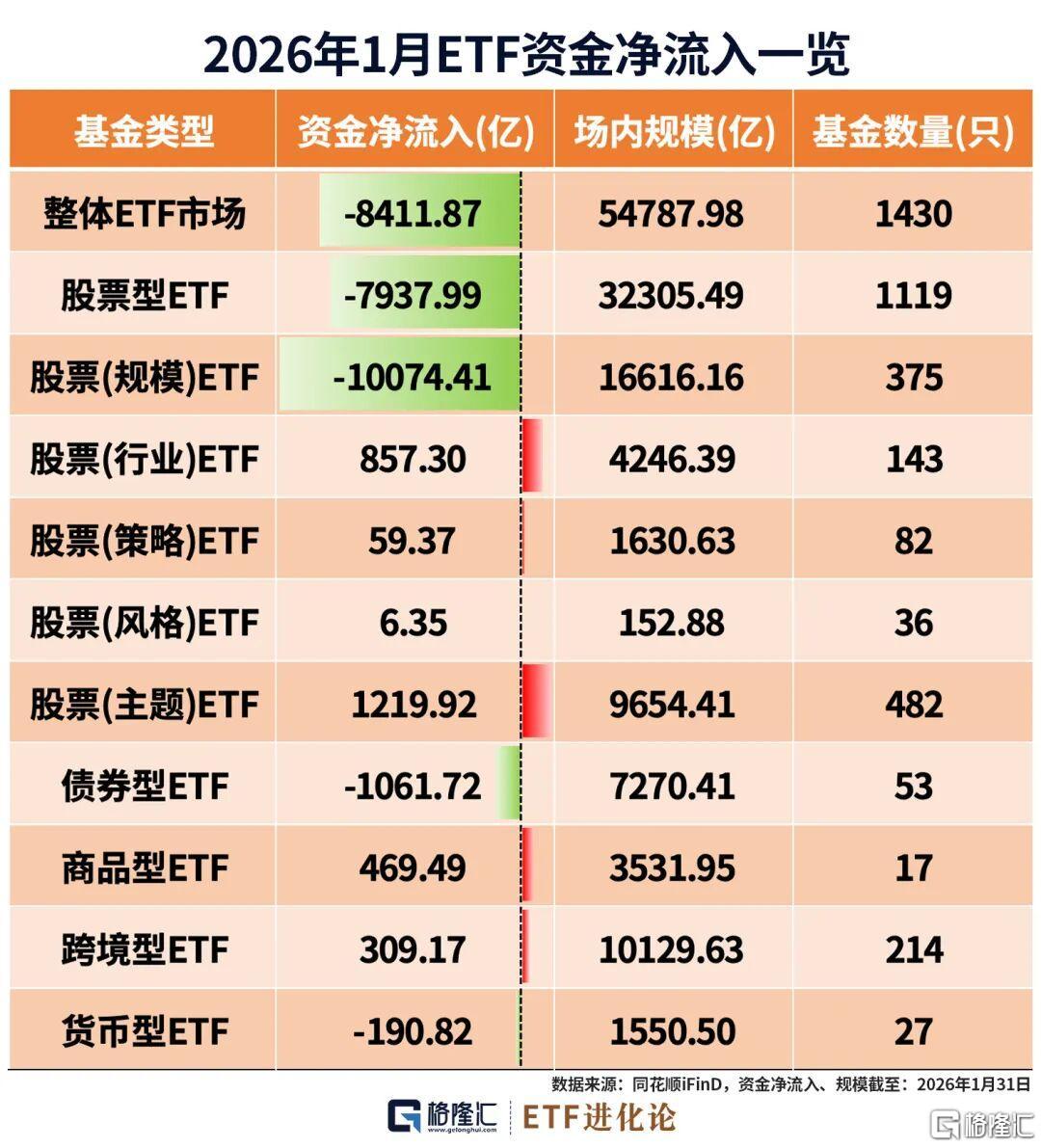
Core Viewpoint - In January 2026, the A-share ETF market exhibited a clear divergence, with over 200 billion yuan flowing into thematic ETFs in sectors like non-ferrous metals, gold, chemicals, and technology, while core broad-based ETFs like CSI 300 and CSI 1000 experienced a net outflow exceeding 1 trillion yuan [1][10]. Group 1: ETF Market Overview - The overall ETF market size reached approximately 54,787.98 billion yuan, with a net outflow of 841.87 billion yuan in January [3]. - Stock-type ETFs saw a net outflow of 793.80 billion yuan, while thematic stock ETFs recorded a net inflow of 1,219.92 billion yuan [3]. - The CSI 300 ETF from Huatai-PineBridge had a net outflow of 1,908.43 billion yuan, marking the largest outflow among broad-based ETFs [11]. Group 2: Performance of Thematic ETFs - The non-ferrous metals ETF and gold ETFs attracted significant inflows, with the non-ferrous metals ETF receiving 182.57 billion yuan and the gold ETF 147.71 billion yuan [13]. - The semiconductor ETFs, including the China-Korea Semiconductor ETF, saw substantial gains, with the former increasing by 45.09% in January [6]. - Other notable performers included the chemical ETF and the electric grid equipment ETF, which also received over 100 billion yuan in inflows [13]. Group 3: Sector Performance - In January, the non-ferrous metals and technology sectors alternated as the leading gainers, with the semiconductor and gold stock ETFs rising over 40% [4]. - The AI application concept surged, leading to a 20% increase in the media ETF, while oil and gas stocks also saw gains of over 20% [4]. - Conversely, the banking ETF and automotive ETF experienced declines, with the banking ETF dropping over 6% [7][8].

投资大咖说 | 从“长期持有”到“灵活交易”的迭代——访太平基金林开盛
Sou Hu Cai Jing· 2026-02-02 00:34
"调研的方式有很多种,高效匹配自己的节奏才是关键。"林开盛更青睐券商策略会上的集中交流、上市 公司一对一的对话,以及一些与产业息息相关的大型展会。"例如,去一次展会,我能一次性实现对全 产业链硬件、软件的感性认知,效率远高于单次出差。"林开盛说。 他的投资理念里,藏着一个朴素的 目标:根据对大趋势的挖掘和理解做投资。"我希望在和市场上其他投资者面对同样的公开信息时,能 凭借历史积累和经验沉淀,梳理出更深入的洞见。"他坦言,自己常在某些个股涨了30%至50%后才明 白"上涨逻辑",但那些因为"信息差"而错过的标的并不可惜,因为在他的研究体系下,也可以通过对历 史规律的推演和股票市场的理解找到其他值得投资的方向。 而在控制回撤方面,他也有自己的心得: 一是通过配置低相关性的行业对冲风险;二是坚守"买在低位"的原则,降低个股波动率;三是严守止盈 纪律,在标的估值偏高时果断切换。 ◎记者 朱妍 从"长期持有"的价值信徒,到"灵活交易"的市场猎 手,八年半投资生涯,太平基金林开盛的投资框架经历了迭代。凭借对科技、化工等多轮产业行情的精 准把握,其管理的太平行业优选股票走出了一条独特的投资之路。 从"坐过山车"到"高低切 ...

规模达2.99万亿元,仍将持续爆发,这类基金有望成低风险理财“压舱石”
3 6 Ke· 2026-02-02 00:22
受访公募机构表示,当前,居民资产配置持续向金融资产转移,"固收+"产品凭借其清晰的风险收益特 征,有望成为承接稳健类资金的重要载体,市场规模或进一步增长。 "固收+"基金规模达2.99万亿元,有望成低风险理财市场"压舱石" 随着天量存款到期、低利率环境延续,"固收+"基金规模和业绩迎来"双丰收"。 "固收+"产品规模快速增长 "固收+"产品规模持续扩张。中金公司研报数据显示,截至2025年末,全市场2292只"固收+"基金规模合 计达2.99万亿元(统计一级债基、二级债基、可转债、偏债混、低仓位灵活配置基金、偏债混合型 FOF),创历史新高;环比增长9%,较去年同期增长56%。从细分品类来看,2025年四季度,二级债基 大幅扩容,最新规模达1.55万亿元,环比增长19%。 进入2026年以来,基金公司继续加大力度布局"固收+"基金,包括汇添富、富国、易方达、国泰、摩根 等多家基金公司。 兴业基金固定收益投资部总经理助理腊博表示,"固收+"产品规模快速增长是多方面因素共同影响的结 果,低利率环境是重要的背景,较低的存款利率和债券收益率难以满足投资者对收益的诉求,经济结构 转型和政策支持使市场风险偏好显著提升。 ...
“小确幸”式狂欢暗藏风险LOF套利狂潮谁在推波助澜
Zhong Guo Zheng Quan Bao· 2026-02-01 20:53
Core Viewpoint - The recent surge in LOF (Listed Open-Ended Fund) arbitrage has captured the attention of investors, driven by high premium levels and social media influence, reflecting a shift in investor sentiment and logic in the current market environment [1][2][3] LOF Arbitrage Heat - LOF has become a focal point in the market, with 16 LOF products experiencing a collective price surge on January 29, indicating a significant interest from investors [1] - The premium levels of LOF products have remained high, with 8 products exceeding a 10% premium as of January 30, driven by strong performance in resource-related LOFs due to rising commodity prices [2][3] Social Media Influence - Financial influencers have created detailed "how-to" guides for LOF arbitrage, leading to increased engagement and participation from novice investors [2] - The rapid dissemination of information through social media platforms has amplified the interest in LOF arbitrage, with many investors sharing their experiences and profits [4][5] Market Dynamics - The rise in LOF arbitrage is attributed to multiple factors, including the strong performance of specific LOFs like Guotou Silver LOF, which saw a premium rate exceeding 60% due to market conditions [4][5] - The restriction on new subscriptions for popular LOFs has led to increased demand in the secondary market, further driving up prices and premiums [3][5] Investor Behavior - Many investors participating in LOF arbitrage are motivated by the desire for small, manageable profits rather than high-risk, high-reward strategies, reflecting a shift in investment psychology [6][7] - The phenomenon of "herd behavior" is prevalent, with many investors making decisions based on social media recommendations rather than thorough product understanding, which could lead to market bubbles [8] Industry Implications - The current LOF arbitrage trend highlights the need for improved liquidity in LOF products, as many have not been prioritized by fund companies in recent years [7] - The evolving investor mindset and the impact of social media on investment decisions suggest a growing demand for stable investment options, necessitating industry adaptation [8]
金银“人声鼎沸时”
Shang Hai Zheng Quan Bao· 2026-02-01 18:16
Group 1 - The core viewpoint of the articles highlights the significant surge in gold and silver prices since the beginning of 2026, driven by strong profit-making effects attracting substantial capital inflow into gold-related ETFs [1] - As of January 29, 2026, the domestic market saw a net inflow of 5.104 billion yuan into gold-related ETFs, with the total scale reaching 353.993 billion yuan [1] - Major gold ETFs in the domestic market have seen substantial growth, with Huashan Gold ETF at 135.475 billion yuan, Bosera Gold ETF at 57.656 billion yuan, E Fund Gold ETF at 50.473 billion yuan, and Guotai Gold ETF at 45.141 billion yuan [1] Group 2 - The historical context of gold prices shows significant volatility, with past peaks and declines, indicating that the current high prices may be subject to substantial corrections [2] - The article emphasizes that the current market is characterized by strong speculative sentiment, and a shift in influencing factors could lead to a sharp price decline [2] - It is noted that true investment success comes from understanding and adhering to fundamental principles rather than blindly following market trends [2]

规模达2.99万亿元,仍将持续爆发!这类基金有望成低风险理财“压舱石”
Zhong Guo Ji Jin Bao· 2026-02-01 13:13
进入2026年以来,基金公司继续加大力度布局"固收+"基金,包括汇添富、富国、易方达、国泰、摩根 等多家基金公司。 兴业基金固定收益投资部总经理助理腊博表示,"固收+"产品规模快速增长是多方面因素共同影响的结 果,低利率环境是重要的背景,较低的存款利率和债券收益率难以满足投资者对收益的诉求,经济结构 转型和政策支持使市场风险偏好显著提升。 腊博认为,随着存款利率的吸引力下降,存款向"固收+"产品、保险产品、理财产品和权益类产品转化 的比例也会相应提升。而从产品布局的角度来看,基金公司布局不同风险梯度的"固收+"产品,可以更 好地契合投资者不同的风险收益偏好。 随着天量存款到期、低利率环境延续,"固收+"基金规模和业绩迎来"双丰收"。 受访公募机构表示,当前,居民资产配置持续向金融资产转移,"固收+"产品凭借其清晰的风险收益特 征,有望成为承接稳健类资金的重要载体,市场规模或进一步增长。 "固收+"产品规模快速增长 "固收+"产品规模持续扩张。中金公司(601995)研报数据显示,截至2025年末,全市场2292只"固收 +"基金规模合计达2.99万亿元(统计一级债基、二级债基、可转债、偏债混、低仓位灵活配置基 ...
新旧交替!百亿基金经理大洗牌
券商中国· 2026-02-01 13:12
Core Viewpoint - The rise of AI technology has led to a new batch of active equity fund managers managing over 10 billion yuan, referred to as "new hundred billion" fund managers, who are now part of the latest lineup alongside established managers like Zhang Kun and Liu Yanchun, creating a "new and old" transition in the fund management landscape [1][7]. Group 1: New vs. Old Fund Managers - As of January 31, the number of active equity fund managers managing over 10 billion yuan remains above 100, continuing a trend of recovery since Q3 2025, returning to levels seen at the end of 2023 [2]. - "New hundred billion" fund managers typically have shorter management tenures and previously lower scales, but have rapidly grown their assets under management (AUM) in 2025, with examples like Zhang Lu from Yongying Fund, whose AUM increased from just over 2 billion yuan at the end of 2024 to over 30 billion yuan [2]. - Other notable "new hundred billion" managers include Lan Xiaokang from China Europe Fund and Zheng Xi from E Fund, both of whom saw significant AUM increases in the past year [3]. Group 2: Performance and Strategy Shifts - Established "old hundred billion" managers like Zhang Kun and Liu Yanchun still hold significant AUM but have seen declines from their peak levels, with Zhang Kun's AUM dropping from over 130 billion yuan in 2021 to around 48 billion yuan currently [3]. - The market dynamics have shifted, with "new hundred billion" managers benefiting from the AI and technology sectors, while "old hundred billion" managers have largely maintained positions in traditional blue-chip assets, leading to performance discrepancies [7][8]. - Some "old hundred billion" managers have begun to adjust their strategies, with examples like Xie Zhiyu, who has shifted from blue-chip stocks to technology-focused investments, achieving notable returns [8]. Group 3: Market Dynamics and Risks - The current market structure reflects a systematic reconstruction of active equity funds driven by style rotation and performance dynamics, with a notable shift towards technology growth sectors [7]. - There is a cautionary note regarding the potential risks associated with large fund sizes, as excessive concentration in specific sectors like AI could lead to significant volatility and redemption pressures [9][10]. - The regulatory environment is tightening, requiring fund managers to create sustainable performance metrics while managing the risks associated with large AUM and concentrated holdings [10].

“顶流”暗淡了星光,新秀“杀了个痛快”,罕见大洗牌来了
Xin Lang Cai Jing· 2026-02-01 13:12
Core Insights - The number of active equity fund managers managing over 10 billion yuan increased from 77 at the end of 2024 to 93 by the end of 2025, indicating a significant reshuffling in the "billion club" of fund managers [1][2][10] - Traditional top fund managers have seen a decline in their management scale, while new managers focusing on technology sectors have emerged rapidly, reflecting a shift in investor preferences towards strategies that align with market trends [1][2][3][5] Fund Manager Changes - As of Q4 2025, 93 active equity fund managers manage over 10 billion yuan, an increase of 16 from the previous year, with notable names like Zhang Kun and Xie Zhiyu still leading the pack [2][10] - Some star fund managers, particularly those heavily invested in consumer stocks, have experienced significant scale reductions, with losses exceeding 10 billion yuan for managers like Liu Yanchun and Zhang Kun [2][10] - New entrants in the technology sector, such as Ren Jie and Zhang Haixiao, have seen their management scales grow from under 1 billion yuan to over 10 billion yuan, showcasing the rapid rise of new talent [2][10] Market Structure and Style Changes - The changes in the billion club are attributed to a combination of short-term market style shifts and a long-term feedback mechanism between scale and performance [3][11] - The transition from a focus on large-scale fund managers to those offering sustainable performance indicates a maturation of investor behavior, moving away from merely chasing historical performance [3][11][12] Industry Trends - The public fund industry is currently undergoing a high-quality development phase, with regulatory actions promoting long-term assessments and fee reforms, pushing the industry to prioritize investor returns over sheer scale [4][12] - The trend of "de-starring" fund managers is gaining traction, as firms seek to reduce reliance on individual managers and focus on building robust research teams [5][12][13] Investment Strengths - Future success in the billion club will depend on fund managers' abilities to control drawdowns and adapt investment strategies, emphasizing the importance of "hard skills" in investment management [6][14] - The industry is expected to evolve towards two main types of funds: those providing stable excess returns and those with clear investment styles, while poorly defined products are likely to be phased out [6][14][15]