联发科

Search documents
手机市场进入整活时代
创业邦· 2025-10-31 06:06
Core Viewpoint - The article discusses the competitive landscape in the smartphone industry, highlighting how companies are innovating in product design and technology integration to maintain market relevance and profitability amid stagnant growth and increasing competition [6][11][30]. Group 1: Product Innovations - Xiaomi's recent launch of the 17 series and its unique back screen design has sparked mixed reactions on social media, indicating a trend of creative product features among smartphone manufacturers [6][11]. - Realme's GT8 series introduces modular design elements for camera modules, showcasing a focus on aesthetic customization [10]. - Honor's concept of the robot phone, which integrates a mechanical arm gimbal, represents a bold innovation, although it remains in the conceptual stage with plans for mass production next year [9][11]. Group 2: Market Dynamics - The smartphone market is experiencing intense competition, leading manufacturers to explore innovative product designs as a means to differentiate themselves and create new premium pricing opportunities [11][16]. - Apple's iPhone Air exemplifies this trend by prioritizing extreme miniaturization and integration at the cost of overall specifications, indicating a strategic shift towards exploring consumer acceptance of design over functionality [13][16]. - The article notes that both Apple and Android manufacturers are seeking new differentiation strategies as the gap in hardware specifications narrows [16][30]. Group 3: Vertical Integration and Supply Chain Control - The article outlines a shift from horizontal division of labor in the smartphone industry back to vertical integration, as companies seek to regain control over core technologies and components [23][30]. - Apple has been particularly aggressive in this regard, developing its own 5G modem and other components to reduce reliance on suppliers like Qualcomm and Sony, thereby enhancing its supply chain dominance [31][30]. - The trend of "joint development" is highlighted, where brands define product specifications and suppliers customize components, allowing manufacturers to reclaim some degree of "definition power" over their products [28][30]. Group 4: Historical Context and Future Implications - The article references the historical context of the smartphone industry, noting that the trend towards vertical integration is a response to the challenges posed by a highly competitive market and the need for differentiation [19][30]. - It emphasizes that the current market dynamics compel manufacturers to innovate not just in product features but also in how they manage their supply chains and technological capabilities [30][31].



高通正面“叫板”英伟达,入局AI芯片能否打破市场格局
Hua Xia Shi Bao· 2025-10-31 03:39
Core Insights - Qualcomm has officially entered the AI chip market with the launch of AI200 and AI250 chips, targeting data centers and aiming to compete with Nvidia, the current market leader [1][2] - The decision to enter the AI chip market is driven by the need to adapt to market changes and capitalize on the potential of AI technology, especially as Qualcomm faces increasing competition in the mobile chip sector [1][3] - The AI chip market is experiencing explosive growth, with Nvidia currently dominating the space, while Qualcomm aims to leverage its expertise in mobile chips to carve out a niche in AI [4][5] Product Launch and Features - The AI200 and AI250 chips are expected to be commercially available in 2026 and 2027, respectively, with plans for annual releases of new computing chips [2] - The AI200 chip is designed for rack-level AI inference, supporting 768GB LPDDR memory for enhanced performance and cost efficiency [2] - The AI250 chip features an innovative memory architecture that significantly improves memory bandwidth and reduces power consumption, focusing on inference rather than training [2] Market Dynamics - The demand for AI chips has surged since the rise of ChatGPT, with Nvidia's market capitalization reaching approximately $4.89 trillion [4] - Qualcomm's previous attempts to enter the data center market were unsuccessful, but the current strategy focuses on competing directly with Nvidia in the AI chip sector [5] - The AI chip market is expected to evolve into a collaborative ecosystem with multiple strong players, including Qualcomm and Huawei, particularly in edge AI applications [6] Financial Performance - Qualcomm reported a 10% year-over-year revenue increase to $10.365 billion for the third fiscal quarter of 2025, with net profit rising 25% to $2.666 billion [7] - The company faces challenges in maintaining its market share in the smartphone application processor market, with MediaTek leading at 36% and Qualcomm at 28% [7][8] - Regulatory scrutiny from Chinese authorities poses additional challenges for Qualcomm, impacting its strategic positioning [7][8] Future Outlook - The global AI computing market is projected to reach $1.21 trillion by 2025, with hardware accounting for approximately $762.3 billion, indicating significant growth potential for companies like Qualcomm [8]

内存价格,失控狂飙
猿大侠· 2025-10-30 04:40
Core Viewpoint - The article discusses the impact of the "super cycle" in memory prices, particularly DRAM and NAND Flash, on the Chinese smartphone supply chain, highlighting significant cost pressures and potential delays in product delivery [1]. Group 1: Memory Price Trends - DRAM and NAND Flash prices are continuously rising, affecting the supply chain of Chinese smartphones [1]. - The delivery period for key memory types like LPDDR5X has extended to 26-39 weeks, with potential delays in order fulfillment until mid-2026 [1]. - Major memory suppliers, including Samsung, SK Hynix, and Micron, plan to increase prices further in Q4, with potential hikes of up to 30% [5]. Group 2: Impact on Smartphone Manufacturers - Media reports indicate that companies like Xiaomi are directly adjusting product pricing due to soaring memory costs, with the Redmi K90 series seeing price increases of 300 to 600 yuan compared to previous models [2][5]. - Xiaomi's founder, Lei Jun, acknowledged the "outrageous" rise in memory prices, which has forced the company to raise prices beyond its control [3]. - Other domestic brands, such as vivo and OPPO, have also raised prices for their models in response to increased memory costs [5]. Group 3: Financial Performance of MediaTek - MediaTek's financial performance shows a slight decline in gross margin and operating profit margin in Q4 2024, with expectations of profit pressure from rising memory and wafer foundry costs starting in Q4 2025 [2]. - The gross margin for MediaTek is projected to be 48.54% in Q4 2024, down from 48.82% in Q3 2024 [2].

手机市场进入整活时代
远川研究所· 2025-10-29 13:12
Core Viewpoint - The article discusses the competitive landscape in the smartphone industry, highlighting how companies are innovating in product design and technology integration to maintain market share and profitability amidst stagnating growth [5][10][17]. Group 1: Product Innovations - Xiaomi's 17 series and its unique back screen design sparked mixed reactions on social media, indicating a trend of creative product features among smartphone manufacturers [5][10]. - Realme's GT8 series introduced modular camera designs, showcasing the industry's push for aesthetic and functional differentiation [6][11]. - Honor's concept of the robot phone, which integrates a mechanical arm gimbal, represents a bold innovation, although it remains in the conceptual stage with plans for mass production next year [7][9]. Group 2: Market Dynamics - The smartphone market is experiencing intense competition, leading manufacturers to explore innovative product designs as a means to create new premium pricing opportunities [10][17]. - Companies are increasingly focusing on vertical integration and self-research capabilities to gain control over core components, aiming to differentiate their products in a saturated market [18][19]. Group 3: Supply Chain and Technology Integration - The article emphasizes the shift from horizontal division of labor to vertical integration in the smartphone industry, driven by the need for manufacturers to reclaim "definition rights" over their products [26][32]. - Apple has been a leader in this trend, developing its own components like the C1 5G baseband chip and Wi-Fi chip N1, which significantly increases the proportion of self-developed parts in its products [16][33]. - The competitive landscape has forced companies to enhance their technological capabilities and redefine their relationships with suppliers, as seen in Apple's strategic moves to reduce reliance on external suppliers like Qualcomm and Sony [28][33].

美股异动丨台积电盘前涨超1% 消息称其3纳米芯片订单激增
Ge Long Hui· 2025-10-29 08:24
Core Viewpoint - TSMC is experiencing a surge in orders for its advanced 3nm chips, driven by the strong market performance of Apple's iPhone 17 series, indicating a new peak in demand for its advanced manufacturing processes [1] Group 1: Market Performance - TSMC's stock rose by 1.24% to $305.26 ahead of market opening, reflecting positive investor sentiment [1] - The demand for TSMC's 3nm chips is significantly increasing, with major clients like MediaTek and Qualcomm utilizing this technology for their flagship chips [1] Group 2: Production Capacity - TSMC's 3nm order momentum remains strong, and there is an expectation for an increase in the utilization rates of its previously weaker 6/7nm production capacities [1] Group 3: Client Relationships - NVIDIA has become the sole customer for TSMC's next-generation A16 process, with both companies currently engaged in joint testing [1] - Apple, a long-term major client of TSMC, has not yet initiated discussions regarding the adoption of the A16 process for its mobile application processors [1] Group 4: Future Developments - According to NVIDIA's GPU roadmap, the Feynman architecture GPU, expected to launch in 2028, will fully utilize TSMC's A16 process technology [1]

2025年Q3全球PC出货量同比增长8.1%,Windows 10停服与关税变化推动市场回暖
Counterpoint Research· 2025-10-28 04:26
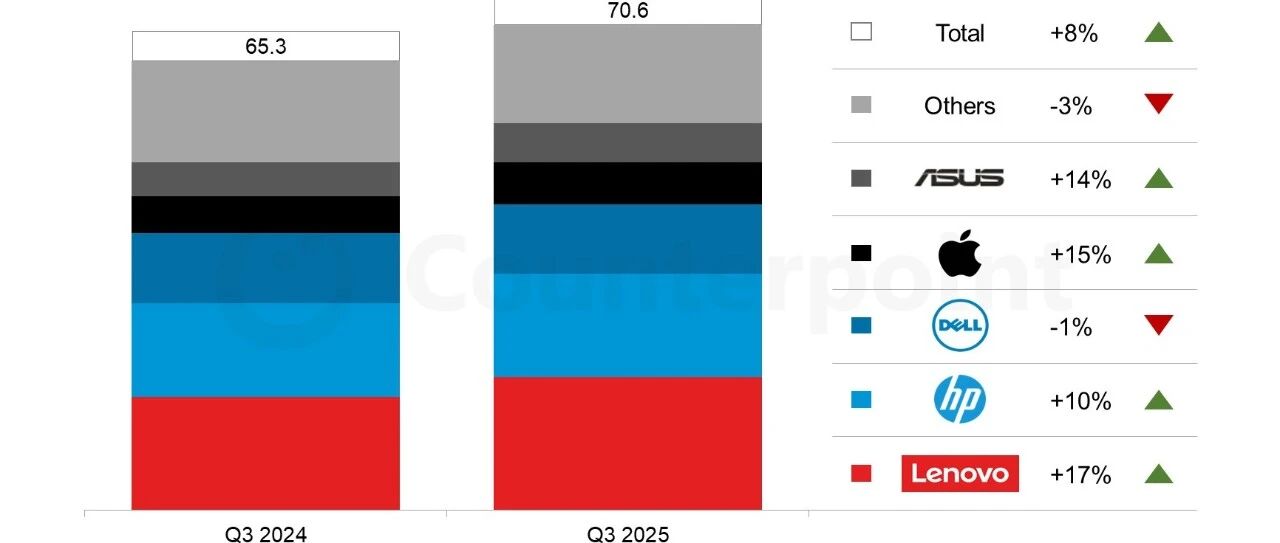
Core Insights - The global PC shipment volume increased by 8.1% year-on-year in Q3 2025, driven by the end of support for Windows 10 and strategic inventory adjustments related to changes in U.S. import tariffs [5][4] - Approximately 40% of the PC installed base is still running Windows 10, indicating a significant replacement cycle that is expected to drive market growth in the coming years [5][9] - Major OEMs capitalized on the replacement cycle, with several companies achieving double-digit year-on-year growth, while smaller brands saw flat or slightly declining shipments [7][8] Market Dynamics - Lenovo maintained its position as the global market leader with a shipment increase of 17.4%, the highest among the top six manufacturers [8] - HP ranked second with a 10.3% year-on-year increase, showcasing its strong penetration in the commercial market [8] - Dell experienced a slight decline of 0.9% year-on-year, reflecting cautious purchasing behavior among core enterprise clients [8] Future Trends - The rise of AI PCs is anticipated to significantly boost shipments starting in 2026, driven by the commercialization of next-generation processors designed for local AI computing [9][12] - Companies are beginning to procure AI-enabled PCs not out of immediate necessity but to prepare for future applications, indicating a shift towards "edge intelligence" as the next wave of replacement [11][12] - The 2026 CES is expected to be a pivotal event for the AI PC market, showcasing numerous local AI demonstrations and new product launches [12]



半个月三场大会,AI战火蔓延手机圈
3 6 Ke· 2025-10-27 23:26
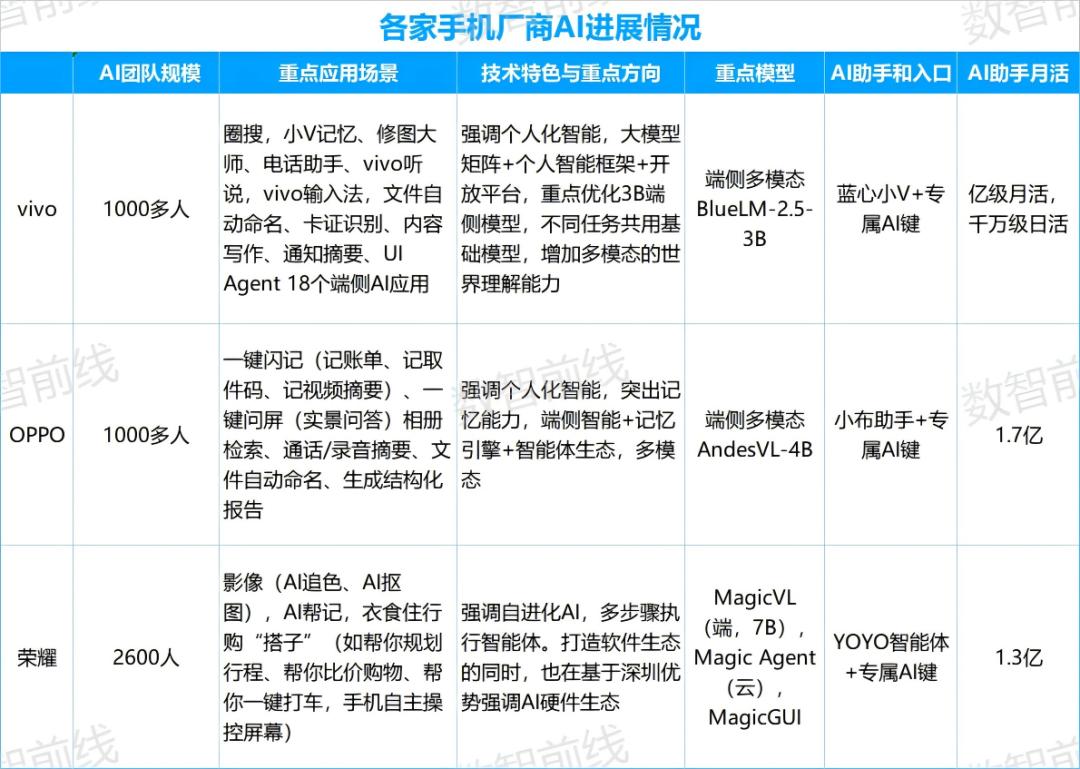
Core Insights - Mobile manufacturers are shifting focus from large parameter models to edge-based multimodal models, reflecting a significant change in AI strategy [1][8][11] - AI has become a central topic at recent developer conferences held by vivo, OPPO, and Honor, showcasing their new understanding of AI strategies and model applications [1][2] AI Development Trends - The application of AI in mobile devices has evolved from text processing to include image and voice processing, with a notable increase in edge-side multimodal models [1][3] - vivo has introduced 18 edge-side AI applications, enhancing user interaction through complex task management and intent recognition [1][4] - OPPO's features like "one-click screen inquiry" and "one-click flash note" demonstrate real-time understanding and automation of user tasks [2][4] - Honor claims over 3,000 automated scenarios, streamlining user interactions across various applications [2][4] Model Evolution - Mobile manufacturers have progressed through three stages of model development, moving from large language models to multimodal models with a focus on edge deployment [3][5] - Recent releases include Honor's 7B multimodal model MagicGUI and vivo's 3B model BlueLM-2.5-3B, integrating language, vision, and logical reasoning capabilities [5][6] Challenges in Edge Model Deployment - Current AI assistants often rely on multiple models for different tasks, leading to complexities in integrating external cloud models [8][11] - The performance of edge models is constrained by chip capabilities, with current models achieving 2B-5B parameters, equivalent to 32-70B cloud models [8][10] - The need for higher performance chips and storage for edge models poses challenges, especially in balancing cost and user experience [11][12] Ecosystem Development - The development of AI agents is still in its early stages, with current automation tasks limited to manufacturer-specific applications [13][15] - Manufacturers are building AI ecosystems to enhance cross-application functionality, with vivo, OPPO, and Honor leading efforts in creating reusable capabilities for partners [15][16] - Collaboration with internet companies is crucial for expanding the AI ecosystem, as user data and application value are significant concerns for app developers [16][17]
香农芯创股价暴涨背后:存储芯片“批发商”是如何被推上风口的?
经济观察报· 2025-10-27 12:38
Core Viewpoint - The storage chip market is experiencing significant price increases, yet this has not translated into proportional financial performance for Shannon Chip Innovation, which reported a revenue increase but a decline in net profit [2][3]. Financial Performance - For the first three quarters of 2025, Shannon Chip Innovation achieved a revenue of 26.4 billion yuan, a year-on-year increase of 59.90%, while the net profit attributable to shareholders was 359 million yuan, reflecting a year-on-year decrease of 1.36% [2]. Stock Performance - On October 27, 2025, the stock price of Shannon Chip Innovation rose by 4.77%, reaching 133.66 yuan per share, with a cumulative increase of 234% from September 5 to October 27, 2025, compared to a 9.89% increase in the ChiNext Index during the same period [2]. Business Model - The company's revenue is primarily derived from "electronic component distribution," which accounted for 97.03% of total revenue, while its original "reducer business" contributed only 0.93% [5]. - Shannon Chip Innovation operates mainly as a middleman, purchasing from manufacturers like SK Hynix and selling to major clients such as Alibaba and Huacomm [5][6]. Inventory Management - The company employs two procurement models: "order-based procurement" to minimize inventory risks and "stock procurement" based on market demand forecasts [6][7]. - The management indicated that the decline in net profit is due to high margins in the previous year, and current margins are improving on a quarter-over-quarter basis [5][6]. Market Positioning - Shannon Chip Innovation is focusing on self-developed chips and AI computing, with its brand "Haipu Storage" targeting the enterprise SSD market [10][11]. - The company is also involved in a joint venture for AI computing, indicating a strategic shift towards higher value-added services [11][12]. Industry Outlook - The storage chip market is expected to remain strong, with predictions of price increases for DRAM in Q4 2025, driven by supply constraints and rising demand from cloud service providers [16][17]. - Industry leaders express optimism about the semiconductor market in 2026, suggesting a favorable environment for companies like Shannon Chip Innovation [16][18].


香农芯创股价暴涨背后:存储芯片“批发商”是如何被推上风口的?
Jing Ji Guan Cha Wang· 2025-10-27 11:53
Core Viewpoint - The stock price of Shannon Chip Innovation (300475.SZ) has surged by 234% from September 5, 2025, to October 27, 2025, significantly outperforming the growth of the ChiNext Composite Index, which only increased by 9.89% during the same period. This surge is attributed to the current price increase in storage chips, despite the company's financial performance not reflecting this growth [2][3]. Financial Performance - For the first three quarters of 2025, Shannon Chip Innovation reported revenue of 26.4 billion yuan, a year-on-year increase of 59.90%. However, the net profit attributable to shareholders decreased by 1.36% to 359 million yuan [2]. - The company’s stock trading has been marked by significant volatility, with management indicating that the operational performance has not changed in line with the stock price increase, suggesting potential irrational speculation in the market [3]. Business Model - The company primarily operates as a distributor of electronic components, with 97.03% of its revenue coming from this segment, amounting to 16.6 billion yuan in the first half of 2025. The remaining revenue comes from its original business in washing machine parts [4]. - Shannon Chip Innovation holds distribution rights for major manufacturers like SK Hynix and MTK, selling products primarily to large internet service providers and ODMs [4]. Inventory Management - The company employs two procurement models: "order-based procurement" to minimize inventory risks and "stock procurement" based on market demand forecasts. The former provides stable margins, while the latter aims to capitalize on market fluctuations [6][7]. Market Positioning - The company’s high rolling P/E ratio of 239 suggests that the market is valuing its potential in self-developed chips and AI computing capabilities, despite its distribution business being the main revenue driver [8]. - Shannon Chip Innovation is developing its own brand of storage products, "Haipu Storage," and has made investments in AI computing through a joint venture, indicating a strategic shift towards higher value-added services [9][10]. Industry Outlook - The ongoing price increase in storage chips is expected to continue, with major players like SK Hynix and Samsung predicting a positive outlook for the semiconductor market in 2026, including significant price hikes for DRAM contracts [14][15].

20251027 China TMT Breakout
傅里叶的猫· 2025-10-27 11:07
Global Insights - Ongoing US-China negotiations are expected to delay certain policies [4] - Arkham Intelligence reported that SpaceX transferred a total of 1,215 bitcoins to multiple addresses [4] - Citigroup highlighted Anthropic's agreement with Google to procure up to 1 million TPUs, indicating potential benefits for TSMC, MediaTek, and KYEC due to increased TPU chip shipments [5] China Insights - Alibaba upgraded Qwen deep research with one-click webpage and podcast generation, achieving accuracy on par with Gemini, outperforming ChatGPT and Grok [7] - Goldman Sachs noted the increasing adoption of Horizon Journey 6 platform in new vehicle models, with mass production of J6P and H5D starting in EXEED models [7] - Xiaoma Zhixing announced the mass production of 300 units of the seventh-generation Robotaxi, aiming for a fleet of 1,000 by the end of 2025 [8] - Citigroup reported that GoerTek's Q3 2025 performance met expectations, with revenue growth of 4% year-on-year to 30.6 billion RMB [8] - Xiaomi is expected to announce Q3 2025 results on November 18, with a projected net profit of 1.2 billion RMB, reflecting a year-on-year increase of 64% [9] - Raycus Laser's Q3 2025 revenue grew by 10% year-on-year to 841 million RMB, with a significant net profit increase of 107% to 50 million RMB [10] - Nomura identified Shenghong Technology as a key beneficiary of Nvidia's innovation cycle, projecting a revenue and earnings CAGR of 40% and 45% respectively from FY2025 to FY2027 [11]