
锦欣生殖

Search documents
母婴消费行业点评:国家育儿补贴出台,改善母婴消费预期
Shenwan Hongyuan Securities· 2025-07-29 03:43
Investment Rating - The report rates the mother and baby consumption industry as "Overweight" [2][9] Core Insights - The introduction of a national childcare subsidy of 3,600 yuan per child per year, totaling up to 10,800 yuan per child, is expected to improve consumption expectations in the mother and baby sector [3] - The report highlights that despite a decline in birth rates over the past seven years, the overall mother and baby market has experienced a compound annual growth rate (CAGR) of over 15% from 2018 to 2024 due to consumption upgrades and refined parenting [3] - The report emphasizes the rise of domestic brands in the mother and baby sector, with significant market share gains and a return of industry influence to local brands [3] Summary by Sections National Childcare Subsidy - The national childcare subsidy program will start on January 1, 2025, providing cash subsidies to families with children under three years old, with a basic standard of 3,600 yuan per year [3] - Local governments are expected to introduce additional subsidies, creating a wave of local support for childbirth [3] Market Growth and Opportunities - The mother and baby market is projected to rebound due to improved policies and an anticipated increase in birth rates in 2024 [3] - Key sectors and companies recommended for investment include: - Fertility and reproductive health: Focus on companies like Jinxin Reproductive and Livzon Pharmaceutical [3] - Infant nutrition: Recommendations include China Feihe and Yili Group [3] - Baby appliances: Suggested investment in Bear Electric [3] - Apparel and home textiles: Companies like Semir and Anta are highlighted [3] - Baby care products: Brands such as Runben and New Page are recommended [3] Valuation Table - The report includes a valuation table with various companies in the mother and baby sector, indicating their stock prices, market capitalization, and profit forecasts for 2025, 2026, and 2027, along with corresponding investment ratings [4]



受利好政策刺激,这几个板块在开盘后大涨
Guan Cha Zhe Wang· 2025-07-29 03:22
(原标题:受利好政策刺激,这几个板块在开盘后大涨) 7月29日,沪指低开0.06%,报3595.81点;深成指低开0.16%,报11199.63点;创业板指高开0.01%,报 2362.77点。然而受前一天《育儿补贴制度实施方案》(以下简称《方案》)公布消息影响,7月29日开 盘后,乳业、托育、辅助生殖等相关板块大涨。 开盘后不久,作为代表的乳业板块涨幅一度超过4.5%,包括骑士乳业、贝因美、西部牧业等股票均有 大涨。不过随着交易进行,相关涨幅有所回调。 截至发稿前,部分乳业股票的股价上涨情况 与A股类似,部分育儿产业相关股票在港股市场也经历了开盘后涨幅极高,但随着交易进行涨幅逐渐下 滑,甚至略有下跌的变化。如澳优,开盘后涨幅一度接近14%,但截至发稿前,该股涨幅减少至3%。 锦欣生殖股价涨幅也从开盘后的10%一路调整至开盘时的原点。 不过值得注意的是,与大多数开盘后涨幅有所回调的股票不同,中国育儿网络在港股的股价一路强势走 高。截至发稿前,已经上涨92.73%。 据《每日经济新闻》报道,中泰证券研究所政策组首席分析师杨畅在接受采访时表示,育儿补贴在缓解 养育压力的同时,将会发挥出带动消费的作用。据他估算,2 ...
多行业联合解读国家育儿补贴新政
2025-07-29 02:10
Summary of Conference Call on National Childcare Subsidy Policy Industry Overview - The conference call discusses the impact of the national childcare subsidy policy on various industries, particularly focusing on the maternal and infant products market, including companies like Feihe, Jianhe International, Aoyou Dairy, and Mengniu Dairy [1][3][5]. Key Points and Arguments 1. **Childcare Subsidy Policy Implementation**: Starting January 1, 2025, the government will provide a monthly subsidy of 300 yuan for children under three years old, applicable to those born after January 1, 2022 [2][6]. 2. **Impact on Maternal and Infant Products Market**: The subsidy is expected to enhance family consumption capacity, benefiting retail companies like Aiyingshi and Haiziwang significantly [1][5]. 3. **Feihe's Financial Performance**: Feihe anticipates a revenue of 20.7 billion yuan in 2024, a 6.2% increase year-on-year, with a net profit of 3.65 billion yuan, up 11% [1][3]. 4. **Jianhe International's Strategy**: The company has diversified its product offerings, with infant nutrition accounting for about half of its revenue. It has expanded its market presence, particularly in lower-tier cities, and aims to increase customer acquisition through promotional events [7][10]. 5. **Aoyou Dairy's Market Position**: Aoyou Dairy leads in the goat milk powder segment and has secured 70% of its raw milk costs, ensuring stable profit margins amid the new policy [8][4]. 6. **Mengniu Dairy's Growth Potential**: Although Mengniu's infant formula business is relatively small, its organic milk powder products are expected to benefit from the subsidy, potentially increasing sales and profitability [9][4]. 7. **Retail Sector Dynamics**: The retail sector, especially maternal and infant products, is poised for growth due to the subsidy, with companies like Aiyingshi and Haiziwang expanding their store networks and product offerings [10][5]. 8. **Consumer Electronics Impact**: Companies like Bear Electric are expected to benefit from the subsidy, with significant growth in maternal and infant appliances, projecting over 40% growth in related product sales [18][3]. 9. **Clothing Market Influence**: The subsidy is likely to boost clothing consumption, particularly in the children's apparel sector, with an estimated increase in spending on children's clothing due to the financial support [19][20]. 10. **Healthcare and Medical Products**: The conference also highlights the potential benefits for healthcare products related to infants, including vaccines and medical services, as the demand for these products is expected to rise with the increase in newborns [16][17]. Other Important Insights - The national subsidy policy represents a significant shift from previous local pilot programs, providing a more inclusive and direct financial support mechanism for families [6][12]. - The policy is expected to stimulate demand across various sectors, including retail, healthcare, and consumer electronics, creating a ripple effect in the economy [12][18]. - Companies are adapting their strategies to leverage the new policy, focusing on expanding product lines and enhancing customer engagement through innovative marketing approaches [7][10]. This summary encapsulates the key discussions and insights from the conference call regarding the national childcare subsidy policy and its implications across various industries.

平安证券(香港)港股晨报-20250729
Ping An Securities Hongkong· 2025-07-29 02:00
Market Overview - The Hong Kong stock market experienced fluctuations, with the Hang Seng Index closing at 23,831 points, down 145 points or 0.61% [1] - The market saw a net inflow of funds through the Stock Connect, amounting to 484 million, with the Shanghai and Shenzhen Stock Connects contributing 283 million and 201 million respectively [1] - The market's trading volume decreased to 82.799 billion [1] US Market Insights - Investors are digesting trade agreements between the US and EU while awaiting the Federal Reserve meeting and economic data [2] - The S&P 500 index closed slightly higher by 1 point, while the Nasdaq rose by 0.3% and the Dow Jones fell by 0.1% [2] - Tesla confirmed a $16.5 billion chip contract with Samsung, leading to a 3% increase in its stock price [2] Market Outlook - The report emphasizes a positive outlook for the Hong Kong stock market, citing low valuations and increasing trading activity under the "profit-making effect" [3] - The report suggests that the recent strong performance of A-shares and Hong Kong stocks will boost global and domestic capital confidence in Chinese equity assets [3] - Key sectors to watch include technology (AI, robotics, semiconductors), innovative pharmaceuticals, and consumer-related sectors benefiting from low-risk interest rates [3] Company Highlights - Hengrui Medicine (1276HK) saw a significant increase of 24% following an announcement of a project worth up to $12.5 billion [1] - Major financial stocks performed well, with Guotai Junan International (1788HK) rising over 9% [1] - The report highlights the performance of various companies, including ZTE Corporation (0763HK), which is focusing on AI and cloud computing solutions [10] Economic Policies - The Chinese government announced a child-rearing subsidy of 3,600 yuan per child per year for families with children under three years old, effective from January 1, 2025 [9] - This policy is expected to stimulate the maternal and infant consumption market and indirectly benefit the assisted reproductive industry [9]
滚动更新丨沪指低开0.06%,婴童概念板块领涨
Di Yi Cai Jing· 2025-07-29 01:39
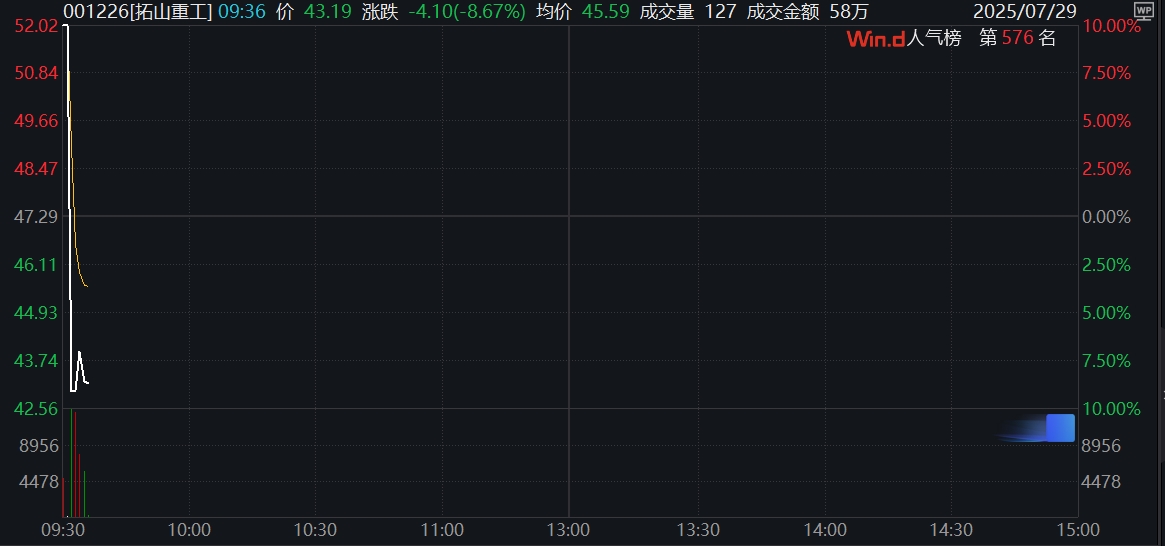
盘面上,乳业、托育板块涨幅居前,军工、量子科技等板块低开。全市场超2800只个股下跌。 09:35 拓山重工盘初直线跳水触及跌停,上演"天地板"。 | 52.02 | 001226[拓山重工] 09:36 价 43.19 涨跌 -4.10(-8.67%) 均价 45.59 成交量 127 成交金额 58万 | | | | 2025/07/29 | | | --- | --- | --- | --- | --- | --- | --- | | | | | | | Win.d人气榜 第 576 名 | | | 50.84 | | | | | | | | 49.66 | | | | | | | | 48.47 | | | | | | 2 | | 47.29 | | | | | | 0. | | 46.11 | | | | | | | | 44.93 | | | | | | | | 43.74 | | | | | | | | 42.56 | | | | | | | | 8956 | | | | | | | | 4478 | | | | | | | | 09:30 10:00 | 10:30 11:00 | 13:00 ...

港股概念追踪 | 国家育儿补贴方案公布!提振母婴消费及辅助生殖市场(附概念股)
智通财经网· 2025-07-28 10:03
Group 1 - The implementation of the childcare subsidy policy is set to begin on January 1, 2025, providing annual subsidies of 3,600 yuan per child for families with children under three years old [1][2] - The subsidy aims to alleviate the financial burden of raising children and is expected to significantly boost the maternal and infant consumption market, indirectly benefiting the assisted reproductive industry [1][3] - Over 20 provinces in China are already exploring childcare subsidy policies, indicating a growing trend towards enhancing birth support measures at the local level [3] Group 2 - Companies in the maternal and infant product sector, such as Goodbaby International, are positioned to benefit from the expected increase in demand due to the subsidy policy [4] - China Feihe, a leading infant formula brand, is likely to see positive impacts from the subsidy as it targets the high-end market, aligning with the demographic benefiting from the policy [5] - The assisted reproductive services sector, represented by companies like Jinxin Fertility, may experience increased demand as the subsidy lowers the cost of raising children, potentially enhancing the willingness of couples facing infertility to seek IVF services [5]
每日报告精选-20250725
GUOTAI HAITONG SECURITIES· 2025-07-25 11:44
Group 1: Strategy Report on "Anti-Involution" International Experience - The report highlights the increasing focus of China's macro policies on "anti-involution" competition since the second half of 2024, aiming to reshape industry structures and promote sustainable high-quality growth [5][6][8] - The U.S. government encourages mergers and acquisitions to eliminate outdated capacities, leading to an oligopolistic market structure that mitigates fierce competition [6] - Japan's response to economic stagnation involved "grouping out to sea" and industry restructuring, significantly increasing market concentration and reducing competition through mergers [7] - Europe addresses "involution" through regulatory frameworks that set competitive boundaries and promote a "slow consumption" culture, allowing companies to focus on product differentiation [8] Group 2: Logistics and Warehousing Industry - In June 2025, the national express delivery volume reached 16.87 billion pieces, a year-on-year increase of 15.8%, driven by e-commerce promotions [9][10] - The express delivery industry saw a revenue growth of 9.0% in June 2025, with a decrease in single-ticket revenue by 5.8%, indicating a moderation in price competition [11] - The report anticipates that the "anti-involution" policies will help stabilize competition and improve the operational environment for express delivery companies [11][12] Group 3: Real Estate Industry - The real estate market in 27 major cities shows signs of weakness, with only 19% indicating a bottoming out, characterized by declining transaction volumes and increasing inventory pressure [15][17] - The second-hand housing market is experiencing regional disparities, with some cities showing significant growth while others remain stagnant [16][18] - The report notes that the inventory clearance cycle is lengthening, particularly in second-tier cities, reflecting structural issues such as declining population attraction and excess land supply [18] Group 4: Robotics Industry - ByteDance's launch of the GR-3 model demonstrates significant improvements in generalization and complex task execution capabilities, indicating potential for future commercialization [20][22] - The GR-3 model outperforms industry competitors in task execution success rates, particularly in new object manipulation [22] - The report suggests that advancements in robotics technology could lead to increased market opportunities as the industry matures [21] Group 5: Semiconductor Industry - The report emphasizes the critical role of semiconductor manufacturing in supporting AI development, highlighting the need for domestic capabilities amid increasing export controls from the U.S. [35][36] - The demand for AI technologies is expected to drive significant growth in the semiconductor sector, with a focus on advanced logic and memory technologies [35][37] Group 6: Investment Banking and Brokerage Industry - The report indicates a significant increase in new fund issuance in June 2025, with a total of 122.12 billion units, reflecting a recovery in investor risk appetite [39][40] - The introduction of new regulations is driving changes in fund products and distribution channels, with a focus on mixed FOF products and floating fee rate products [41]
生育企业集体抢闸IPO,不上市就出局?
3 6 Ke· 2025-07-20 07:33
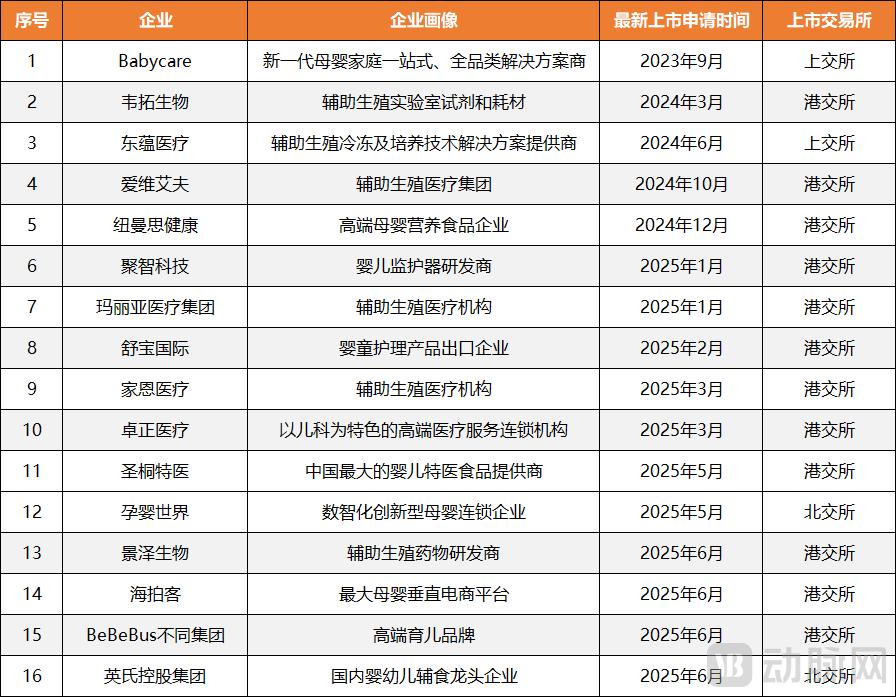
Core Viewpoint - The recent IPO of Saint Bella, known as the "Hermès" of confinement centers, saw a significant first-day increase of 33.74%, reaching a market capitalization of HKD 53.66 billion. However, industry experts view this listing as a desperate move due to the company's ongoing financial struggles, with a total loss of HKD 773 million and no net profit despite rising revenues [1][3]. Company Overview - Saint Bella's listing is part of a broader trend, with over 30 fertility-related companies currently seeking IPOs, including Babycare and Weituo Biotech, as they aim to capitalize on the market before potential downturns [2][3]. - The company has positioned itself at the intersection of maternity care and technology to support its valuation during the IPO process [1]. Financial Performance - Saint Bella reported a revenue increase of 42.6% to HKD 560 million, but still faced a net loss of HKD 420 million, marking a 103.43% increase in losses [9][10]. - Other companies in the sector, such as Newman Health and Haipai Ke, are also experiencing significant financial challenges, with losses and declining profits despite high revenues [7][10]. Market Dynamics - The fertility market in China is under pressure due to a declining birth rate, with 2024 projected to see only 9.54 million newborns, a significant drop from 14.65 million in 2019 [7][11]. - The low market penetration rate of 9.2% in assisted reproduction compared to around 30% in developed countries indicates substantial room for growth, but also highlights the challenges faced by domestic companies [11][12]. Challenges Faced by Companies - High operational costs and aggressive market expansion strategies have led to financial strain for many fertility companies, resulting in a cycle of increasing revenue without corresponding profit growth [16][17]. - Companies like Haipai Ke have reported significant losses, with cumulative losses reaching HKD 1.854 billion, despite high transaction volumes [7][10]. Future Outlook - The assisted reproduction market is expected to grow significantly, with projections indicating a market size of HKD 108.9 billion by 2029, driven by a compound annual growth rate of 12.9% from 2024 to 2029 [18]. - Companies are encouraged to target lower-income markets and innovate to reduce costs, while also considering international expansion to tap into global opportunities [18][20].
锦欣生殖(01951.HK)更新报告:晚育、中美政策红利有望改善需求和支付端
Ge Long Hui· 2025-07-16 02:42
Group 1 - The demand for assisted reproductive technology in China is expected to reach a turning point due to increasing average maternal age and rising proportion of older mothers [1] - From 2023 to 2025, assisted reproduction will be included in national health insurance, which is anticipated to release significant demand following policy implementation [1] - The company, as a leading private player in assisted reproduction, is expected to benefit from tightened licensing and its technical advantages in third-generation IVF [1] Group 2 - The company's overseas business, particularly in the U.S., is experiencing strong growth, with an expected 18.2% year-on-year increase in egg retrieval cycles in 2024 [1] - The U.S. team is expanding, with plans to grow from 23 to 40 doctors by 2027, which will enhance operational capacity [1] - A new policy in California requiring group insurance to cover IVF treatments is expected to directly benefit the company's operations on the West Coast [1] Group 3 - The company has demonstrated resilience in profitability, with a projected domestic gross margin of approximately 27.6% in 2024 [2] - Adjusted net profit is expected to be 420 million yuan, with a profit margin of 14.8%, gradually recovering from the pandemic period [2] - Cost control measures have effectively alleviated pressure on overseas profit margins, with sales and management expense ratios optimized to 22.5% [2] Group 4 - Revenue projections for 2025 and 2026 are estimated at 2.99 billion yuan and 3.26 billion yuan, with growth rates of 6.4% and 9.0% respectively [2] - Adjusted net profit forecasts for 2025 and 2026 are 420 million yuan and 470 million yuan, with growth rates of 0.9% and 10.5% respectively [2] - The company maintains a target price of HKD 3.69 per share, corresponding to 22x and 20x PE for 2025 and 2026, reflecting confidence in long-term value and industry recovery [2]
锦欣生殖(01951):更新报告:晚育、中美政策红利有望改善需求和支付端
Haitong Securities International· 2025-07-14 01:02
Investment Rating - The report maintains an "OUTPERFORM" rating for Jinxin Fertility [1][2]. Core Views - The demand for assisted reproductive technology (ART) in China is expected to reach a turning point, driven by delayed childbearing and the gradual release of policy benefits. The average childbearing age in China is approaching 30, leading to an increase in the proportion of older mothers and a significant rise in demand for ART [3][29]. - The company's overseas business is experiencing strong growth, particularly in the U.S., where the number of egg retrieval cycles is projected to increase by 18.2% year-on-year in 2024. New policies in California are expected to further boost demand for ART services [3][4]. Summary by Sections 1. Future Trends in China's Assisted Reproductive Demand - The number of newborns in China is expected to stabilize in 2024, with a continuous increase in the proportion of births from older mothers. The average childbearing age has risen to 29.0 years, with a significant demand for ART from older women [14][16]. - The penetration rate of ART in China is anticipated to accelerate as the average childbearing age surpasses 30, similar to trends observed in other developed countries [19][20]. - Payment policies are identified as a core factor influencing ART penetration rates, with significant room for improvement in China's healthcare insurance and subsidy policies [25][26]. 2. Revenue and Profit Outlook for Domestic and Overseas Businesses - The company's revenue for 2024 is projected at RMB 28.1 billion, reflecting a modest growth of 0.8%, primarily due to patients delaying treatment in anticipation of policy changes [34]. - The domestic business is expected to stabilize, while the overseas business, particularly in the U.S., is set to grow significantly due to an increase in the number of doctors and favorable policy changes [38][40]. - The company has successfully controlled costs, with a sales and management expense ratio of approximately 22.5%, which has helped mitigate pressure on profit margins [44]. 3. Profit Forecast and Valuation - The company is expected to achieve revenues of RMB 29.9 billion and RMB 32.6 billion in 2025 and 2026, respectively, with growth rates of 6.4% and 9.0% [5][46]. - The adjusted net profit is forecasted to be RMB 4.2 billion and RMB 4.7 billion for the same years, with growth rates of 0.9% and 10.5% [5][46]. - The target price for the company's stock is set at HKD 3.69, corresponding to a price-to-earnings ratio of 22x for 2025 and 20x for 2026, reflecting confidence in the company's long-term value as a leader in the assisted reproductive sector [49].