三全食品

Search documents
三全食品:短期借款主要是匹配理财到期时间的阶段性头寸使用
Zheng Quan Ri Bao Zhi Sheng· 2025-07-29 11:08
Core Viewpoint - Sanquan Foods has clarified that its self-owned funds, including bank wealth management products and large transferable time deposits, are adequately positioned to meet investment and short-term debt repayment needs without negatively impacting its main business, operational capability, cash flow, or asset status [1] Financial Position - The company indicated that its bank wealth management products are listed under trading financial assets on the balance sheet, while large transferable time deposits are categorized under other non-current assets [1] - Short-term borrowings are primarily used to match the timing of wealth management product maturities [1] Investment Impact - The company asserts that the current external investment will not adversely affect its core business or financial health [1]

食品加工板块7月29日跌0.53%,C技源领跌,主力资金净流出1.27亿元
Zheng Xing Xing Ye Ri Bao· 2025-07-29 08:34
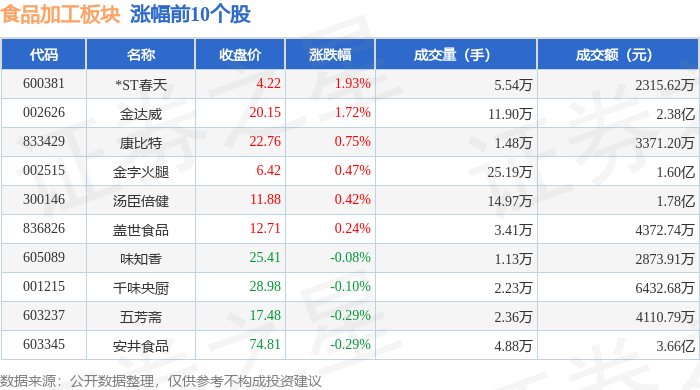
从资金流向上来看,当日食品加工板块主力资金净流出1.27亿元,游资资金净流出2488.55万元,散户资 金净流入1.52亿元。食品加工板块个股资金流向见下表: | 代码 | 名称 | 主力净流入(元) | | 主力净占比 游资净流入 (元) | | 游资净占比 散户净流入 (元) | | 散户净占比 | | --- | --- | --- | --- | --- | --- | --- | --- | --- | | 603345 | 安井食品 | | 3588.42万 | 9.81% | -3645.99万 | -9.97% | 57.57万 | 0.16% | | 002515 | 金字火腿 | | 2249.10万 | 14.02% | -1481.85万 | -9.24% | -767.25万 | -4.78% | | 002702 海欣食品 | | | 1308.54万 | 13.69% | -383.06万 | -4.01% | -925.48万 | -9.68% | | 002626 | 金达威 | | 1100.54万 | 4.62% | 1399.42万 | 5.88% | -2499.96 ...


经济越来越差,这八大行业越赚爆!
创业家· 2025-07-28 10:05
Core Viewpoint - The article discusses how certain industries are thriving despite a general perception of economic downturn, highlighting eight sectors that present significant business opportunities in a low-desire society [3]. Group 1: Economic Trends - The concept of a "low-desire society" does not equate to a lack of opportunities, as consumer behavior is shifting towards different spending patterns [4]. - The phenomenon of consumption upgrading and demand migration is identified as the largest business opportunity [5]. Group 2: Key Industries - **Second-hand Economy**: The second-hand luxury market in Japan, represented by companies like Daikokuya, has seen a significant revenue increase. In China, platforms like Hongbulin and Panghu are experiencing similar growth [6][7]. - **Pet Economy**: Despite declining birth rates, spending on pets is increasing, with brands like Inaba in Japan and Guobao in China seeing strong sales [10][11]. The pet healthcare sector is also expanding rapidly [12][13]. - **Adult Care**: The adult diaper market in Japan has surpassed $10 billion, indicating a substantial growth potential for similar products in China [14][15][16]. - **Health Food and Beverages**: Changes in population structure and rising health awareness are driving the growth of sugar-free beverages and functional foods in both Japan and China [19][20]. - **Beauty Economy**: The demand for beauty products, such as collagen supplements and home beauty devices, remains strong, indicating that beauty is both an economic and therapeutic necessity [22]. - **Outdoor and Leisure**: The outdoor equipment market is thriving, with brands in China experiencing rapid sales growth, reflecting a desire for leisure activities despite economic constraints [22]. - **Emotional Economy**: Products that provide emotional comfort, such as low-alcohol beverages and unique consumer goods, are gaining popularity [23][24]. - **Convenience Economy**: The demand for convenience foods and smart home appliances is rising as younger generations seek to save time in cooking and household chores [27][28]. Group 3: Market Outlook - The article suggests that while many perceive the current market as a "cold winter," the true winners are those who can identify and invest in counter-cyclical opportunities [31].

三全食品拟13亿赴澳大利亚投资 业绩连降货币资金3亿
Zhong Guo Jing Ji Wang· 2025-07-25 06:29
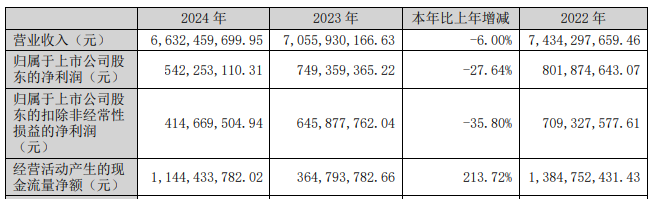
Investment Overview - Sanquan Foods plans to establish a wholly-owned subsidiary in Hong Kong, which will then invest in a wholly-owned subsidiary in the Cayman Islands, ultimately leading to the establishment of a production base in Australia. This move aims to enhance the company's global strategy and accelerate overseas business development [1][2] - The total investment for this initiative is approximately AUD 280 million, which is intended for setting up and operating overseas companies, purchasing fixed assets, and developing marketing systems among other uses. The actual investment amount will be subject to approval by Chinese and local authorities [1][2] Financial Performance - Sanquan Foods has experienced a decline in performance over the past two years, with revenues decreasing from CNY 74.34 billion in 2022 to CNY 66.32 billion in 2024, representing a drop of 10.7% [3][4] - The net profit attributable to shareholders has also decreased significantly, from CNY 8.02 billion in 2022 to CNY 5.42 billion in 2024, marking a decline of 32.1% [3][4] - In the first quarter of 2025, the company reported a revenue of CNY 2.22 billion, down 1.58% year-on-year, and a net profit of CNY 208 million, down 9.22% year-on-year [5] Cash Flow and Assets - The net cash flow from operating activities showed a significant increase in 2024, reaching CNY 1.14 billion, compared to CNY 364 million in 2023, indicating a 213.72% increase [4] - As of the end of the first quarter of 2025, the company had cash and cash equivalents of CNY 319 million and short-term borrowings of CNY 600 million [5][7]
速冻米面失速,三全食品遭遇业绩“双降”危机,巨资海外建厂能否打破增长桎梏
Zheng Quan Zhi Xing· 2025-07-25 02:12
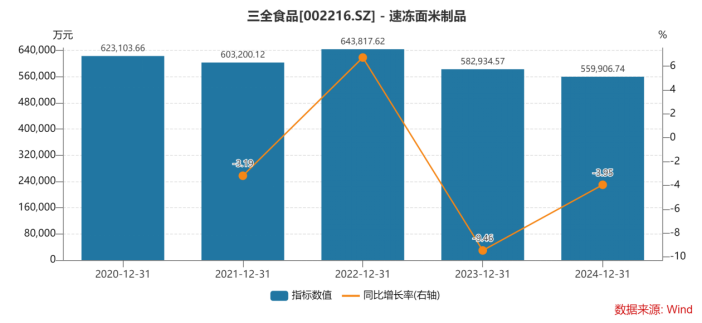
Core Viewpoint - The frozen food industry is facing significant challenges in 2024, with Sanquan Foods experiencing a decline in both revenue and net profit for the second consecutive year, marking a notable downturn since its IPO in 2008 [1] Group 1: Financial Performance - In 2024, Sanquan Foods' revenue decreased by 6% to 6.632 billion yuan, while net profit fell by 27.64% to 542 million yuan [1] - The company reported its worst first-quarter performance since 2021, continuing the trend of declining earnings [1] - The revenue from frozen staple foods, which has historically contributed over 80% to the company's income, has shown significant volatility from 2020 to 2024 [2][4] Group 2: Market Dynamics - The decline in revenue for frozen staple foods is attributed to weak consumer demand, a decline in supermarket channels, and intensified industry competition [1] - The sales volume of frozen staple foods saw a slight increase, but revenue fell nearly 4% year-on-year, indicating a strategy of price reduction to maintain market share [1] - The core products "tangyuan, dumplings, and zongzi" experienced revenue fluctuations, with declines of -8.07%, 3.92%, -15.74%, and -5.84% from 2021 to 2024 [4] Group 3: Product and Channel Strategy - Despite a 2.04% increase in sales volume for frozen staple foods, revenue decreased by 3.95%, highlighting a "volume increase but weak profit" scenario [5] - The company is attempting to diversify its product offerings and has launched new series of dumplings and tangyuan in 2024 [9] - Sanquan Foods is also focusing on e-commerce, which saw a revenue increase of 58.5% in 2024, although it still represents less than 6% of total revenue [5][9] Group 4: International Expansion - In response to domestic market pressures, Sanquan Foods plans to invest in a production base in Australia and expand into markets in Australia, New Zealand, and Southeast Asia [11] - The planned investment for the overseas production base is approximately 2.8 billion Australian dollars (about 1.32 billion yuan), which poses challenges related to consumer preferences, supply chain integration, and regulatory compliance [11]
低欲望时代,这八大行业将赚得盆满钵满
创业家· 2025-07-24 09:57
Core Insights - The article discusses how certain industries are thriving despite a general perception of economic downturn, highlighting eight key sectors that present significant business opportunities in a low-desire society [3][4]. Group 1: Key Industries - **Second-hand Economy**: The second-hand luxury market in Japan, represented by companies like Daikokuya, has seen a surge in revenue. In China, platforms like Hongbulin and Panghu are experiencing similar growth [6][7][9]. - **Pet Economy**: With a decline in birth rates, spending on pets has increased. Companies like Inaba in Japan and Guobao in China are capitalizing on this trend, with pet food and healthcare products seeing significant sales growth [10][12][13]. - **Adult Care**: The adult diaper market in Japan has surpassed $10 billion, indicating a strong potential for similar products in China, particularly as the population ages [14][15][16]. - **Health Food and Beverages**: Changes in population structure and rising health awareness have led to the success of sugar-free products and functional beverages in both Japan and China [19][20]. - **Beauty Economy**: Despite economic constraints, demand for beauty products like collagen supplements and home beauty devices remains high, indicating a persistent consumer interest in personal care [22]. - **Outdoor Recreation**: The outdoor equipment market is thriving, with brands in both Japan and China seeing significant sales growth, as consumers seek leisure activities despite economic challenges [22]. - **Emotional Economy**: Products that provide emotional comfort, such as low-alcohol beverages and unique consumer goods, are gaining popularity, reflecting a shift in consumer spending habits [23][24]. - **Lazy Economy**: The demand for convenience products, such as frozen foods and smart home appliances, is increasing as younger generations prioritize time-saving solutions [27][28][29]. Group 2: Market Trends - **Consumer Behavior**: The article emphasizes that even in a low-desire economy, there are opportunities for growth in sectors that cater to changing consumer needs and preferences [31]. - **Investment Opportunities**: Companies that can identify and invest in these counter-cyclical sectors are likely to emerge as winners in the current economic climate [31].

三全食品(002216):深耕速冻领域 双轮驱动与全渠道布局引领增长
Xin Lang Cai Jing· 2025-07-24 00:35
Core Viewpoint - Sanquan Foods, as a leading enterprise in the domestic frozen food industry, has significant growth potential due to its strong historical foundation, robust R&D capabilities, and diversified channel layout [1] Group 1: Industry Overview - The frozen food market in China reached a scale of 168.9 billion yuan in 2022 and is expected to grow to 198.6 billion yuan by 2024 [1] - The market for frozen rice and noodle products, the largest category in the industry, is projected to be approximately 81.6 billion yuan in 2023, with Sanquan Foods, Si Nian, and Wan Zai Ma Tou forming a competitive triad [1] - The pre-prepared dish market is experiencing explosive growth, driven by the pandemic and the standardization of the restaurant industry, becoming a new growth driver for the sector [1] Group 2: Company Strategy - Sanquan Foods employs a dual-brand strategy with "Sanquan" and "Longfeng," focusing on the traditional frozen rice and noodle business while accelerating the layout of frozen cooked meat products as a second growth curve [2] - The company is enhancing its product matrix to meet diverse consumer needs through a strategy of large single products and scenario-based extensions in its traditional frozen rice and noodle business [2] - The company is also expanding its product offerings in frozen prepared foods, aligning with trends in the restaurant industry towards standardization and convenience [2] Group 3: Operational Excellence - Sanquan Foods operates a refined full-chain strategy for both B2B and B2C segments, combining distributor and direct sales models in retail, and offering customized services to bind large clients in the restaurant channel [3] - The company is actively expanding into e-commerce and new retail channels, enhancing market penetration and brand influence through collaborations with leading influencers and community group buying [3] - Continuous investment in R&D has led to the successful development of microwave and air fryer product lines, catering to consumer demands for convenience and health [3] Group 4: Financial Performance and Forecast - The company maintains a stable revenue structure with collaborative growth in frozen rice and noodle products and frozen prepared foods, despite intense market competition [3] - Revenue projections for Sanquan Foods are estimated at 6.874 billion yuan, 7.204 billion yuan, and 7.625 billion yuan for the years 2025-2027, with net profits of 558 million yuan, 601 million yuan, and 649 million yuan respectively [4] - The company’s price-to-earnings ratios are forecasted to be 17.88, 16.59, and 15.38 for the same period, indicating a valuation below the average of comparable companies [4]
2025年吉林省过度包装产品质量监督抽查结果发布
Zhong Guo Zhi Liang Xin Wen Wang· 2025-07-23 07:53
Summary of Key Points Core Viewpoint - The quality supervision sampling results for excessive packaging products in Jilin Province for the first and second quarters of 2025 indicate a 6% non-compliance rate, with 3 out of 48 batches failing to meet quality standards [1]. Group 1: Quality Supervision Results - Jilin Province's market supervision authority conducted quality checks on 48 batches of excessive packaging products, revealing a non-compliance rate of 6% [1]. - Three batches from three different producers were found to be non-compliant, leading to legal actions by local market regulatory departments [1]. Group 2: Product Details - The report includes a detailed table of products tested, specifying product names, specifications, production dates, brands, and compliance results [1]. - Notable compliant products include various tea gift boxes and zongzi (sticky rice dumplings) with different weights and packaging styles, all passing the quality checks [2][3][4].
星巴克为增长拼了:开自习室只是开始丨消费参考
2 1 Shi Ji Jing Ji Bao Dao· 2025-07-23 04:25
Group 1 - Starbucks has launched "self-study rooms" in several stores in Guangzhou and Shenzhen, allowing customers to study without fees, time limits, or reservations, and providing free power outlets and water [1][2] - The company is granting more autonomy to its Chinese team, as evidenced by recent price reductions on key products and collaborations with popular brands, indicating a shift towards more flexible operations [2][4] - Starbucks China reported a revenue of $739.7 million (approximately 5.317 billion RMB) for the latest fiscal quarter, with a year-on-year growth of 5%, while same-store sales remained flat [4][5] Group 2 - The increase in customers using the self-study rooms may impact the overall customer experience at Starbucks, which is a consideration for the company [3] - Comparatively, Luckin Coffee reported a revenue growth of 41.2% to 8.87 billion RMB in the first quarter, highlighting competitive pressures on Starbucks [5] - There are ongoing rumors regarding the potential sale of Starbucks' stake in China, with speculation that the company may retain 30% of its shares while distributing the rest among multiple buyers [5][6]

拟13亿赴澳洲建厂,三全食品海外寻增
Bei Jing Shang Bao· 2025-07-22 11:59
Core Viewpoint - Sanquan Foods plans to establish a wholly-owned subsidiary in Hong Kong and subsequently invest approximately AUD 280 million (around RMB 1.3 billion) to build a production base in Australia, aiming to enhance its global strategic layout [2][3]. Investment and Expansion - The investment will account for 30% of the last year's audited net assets and will be used for setting up and operating overseas companies, purchasing fixed assets (including factory purchases, R&D center construction, equipment procurement, fully automated cold storage construction, and cold chain logistics vehicles), infrastructure renovation, marketing system development, and working capital [2]. - The primary target markets for this overseas expansion are Australia, New Zealand, and Southeast Asia, which are characterized by high consumer spending and low competition density, providing significant growth potential [3]. Financial Performance - In 2023, Sanquan Foods experienced a revenue decline of 5.09% and a net profit decrease of 6.55%, with further declines projected for 2024, where revenue and net profit are expected to drop by 6% and 27.64%, respectively [3][4]. - The company's main products, including dumplings, tangyuan, and zongzi, saw revenue declines of 15.74% and 5.84% in 2023 and 2024, respectively, with gross margins also shrinking [4]. Market Trends - The domestic frozen food market is undergoing structural changes, with traditional staple categories facing pressure while niche snack categories are emerging [4]. - In 2024, only three out of eleven listed frozen food companies achieved both revenue and net profit growth, indicating a challenging market environment [4]. Industry Insights - Many frozen food companies are increasingly focusing on overseas markets to capture growth opportunities, with examples including Anjuke Foods and Huifa Foods, which have successfully entered international markets [5][6]. - Experts suggest that establishing production bases abroad can help companies control supply chains and ensure product quality, although initial investments are high and the payback period is long [6].