建信基金

Search documents
FOF指数化配置渐成趋势 部分产品10只重仓基9只为ETF
Zheng Quan Shi Bao· 2025-10-26 22:34
Core Insights - The trend of index-based allocation in public FOFs (funds of funds) is becoming increasingly evident, with many FOFs heavily investing in ETFs [1][3] - The demand for diversified FOF products and ETF-FOF innovations is rising, reflecting a shift in investment strategies [4][5] - The growing complexity and variety of index funds require enhanced asset allocation capabilities from fund managers [6][7] Group 1: FOF Investment Trends - As of October 25, 2023, many FOFs have a significant portion of their top holdings in ETFs, with some FOFs having up to 9 out of 10 top holdings as ETFs [1][2] - Notable examples include the Jianxin FOF and Wanjiayou FOF, which have multiple ETFs among their top holdings, indicating a strong preference for index funds [2][3] - A report from Huatai Securities predicts that by the end of 2024, 90.73% of public FOFs will have allocated to ETFs [3] Group 2: New Product Innovations - The market is seeing the introduction of new FOF products, such as multi-asset allocation FOFs and ETF-FOFs, to meet investor demand [4][5] - As of October 25, 2023, there are 7 multi-asset allocation FOFs established in 2025, which include provisions for index funds [4] - The ETF-FOF products are designed to allocate over 80% of their non-cash underlying assets to ETFs, reflecting a strategic response to market demand [5] Group 3: Challenges and Requirements - The rise of index-based allocation increases the complexity of asset management, necessitating higher asset allocation skills from fund managers [6][7] - Fund managers are expected to develop capabilities in multi-asset allocation and to identify arbitrage opportunities, which are essential for achieving excess returns [6][7] - Challenges include market volatility affecting asset rotation strategies and potential liquidity issues with certain ETFs, which could lead to homogenization of ETF-FOF products [7]
黄金行情“急转直下” 有色金属或面临价值重估
Zhong Guo Zheng Quan Bao· 2025-10-26 21:06
Core Viewpoint - The recent surge in gold prices has faced a significant technical correction, leading to substantial declines in gold ETFs and related stocks, while other metals like copper and rare earths are undergoing a revaluation process [1][4]. Summary of Gold ETFs and Stocks - Following a record high on October 20, gold prices plummeted on October 21, with London spot gold dropping 5.31% to $4,124.36 per ounce, marking the largest single-day decline since April 2013 [1]. - Gold stock ETFs experienced notable declines, with the Guotai CSI Hong Kong-Shenzhen Gold Industry Stock ETF falling 7.60%, leading the market, while several others saw declines exceeding 6% [1][2]. - Year-to-date performance shows significant gains for various gold ETFs, with some increasing over 80%, while others rose more than 50% [2]. Cautious Approach to Gold Volatility - Analysts indicate that gold price fluctuations reflect market confidence in the global monetary system, with gold often becoming a key asset during shifts in central bank policies [3]. - The recent downturn is attributed to an overheated market following rapid price increases, necessitating a technical correction [3][4]. Revaluation of Non-Gold Metals - The precious metals market is experiencing volatility, with copper maintaining strong performance despite concerns over supply and demand [4]. - The investment landscape for non-gold metals is categorized into three segments: precious metals, industrial metals, and rare metals, each influenced by different factors such as geopolitical risks and supply-demand dynamics [4][5]. Investment Outlook for Various Metals - The recent correction in gold is linked to easing geopolitical tensions and profit-taking, yet it retains long-term asset allocation value [5]. - Silver's future remains uncertain, closely tied to geopolitical developments and Federal Reserve actions [5]. - Copper faces a "double weakness" scenario in supply and demand, while rare earths are expected to maintain a positive outlook due to their strategic importance [5][6].
FOF指数化配置渐成趋势部分产品10只重仓基9只为ETF
Zheng Quan Shi Bao· 2025-10-26 17:46
Core Insights - The trend of index-based allocation in public FOFs (funds of funds) is becoming increasingly evident, with many FOFs heavily investing in ETFs [1][3] - The demand for diversified FOF products and ETF-FOF innovations is rising, reflecting a shift in investment strategies [4][5] - The growth of index funds is enhancing the asset allocation efficiency of FOFs, but it also raises the bar for fund managers' capabilities [6][7] Group 1: FOF Investment Trends - As of October 25, 2023, 90.73% of public FOFs are reported to have allocated to ETFs, indicating a significant shift from actively managed funds to index-based strategies [3] - Notably, among the 37 FOFs that disclosed their Q3 reports, 11 had ETFs as their largest holding, with some ETFs constituting over 10% of the fund's net asset value [3][4] - The increasing preference for ETFs is evident, with several FOFs reporting a majority of their top holdings as ETFs, covering various categories such as broad-based, thematic, and commodity ETFs [2][3] Group 2: Product Innovation and Market Demand - The market has seen the introduction of new FOF products, including multi-asset and ETF-FOF variants, to meet the growing demand for diversified investment options [4][5] - As of October 25, 2023, there are seven multi-asset FOFs established in 2025, all of which include index funds in their investment scope [4] - The ETF-FOF products are designed to allocate over 80% of their non-cash underlying assets to ETFs, reflecting a strategic response to the increasing demand for passive investment vehicles [5] Group 3: Challenges and Managerial Requirements - The proliferation of index funds necessitates enhanced asset allocation skills from fund managers, as they must navigate a more complex array of investment options [6][7] - Fund managers face challenges in asset rotation due to market volatility and the potential for ETF homogeneity, which may dilute competitive advantages [7] - The ability to generate excess returns through innovative strategies, such as arbitrage opportunities and participation in IPOs, is becoming crucial for FOF managers [6][7]
超300只债基披露2025年三季报 投资操作各有不同
Zheng Quan Ri Bao· 2025-10-26 16:15
Group 1 - The public fund report for Q3 2025 shows over 300 bond funds have disclosed their performance, with 157 funds achieving net value growth [1] - The top-performing fund, Taixin Huiying Bond A, recorded a net value growth rate of 28.01%, while its C share only achieved 7.99%, indicating a significant performance disparity [1] - The bond market experienced notable adjustments in Q3 due to factors such as improved risk appetite among investors, stable macroeconomic conditions, and low bond yields reducing the attractiveness of fixed-income products [1] Group 2 - Several convertible bond funds achieved high net value growth rates, with five out of the top seven funds being convertible bond funds, including Rongtong Convertible Bond A and Jianxin Convertible Bond A [2] - The market's risk appetite has significantly increased, leading to a "see-saw effect" between stocks and bonds, with convertible bonds benefiting from the rising stock market, particularly in the technology sector [2] - Different fund managers have varied strategies; for instance, Rongtong Convertible Bond actively increased its positions in AI and innovative pharmaceutical sectors, while Changsheng Convertible Bond optimized its industry allocation based on market conditions [2] Group 3 - Wanji Convertible Bond has shifted to a "dual low convertible bond" strategy, maintaining a bond position between 85% and 90%, with plans to increase positions if the market corrects [3] - The bond market is seen as a low-risk option for investors, with recent trends indicating a recovery phase, particularly in the long-term bond segment [3] - Future bond market performance is expected to depend on monetary and fiscal policy combinations, with potential for downward adjustments in interest rates and opportunities in long-term bonds and green bonds [3]
10只重仓基金9只是ETF,FOF指数化配置趋势持续凸显
券商中国· 2025-10-25 13:28
Core Viewpoint - The trend of index-based allocation in public FOFs (Fund of Funds) is becoming increasingly prominent, with a significant preference for ETFs (Exchange-Traded Funds) over actively managed funds [1][4][7]. Group 1: FOF Holdings and Trends - As of October 25, 2023, many FOFs have shifted their top holdings to ETFs, with 9 out of 10 top funds in some cases being ETFs, indicating a clear trend towards index-based investment strategies [1][3]. - The report highlights that 90.73% of public FOFs are expected to allocate to ETFs by the end of 2024, with approximately 9.2% of FOF holdings being ETFs by mid-2025 [4][6]. - Notably, among the 37 FOFs that disclosed their third-quarter reports, 11 had ETFs as their largest holding, with 5 of these ETFs having a holding value exceeding 10% of the fund's net asset value [4]. Group 2: Product Innovation and Demand - In response to strong demand, new products such as multi-asset allocation FOFs and ETF-FOFs are being introduced, reflecting the evolving landscape of fund offerings [2][5]. - The emergence of multi-asset FOFs, which allow for a mix of active and passive investments, is evident, with recent launches indicating a growing trend towards diversified investment strategies [5][6]. - The ETF-FOF products are designed to allocate over 80% of their non-cash assets to ETFs, showcasing a significant shift towards passive investment strategies [5][6]. Group 3: Managerial Challenges and Opportunities - The proliferation of index funds presents both opportunities and challenges for fund managers, as they must enhance their asset allocation capabilities to navigate a more complex investment landscape [7][8]. - Fund managers are increasingly focusing on diverse asset classes, including equities, fixed income, commodities, and overseas investments, to create optimal portfolios that outperform traditional strategies [7]. - However, challenges such as market volatility and liquidity issues in certain ETFs may complicate asset rotation strategies, necessitating innovative approaches to maintain competitive advantages [8].

华夏安博仓储REIT将启动网下询价
Tianfeng Securities· 2025-10-25 10:00
Group 1: Industry Dynamics - Huaxia Anbo Warehousing REIT will initiate offline inquiry on October 30, with a price range of 5.103 to 6.235 yuan per share, and a total issuance of 400 million shares approved by the China Securities Regulatory Commission [1][7]. - The initial strategic placement will account for 280 million shares, representing 70% of the total issuance, while 84 million shares will be offered in the initial offline issuance (21%) and 36 million shares to public investors (9%) [1][7]. Group 2: Primary Market - As of October 24, 2025, the total issuance scale of listed REITs reached 196.6 billion yuan, with 75 REITs issued [8][9]. Group 3: Market Performance - During the week of October 20 to October 24, 2025, the CSI REITs total return index increased by 0.16%, while the total REITs index rose by 0.35% [2][17]. - The total REITs index underperformed the CSI 300 index by 2.89 percentage points but outperformed the CSI All Bond Index by 0.33 percentage points [2][17]. - The top-performing REITs included ICBC Mengneng Clean Energy REIT (+4.06%), AVIC Easy Business Warehousing Logistics REIT (+3.58%), and Shanghai-Hangzhou-Ningbo Hanghui REIT (+3.23%) [2][17]. Group 4: Liquidity - The total trading volume of REITs for the week was 544 million yuan, a 31.3% increase from the previous week [3][38]. - The trading volumes for property and operating rights REITs were 350 million yuan and 194 million yuan, respectively, with both showing similar increases of around 31% [3][38]. - The largest trading volume among REIT types was in transportation infrastructure, accounting for 18.9% of the total [3][38]. Group 5: Valuation - The report does not provide specific valuation metrics or insights related to the valuation of REITs [44].
机构风向标 | 菲沃泰(688371)2025年三季度已披露前十大机构持股比例合计下跌3.22个百分点
Xin Lang Cai Jing· 2025-10-25 03:00
Core Insights - Favored Tech Corporation Limited (菲沃泰) reported its Q3 2025 financial results, revealing that as of October 24, 2025, seven institutional investors held a total of 233 million shares, representing 69.41% of the company's total equity [1] - The institutional ownership percentage decreased by 3.22 percentage points compared to the previous quarter [1] Institutional Investors - The institutional investors include Favored Tech Corporation Limited, Wuxi Fina Enterprise Management Partnership, Shenzhen China Resources Capital Equity Investment, China Construction Bank's Guoshou Anbao Smart Life Fund, Qingdao Yirong United Equity Investment Management Center, Shanghai Fuhe Private Fund Management, and Beijing Woyan Capital Management Center [1] - The total institutional ownership is significant, indicating strong interest from major investment entities [1] Public Funds - In this reporting period, 89 public funds were disclosed, including notable funds such as Southern Zhihong Mixed A, Guotai Shanghai Composite ETF, and Jianxin Shanghai Composite Smart Selection Sci-Tech Innovation Value ETF [1] - The absence of previously disclosed public funds suggests a shift in investment strategies or market conditions [1]

叶乐天2025年三季度表现,建信央视财经50指数(LOF)基金季度涨幅7.99%
Sou Hu Cai Jing· 2025-10-24 21:13
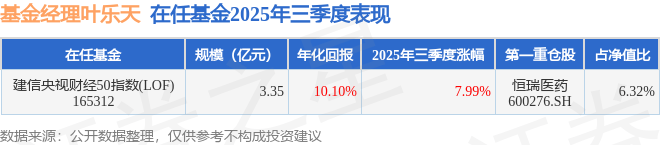
Core Insights - The article highlights the performance of various funds managed by Ye Letian, showcasing significant returns and stock adjustments over time [1][2][3][4][6] Fund Performance - The Jianxin CCB CCTV Finance 50 Index (LOF) fund has a scale of 3.35 billion yuan with an annualized return of 10.10% and a Q3 2025 increase of 7.99%, with its top holding being Heng Rui Pharmaceutical at 6.32% of net value [1] - Ye Letian's management of the Jianxin CSI 500 Index Enhanced A fund resulted in a cumulative return of 223.79% and an average annualized return of 10.52%, with 341 stock adjustments during his tenure, achieving a win rate of 51.91% [1] Stock Adjustment Cases - Notable successful stock adjustments include: - Dongfang Caifu: Purchased in Q4 2014, sold in Q2 2015, with a holding period return of 358.31% and a company profit growth of 1015.45% [1][3] - Shanghai Electric: Acquired in Q3 2024 and sold in Q4 2024, yielding an estimated return of 98.88% with a revenue growth of 1.21% [4] Underperforming Stocks - The article also details underperforming stocks managed by Ye Letian: - Xingyuan Environment: Bought in Q4 2017 and sold in Q3 2018, resulting in a loss of 73.86% with a revenue decline of 23.60% [5][6] - Other underperforming stocks include Changtong Group and Baolixin, with estimated losses of -60.24% and -59.05% respectively [2]
“日光基”再现! 科技、资源类主题型基金业绩排名靠前
Mei Ri Jing Ji Xin Wen· 2025-10-24 03:10
Core Insights - The recent launch of the China Europe Value Navigation Mixed Fund achieved a net subscription amount of 1.97 billion yuan within just one day of its offering, indicating strong demand for equity funds despite a volatile A-share market [1][2][3] Fund Performance and Trends - The China Europe Value Navigation Fund's subscription limit was set at 2 billion yuan, and it successfully raised 1.97 billion yuan by the end of its first day of offering [2] - The fund manager, Lan Xiaokang, has a strong track record, with his managed funds achieving significant returns, including a 170.24% return for the China Europe Dividend Enjoy Fund [2] - The performance of newly launched equity funds has been notable, with several funds achieving over 20% net value growth in the past month, particularly in technology and resource sectors [1][4][5] Market Dynamics - Despite the A-share market's stagnation, the issuance of equity funds remains robust, with 30 public funds opening for subscription in the week of October 20-26, 2023, and equity funds making up 76.67% of this total [3] - Over 10 actively managed equity funds have raised more than 1 billion yuan since the third quarter of this year, with some exceeding 2 billion yuan [3] Sector Focus - Technology and resource-themed funds have shown strong performance, with specific funds like Taikang Resource Selection and Huaxia Quantitative Stock Selection achieving net value growth rates of 23.28% and 25.2%, respectively [4][5] - The disparity in performance among newly launched funds is significant, with some funds experiencing negative returns while others, particularly those focused on technology and AI, have excelled [5][6] Future Outlook - Fund managers remain optimistic about the future of technology investments, emphasizing the potential of cyclical stocks and opportunities that combine consumption and technology [1][5] - Morgan Asset Management highlights strong performance in sectors like semiconductors and AI infrastructure, while also noting the market's current consolidation phase [6]
北京公募“长情”向新
Shang Hai Zheng Quan Bao· 2025-10-23 18:39
Group 1: Industry Overview - Public funds are becoming increasingly important institutional investors in the capital market, playing a significant role in deepening reforms and promoting high-quality economic development [2][3] - The public fund industry has surpassed 35 trillion yuan in scale and is at a critical juncture for reform and high-quality development [6][8] Group 2: Huaxia Fund - Huaxia Fund actively guides social capital towards technology industries, enhancing its investment research capabilities in the tech sector [3][4] - The fund has developed a diverse range of thematic funds and ETFs focused on new productive forces, including the "Innovation Frontier" series and "Industry Leader" series [3][4] - As of now, Huaxia Fund manages over 200 billion yuan in investments directed towards technology companies in the secondary market [4] Group 3: Industrial and Technological Focus - Huaxia Fund emphasizes the importance of directing social capital towards new productive forces and technology industries, creating a high-level circulation ecosystem between technology, capital, and the real economy [4][5] - The fund has established a dedicated research team to enhance its ability to identify high-tech companies with strong innovation capabilities and good market prospects [4][5] Group 4: ICBC Credit Suisse Fund - ICBC Credit Suisse Fund has become a leading institution in the industry, with its first product achieving a cumulative return of 855.07% since inception [6][7] - The fund has demonstrated strong performance in both equity and fixed income sectors, with its active equity products ranking first in excess returns over various time frames [6][7] Group 5: Investment Strategy and Performance - The fund has developed a comprehensive investment strategy that includes a wide range of products, from fixed income to equity and pension finance, with a focus on long-term, value-driven investments [6][8] - ICBC Credit Suisse Fund has a robust talent development system, with over 70% of its fund managers being internally trained [9][10] Group 6: Jiashi Fund - Jiashi Fund has focused on guiding social capital towards high-value sectors during the "14th Five-Year Plan" period, managing assets totaling 1.61 trillion yuan [11][12] - The fund has invested over 220 billion yuan in sectors such as technology, manufacturing, and new energy, emphasizing deep research-driven fundamental investment [12][13] Group 7: Product Development and Investor Education - Jiashi Fund has built a comprehensive product system that includes both active and passive investment options, catering to various risk preferences [13][14] - The fund is committed to investor education, helping investors understand the value of technology investments and manage their risk preferences [14] Group 8: Jianxin Fund - Jianxin Fund has established a diverse product system covering various asset types, focusing on empowering the development of new productive forces [15][16] - The fund has launched multiple technology-focused products and has invested in over 1,400 technology-related enterprises [15][16] Group 9: Social Responsibility and Sustainable Development - Jianxin Fund actively participates in social responsibility initiatives, including investments in rural revitalization and green projects [17][18] - The fund has developed a robust risk management system to safeguard client assets and ensure compliance [17][18] Group 10: Future Outlook - Jianxin Fund aims to continue enhancing its research capabilities and product offerings to meet the wealth management needs of residents and support the transformation of the real economy [19]