伊利股份

Search documents
ETF盘中资讯|吃喝板块震荡磨底!白酒估值处历史低位,左侧布局时机已现?机构:价值洼地值得重视
Sou Hu Cai Jing· 2026-01-23 06:53
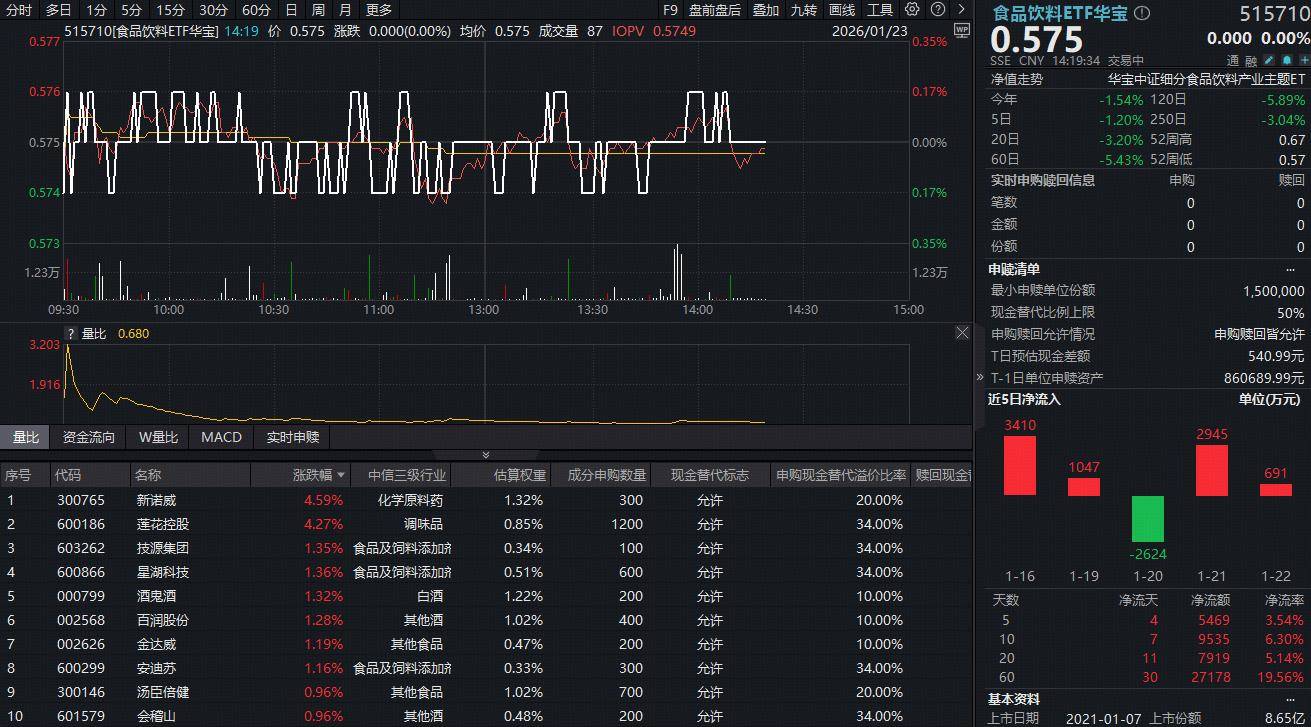
Group 1 - The overall performance of the food and beverage sector is currently experiencing fluctuations, with the Huabao Food and Beverage ETF (515710) trading near the waterline, reflecting the sector's overall trend [1] - Major consumer goods stocks are leading in gains, with Lianhua Holdings rising over 4%, while some liquor stocks like Shanxi Fenjiu and Yanghe are slightly down, dragging the sector's performance [1] - Research from Guotai Haitong Securities indicates that the current stock prices of liquor companies have largely reflected market expectations, with low valuation levels and attractive dividend yields, suggesting potential for price recovery [3] Group 2 - The period leading up to the 2026 Spring Festival is expected to be the most challenging for liquor pricing, but there is potential for a correction in the market's pessimistic outlook on liquor prices [3] - The food and beverage sector is currently at historical low valuation levels, making it a favorable time for left-side positioning, with the food index's price-to-earnings ratio at 19.42 times, at the 2.1% percentile of the last decade [3] - Future market trends may show a clear distinction between growth sectors and liquor, with increased focus on snacks and dairy industries, which are expected to benefit from policy support and improving monthly data [4] Group 3 - The Huabao Food and Beverage ETF (515710) primarily invests in leading high-end and mid-range liquor stocks, with about 60% of its portfolio allocated to these sectors, and the top ten weighted stocks include major brands like Moutai and Yili [5] - Investors can also access the Huabao Food and Beverage ETF through linked funds, providing an opportunity to invest in core assets of the food and beverage sector [5] - The current market environment suggests limited downside for leading consumer companies post-2026, with significant upside potential due to attractive dividend yields and the ability to navigate through economic cycles [4]

吃喝板块震荡磨底!白酒估值处历史低位,左侧布局时机已现?机构:价值洼地值得重视
Xin Lang Cai Jing· 2026-01-23 06:30
Group 1 - The food and beverage sector is experiencing fluctuations, with the Huabao Food and Beverage ETF (515710) trading near the waterline throughout the day [1][9] - Major consumer goods stocks are leading the gains, with Lianhua Holdings rising over 4%, and several others like Xinghuo Technology, Jiu Gui Jiu, and Jindawei increasing by more than 1% [1][9] - Some liquor stocks, such as Shanxi Fenjiu and Yanghe Co., are underperforming, slightly dragging down the sector's overall performance [1][9] Group 2 - Guotai Junan Securities reports that the current stock prices of liquor companies reflect market expectations, with the sector's valuation being relatively low and attractive dividend yields [11] - The market is expected to see a correction in the pessimistic price expectations for the liquor industry, with companies focusing on their core price points and advantageous markets [11] - The food and beverage sector is at a historical low valuation, making it a potentially good time for left-side positioning [11] Group 3 - CITIC Construction points out that the market is currently favoring sectors like snacks and dairy, which have clearer growth prospects, while the liquor sector is in a "bottoming" phase [12] - As the Spring Festival approaches, demand for liquor is expected to increase, with recent stabilization in prices from leading liquor companies and a decrease in inventory [12] - Huazhong Securities emphasizes the importance of dividend yields and the potential for upward elasticity in leading consumer companies post-2026 [12] Group 4 - The Huabao Food and Beverage ETF (515710) tracks the China Securities Index for the food and beverage sector, with approximately 60% of its holdings in leading high-end and mid-range liquor stocks [13] - The top ten weighted stocks include major brands like Moutai, Wuliangye, and Yanghe, along with dairy and condiment leaders [13] - Investors can also access core assets in the food and beverage sector through the Huabao Food and Beverage ETF linked funds [13]
华西证券:汇率升值利好国内资产 重视食品饮料板块三重共振机会
智通财经网· 2026-01-23 03:56
Core Viewpoint - The recent appreciation of the RMB is expected to benefit the food and beverage sector through reduced import costs, improved domestic demand, and increased foreign investment allocation [1][2]. Group 1: Recent Developments - The RMB has accelerated its appreciation, breaking the 7 mark offshore on December 25 and reaching 6.96 onshore by January 22, indicating enhanced economic momentum and improved export competitiveness [1]. - Historical analysis shows that during previous RMB appreciation cycles (May-November 2020 and November-December 2022), the food and beverage sector outperformed the CSI 300 index by 18% and 12%, respectively [2]. Group 2: Cost, Demand, and Valuation Dynamics - Cost: The appreciation of the RMB reduces the converted prices of imported raw materials, leading to lower manufacturing costs and improved profitability. Key raw materials affected include soybeans, palm oil, oats, barley, and tree nuts [2]. - Demand: The recovery of domestic demand is a fundamental support for the strong RMB, which will further lower companies' restocking costs, shifting the industry from passive destocking to active restocking, thus reinforcing demand resilience [2]. - Valuation: The liquidity remains ample during the RMB appreciation cycle, enhancing the inflow of foreign capital into A-shares, which is expected to bring liquidity premiums to the food and beverage sector, known for its high foreign ownership [2]. Group 3: Investment Recommendations - The report highlights three main lines of focus for investment: 1. Cost benefits, recommending companies such as Ximai Food, Lihigh Food, Miaokelando, Qiaqia Food, and H&H [3]. 2. Demand recovery, recommending companies like Anjijia Food, Qianwei Central Kitchen, Youran Dairy, Modern Farming, New Dairy, and Wancheng Group [3]. 3. Valuation recovery, recommending companies including Yili Group, Mengniu Dairy, Xianle Health, Weilong Delicious, and Yanjinpuzi [3].




152股连续5日或5日以上获主力资金净买入
Zheng Quan Shi Bao Wang· 2026-01-23 03:43
据Wind统计,截至1月22日,沪深两市共有152只个股连续5日或5日以上获主力资金净买入。连续获主 力资金净买入天数最多的股票是锋龙股份,已连续17个交易日获净买入;连续获主力资金净买入天数较 多的还有安徽合力、*ST国化、伊利股份、陕西煤业、赣粤高速、寒武纪-U、威星智能、乐山电力等 股。 (文章来源:证券时报网) ...
中国乳业「老三」要IPO了
投资界· 2026-01-23 02:19
Core Viewpoint - Junlebao Dairy Group has officially submitted its IPO application to the Hong Kong Stock Exchange, marking a significant milestone for the company after over 30 years of development in the dairy industry [5][6]. Company History - Founded in 1995 by Wei Lihua with an initial investment of 90,000 yuan, Junlebao started as a small workshop with limited resources [6]. - The company faced early challenges, including a lack of market acceptance, leading to continuous losses in its first two years [6]. - A pivotal moment occurred in 1999 when Sanlu Group acquired a 34% stake in Junlebao, which helped the company gain market credibility [7]. - The 2008 Sanlu milk powder scandal created a trust crisis in the dairy industry, but Junlebao managed to recover by launching successful products like "Daily Active Bacteria" [8]. - In 2010, Mengniu acquired a 51% stake in Junlebao, providing new capital and resources [8]. - Junlebao regained full independence in 2019 by repurchasing shares from Mengniu, positioning itself as a strong competitor in the dairy market [8]. Product Portfolio and Market Position - Junlebao's product range includes low-temperature liquid milk, milk powder, and ambient liquid milk, ranking third among comprehensive dairy companies in China by retail sales [9]. - The company reported revenues of 17.54 billion yuan in 2023, projected to reach 19.83 billion yuan in 2024, with adjusted net profits of 6.03 billion yuan and 11.61 billion yuan respectively [9][10]. - Junlebao has launched several successful products, including the first red date yogurt and the "Jianchun" brand, which emphasizes zero added sugar [11]. - The company holds a 10.6% market share in the fresh milk sector and is the leading brand in high-end fresh milk with a 24.0% market share [11]. Financial Overview - As of the IPO submission, Junlebao's total liabilities exceeded 17.5 billion yuan, with a debt-to-asset ratio of 75%, indicating significant financial pressure [12]. - The company has a robust sales network covering 31 provincial-level regions and approximately 2,200 counties [11]. Investment and Future Prospects - Junlebao has attracted significant investment from major institutions, including Sequoia China and Spring Capital, positioning it for future growth [12][13]. - The company aims to expand its market presence in Hong Kong and Macau, with plans to penetrate Southeast Asian markets as part of its international strategy [13]. Industry Context - The article highlights a growing trend of consumer companies pursuing IPOs in Hong Kong, with Junlebao joining a wave of listings that includes various food and beverage brands [14][15]. - The competitive landscape in the dairy industry is intensifying, necessitating strategic maneuvers for growth and market share acquisition [12].

蒙牛劲敌要IPO了
Xin Lang Cai Jing· 2026-01-23 02:01
Core Viewpoint - Junlebao Dairy Group has officially submitted its IPO application to the Hong Kong Stock Exchange, marking a significant step in its growth journey from a small workshop to a major player in the dairy industry [3][21]. Company History - Founded in 1995 by Wei Lihua with an initial investment of 90,000 yuan, Junlebao started with limited resources, including three small houses and one yogurt machine [5][19]. - The company faced early challenges, including a lack of market acceptance, but gradually built a reputation through quality improvements and innovative marketing strategies [5][19]. - In 1999, Junlebao transformed into a comprehensive liquid milk enterprise, and by 2007, it launched the first red date yogurt in China [6][20]. - The company navigated a significant crisis during the 2008 Sanlu milk powder scandal, which did not directly involve Junlebao, and subsequently regained independence by repurchasing shares from Sanlu in 2009 [6][20]. - In 2019, Junlebao repurchased a 51% stake from Mengniu for 4.011 billion yuan, achieving full independence in the competitive dairy market [6][20]. Financial Performance - Junlebao's revenue is projected to reach 175.46 billion yuan in 2023 and 198.33 billion yuan in 2024, with adjusted net profits of 6.03 billion yuan and 11.61 billion yuan respectively [8][22]. - For the first three quarters of 2025, the company reported revenue of 151.34 billion yuan and a net profit of 9.45 billion yuan [8][22]. Market Position - According to a report by Frost & Sullivan, Junlebao ranks third among comprehensive dairy product companies in China, with a market share of 10.6% in the fresh milk segment and 17.2% in the low-temperature yogurt market [10][24]. - The company has established a strong sales network across 31 provincial-level administrative regions, penetrating approximately 2,200 districts and counties [10][24]. Product Innovation - Junlebao has launched several successful products, including the pioneering red date yogurt and the "Daily Active Bacteria" yogurt, which became a bestseller [10][24]. - The company emphasizes low-temperature liquid milk products, with its premium brand "Yue Xian Huo" leading the high-end fresh milk market with a 24.0% market share [10][24]. Investment and Future Plans - Junlebao has attracted significant investment from major firms, including Sequoia China and Springhill Capital, with Sequoia holding an 8.59% stake as of the IPO [11][25]. - The company aims to expand its market presence in Hong Kong and Macau, using these regions as a springboard for further international expansion [11][25]. Industry Context - The IPO wave among consumer companies in Hong Kong has been notable, with various brands seeking to capitalize on the market's current enthusiasm for consumer goods [4][26]. - The competitive landscape in the dairy industry is intensifying, necessitating that Junlebao capture market share from its rivals to sustain growth [12][26].

农业农村部将推动AI在农业领域应用,农业ETF天弘(512620)两日“吸金”超1600万元,机构:牛肉原奶周期有望共振
2 1 Shi Ji Jing Ji Bao Dao· 2026-01-23 01:47
Group 1 - The agricultural sector showed strong performance with the CSI Agricultural Theme Index rising by 0.55%, driven by significant gains in stocks such as Lier Chemical (up over 5%) and Guangxin Co. (up nearly 4%) [1] - The Tianhong Agricultural ETF (512620) recorded a trading volume of nearly 8 million yuan, with a net inflow of over 7 million yuan on January 21, marking two consecutive days of net inflows totaling 16.38 million yuan [1] - The Tianhong Food and Beverage ETF (159736) also performed well, with a trading volume exceeding 10 million yuan and a net inflow of 685.26 thousand yuan on January 21 [2] Group 2 - The Ministry of Agriculture and Rural Affairs emphasized the increasing application of modern technology in agriculture, including AI and drones, to enhance production efficiency [2] - The Ministry reported that meat cattle farming has been profitable for nine consecutive months, and the losses in dairy cattle farming have been narrowing, indicating a positive trend in the agricultural sector [3] - The commercialization of genetically modified corn and soybean is accelerating, with planting areas expected to exceed 40 million mu by 2025, and a penetration rate projected to rise from 15% to over 25% by 2026 [3]
负债近80%却巨额分红26亿,茅台也分一杯羹!君乐宝上市前“掏空”自己
Sou Hu Cai Jing· 2026-01-23 01:25
Core Viewpoint - Junlebao Dairy Group has submitted its listing application to the Hong Kong Stock Exchange after 753 days of IPO counseling, marking a significant step in overcoming the shadow of the melamine scandal [1] Group 1: Company Background and Development - Junlebao has evolved from relying on partnerships with Sanlu and Mengniu to becoming the third-largest player in the industry, establishing a full industry chain and breaking into the low-temperature fresh milk market with its "Yuexianhuo" brand [2][10] - The company faced significant challenges post-2008 melamine scandal, which damaged its brand image despite its products not being affected [3][4] - After separating from Sanlu, Junlebao received substantial investment from Mengniu, which helped it recover and expand nationally [6] Group 2: Financial Performance and Challenges - Junlebao's financial situation is characterized by high debt levels and aggressive dividend policies, raising concerns about its financial health as it approaches its IPO [15][19] - As of the first three quarters of 2025, the company's total liabilities reached 175.66 billion RMB, with a debt ratio of 77.1%, significantly higher than industry averages [15][17] - Despite high debt, Junlebao has maintained a substantial dividend payout, totaling 2.625 billion RMB from 2023 to 2025, which exceeds its net profit during the same period [19][20] Group 3: Market Position and Growth - Junlebao's revenue growth has outpaced that of its competitors, with a 13% increase in 2024 and a 92.5% rise in adjusted net profit [26] - The company has successfully positioned itself in the low-temperature fresh milk segment, with its revenue share from liquid milk products increasing from 55.1% in 2023 to 61.1% in the first three quarters of 2025 [29][30] - However, its milk powder segment has seen a decline, with revenue share dropping from 30.9% to 22.1% during the same period, indicating a struggle in this category [31][32] Group 4: Strategic Initiatives and Future Outlook - Junlebao has engaged in multiple acquisitions since 2021 to enhance its scale and market presence, although it has not yet achieved its ambitious sales target of 50 billion RMB by 2025 [33] - The company aims to continue its growth trajectory and solidify its position as a major player in the dairy industry, despite the challenges posed by high debt and market competition [16][28]
2025年信用债发行情况回顾:乘势扩容续创新,高结构分化态势延续
Dong Fang Jin Cheng· 2026-01-23 01:10
Report Industry Investment Rating No information provided in the content. Core Views of the Report - In 2025, the credit bond issuance interest rate center further declined. After the launch of the science - technology board in the bond market in May, the issuance of science - innovation bonds significantly increased. The continuous growth of industrial bond issuance drove the overall credit bond issuance to reach a new historical high. The net financing of credit bonds increased significantly year - on - year, with only a net financing gap in March [2]. - The financing differentiation pattern between urban investment bonds and industrial bonds intensified in 2025. Urban investment bond issuance continued to shrink, while industrial bond issuance increased significantly driven by the surge in central enterprise bonds. From the perspective of issuer qualifications, high - grade bonds expanded, while medium - and low - grade bonds contracted [2]. - In 2025, the industrial bond issuance scale grew steadily. Most industries saw an increase in industrial bond issuance, and the issuance was concentrated in a few industries. The issuance was also concentrated among leading enterprises, and large central enterprises contributed significantly to net financing [2][4]. - In 2025, urban investment bond issuance remained in a contraction trend, and the net financing gap widened year - on - year. Most regions saw a decline in issuance and an expansion of the net financing gap. The net financing gap of AA - rated urban investment bonds narrowed due to the decrease in maturity volume, but the net financing of medium - and high - grade urban investment bonds in some regions turned negative [4]. Summary According to Related Catalogs 1. Credit Bond Issuance in 2025 1.1 Overall Credit Bond Issuance - In 2025, the credit environment was loose, and the bond market yield was low. With policy dividends, industrial bond issuance increased significantly, driving the continuous expansion of credit bond issuance and a substantial increase in net financing. The total credit bond issuance was 13.9 trillion yuan, a year - on - year increase of 1.7%. The net financing was 2.3 trillion yuan, an increase of 4924 billion yuan year - on - year [7]. - The monthly issuance rhythm showed a "low - front, stable - back" characteristic. Most months had a year - on - year increase in issuance, and only March had a significant net financing gap due to interest rate hikes [12]. 1.2 Issuance Interest Rate - In 2025, the average credit bond issuance interest rate fluctuated at a low level, and the center moved down. The average issuance interest rate was 2.15%, a year - on - year decrease of 35.96bps. The main reasons were the loose monetary policy and the narrowing of credit spreads [15][16]. - Throughout the year, the issuance interest rates of major - term and all - grade credit bonds showed two rounds of rising and then falling. The interest rate was affected by factors such as the tightening of the capital market, policy adjustments, and the stock - bond seesaw effect [22]. 1.3 Issuance Term - In 2025, the weighted - average issuance term of credit bonds was 3.43 years, a year - on - year decrease of 0.17 years. It showed an upward trend in the first half of the year and a downward trend in the second half, mainly due to the increase in financing costs and the significant shortening of the issuance term of central enterprises [23]. 1.4 Cancellation of Issuance - In 2025, the scale of cancelled credit bond issuance was 276.16 billion yuan, a year - on - year increase of 0.34%. The cancellation was mainly due to market interest rate fluctuations and the adjustment of the financing strategies of central and local state - owned enterprises [28]. 2. Credit Bond Financing Structure in 2025 2.1 Financing Performance of Different - Grade Issuers - In 2025, the credit bond market showed a differentiation trend of high - grade expansion and medium - and low - grade contraction. The issuance of AAA - rated, AA + - rated, and AA - rated credit bonds was 9.80 trillion, 2.95 trillion, and 1.10 trillion yuan respectively [35]. 2.2 Financing Performance of Different - Nature Issuers - The credit bond market continued the differentiation trend of shrinking urban investment bond issuance and increasing industrial bond issuance. In 2025, the issuance of urban investment, industrial local state - owned enterprises, central enterprises, and private enterprises was 3.27 trillion, 5.44 trillion, 4.56 trillion, and 0.68 trillion yuan respectively [38]. 2.3 Financing Performance of Different Bond Types - In 2025, the bond types with large issuance scales were medium - term notes, ultra - short - term financing bills, private placement bonds, and general corporate bonds. The issuance of general corporate bonds and private placement bonds increased by more than 10% year - on - year [45]. - Low - grade issuers had a significantly higher proportion of private placement bond issuance. AAA - rated credit bonds were mainly issued in public - offering varieties, while AA + - rated and AA - rated credit bonds had a high proportion of private placement bonds [48][49]. 3. Industrial Bond Issuance in 2025 3.1 By Industry - In 2025, industrial bond issuance showed the characteristics of growth in most industries, contraction in some industries, and high industry concentration. Four industries had issuance exceeding one trillion yuan, and the public utility industry contributed the most to the increase in issuance [50]. 3.2 From the Issuer Dimension - Industrial bond issuance was concentrated among leading enterprises, and central enterprises became the core force of bond financing. The top 100 issuers contributed 43.6% of the issuance scale, and large central enterprises had a significant increase in issuance and net financing [55]. 4. Urban Investment Bond Issuance in 2025 4.1 Regional Financing Performance - In 2025, most regions saw a contraction in urban investment bond issuance and an expansion of the net financing gap. Only a few regions had an increase in issuance or positive net financing [61]. 4.2 Grade - Based Financing Performance - In 2025, the net financing of medium - and high - grade urban investment bonds in many places turned negative, while the net financing gap of AA - rated urban investment bonds narrowed due to the decrease in maturity volume [62].
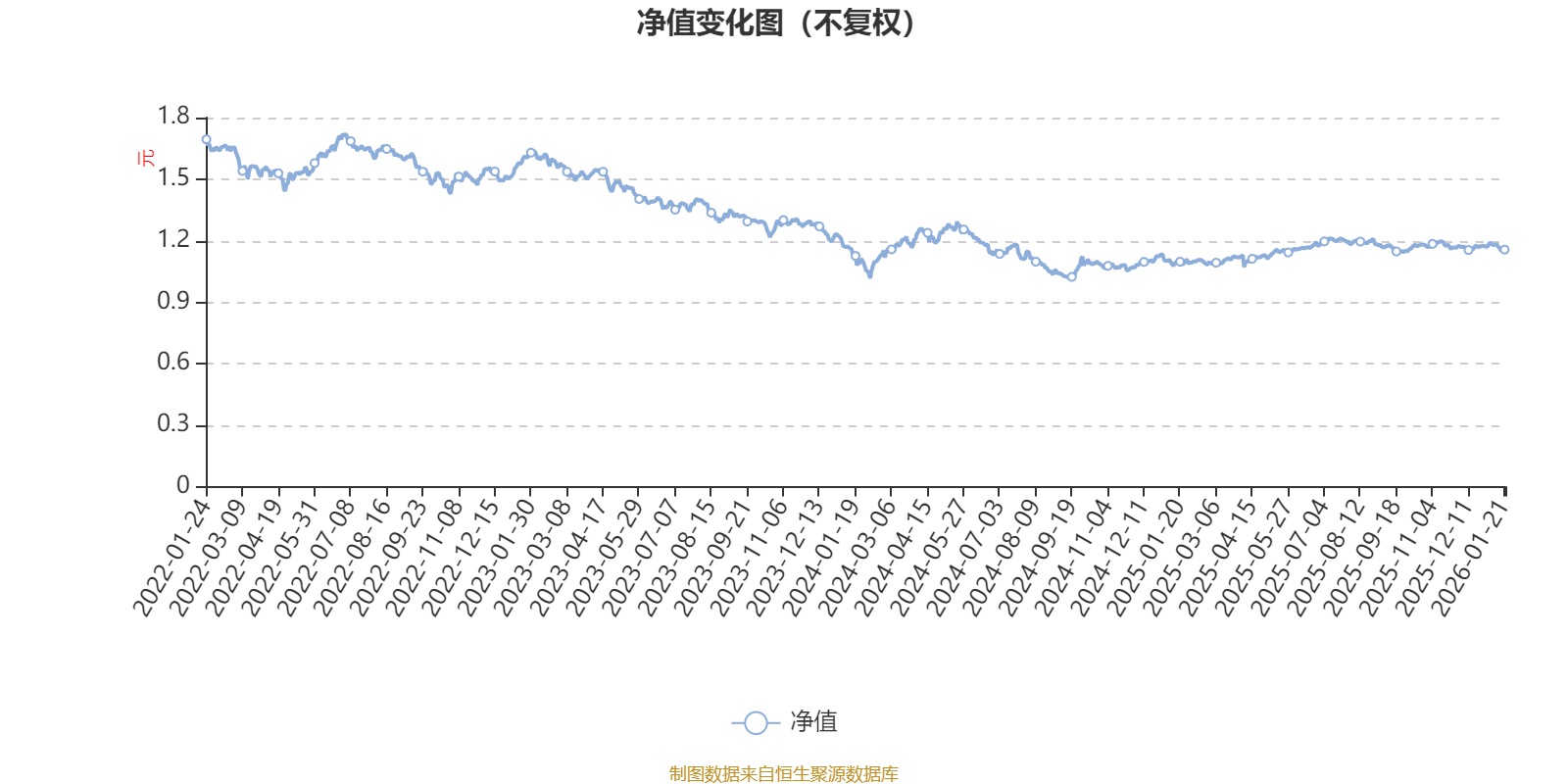
银华混改红利灵活配置混合发起式A:2025年第四季度利润60.81万元 净值增长率2.07%
Sou Hu Cai Jing· 2026-01-22 14:17
AI基金银华混改红利灵活配置混合发起式A(005519)披露2025年四季报,第四季度基金利润60.81万元,加权平均基金份额本期利润0.0232元。报告期内, 基金净值增长率为2.07%,截至四季度末,基金规模为2927.46万元。 截至12月31日,基金近三年夏普比率为-0.3303,位于同类可比基金1257/1275。 该基金属于灵活配置型基金。截至1月21日,单位净值为1.156元。基金经理是贲兴振,目前管理7只基金。其中,截至1月21日,银华稳健增长一年持有期混 合近一年复权单位净值增长率最高,达26.8%;银华汇利灵活配置混合A最低,为3.01%。 基金管理人在四季报中表示,本产品坚持低波红利策略选股。我们会在自己的低波红利选股策略框架内,不断完善方法论,争取获得相对于基准的持续稳定 超额。 截至1月21日,银华混改红利灵活配置混合发起式A近三个月复权单位净值增长率为-1.78%,位于同类可比基金1217/1286;近半年复权单位净值增长率 为-4.18%,位于同类可比基金1261/1286;近一年复权单位净值增长率为5.95%,位于同类可比基金1169/1286;近三年复权单位净值增长率为-28 ...