
海尔智家

Search documents
海尔智家股份有限公司 关于回购境外上市外资股(D股)股份的 进展公告
Zheng Quan Ri Bao· 2026-02-03 06:37
登录新浪财经APP 搜索【信披】查看更多考评等级 证券代码:600690 证券简称:海尔智家 公告编号:临2026-004 本公司董事会及全体董事保证本公告内容不存在任何虚假记载、误导性陈述或者重大遗漏,并对其内容 的真实性、准确性和完整性承担法律责任。 重要内容提示: ★ 回购D股股份的进展情况:自2026年1月21日至2026年1月31日,公司已累计回购D股股份422,000股, 占公司总股本的比例为0.0045%,购买的最高价为2.1025欧元/股、最低价为2.07欧元/股,支付的金额 (含手续费)为 884,105欧元,该等回购股份将全部注销。 一、 回购D股股份的进展情况 2025年5月28日,公司2024年年度股东大会、2025年第一次A股类别股东大会、2025年第一次D股类别股 东大会、2025年第一次H股类别股东大会审议通过了《海尔智家关于提请股东大会给予董事会一般性授 权以决定回购不超过公司已发行D股股份总数30%股份的议案》。2026年1月21日,公司发布《海尔智 家股份有限公司回购境外上市外资股(D股)的提示性公告》,披露了拟开展回购D股股份的相关安 排。 自2026年1月21日(本次回 ...

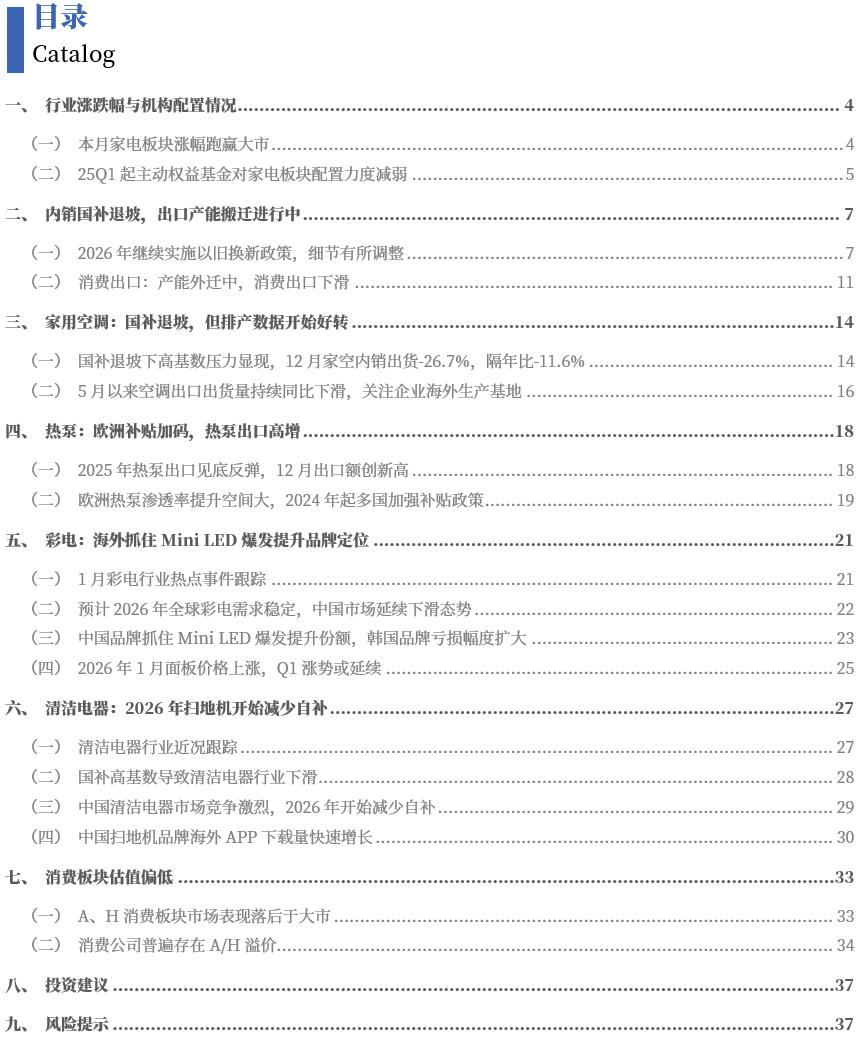
【银河家电】行业动态 2026.1丨内销开始提价,热泵、黑电海外表现突出
Xin Lang Cai Jing· 2026-02-03 06:33
Group 1 - The home appliance sector experienced a decline, with the SW home appliance index dropping by 0.68% as of January 28, 2026, and the current industry P/E ratio (TTM, excluding negative values) standing at 15.60 times [3][22] - Major home appliance companies have begun to raise prices due to increased costs from rising metal raw material prices and memory chips, alongside the reduction of national subsidies [3][22] - Midea implemented a tiered price increase strategy in early January, raising prices by 2% on January 3 and an additional 4% on January 5, with online retail prices for air conditioners increasing by 5.7% compared to December 2025 [3][22] Group 2 - National subsidies for home appliances are set to decline, but large appliances will continue to benefit from subsidies in 2026, including refrigerators, washing machines, televisions, air conditioners, computers, and water heaters [4][23] - The retail sales of home appliances and audio-visual equipment saw significant year-on-year declines in October, November, and December 2025, with decreases of 14.6%, 19.4%, and 18.7% respectively [4][23] - The production of domestic air conditioners in early 2026 is projected to decline by 14.8% in January-February and 5.7% in March compared to the same period last year [4][23] Group 3 - European countries are increasing the promotion of heat pumps, with exports reaching a historical high of 1.62 billion yuan in December 2025, marking a year-on-year increase of 21.7% [5][20] - The heat pump market in Europe is expected to improve, driven by the restoration or enhancement of subsidy policies, with a penetration rate of only 12% in 2024, indicating significant growth potential [5][24] - The promotion of heat pump heating is a key strategy for achieving carbon neutrality by 2050, which is expected to sustain the improvement of exports from China [5][24] Group 4 - TCL is set to acquire Sony's television business, forming a joint venture where TCL will hold 51% and Sony 49%, with the final agreement expected by the end of March 2026 [6][21] - TCL's adjusted net profit for 2025 is projected to be between 2.33 billion and 2.57 billion Hong Kong dollars, reflecting a year-on-year growth of 45-60% [6][21] - The merger is anticipated to increase TCL and Sony's combined market share to 16.7% by 2027, potentially surpassing Samsung's projected market share of 16.2% [6][21]

家电渠道扁平化的业务机遇
Xin Lang Cai Jing· 2026-02-03 06:33
家电产业链,下游渠道 ★ ★ 转 载 声 明 转载请联系market-service@cib.com.cn邮箱,我们尽快给予回复。本报告相关内容未经我司书面许可,不得进行引用或转载,否则我司保留追诉权利。 服 务 支 持 人 员 经过近四十年代的发展,家电渠道已从"广覆盖"的扩张时代,迈入"提效率"的深耕阶段。20世纪90年代至2013年"家电下乡"政策结束前,家电销售增长高 度依赖渠道扩张,因此渠道建设以提高覆盖面为目标,企业往往依托代理商进行渠道扩张。自2013年以来,主流家电企业渠道建设基本完成,叠加电商平 台迅猛发展,渠道竞争重心开始转向提高效率,旨在降低流通成本、提升价格竞争力。 提高渠道效率的关键在于扁平化。格力着力重构厂商关系,在推动线上发展、强化对线下渠道管控的基础上,于2025年建立"恒信系"渠道体系,迈出扁平 化关键一步。美的以提升供应链效率与数字化能力为驱动,继2017年推行网批模式后,于2024年启动直达消费者模式(Direct to Consumer,DTC),有效 支撑中小型零售渠道的扁平化拓展。海尔智家通过私有化海尔电器,消除产销职能的交叉,又于2025年推进"数字库存"变革,实 ...

大消费组二月消费金股:布局消费反转
CMS· 2026-02-03 06:02
证券研究报告 | 行业简评报告 2026 年 02 月 03 日 布局消费反转! 大消费组二月消费金股 研究部/消费品 % 1m 6m 12m 绝对表现 4.3 4.6 25.0 相对表现 3.1 -8.7 1.7 资料来源:公司数据、招商证券 -10 0 10 20 30 Feb/25 May/25 Sep/25 Jan/26 (%) 消费品 沪深300 相关报告 1、《招商证券 1 月港股消费观察: 外卖反垄断如何影响港股消费股前 景?》2026-01-27 2、《大消费组一月消费金股—双节 消费亮点前瞻》2026-01-06 ❑ 轻纺 杨蕊菁:看好家居板块修复以及倍加洁益生菌业务发展 风险提示:消费下行风险,消费复苏疲软风险、宏观经济变动风险等。 推荐(维持) 行业规模 | | | 占比% | | --- | --- | --- | | 股票家数(只) | 1216 | 23.5 | | 总市值(十亿元) | 17628.3 | 15.6 | | 流通市值(十亿元) | 16321.4 | 15.9 | 行业指数 3、《招商证券 12 月港股消费观察— 1-2 月流动性改善后港股消费买什 么?》2025 ...
平安证券(香港)港股晨报-20260203
Ping An Securities Hongkong· 2026-02-03 03:37
Market Overview - The Hong Kong stock market experienced a decline, with the Hang Seng Index closing at 23,831 points, down 145 points or 0.61% [1][5] - The Hang Seng Technology Index fell by 3.36%, while the Hang Seng China Enterprises Index decreased by 2.54% [1][5] - The market turnover decreased to 82.799 billion [1][5] U.S. Market Performance - The U.S. stock market saw gains, with the Dow Jones Industrial Average rising over 500 points, closing up 1.05% at 49,407.66 points [2] - The Nasdaq and S&P 500 also recorded increases of 0.56% and 0.54%, respectively [2] - Over 100 companies in the S&P 500 are set to report earnings this week, including major players like Amazon and Alphabet [2] Investment Opportunities - The report highlights the potential for long-term growth in sectors supported by the "self-reliance in technology" policy, particularly in AI applications, semiconductors, and industrial software [3] - The infrastructure and copper mining sectors, particularly China Railway (0390.HK), are noted for their recent performance, with a weekly increase of 11.0% before a slight pullback [3] - The report suggests continued focus on sectors benefiting from domestic consumption policies, including sports apparel and non-essential services [3] Key Company Insights - China Telecom (0763.HK) is recognized for its comprehensive product line and solutions in the telecommunications sector, despite a slight decline in revenue and net profit for 2024 [10] - The company maintains a high gross margin of 37.91% and is expected to leverage its advancements in computing power to sustain competitive advantages [10] - The projected net profits for 2025 and 2026 are 7.98 billion and 8.81 billion RMB, respectively, indicating a relatively low valuation compared to its earnings potential [10] Market Trends - The report emphasizes the importance of the low-altitude economy, with a guideline established for its standardization by 2027, which is expected to drive demand in this sector [9] - Companies like AVIC (2357.HK) and ZTE (0763.HK) are recommended for their potential in the low-altitude economy [9] - The report also notes the government's initiatives to boost consumer spending during the Spring Festival, which may benefit companies in the automotive and home appliance sectors [9]
未知机构:中信家电2025Q4基金重仓专题预期改善Q4基金重仓家电比例环比回暖-20260203
未知机构· 2026-02-03 02:20
Summary of Key Points from the Conference Call Industry Overview - The focus is on the home appliance industry, specifically the performance of major appliance segments including white goods, black goods, kitchen appliances, and small appliances [1][2][5]. Core Insights - **Fund Holdings in Home Appliances**: In Q4 2025, the proportion of actively managed equity funds holding home appliances increased, but it remains at a historically low level [1][3]. - **White Goods Performance**: The proportion of funds invested in white goods has seen a recovery, with a notable increase in the number of funds holding these stocks [5]. The market anticipates a continuation of national subsidies in 2026, which is expected to support domestic demand [5]. - **Black Goods Stability**: The proportion of funds in black goods remained stable, attributed to significant pressure on domestic sales due to the depletion of demand from previous subsidies [6][7]. - **Diverse Segment Performance**: Kitchen appliances, small appliances, and lighting segments are experiencing varied levels of attention, with some remaining underweight due to weak demand in the real estate sector [8]. Financial Metrics - **Fund Holdings Data**: - In Q4 2025, the proportion of actively managed equity funds in home appliances was 2.05%, up by 0.11 percentage points from the previous quarter [5]. - The allocation to white goods was 1.58%, an increase of 0.23 percentage points, with a significant rise in the number of funds holding these stocks [5]. - The underweight status for kitchen appliances, small appliances, and lighting was noted, with respective allocations of 0.03%, 0.03%, and 0.02% [8]. Future Outlook - **Market Expectations**: The outlook for leading home appliance companies is positive, with expectations of steady growth in performance [2][5]. - **Investment Recommendations**: - Focus on leading white goods companies that are expected to benefit from continued national subsidies in 2026 [8]. - Consider companies with manufacturing and brand advantages in overseas markets, such as Midea Group, Haier Smart Home, and TCL Electronics [8]. - Opportunities in MiniLED technology and commercial cold chain sectors are highlighted, with specific companies like Hisense and TCL leading in these areas [8][9]. Risks and Considerations - Potential risks include geopolitical trade risks, intensified industry competition, significant fluctuations in raw material prices, and the possibility of market demand recovery falling short of expectations [11].


2月债市策略及市场关注点分析
2026-02-03 02:05
Summary of Key Points from Conference Call Industry Overview - The conference call primarily discusses the bond market strategies and the economic outlook for February 2026, focusing on government bonds, credit bonds, and the impact of monetary policy on these markets [1][2][3]. Core Insights and Arguments 1. **Monetary Policy and Interest Rates**: - Current monetary policy remains accommodative with optimistic economic and inflation expectations, leading to a 10-year government bond yield surpassing 1.8%. However, breaking this level is challenging without clear signals for interest rate cuts [1][2]. - The 10-year bond yield is currently around 1.8%, slightly above the low of 1.77% seen in mid-November [2]. 2. **Credit Bonds and Market Dynamics**: - Increased volatility in the stock market may affect the scale of fixed-income funds, influencing preferences for low-grade credit (1-2 years) and high-grade credit (3-5 years) [2][3]. - The issuance of bonds by private enterprises is rising due to government support, with significant events in 2025 indicating a focus on enhancing financing mechanisms for small and medium enterprises [2][10]. 3. **Policy-Driven Opportunities**: - The government is expected to provide funding support to local governments to ensure economic growth targets are met, with an emphasis on increasing the total amount and optimizing the structure of special debt [15][16]. - The introduction of new policy financial tools worth 500 billion yuan is anticipated to promote project construction [16]. 4. **Investment Strategies**: - Investors are advised to consider holding bonds over the Spring Festival, weighing coupon levels and expectations for interest rate declines post-holiday. Current low coupon levels suggest caution [4]. - Specific recommendations include focusing on government bonds with potential for price appreciation, such as 10-year active bonds and long-duration bonds (30 and 50 years) [5][6][7]. 5. **Sector-Specific Insights**: - The private sector's bond issuance is notably increasing, with significant participation from industries like utilities, transportation, and pharmaceuticals. This trend indicates a shift in the market dynamics, with non-financial enterprises gaining ground [10][13][14]. - The issuance of asset-backed securities (ABS) and asset-backed notes (ABN) is becoming a popular financing choice for private enterprises, supported by favorable government policies [11]. Additional Important Content - **Long-Term Investment Considerations**: - While 50-year government bonds are recommended for their favorable odds, investors should be cautious about extending duration too much in their portfolios [7]. - The liquidity of 50-year bonds is sufficient for trading and holding needs, but larger portfolios may require more active long-term bonds [7]. - **Future Economic Growth and Government Support**: - The government aims to stimulate future industrial development through leading technology enterprises, which will receive extensive policy support [17]. - Local governments are expected to expand domestic demand through various measures, including job security and wage increases, focusing on service consumption sectors [18]. This summary encapsulates the key points discussed in the conference call, providing insights into the bond market, investment strategies, and the broader economic context.
原材料价格上涨对白电龙头影响有限,白电1-2月排产增速环比改善
Zhong Guo Neng Yuan Wang· 2026-02-03 02:01
国信证券近日发布家电行业2026年2月投资策略:近期铜等原材料价格上涨引发市场对白电龙头盈利的 担忧,通过复盘此前几轮周期发现,原材料成本上涨对毛利率的负面影响逐渐减弱,白电龙头通过结构 调整、费用节省等方式,盈利能力有望穿越周期。2026年1月,以SHFE铜和SHFE铝收盘价月均值计 算,铜价和铝价同比分别上涨36.7%和20.9%。 以下为研究报告摘要: 核心观点 白电1-2月排产降幅收窄,政策拉动下需求有望企稳。据产业在线数据,2月我国白电合计排产量达到 2379万台,较去年同期生产实绩下降22.1%;1-2月合计排产量预计下降5.0%。环比2025Q4排产10%以 上的降幅来看,白电排产表现有所修复。分品类看,2月空调内/外销排产量较去年同期内/外销量分 别-38.1%/-26.5%,合计排产量1149万台,较去年同期产量下降31.6%,1-2月累计下降10.3%;冰箱内/外 销排产量较去年同期内/外销量分别-17.1%/-8.0%,合计排产量600万台,较去年同期产量下降17.0%,1- 2月累计下降6.4%;洗衣机内/外销排产量较去年同期内/外销量分别-5.9%/+1.5%,合计排产量630万台, ...
港股概念追踪|以旧换新政策带动消费需求释放 机构普遍看好家电产业链估值回暖(附概念股)
Zhi Tong Cai Jing· 2026-02-03 01:32
(原标题:港股概念追踪|以旧换新政策带动消费需求释放 机构普遍看好家电产业链估值回暖(附概念 股)) 国家税务总局利用税收大数据对消费情况进行跟踪分析显示,2025年我国消费市场活跃。 智通财经APP获悉,新一轮以旧换新行动正在各地火热进行。在济南市济阳区,这几天就开展起乡村国 补活动,上百款家电、3C产品走进村镇,当地政府专项下发国补资格码,村民不仅可以直接享受国 补,还能额外享受到商家补贴,上千名附近村镇居民涌入活动现场,热闹非凡。 中信建投发布研报称,2026年面临铜价中枢上移与人民币升值的双重考验,该行认为其对家电龙头盈利 的冲击整体可控。过往经验看,顺价是化解成本压力最为有效的核心手段。国补落地下需求有支撑,元 旦后提价存共识。凭借强大的终端定价权、成熟的成本传导机制以及完善的汇率风险管理体系,龙头企 业有能力穿越周期波动,维持盈利模型的稳健。 当前板块估值处于历史低位,兼具稳健增长与高分红特性,配置价值凸显。 中信证券指出,预期改善,2025Q4主动偏股型基金重仓家电比例环比回升,但仍处于历史较低水平。 其中重仓白电比例有所回升;黑电持仓比例持平;厨电、小家电、照明、零部件板块关注度分化。展望 未 ...


以旧换新政策带动消费需求释放,机构普遍看好家电产业链估值回暖(附概念股)
Zhi Tong Cai Jing· 2026-02-03 01:32
国家税务总局利用税收大数据对消费情况进行跟踪分析显示,2025年我国消费市场活跃。 家电(核心股)产业链相关港股: 美的集团(00300)、海尔智家(06690)、海信家电(核心股)(00921)、TCL电子(01070)、创维集团 (00751)、小米集团-W(01810) 股票频道更多独家策划、专家专栏,免费查阅>> 责任编辑:栎树 2025年,在以旧换新政策带动下,冰箱等日用家电(核心股)零售业、燃气灶等厨具卫具零售业、手机 等通信设备零售业销售收入同比分别增长17.4%、12.9%和18.6%,消费需求加速释放。 智通财经获悉,新一轮以旧换新行动正在各地火热进行。在济南市济阳区,这几天就开展起乡村国补活 动,上百款家电(核心股)、3C产品走进村镇,当地政府专项下发国补资格码,村民不仅可以直接享 受国补,还能额外享受到商家补贴,上千名附近村镇居民涌入活动现场,热闹非凡。 中信建投发布研报称,2026年面临铜价中枢上移与人民币升值的双重考验,该行认为其对家电(核心 股)龙头盈利的冲击整体可控。过往经验看,顺价是化解成本压力最为有效的核心手段。国补落地下需 求有支撑,元旦后提价存共识。凭借强大的终端定价权、 ...