
思瑞浦

Search documents
60亿!上市公司加速出资GP
FOFWEEKLY· 2025-10-24 10:01
Core Insights - The average investment size from listed companies in September increased compared to August, indicating an overall upward trend in private equity fund investments [3][8] - A total of 42 listed companies (including subsidiaries) participated in funding 43 private equity funds, with a total disclosed investment amount of 6.005 billion yuan and an average single investment amount of 128 million yuan [7][8] Investment Distribution - The most active regions for listed company investments were Guangdong and Zhejiang, followed by Jiangsu and Shanghai [19] - Beijing had the largest investment scale in September, exceeding 1 billion yuan [19] - The majority of investments were in the range of 1-5 billion yuan, accounting for 42% of total investments, while investments below 1 billion yuan accounted for 25% [20] Industry Distribution - The industrial sector had the highest investment amount among listed companies in September, followed by public utilities [14] - In terms of investment frequency, materials and financial companies ranked first [14] Partner Nature Distribution - All listed companies participating in equity investments in September acted as Limited Partners (LPs) [16] Active Companies and Investment Events - Notable active institutions included Huaxia Xuanke and Suzhou Weiteli New Venture Capital Management, focusing on new consumption and technology-driven sectors [25][26] - Specific investment events included partnerships with various investment firms targeting projects in semiconductor, renewable energy, and digital technology sectors [29][31][32]


半导体行业双周报(2025、10、10-2025、10、23):AI驱动存储行业景气上行-20251024
Dongguan Securities· 2025-10-24 07:12
Investment Rating - The report maintains an "Overweight" rating for the semiconductor industry, indicating an expectation that the industry index will outperform the market index by more than 10% over the next six months [48]. Core Insights - The semiconductor industry index has seen a cumulative decline of 9.48% over the past two weeks, underperforming the CSI 300 index by 7.29 percentage points. However, since the beginning of 2025, the semiconductor index has risen by 44.73%, outperforming the CSI 300 index by 27.66 percentage points [7][15]. - The report highlights a significant price increase in storage products driven by the explosion of AI applications, leading to a surge in demand for high-performance storage chips used in AI servers and data centers. Major companies like Micron and Samsung have raised prices by 20%-30% and 15%-30% respectively [41][25]. Industry News and Company Dynamics - The report notes that the global semiconductor equipment investment reached $33.07 billion in Q2 2025, a 24% year-on-year increase [18]. - The Chinese smartphone market saw a 3% decline in Q3 2025, with Vivo regaining the top position in shipments [22]. - The report mentions that the utilization rate of wafer foundries in the second half of 2025 is better than expected due to low inventory levels among chip design companies and strong AI demand [23]. - The report anticipates a "super cycle" in the storage chip market, with price increases expected to continue until 2026, driven by high demand from data centers and smart devices [25]. Semiconductor Industry Data Updates - Global smartphone shipments reached 323 million units in Q3 2025, a year-on-year increase of 2.09% [34]. - In September 2025, domestic new energy vehicle sales reached 1.604 million units, a year-on-year increase of 24.6% [36]. - Global semiconductor sales in August 2025 amounted to $64.88 billion, a year-on-year increase of 21.7% [38]. Investment Recommendations - The report suggests focusing on segments benefiting from the price increases in storage products, including storage modules, niche storage, and supporting materials [41]. - Specific companies to watch include: - Northern Huachuang (002371) - Zhongwei Company (688012) - Huahai Qingke (688120) - Tuo Jing Technology (688072) [44][45].
投资200亿,士兰微挑战高端模拟芯片制造
3 6 Ke· 2025-10-20 12:55
Core Viewpoint - The announcement by Silan Microelectronics to invest 20 billion RMB in building a 12-inch high-end analog chip production line in Xiamen highlights the company's ambition to enhance its capabilities in the analog chip market, which is currently dominated by foreign firms like Texas Instruments and Analog Devices [1][9]. Company Overview - Silan Microelectronics, established in 1997 and listed in 2003, has evolved into a comprehensive semiconductor company involved in chip design, manufacturing, and packaging, with projected revenues of 12.68 billion RMB for 2024 and total assets of approximately 24.8 billion RMB [1][4]. Investment Details - The project involves a total investment of 20 billion RMB, with a planned capacity of 45,000 wafers per month, implemented in two phases. The first phase will cost 10 billion RMB, aiming for a monthly capacity of 20,000 wafers, while the second phase will add an additional 25,000 wafers per month [6][8]. Market Context - The global analog chip market is projected to reach 79.43 billion USD in 2024, with a forecasted growth to 83.16 billion USD in 2025, indicating a 4.7% increase [8]. In China, the analog chip market is expected to grow significantly, with a projected size of 195.3 billion RMB in 2024, accounting for about 35% of the global market [9]. Competitive Landscape - The analog chip market is heavily influenced by major players such as Texas Instruments and Analog Devices, which dominate both the global and Chinese markets. The domestic self-sufficiency rate for analog chips is currently around 16%, with even lower rates for automotive-grade chips [9][10]. Strategic Partnerships - Silan Microelectronics has entered into strategic cooperation agreements with local governments and investment groups to facilitate the establishment of the new production line, indicating a collaborative approach to enhance local semiconductor manufacturing capabilities [4][5]. Future Outlook - The investment in the analog chip production line is seen as a critical step for Silan Microelectronics to capture market share in a rapidly growing sector, particularly as demand for specialized chips in automotive and industrial applications continues to rise [8][9].


思瑞浦(688536) - 关于“思瑞定转”定向可转债2025年付息的公告
2025-10-20 11:31
| 证券代码:688536 | 证券简称:思瑞浦 | 公告编号:2025-058 | | --- | --- | --- | | 转债代码:118500 | 转债简称:思瑞定转 | | 思瑞浦微电子科技(苏州)股份有限公司 关于"思瑞定转"定向可转债 2025 年付息的公告 本公司董事会及全体董事保证本公告内容不存在任何虚假记载、误导性陈述 或者重大遗漏,并对其内容的真实性、准确性和完整性依法承担法律责任。 重要内容提示: 思瑞浦微电子科技(苏州)股份有限公司(以下简称"公司")于2024年10 月25日发行的可转换公司债券将于2025年10月28日开始支付自2024年10月25日 至2025年10月24日期间的利息。根据公司《发行可转换公司债券及支付现金购买 资产并募集配套资金之可转换公司债券登记完成暨实施情况报告书》(以下简称 "《实施情况报告书》")以及公司与各可转债持有人签署的《发行可转换公司 债券及支付现金购买资产协议》(以下简称"《购买资产协议》")有关条款的 规定,现将有关事项公告如下: 一、定向可转债发行概况 1 "思瑞定转"可转债付息债权登记日:2025年10月24日 可转债付息日:2025 ...

数据折射资本市场助力科创实践轨迹 强化枢纽功能 A股含“科”量跃升
Zhong Guo Zheng Quan Bao· 2025-10-19 22:29
Group 1: Capital Market Support for Technological Innovation - The total financing in the stock and bond markets reached 57.5 trillion yuan over the past five years, with direct financing's proportion increasing to 31.6% [1] - During the "14th Five-Year Plan" period, the bond market issued over 52.4 trillion yuan in various bonds, with 1.77 trillion yuan specifically for technology innovation companies [1] - Private equity and venture capital funds participated in 90% of companies listed on the Sci-Tech Innovation Board and the Beijing Stock Exchange, and over half of the companies listed on the Growth Enterprise Market [1] Group 2: Policy and Structural Changes - The China Securities Regulatory Commission (CSRC) has enhanced the inclusivity and adaptability of policies for hard technology companies, exemplified by the support for sectors like artificial intelligence and commercial aerospace [2] - The capital market's service for technological innovation has shown significant results, with over 90% of IPOs during the "14th Five-Year Plan" being high-tech enterprises [2][3] - A series of supportive policies, including the "National Nine Articles" and "Technology Sixteen Articles," have been released to strengthen support for technological innovation [3] Group 3: Financial Product Innovation - The capital market has continuously innovated financial products to better align with technological innovation, including the development of technology innovation bonds and ETFs [4][5] - The issuance of technology innovation bonds has accelerated, with a total of 1.77 trillion yuan issued, reflecting a significant increase in the scale of these financial instruments [4] - Public REITs have also seen growth, with 79 products registered and nearly 200 billion yuan raised, indicating a trend towards integrating technology assets into the market [5] Group 4: Investment Trends and Capital Flow - Private equity and venture capital funds have invested in 90% of companies on the Sci-Tech Innovation Board, indicating a strong focus on early-stage technology innovation [6] - Long-term capital, including social security and insurance funds, has increasingly flowed into the technology sector, with a 32% increase in the market value held by these funds compared to the end of the "13th Five-Year Plan" [6][7] - The shift in trading structure shows that professional institutions have increased their holdings in A-shares, with technology companies' trading volume rising from 34% to 48% [7] Group 5: Future Outlook - Looking ahead to the "15th Five-Year Plan," there are expectations for improved long-term capital arrangements to address structural financing challenges for technology innovation enterprises [8] - The focus will be on enhancing the "long money, long investment" system to facilitate the entry of long-term funds into the market [8]
强化枢纽功能 A股含“科”量跃升
Zhong Guo Zheng Quan Bao· 2025-10-19 20:13
Core Insights - The capital market has significantly supported technological innovation during the "14th Five-Year Plan" period, with direct financing increasing to 31.6% and a total of 57.5 trillion yuan raised in stock and bond financing [1][2] - The issuance of various bonds in the exchange bond market exceeded 52.4 trillion yuan, with 1.77 trillion yuan specifically for technology innovation bonds, aligning with the strategy for a strong technological nation [1][3] - The capital market's focus on technology has become clearer, with a notable increase in the number of high-tech companies and strategic emerging industries participating in IPOs [2][3] Financing and Investment Trends - The top three industries by IPO amount during the "14th Five-Year Plan" were semiconductors, hardware equipment, and electrical equipment, with over 90% being high-tech enterprises [2] - Private equity and venture capital funds have invested in 90% of companies listed on the Sci-Tech Innovation Board and the Beijing Stock Exchange, indicating strong support for early-stage technology firms [5][6] - The market for technology innovation bonds has seen accelerated issuance, with a significant increase in the scale of existing bonds, providing robust financial support for technology companies [4][6] Policy Support and Market Structure - A series of supportive policies, including the "National Nine Articles" and "Six Merger Articles," have been released to enhance support for technological innovation and optimize resource allocation in the capital market [3][7] - The market structure is evolving, with a notable increase in the market capitalization of technology sectors, now accounting for over 25% of the A-share market, surpassing traditional sectors like banking and real estate [2][6] - The introduction of innovative financial products, such as technology innovation bond ETFs and REITs, is expected to further align the capital market with the needs of technological innovation [4][5] Long-term Capital and Investment Strategies - Long-term capital, including social security and insurance funds, has increasingly entered the market, with a total market value of approximately 21.4 trillion yuan held by various long-term funds [6] - The focus on strategic investments in new productivity and dual carbon goals is expected to drive the growth of pension fund returns while supporting high-quality development in the real economy [6][7] - The capital market is anticipated to continue evolving, with efforts to enhance the investment patience of market-oriented institutions and address structural financing challenges for technology innovation enterprises [7]
苏州并购重组实现“1+1>2”
Su Zhou Ri Bao· 2025-10-18 00:21
Core Viewpoint - The implementation of the "Six Guidelines for Mergers and Acquisitions" has significantly stimulated the M&A market in Suzhou, supporting economic transformation and high-quality development through various strategic initiatives [1][2]. Group 1: M&A Market Activity - As of September last year, Suzhou listed companies completed 40 M&A events, with a total transaction scale reaching 25.6 billion yuan, indicating strong M&A activity in the capital market [1]. - In the first nine months of this year, 25 M&A events were completed by listed companies in Suzhou, showcasing the ongoing momentum in the M&A landscape [4]. - The establishment of local M&A funds, such as the 1.3 billion yuan fund by Dongwu Securities, has facilitated investments totaling 7.68 billion yuan, further driving M&A activities [4]. Group 2: Policy Support and Strategic Initiatives - The "Six Guidelines" encourage listed companies to utilize various payment tools for M&A, enhancing transaction flexibility and supporting technology innovation and industrial upgrades [2]. - Suzhou's action plan for 2025-2027 aims to establish a one-stop service platform for M&A, fostering the growth of key industry representatives and creating a 100 billion yuan M&A transaction scale [3]. - The establishment of the Suzhou Capital Market M&A Alliance aims to enhance collaboration among financial institutions, service providers, and listed companies, promoting a professional exchange platform [3]. Group 3: Sector-Specific M&A Trends - Over 70% of completed M&A projects in Suzhou are industry-related, reflecting a strategic focus on strengthening core businesses and supply chain integration [5]. - Private enterprises account for nearly 90% of M&A activities, highlighting the vitality of Suzhou's private economy, while state-owned enterprises focus on finance and infrastructure [5]. - M&A activities in high-tech sectors, such as semiconductors and biotechnology, represent over 70% of the total, aligning with Suzhou's goal of developing a digital economy innovation cluster [5]. Group 4: Significant M&A Cases - Four major asset restructurings have been completed, including 隆扬电子's acquisition of 德佑新材, which aims to achieve technological synergy and industry chain integration [6]. - 罗博特科's acquisition of 斐控泰克 marks a strategic shift towards the semiconductor field, enhancing its competitive position in clean energy and semiconductor equipment [7]. - 旭杰科技's acquisition of 中新旭德 will expand its business into downstream solar power operations, promoting synergy across the solar energy value chain [7]. - 华亚智能's restructuring with 冠鸿智能 allows for rapid entry into the smart equipment sector, enhancing its technical capabilities and market position [8].
科技股回调,中芯国际跌逾3%,科创芯片50ETF(588750)跌超3%!寒武纪三季报披露在即!芯片国产化长逻辑不变,短期调整如何应对?
Xin Lang Cai Jing· 2025-10-17 06:31
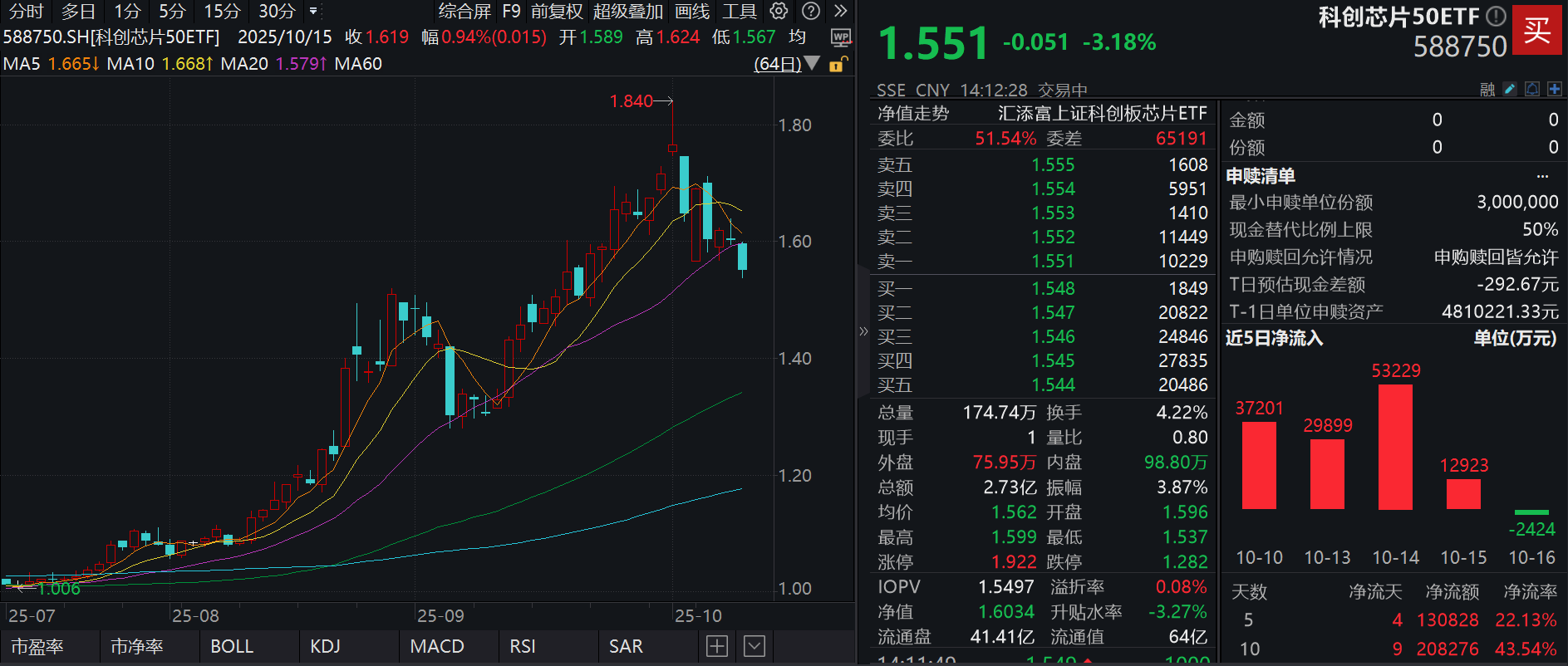
Core Viewpoint - The semiconductor sector, particularly the Sci-Tech Innovation Board's chip index, is experiencing fluctuations, with significant movements in individual stocks and ETFs, reflecting the ongoing dynamics in the AI chip market and broader semiconductor industry [1][3][4]. Market Performance - As of October 17, 2025, the Sci-Tech Innovation Board chip index (000685) decreased by 3.36%, with individual stocks showing mixed results, such as Weijie Chuangxin (688153) rising by 3.28% and Baiwei Storage (688525) falling by 7.96% [1]. - The Sci-Tech Chip 50 ETF (588750) also saw a decline of 3.18%, with a recent price of 1.55 yuan, but it had a cumulative increase of 7.88% over the past month as of October 16, 2025 [1]. Fund Flows and Liquidity - The Sci-Tech Chip 50 ETF experienced a significant growth in scale, increasing by 7.69 billion yuan over the past week, ranking first among comparable funds [3]. - The ETF's shares grew by 5.70 million over the same period, also leading among comparable funds [3]. - Despite a recent net outflow of 24.24 million yuan, the ETF saw a net inflow of 1.308 billion yuan over the last five trading days, averaging 262 million yuan per day [3]. Company Developments - Cambricon is expected to release its Q3 2025 financial report on October 18, 2025, which will include revenue and net profit data [3]. - On October 15, 2025, Cambricon signed a strategic cooperation agreement with SenseTime to develop solutions that integrate hardware and software, focusing on the Syuan series chips [3]. Industry Trends - TSMC reported better-than-expected Q3 financial results, boosting market optimism regarding the demand for AI chips, which is seen as a bellwether for the semiconductor manufacturing industry [4]. - TSMC remains optimistic about AI growth, indicating that demand is stronger than previously anticipated and that they are working to increase production capacity by 2026 [4]. Investment Recommendations - Analysts suggest focusing on sectors with high growth potential, such as computing power, foundry services, and equipment, as well as storage and analog sectors benefiting from a recovery in the industry cycle [5]. - The Sci-Tech Chip Index is noted for its higher "chip content," indicating stronger growth potential and elasticity compared to other indices [5][6]. Index Characteristics - The Sci-Tech Chip Index focuses on the upstream and midstream segments of the semiconductor industry, with a core segment representation of 95%, which is higher than other indices [6][8]. - The index is designed to reflect the development trends of the semiconductor industry more responsively due to its quarterly rebalancing [7]. Performance Metrics - The Sci-Tech Chip Index is projected to have a net profit growth rate of 71% for H1 2025 and an estimated 100% growth for the entire year, significantly outperforming its peers [9]. - The index has shown a maximum increase of 186.5% since its inception, indicating strong upward elasticity compared to other industry indices [10][11].


东海证券晨会纪要-20251016
Donghai Securities· 2025-10-16 05:46
Group 1: Inflation Data - In September 2025, the CPI decreased by 0.3% year-on-year, while the PPI decreased by 2.3% year-on-year, indicating ongoing deflationary pressures [5][6][7] - The core CPI rose to 1.0% year-on-year, marking five consecutive months of increase, driven by stable service prices and a significant rise in gold jewelry prices [8][9] - The impact of tail effects on CPI and PPI is expected to diminish after October, with potential price increases in various sectors, particularly in household appliances and medical services [5][6] Group 2: Machinery Equipment Industry - In September 2025, excavator sales reached 19,858 units, a year-on-year increase of 25.4%, with domestic sales growing by 21.5% and exports by 29% [10][11] - The domestic excavator market is supported by ongoing infrastructure investments and government policies aimed at urban renewal and old community renovations [11][12] - Major exhibitions showcased numerous electric and intelligent equipment, indicating a shift towards modernization in the machinery sector [12][13] Group 3: Semiconductor Industry - The semiconductor industry showed signs of recovery in September 2025, with prices increasing and demand driven by AI applications and consumer electronics [16][18] - Storage chip prices saw significant increases, with major manufacturers announcing price hikes of 10% to 30% for NAND and DRAM products [20][21] - The overall semiconductor market is expected to continue its upward trend, with a focus on AIOT and key components, despite external pressures from U.S. policies [16][21]
优迅股份IPO生死局:3000万元软件退税是否“骗税”引争议
Xin Lang Zheng Quan· 2025-10-15 06:32
优迅股份成立于2003年2月,主要从事光通信前端收发电芯片的研发、设计与销售。 优迅股份近一个月的核心争议直指其嵌入式软件增值税退税的合理性与真实性。根据公开数据,2022年 至2025年上半年,优迅股份归母净利润分别为8139.84万元、7208.35万元、7786.64万元、4695.88万元, 而同期获得的嵌入式软件退税金额分别为993.41万元、698.05万元、957.87万元、439.54万元,占当期净 利润的比例分别高达12.20%、9.68%、12.30%、9.36%。2022年至2025年上半年,优迅股份获得的增值 税即征即退金额累计超过3000万元,占各期净利润比例平均超过10%。 争议的种子源于国家对软件产业的税收扶持政策。根据《财政部、国家税务总局关于软件产品增值税政 策的通知》,嵌入式软件产品可享受增值税实际税负超过3%部分即征即退。 有举报信及相关媒体指出,优迅股份的主营产品——光通信电芯片(如TIA、收发合一芯片等)本质上 属于模拟芯片或模数混合芯片。在芯片设计行业,这类芯片通常通过硬件电路实现功能。 举报材料还指出,同行业中以模拟和信号链芯片设计为主的企业,如思瑞浦、圣邦股份等 ...