良品铺子

Search documents
良品铺子:控股股东终止控制权转让
Ge Long Hui· 2025-10-16 13:02
格隆汇10月16日|良品铺子公告,2025年7月17日,长江国贸与公司控股股东宁波汉意及其合伙人杨红 春、杨银芬、张国强、潘继红,以及良品投资及其股东签订了《股份转让协议》。宁波汉意拟向长江国 贸协议转让其持有的上市公司7223.99万股股份,占上市公司股份总数的18.01%;良品投资拟向长江国 贸协议转让其持有的上市公司1197.01万股股份,占上市公司股份总数的2.99%。近日,收到控股股东宁 波汉意及其一致行动人良品投资函告,截至《股份转让协议》约定的最终截止日2025年10月15日,《股 份转让协议》约定的生效条件未能全部成就,依据《股份转让协议》有关约定,本次《股份转让协议》 终止。本次终止控制权转让事项不会导致公司控制权发生变更,公司控股股东仍为宁波汉意,实际控制 人仍为杨红春、杨银芬、张国强和潘继红。 ...

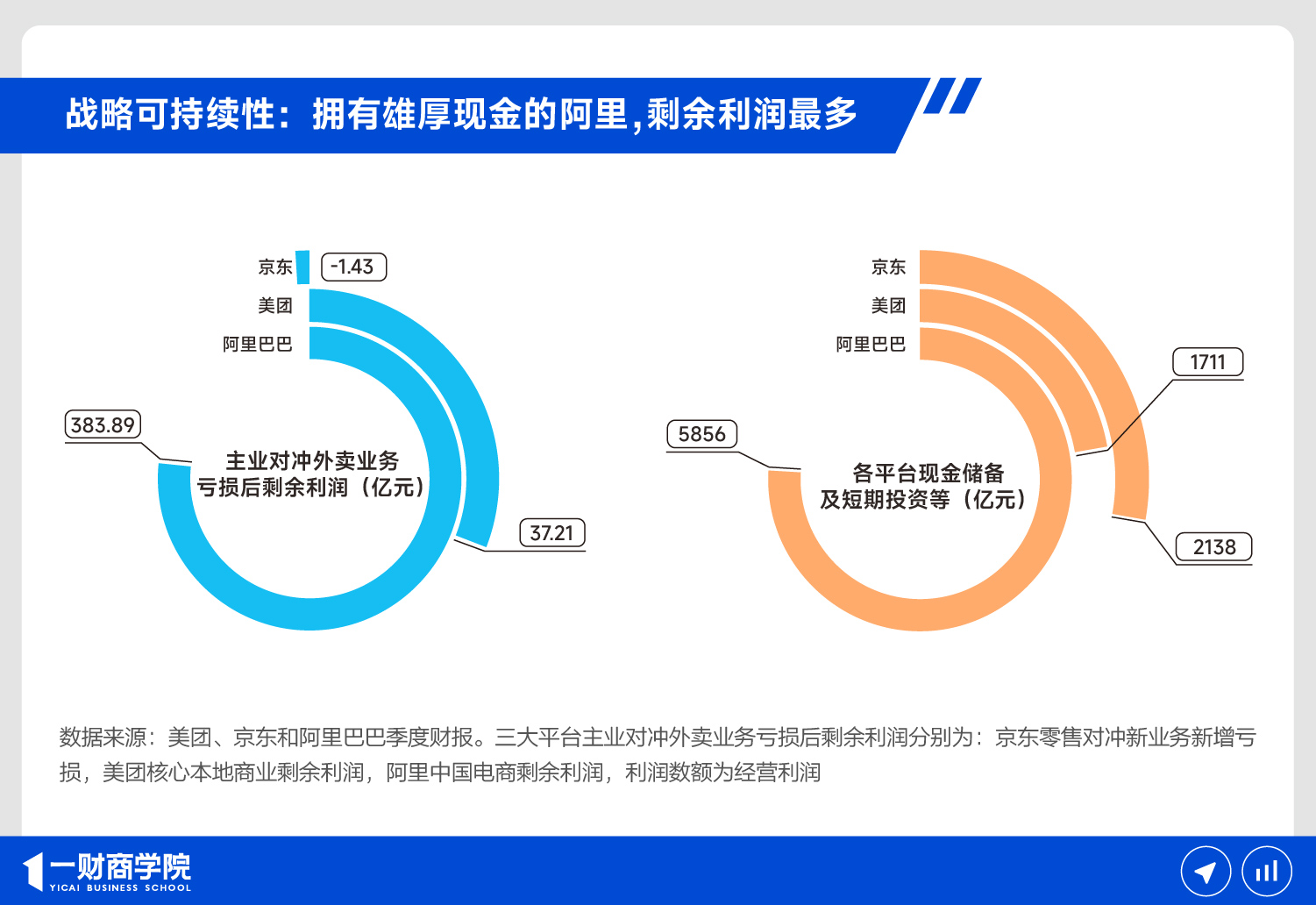
淘宝闪购首迎双11:竞争优势凸显的时机到了
Zhong Guo Jing Ji Wang· 2025-10-15 11:08
Core Insights - The report by Yi Financial Academy highlights the transformative trends in the takeaway market, driven by the rise of instant delivery services like Taobao Flash Purchase, indicating a shift from traditional e-commerce to a focus on immediacy and consumer experience [1] Group 1: Platform Competition and Business Opportunities - Taobao Flash Purchase has significantly altered the competitive landscape of the takeaway market, establishing a triopoly with Meituan and JD, moving from short-term subsidy wars to long-term ecological collaboration and operational efficiency [2][5] - The rise of Taobao Flash Purchase has created new business opportunities for merchants, allowing them to leverage multiple platforms for greater exposure and order flexibility, as seen with brands like Heytea, which experienced a 255% week-on-week increase in new customers after joining [5][6] Group 2: Restructuring of the Restaurant Industry - Takeaway services are becoming a digital infrastructure for the restaurant industry, with significant increases in online orders during peak periods, indicating that takeaway is no longer an auxiliary channel but a primary growth driver [7][8] - The digital transformation allows for enhanced membership operations, as demonstrated by Xiaogu's spicy hot pot, which gained 1 million new members in one month through Taobao Flash Purchase, showcasing the potential for substantial customer retention and private traffic accumulation [7][8] Group 3: Changing Consumer Behavior - The emergence of Taobao Flash Purchase is shifting consumer behavior from planned purchases to instant gratification, with examples like a 132% year-on-year increase in flower orders during the Qixi Festival, reflecting the demand for immediate satisfaction in various consumer scenarios [10][11] - Retail brands are restructuring their supply chains to support instant delivery, transforming physical stores into community service centers, thus enabling a new model of "order online, store delivery, and hourly fulfillment" [11][12] Group 4: Future of Takeaway Wars - The upcoming Double 11 shopping festival will highlight the ecological synergy of major consumption platforms, with Taobao Flash Purchase offering significant discounts and integrating various membership systems to enhance consumer engagement [15][16] - Merchants are transitioning from relying solely on traffic to focusing on operational efficiency, with examples like the "satellite store" model adopted by restaurants, leading to a 230% monthly sales increase, indicating a shift towards a more sustainable growth model [18][19]


休闲食品板块10月14日跌0.25%,万辰集团领跌,主力资金净流出2718.42万元
Zheng Xing Xing Ye Ri Bao· 2025-10-14 08:39
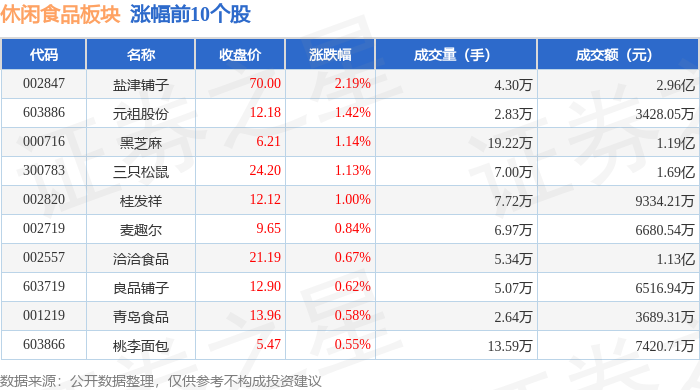
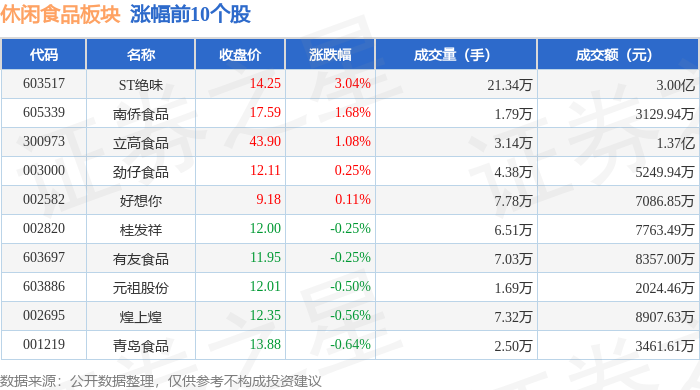
Market Overview - The leisure food sector experienced a decline of 0.25% on October 14, with Wancheng Group leading the drop [1] - The Shanghai Composite Index closed at 3865.23, down 0.62%, while the Shenzhen Component Index closed at 12895.11, down 2.54% [1] Individual Stock Performance - Salted Fish Shop (002847) rose by 2.19% to close at 70.00, with a trading volume of 43,000 hands and a transaction value of 296 million [1] - Yuanzi Co. (603886) increased by 1.42% to 12.18, with a trading volume of 28,300 hands and a transaction value of 34.28 million [1] - Wancheng Group (300972) fell by 3.04% to 173.54, with a trading volume of 23,800 hands and a transaction value of 419 million [2] Capital Flow Analysis - The leisure food sector saw a net outflow of 27.18 million from main funds, while retail investors had a net inflow of 29.55 million [2] - Major stocks like Salted Fish Shop and Good Products Shop saw significant net inflows from main funds, while others like Yuanzi Co. experienced net outflows [3] Summary of Key Stocks - Salted Fish Shop had a main fund net inflow of 12.23 million, while retail investors had a net outflow of 27.79 million [3] - Good Products Shop recorded a main fund net inflow of 11.57 million, with both retail and speculative funds showing outflows [3] - Three Squirrels (300783) had a main fund net inflow of 10.96 million, but retail investors withdrew 7.50 million [3]



数读 | 良品铺子“花生上树”事件:AI时代下的常识乌龙与信任拷问
Huan Qiu Wang Zi Xun· 2025-10-14 02:41
Core Insights - The incident involving the misrepresentation of peanuts as growing on trees by a brand has sparked significant public discourse, highlighting the pitfalls of AI technology in marketing and the erosion of brand trust [1][2][6] Group 1: Incident Overview - On August 27, 2025, a social media user discovered an error in a promotional image from a brand, which incorrectly stated that peanuts grow on trees, leading to widespread disbelief and ridicule [1] - The hashtag related to the incident gained over 203.9 million views on Weibo and 38.48 million views on Douyin, indicating the extensive reach of the controversy [3] - The brand issued an apology and initiated a comprehensive review within 28 hours of the issue being identified, but the response did not fully quell public concern [4] Group 2: Media Response - Major media outlets focused on two main issues: the misuse of AI technology and the lack of basic agricultural knowledge within the brand [2] - Reports highlighted that 10 mainstream media outlets directly referenced the brand's apology, while others criticized the incident as an industry joke stemming from human error rather than AI flaws [2] - The media coverage elevated the discussion from mere online jokes to a serious examination of marketing practices and brand accountability [2] Group 3: Public Sentiment - Public reactions revealed three primary concerns: the inadequacy of the brand's review processes, the potential for misleading product information, and the inappropriate use of AI as a scapegoat for human error [4] - Keywords such as "verification," "apology," and "consumer" emerged as focal points in the discourse, reflecting public demand for accountability and transparency [3] Group 4: Industry Implications - The incident serves as a cautionary tale for brands about the importance of maintaining professional standards and rigorous content review processes in the age of AI [6] - The overarching message emphasizes that while technology can enhance efficiency, it cannot replace fundamental knowledge and responsibility in marketing practices [6]
休闲食品板块10月13日跌1.32%,万辰集团领跌,主力资金净流出3690.65万元
Zheng Xing Xing Ye Ri Bao· 2025-10-13 12:38
证券之星消息,10月13日休闲食品板块较上一交易日下跌1.32%,万辰集团领跌。当日上证指数报收于 3889.5,下跌0.19%。深证成指报收于13231.47,下跌0.93%。休闲食品板块个股涨跌见下表: 从资金流向上来看,当日休闲食品板块主力资金净流出3690.65万元,游资资金净流入917.8万元,散户资 金净流入2772.85万元。休闲食品板块个股资金流向见下表: | 代码 | 名称 | 主力净流入(元) | | 主力净占比 游资净流入 (元) | | 游资净占比 散户净流入 (元) | | 散户净占比 | | --- | --- | --- | --- | --- | --- | --- | --- | --- | | 003000 | 劲仔食品 | | > 952.45万 | 18.14% | -334.80万 | -6.38% | -617.65万 | -11.76% | | 603517 | ST绝味 | | 912.85万 | 3.04% | -547.95万 | -1.82% | -364.90万 | -1.22% | | 300973 | 立高食品 | | 762.50万 | 5.56% ...
报告会场外市集“火出圈”,国潮新品外贸优品引市民热购
Sou Hu Cai Jing· 2025-10-13 04:31
Core Insights - The event in Wuhan showcased a variety of local products and aimed to promote the city as a hub for international consumption, highlighting the growth of the local economy and consumer market [1][3]. Group 1: Event Overview - The "Building a Support Point, Being a Leader" themed report meeting took place in Wuhan, featuring a marketplace with diverse products, attracting a large audience [1]. - Various local businesses and institutions participated, including duty-free shops, supermarkets, and food companies, presenting a range of trendy and export-quality products [3]. Group 2: Local Products and Innovations - Yangtze River Foods showcased traditional snacks like cherry blossom cakes and mung bean cakes, emphasizing the need for innovation in old brands to meet modern consumer demands [4]. - The "Chasing Light Wuhan" series of gift boxes, incorporating local landmarks, has gained popularity among younger consumers and was recognized as one of Wuhan's top gifts [4]. Group 3: Logistics and Delivery Innovations - SF Express introduced its drone company, Fengyi Technology, which has received approval for six low-altitude flight routes in Hubei, focusing on medical delivery, commercial dining, and logistics [4]. - The company is exploring new models for instant food delivery via drones, aiming to enhance commercial development in Wuhan [4].

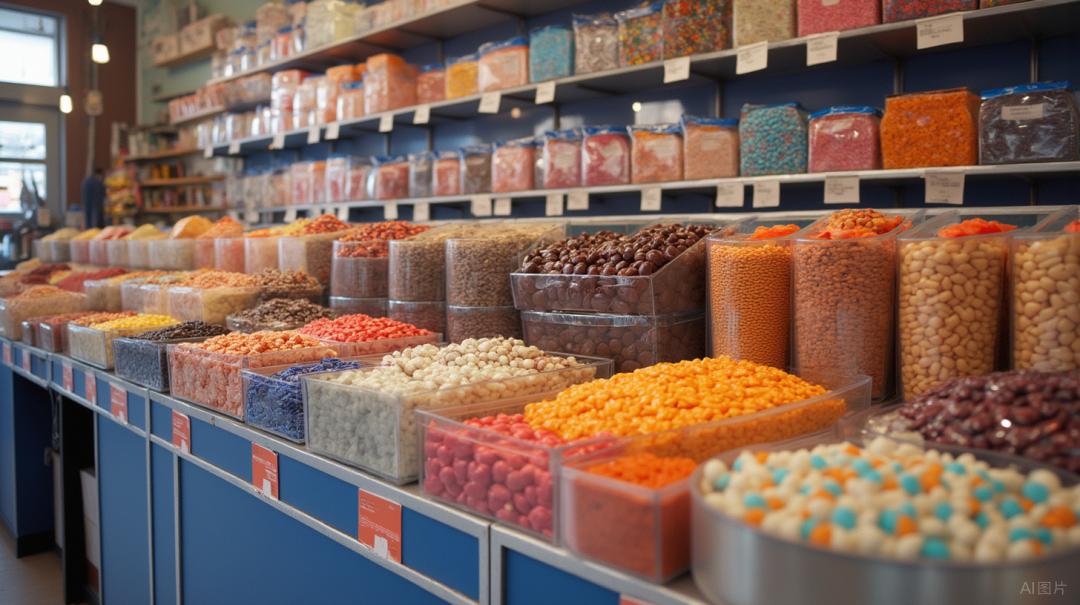
这届零食,越贵越高端?
投中网· 2025-10-11 09:08
Core Viewpoint - The article discusses the paradox of rising snack prices in China, where snacks that were once affordable are now perceived as luxury items, leading to a loss of "snack freedom" for consumers [5][10]. Group 1: Historical Context of Snack Consumption - In the past, consumers chose snacks based on taste and price, with little brand loyalty, often mixing various brands in their purchases [6]. - The rise of major snack brands like Liangpinpuzi and Three Squirrels around 2010 shifted consumer behavior towards brand recognition and loyalty, leading to a more concentrated market [6][7]. - Early competition among snack brands involved aggressive pricing strategies, including significant discounts and promotions to attract consumers [7]. Group 2: Shift to Premium Pricing - By 2019, Liangpinpuzi adopted a "high-end snack" positioning, linking product quality directly to pricing, which has led to significant price increases for similar products over the years [8]. - The change in pricing units from larger to smaller measurements has obscured consumers' perception of price increases, contributing to the feeling that snacks have become unaffordable [8][9]. - The emergence of high-priced snacks has resulted in a loss of the previously enjoyed "snack freedom," as consumers now feel priced out of the market [8][10]. Group 3: Market Response and New Trends - The rise of "white-label" snack stores offering high value for money has disrupted traditional snack brands, with the market for these stores growing from 211 billion yuan in 2019 to 809 billion yuan in 2023, reflecting a 40% compound annual growth rate [10]. - Traditional snack brands like Three Squirrels and Liangpinpuzi have faced declining revenues, with Three Squirrels' revenue dropping from over 10 billion yuan in 2019 to 7.1 billion yuan in 2023 [10][11]. - In response to market pressures, brands have attempted to lower prices, but these efforts have had limited success due to established negative perceptions of high pricing [11]. Group 4: Consumer Sentiment and Future Outlook - The article highlights a growing consumer sentiment against high prices that lack corresponding value, indicating a shift towards seeking better price-to-value ratios [14][15]. - Brands that fail to justify their high prices with tangible quality improvements risk losing consumer trust and market share [15][16]. - The future of the snack industry may depend on balancing premium offerings with consumer expectations for affordability and value, as the market moves away from a singular focus on high pricing [16].
食品饮料行业深度报告:食品饮料:存量时代的品牌突围路径
Capital Securities· 2025-10-10 13:12
Investment Rating - The report rates the food and beverage industry as "Positive" [1] Core Insights - The food and beverage sector is entering a "stock era" where consumption per capita has peaked, leading to dual pressure on volume and price. This shift necessitates a change in investment logic, with leading companies focusing on shareholder returns and high dividend yields to provide a safety margin [5][18] - Brands are adapting to the trend of consumption substitution by enhancing product cost-effectiveness or quality-price ratios, which may lead to a restructuring of the industry landscape [5] - There are localized opportunities benefiting from consumption upgrades, particularly in categories like juice and liquid milk, where consumers are willing to pay more for improved quality [5] - The emergence of niche products catering to specific consumer groups, particularly among Generation Z, is noted, with these products often having emotional attributes and social relevance [5] - Changes in traffic and channel dynamics present new opportunities for smaller and new brands, with the growth of discount supermarkets and high-end membership stores expected to drive industry growth [5] - Domestic food and beverage brands are increasingly looking to expand overseas, particularly in Southeast Asia, where the market for snacks is projected to exceed $20 billion in 2024, presenting significant growth potential [5] Summary by Sections 1. Characteristics of the Stock Era - The overall consumption market has shown moderate recovery, with retail sales in China reaching 32.39 trillion yuan from January to August 2025, a year-on-year increase of 4.6% [14] - The food and beverage industry shows internal differentiation, with some sub-sectors like fresh meat and edible oils experiencing growth, while others like liquor and beer face declines [15] 2. Brand Breakthrough Paths in Food and Beverage - The report emphasizes the importance of enhancing product value propositions to maintain competitive advantages amid rising consumption substitution trends [5] - It highlights the significance of localized consumption upgrades in specific product categories, which can drive higher consumer spending [5] 3. Sub-industry Analysis - The report provides detailed insights into various sub-industries, including liquor, beer, dairy products, condiments, snacks, and soft drinks, analyzing their performance and market dynamics [7] 4. Investment Recommendations - The report suggests that leading companies in the food and beverage sector are increasingly focusing on shareholder returns, with a notable rise in dividend rates, particularly in the liquor industry [33]
赴港二次上市 五芳斋欲破国际化瓶颈
Zhong Guo Jing Ying Bao· 2025-10-10 09:56
Core Viewpoint - Wufangzhai, known as the "first stock of zongzi," has announced plans for a secondary listing in Hong Kong to accelerate its international strategy and enhance its brand image, amid pressures on its core business growth and the need for diversified financing channels [1][2]. Group 1: Company Strategy - The company aims to leverage the Hong Kong listing to expand its overseas capital channels and secure better capital support, which is essential for alleviating domestic market competition and funding future expansions and upgrades [2][3]. - Wufangzhai's management has been restructured to include professionals with legal and financial backgrounds, enhancing its capabilities in capital operations and financial compliance [1][2]. - The company has faced a nearly 30% decline in market value since its A-share debut in 2022, with current market capitalization below 3.5 billion yuan [2]. Group 2: Financial Performance - In 2024, Wufangzhai's revenue from zongzi dropped by 18.64% to 1.579 billion yuan, with sales volume decreasing by 20.92% from 54,400 tons in 2023 to 43,000 tons [3]. - The company reported a slight revenue increase of 0.66% in the first half of 2025, but net profit fell by 16.70%, indicating a struggle with profitability despite minor revenue growth [3]. - Non-zongzi products contributed less than 17% to total revenue, highlighting the company's heavy reliance on its core zongzi business [3]. Group 3: Market Challenges - The zongzi market is becoming increasingly competitive, with various snack and bakery brands entering the space, putting pressure on Wufangzhai's market share [3][4]. - The company has initiated a "zong+" strategy since 2019 to diversify its product offerings, but non-zongzi categories have not yet achieved significant scale [3][4]. - Wufangzhai's international expansion has been slow, with overseas revenue accounting for only 0.7% of total revenue in 2024, and further declining to 0.4% in the first half of 2025 [5]. Group 4: Quality Control and Trust Issues - Quality control issues have impacted Wufangzhai's international expansion and domestic consumer trust, with incidents involving outsourced production raising concerns [6][7]. - The company has adopted a production model that relies on both in-house and outsourced manufacturing, which has led to quality control challenges [7]. - To regain consumer trust, Wufangzhai must enhance its supply chain management and transparency [7]. Group 5: Capital Management - In response to market pressures, Wufangzhai has initiated a share buyback program, purchasing 200,000 shares for approximately 3.59 million yuan, aimed at boosting market confidence and optimizing capital efficiency [8]. - The Hong Kong listing is viewed as a critical step for the company to navigate its performance pressures and internationalization efforts, but it must focus on optimizing its business structure and quality systems moving forward [8].

这届零食,越贵越高端?
3 6 Ke· 2025-10-10 04:06
Core Insights - The rising prices of snacks, particularly in the context of "light luxury" experiences, have led to a perception that everyday snacks are becoming unaffordable, with brands like "薛记炒货" and "么凤士多" exemplifying this trend [1][11][19] - The shift from a focus on taste and value to brand recognition and high pricing has created a disconnect between consumer expectations and actual product value, leading to a decline in "snack freedom" [2][5][10] Industry Evolution - The snack market has evolved from a diverse selection of local and unbranded products to a more concentrated market dominated by well-known brands like 良品铺子 and 三只松鼠, which have changed consumer purchasing habits [2][4] - The initial price wars among snack brands led to significant consumer benefits, but as brands established themselves, they began to increase prices, often without clear justification [4][5] Consumer Behavior - Consumers have increasingly associated brand names with quality, leading to a willingness to pay more for branded snacks, but this has also resulted in a backlash as prices have escalated beyond reasonable limits [5][10][18] - The emergence of "平价白牌" snack stores has highlighted a shift back towards value-driven purchasing, with these stores rapidly gaining market share by offering competitive pricing [8][10] Financial Performance - The financial performance of traditional snack brands has declined, with 三只松鼠 and 良品铺子 experiencing significant revenue drops, indicating a potential market correction as consumers seek better value [10][11] - 良品铺子 has initiated a major price reduction strategy in response to declining sales, but the effectiveness of this strategy remains uncertain as consumer perceptions of high pricing linger [10][11] Market Trends - The snack industry is witnessing a trend where high pricing is often mistaken for high quality, leading to a "high-end disease" where brands fail to provide tangible value for their elevated prices [12][19] - The industry's focus on high pricing without corresponding value has led to a growing consumer demand for transparency and justification of costs, indicating a shift towards more rational purchasing behavior [18][19]