
华峰化学

Search documents
华峰化学涨2.03%,成交额1.24亿元,主力资金净流出1377.96万元
Xin Lang Zheng Quan· 2025-09-26 05:32
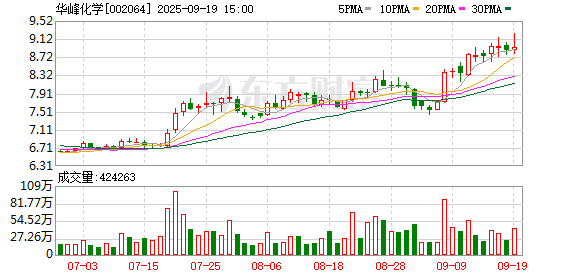
Group 1 - The core viewpoint of the articles highlights the recent performance and financial status of Huafeng Chemical, including stock price movements and financial results [1][2][3] - As of September 26, Huafeng Chemical's stock price increased by 2.03% to 9.05 CNY per share, with a total market capitalization of 44.91 billion CNY [1] - The company has seen a year-to-date stock price increase of 12.70%, with significant gains over various trading periods: 1.34% over the last 5 days, 12.56% over the last 20 days, and 34.67% over the last 60 days [1] Group 2 - For the first half of 2025, Huafeng Chemical reported a revenue of 12.14 billion CNY, a year-on-year decrease of 11.70%, and a net profit attributable to shareholders of 983 million CNY, down 35.23% year-on-year [2] - The company has distributed a total of 4.88 billion CNY in dividends since its A-share listing, with 2.23 billion CNY distributed in the last three years [3] - As of June 30, 2025, the number of shareholders increased by 12.04% to 65,100, while the average circulating shares per person decreased by 10.81% to 75,999 shares [2][3]

反内卷深度报告:反内卷,化工从“吞金兽”到“摇钱树”
2025-09-26 02:29
Summary of Key Points from the Conference Call Industry Overview - The report focuses on the **Chinese chemical industry** and its transition from a "cash-consuming beast" to a "cash-generating tree" due to reduced capital expansion and strong operating cash flow [1][13]. Core Insights and Arguments - **Capital Expansion Trends**: The capital expenditure in the basic chemical industry is decreasing, with the proportion of construction projects to fixed assets declining. This trend is expected to continue, leading to positive free cash flow over the next five years [1][4][5]. - **Cash Flow and Dividends**: The petrochemical sector has turned positive in operating cash flow, with a potential dividend yield exceeding 10% by 2027 for some companies if 70% of cash flow is allocated to dividends [1][9]. - **Cost Advantages**: Chinese chemical companies benefit from lower energy and labor costs compared to European counterparts, which face high production costs and low capacity utilization [1][10]. - **Impact of Anti-Overexpansion Policies**: The anti-overexpansion policies are expected to limit capital expansion but will enhance free cash flow and dividend-paying capacity, improving the investment value of leading companies [1][13][14]. Important but Overlooked Content - **Sector-Specific Insights**: - The chromium salt industry is expected to see strong demand growth due to increased orders from gas turbines and military applications, while supply is constrained by environmental regulations [2][42]. - The coal chemical sector is experiencing a recovery in profitability due to rising global energy prices and improved demand, despite being at historical low price levels [15][18]. - The refrigerant market is projected to grow due to rising demand and supply constraints, particularly for R32 and automotive refrigerants [44]. - **Future Trends**: The report anticipates a significant upward trend for leading companies in the chemical sector, driven by improved profitability and valuation as the industry undergoes capacity clearing [14][41]. Conclusion - The Chinese chemical industry is poised for a recovery phase, with strong cash flow generation and potential for high dividend yields, particularly for leading firms. The anti-overexpansion policies, while restrictive, may ultimately enhance the industry's long-term health and investment attractiveness [1][13][14].
专家分享:氨纶行业现状与展望
2025-09-26 02:28
Summary of the Spandex Industry Conference Call Industry Overview - The spandex industry is currently facing overcapacity, with an expected addition of approximately 700,000 tons from 2021 to 2025, while demand growth has not kept pace, leading to prices dropping to historical lows below 5,000 yuan compared to pre-supply-side reform levels in 2016 [1][3][20] - Global spandex capacity is projected to grow at an average rate of nearly 10% during the 14th Five-Year Plan, reaching 1.93 million tons by the end of 2025, with China accounting for 80% of global supply [1][4] - The industry concentration has significantly increased to 79%-80%, although competition remains fierce [1][6] Key Insights and Arguments - The spandex industry's cash flow is marginally declining, currently operating below the breakeven line [1] - In 2022, the industry's operating rate was the lowest in recent years at 76%, with a slight recovery to around 81% in the first eight months of 2025 [1][9] - Average inventory levels have decreased from approximately 50 days to about 45 days, but the destocking process is slow [10][22] - The expected spandex production for 2025 is 1.1 million tons, representing a year-on-year growth of about 5% [11] Demand Trends - Demand for spandex is projected to show slight growth during the 14th Five-Year Plan, with a forecasted decline to around 8% in 2025, driven mainly by products like masks, protective clothing, and homewear [12] - The export volume of spandex increased by 10.3% year-on-year to 56,000 tons in the first eight months of 2025, although the average export price has decreased [17] Price Dynamics - Spandex prices have fallen from a peak of 78,500 yuan per ton in August 2021 to approximately 23,000 yuan per ton, which is only one-third of the peak price [2] - The price of spandex is currently at historical lows, with significant fluctuations observed due to market conditions and supply-demand imbalances [20] Capacity Expansion and Competition - Major companies like Huafeng Chemical and Xiaoxin are actively expanding their capacities, with Huafeng adding 30,000 tons in the first half of 2025 and planning further expansions [5][23] - The industry is seeing a trend towards vertical integration, with many spandex manufacturers extending into upstream production areas like BDO [25][26] Challenges and Risks - The industry is experiencing a significant number of companies facing financial difficulties, leading to production halts and potential exits from the market [31][33] - The competition for market share is intense, with companies often resorting to pricing strategies to attract new customers [8] Future Outlook - The spandex industry is expected to face continued challenges with overcapacity and fluctuating demand, leading to a cautious outlook for future growth [27] - The anticipated production capacity growth rate is expected to slow down to around 5% during the 15th Five-Year Plan, with potential for further consolidation in the industry [28] Conclusion - The spandex industry is at a critical juncture, with significant overcapacity, declining prices, and intense competition. Companies must navigate these challenges while seeking opportunities for growth through innovation and strategic expansions.
基础化工行业周报:美联储降息落地,丙烯酸、醋酸等涨幅居前-20250923
Shanghai Securities· 2025-09-23 12:31
Investment Rating - The report maintains an "Overweight" rating for the basic chemical industry [1][8]. Core Viewpoints - The Federal Reserve's recent interest rate cut is expected to boost commodity prices, which may enhance the market sentiment for bulk chemicals [3]. - The basic chemical index underperformed the CSI 300 index by 0.89 percentage points, with a decline of 1.33% over the past week [1][13]. - Key sub-industries showing positive performance include food and feed additives (2.99%), civil explosives (2.96%), and rubber additives (2.41%) [1][14]. Market Trends - The basic chemical index decreased by 1.33% from September 13 to September 19, while the CSI 300 index fell by 0.44% [1][13]. - The top-performing sub-industries during this period were food and feed additives, civil explosives, rubber additives, spandex, and adhesives [1][14]. Chemical Price Trends - The top five products with the highest weekly price increases were liquid chlorine (40.00%), acrylic acid (4.17%), aniline (3.30%), acetic acid (3.17%), and washing oil (2.86%) [2][21]. - Conversely, the products with the largest price declines included hydrochloric acid (Shandong) (-100.00%), domestic vitamin E (-8.77%), and epoxy chloropropane (-5.32%) [2][21]. Industry Dynamics - The Federal Reserve cut the federal funds rate target range from 4.25%-4.50% to 4.0%-4.25%, marking the first rate cut in 2025 [3]. - The report indicates that the current economic activity in the U.S. is slowing down, with employment growth also decelerating [3]. Investment Recommendations - The report suggests focusing on several key sectors: refrigerants, chemical fibers, tire manufacturing, agricultural chemicals, and high-quality growth stocks [8][43]. - Specific companies to watch include Jinshi Resources, Juhua Co., and Wanhu Chemical among others [8][43].
化工反转的起点:从配置到集中,未来哪些板块有望跑出超额
2025-09-22 01:00
Summary of Chemical Industry Conference Call Industry Overview - The chemical sector is experiencing a reversal driven by multiple factors, including the elimination of outdated capacity, control of new supply, initiation of inventory cycles, and steepening cost curves [1][5][21]. - The chemical industry is currently at a low point in price spread data, with profit margins at historical lows, but signs of recovery are emerging as net profit margins have increased from 4.4% in 2024 to 5.8% in the first half of 2025 [1][6]. Key Insights - **Reversal Timing**: The current reversal point for the chemical sector is supported by domestic policy changes and the end of a three-year deep destocking cycle overseas. A significant upturn in the Producer Price Index (PPI) is expected in 2-3 quarters [3][13]. - **Capital Expenditure Trends**: Capital expenditure in the chemical industry is showing a contraction, with fixed asset investment turning negative in the second half of 2025. This trend typically precedes a recovery in PPI [4][12]. - **Cash Flow Stability**: Despite declining profits, leading companies maintain stable operating cash flows, with a cash flow-to-market value ratio of approximately 7.9%, indicating good value [6]. Global Competitive Landscape - Chinese companies have a significantly higher Return on Assets (ROA) compared to 2015 cycle lows and overseas competitors, with China accounting for 43% of global production [7]. - The shift of European energy supply to American LNG has drastically increased natural gas costs, impacting the European chemical industry, particularly in basic chemicals and polymers [8]. Challenges and Opportunities - The European fine chemical sector faces potential market share declines due to supply chain disruptions and the relocation of manufacturing industries to China [10]. - The chemical industry is expected to see varying growth rates across different product categories, with oil and coal chemical products projected to grow faster than phosphorus, fluorine, and silicon products [11]. Investment Strategies - **Stock Selection**: Investors are advised to focus on cyclical stocks with strong recovery potential, such as Wanhua Chemical and Tongkun Group, which may benefit from market cycle shifts [27][30]. - **Market Dynamics**: The relationship between PPI turning points and excess returns in the chemical sector suggests that early positioning can yield significant benefits [14][19]. - **Long-term Growth**: Companies like Juhua Co., Sailun Tire, and Kingfa Sci. & Tech. are highlighted for their long-term growth potential due to their competitive advantages and market positioning [36][40]. Conclusion - The chemical industry is on the cusp of a significant turnaround, driven by structural changes and market dynamics. Investors should remain vigilant for opportunities in leading companies that are well-positioned to capitalize on these trends while being mindful of the challenges posed by global competition and supply chain shifts.
展望三季报,周期的价值发现
2025-09-22 00:59
Summary of Key Points from Conference Call Records Industry Overview - **Chinese Economy and A-Share Market**: The Chinese economy is expected to stabilize, with A-share listed companies' revenue and inventory stabilizing for two consecutive quarters, significantly reducing risk probabilities. New emerging industries are entering a new capital expenditure expansion cycle, benefiting overall valuation recovery [1][5][2]. Core Insights and Arguments - **Capital Market Reforms**: Accelerated release of capital market reform dividends, with the launch of the growth tier on the Sci-Tech Innovation Board and the upcoming targeted issuance standards. The meeting between China and the US leaders stabilizes short-term risk outlook, while the US dollar and overseas interest rate cuts favor China's overall easing policy and the central bank's resumption of government bond trading [1][4][3]. - **Investment Recommendations**: - Emerging technology remains the main investment line, recommending sectors such as the internet, electronic semiconductors, innovative pharmaceuticals, robotics, and media. - Suggested increasing allocations in cyclical and financial sectors, focusing on brokers, insurance, and banks with potential for higher dividend returns, as well as non-ferrous metals, chemicals, real estate, and new energy sectors benefiting from improved supply-demand dynamics [1][6]. - **Aviation Industry Outlook**: The aviation industry's profit center is expected to rise over the next two years, with Q3 performance likely to exceed expectations. A significant reduction in losses is anticipated in Q4, with business travel demand recovery potentially initiating a super cycle in aviation [7][8]. - **Oil Shipping Market**: The TCE rate for VLOC has reached a 30-month high, driven by geopolitical oil prices and increased production from Iran. The demand for compliant VLCC transportation is expected to grow due to increased production in South America and the Middle East, alongside US sanctions. The supply-demand balance is projected to remain stable and favorable over the next 1-2 years [9]. - **Express Delivery Industry**: The express delivery sector is experiencing a recovery in profitability as competition eases due to regulatory measures. Recommendations include companies like SF Express, ZTO Express, and YTO Express, with future profitability dependent on price increases and regulatory effectiveness [10]. Additional Important Insights - **Coal Industry Dynamics**: The coal sector has seen a significant rebound in prices due to supply-side contractions and demand-side replenishment. The price of thermal coal has risen sharply, with expectations of continued demand growth driven by AI and extreme weather conditions [25][26]. - **Steel Industry Trends**: The steel demand is entering a traditional peak season, with slight increases in consumption. The supply side is also tightening, with production cuts expected to support price recovery. Recommendations include focusing on leading companies in the sector [31][32][33]. - **Chemical Industry Challenges**: The chemical industry faces short-term pressures due to low price indices, but medium to long-term prospects are improving as new capacity pressures decrease and capital expenditures decline starting in 2024 [18][19]. - **Energy Sector Opportunities**: In the energy sector, companies like CNOOC and PetroChina are highlighted for their stable performance and high dividend yields, particularly in the context of ongoing reforms and market conditions [16][20]. - **Construction and Real Estate**: The construction sector is expected to benefit from macroeconomic policies aimed at debt resolution, with companies like China State Construction and Sichuan Road & Bridge recommended for their high dividend yields [41][44]. This summary encapsulates the key insights and recommendations from the conference call records, providing a comprehensive overview of the current market landscape and future expectations across various industries.
2025年1-5月中国合成纤维产量为3219万吨 累计增长5.5%
Chan Ye Xin Xi Wang· 2025-09-21 02:13
Group 1 - The core viewpoint of the article highlights the growth trend in China's synthetic fiber industry, with a projected production of 6.78 million tons in May 2025, reflecting a year-on-year increase of 5.5% [1] - From January to May 2025, the cumulative production of synthetic fibers in China reached 32.19 million tons, also showing a cumulative growth of 5.5% [1] - The data is sourced from the National Bureau of Statistics and compiled by Zhiyan Consulting, indicating a robust market outlook for the synthetic fiber sector in the coming years [1] Group 2 - The article lists several publicly listed companies in the synthetic fiber industry, including Hengyi Petrochemical, Rongsheng Petrochemical, and Xin Fengming, among others [1] - Zhiyan Consulting is identified as a leading industry consulting firm in China, specializing in in-depth industry research reports and providing comprehensive consulting services for investment decisions [1]


华峰化学:选举李娟女士为公司第九届董事会职工代表董事
Zheng Quan Ri Bao· 2025-09-19 15:44
Group 1 - The company announced that it will hold its second employee representative assembly on September 19, 2025 [2] - Li Juan has been elected as the employee representative director for the company's ninth board of directors [2]
华峰化学(002064) - 关于董事辞职暨选举职工代表董事的公告
2025-09-19 09:30
公司于 2025 年 9 月 19 日召开公司 2025 年第二次职工代表大会,选举李娟 女士(简历附后)为公司第九届董事会职工代表董事,任期自公司职工代表大会 选举通过之日起至公司第九届董事会任期届满之日止。 一、董事辞职情况 近日,因公司治理结构优化需要,华峰化学股份有限公司(以下简称"公司") 董事、董事会秘书李亿伦女士,申请辞去公司董事职务,辞去上述职务后将继续 担任公司董事会秘书之职。李亿伦女士的辞职不会导致公司董事会成员低于法定 最低人数,不会影响公司董事会正常运行,亦不会对公司正常经营产生不利影响, 其辞职自公司董事会收到辞职报告之日起生效。 截至本公告披露日,李亿伦女士持有公司股份 8,700 股,李亿伦女士将继续 遵守《深圳证券交易所上市公司自律监管指引第 10 号——股份变动管理》等法 律法规相关规定。 李亿伦女士在担任公司董事期间恪尽职守、勤勉尽责,公司及董事会对李亿 伦女士在任职期间所作的辛勤工作和突出贡献表示衷心感谢! 二、选举职工代表董事的情况 根据《中华人民共和国公司法》《深圳证券交易所股票上市规则》及《公司 章程》等相关规定,公司董事会设职工代表董事一名。 证券代码:00206 ...
华峰化学股份有限公司2025年第二次临时股东大会决议公告
Zheng Quan Shi Bao· 2025-09-18 17:54
Meeting Overview - The second extraordinary general meeting of shareholders for Huafeng Chemical Co., Ltd. was convened by the ninth board of directors on September 18, 2025, at 15:00 in Ruian, Zhejiang Province [2] - The meeting was conducted both in-person and via online voting, with specific time slots allocated for each voting method [2] Attendance and Voting - A total of 411 shareholders participated in the voting, representing 3,572,538,359 shares, which accounts for 71.9901% of the total voting shares [3] - Among these, 8 shareholders voted in person, representing 368,070,512 shares (7.4170%), while 403 shareholders voted online, representing 3,204,467,847 shares (64.5731%) [3] Minority Shareholder Participation - 404 minority shareholders participated, representing 285,124,232 shares, which is 5.7455% of the total voting shares [4] - Of these, 5 minority shareholders voted in person, representing 40,893,200 shares (0.8240%), and 399 voted online, representing 244,231,032 shares (4.9215%) [4] Proposal Review Amendment of Articles of Association - The proposal to amend the Articles of Association was approved with 3,571,075,059 shares in favor (99.9590%), 1,397,300 shares against (0.0391%), and 66,000 shares abstaining (0.0018%) [5] - Minority shareholders voted 283,660,932 shares in favor (99.4868%), 1,397,300 shares against (0.4901%), and 66,000 shares abstaining (0.0231%) [6] Shareholders' Meeting Rules - The proposal to amend the Shareholders' Meeting Rules was approved with 3,522,307,209 shares in favor (98.5940%), 50,137,250 shares against (1.4034%), and 93,900 shares abstaining (0.0026%) [8] - Minority shareholders voted 234,893,082 shares in favor (82.3827%), 50,137,250 shares against (17.5844%), and 93,900 shares abstaining (0.0329%) [10] Board Meeting Rules - The proposal to amend the Board Meeting Rules was approved with 3,522,103,384 shares in favor (98.5883%), 50,323,875 shares against (1.4086%), and 111,100 shares abstaining (0.0031%) [12] - Minority shareholders voted 234,689,257 shares in favor (82.3112%), 50,323,875 shares against (17.6498%), and 111,100 shares abstaining (0.0390%) [13] Independent Director Work System - The proposal for the Independent Director Work System was approved with 3,504,222,600 shares in favor (98.0878%), 50,157,475 shares against (1.4040%), and 18,158,284 shares abstaining (0.5083%) [15] - Minority shareholders voted 216,808,473 shares in favor (76.0400%), 50,157,475 shares against (17.5914%), and 18,158,284 shares abstaining (6.3686%) [16] Related Party Transaction Decision-Making System - The proposal for the Related Party Transaction Decision-Making System was approved with 3,522,238,909 shares in favor (98.5921%), 50,234,350 shares against (1.4061%), and 65,100 shares abstaining (0.0018%) [17] - Minority shareholders voted 234,824,782 shares in favor (82.3588%), 50,234,350 shares against (17.6184%), and 65,100 shares abstaining (0.0228%) [18] External Guarantee System - The proposal for the External Guarantee System was approved with 3,521,372,489 shares in favor (98.5678%), 50,611,270 shares against (1.4167%), and 554,600 shares abstaining (0.0155%) [19] - Minority shareholders voted 233,958,362 shares in favor (82.0549%), 50,611,270 shares against (17.7506%), and 554,600 shares abstaining (0.1945%) [21] 2025 Interim Profit Distribution Plan - The proposal for the 2025 Interim Profit Distribution Plan was approved with 3,571,471,759 shares in favor (99.9701%), 994,200 shares against (0.0278%), and 72,400 shares abstaining (0.0020%) [22] - Minority shareholders voted 284,057,632 shares in favor (99.6259%), 994,200 shares against (0.3487%), and 72,400 shares abstaining (0.0254%) [23] Legal Opinion - The meeting was witnessed by lawyers from Zhejiang Anyang Law Firm, confirming that the meeting's procedures complied with relevant laws and regulations [24] Documents for Reference - The resolutions from the second extraordinary general meeting of shareholders and the legal opinion from Zhejiang Anyang Law Firm are available for review [25]
