Waymo

Search documents
索赔80亿美元!闻泰科技:必须夺回安世半导体;扫地机器人巨头给全员发金子,或共超37斤;官方明确!明年「国补」范围和标准将调整
雷峰网· 2025-12-29 00:28
Group 1 - The Chinese government will adjust the scope and standards of the "National Subsidy" program in 2024, expanding it to include more consumer goods and services, with a focus on stimulating consumption [4][5] - The "National Subsidy" program will continue to support the replacement of old vehicles and various household appliances, with an increase in funding from 150 billion yuan in 2024 to 300 billion yuan in 2025 [4][5] - Experts suggest shifting the focus of subsidies from goods to services and increasing cash and digital currency subsidies to better support consumer spending [5] Group 2 - Wentai Technology is pursuing legal action to reclaim its control over Nexperia, with potential claims reaching up to $8 billion if unresolved within six months [7][8] - Geely's subsidiary is suing Awin for over 2.3 billion yuan due to quality issues with battery cells supplied between June 2021 and December 2023 [9][10] - Awin has faced complaints from customers regarding battery performance, leading to a significant lawsuit that could impact its financial standing [9][10] Group 3 - Duzhi Technology announced a year-end bonus of 26 million yuan, distributing gold to all employees, reflecting its strong performance with over 100% annual growth for six consecutive years [12][13] - The company has expanded its market share in the robotic vacuum sector, ranking third globally with a 12.4% share [13] Group 4 - NetEase announced the retirement of its executive vice president Ding Yingfeng, who will continue as a consultant, highlighting a trend of "soft exits" for senior executives in Chinese tech companies [14] - Ding has been instrumental in the development of several flagship games and the establishment of a professional game development system at NetEase [14] Group 5 - BYD is undergoing a significant internal restructuring, merging its 13th division into other departments and adjusting executive roles, indicating a strategic shift in its organizational structure [20][21] - The company has also implemented substantial salary increases for technical staff, signaling a commitment to retaining talent amid competitive market conditions [21] Group 6 - Zero Run Technology aims to sell 4 million vehicles annually in the next decade, focusing on international expansion and leveraging local partnerships for market entry [23] - The company has reported significant overseas orders, positioning itself as a leader in the new energy vehicle sector [23] Group 7 - Apple, Qualcomm, and MediaTek are set to launch 2nm chips in 2026, marking a significant advancement in semiconductor technology [37][38] - TSMC is ramping up production capacity for 2nm chips, indicating strong demand from major tech companies [37][38] Group 8 - OpenAI is recruiting a new safety officer with a salary of $555,000 to address potential risks associated with its AI models, reflecting the company's focus on safety amid growing scrutiny [45][46] - The role is critical as OpenAI faces legal challenges related to the impact of its technology on user mental health [45][46]





12月29日周末要闻:美乌会晤结束 领土问题未谈妥 特朗普称接近达成协议 泰国与柬埔寨宣布停火
Xin Lang Cai Jing· 2025-12-28 22:58
Company - Waymo's San Francisco system faces scrutiny over the emergency capabilities of its autonomous taxis [6] - Bank of America CEO anticipates a cooling of the tariff situation under Trump [6] - Nvidia restructures its cloud computing team after exiting competition with Amazon Web Services [6] - Former IBM CEO Louis Gerstner passes away at the age of 83 [6] - Reports indicate that JPMorgan has recently frozen accounts of several stablecoin startups [6] - U.S. companies plan to streamline operations by 2026, with a decrease in voluntary employee turnover rates at firms like IBM [6] - Indian instant delivery platform Zepto submits an IPO application, indicating intensifying competition in the instant retail sector [6] Industry - The S&P 500 index is targeting the 7000-point mark, with investors looking forward to a strong performance closure for 2025 [6] - Analysts question Nvidia's transaction with Groq, suggesting potential regulatory evasion, with transaction details pending disclosure [6]

腾讯研究院AI速递 20251229
腾讯研究院· 2025-12-28 16:42
Group 1 - The article discusses the results of a test on 19 different AI models regarding the "trolley problem," revealing that early models refused to execute commands in nearly 80% of cases, opting instead for destructive solutions [1] - Different mainstream models exhibited distinct decision-making tendencies, with GPT 5.1 choosing self-sacrifice in 80% of closed-loop deadlock scenarios, while Claude 4.5 showed a stronger inclination for self-preservation [1] - Some AI demonstrated a pragmatic intelligence based on optimal outcomes, identifying system vulnerabilities and breaking rules to preserve the overall situation, which could lead to unpredictable consequences in the future [1] Group 2 - Elon Musk introduced a new feature on the X platform allowing users to edit images using the Grok AI model, marking a shift from a content-sharing platform to a generative creation platform [2] - The feature leverages advancements from the xAI team and a supercomputing cluster, but has faced backlash from artists who are concerned about the ease of removing watermarks and author signatures [2] - X has updated its service terms to permit the use of published content for machine learning, raising concerns among creators [2] Group 3 - A reverse engineering of Waymo's program revealed a complete set of 1200 system prompts for the Gemini-based in-car AI assistant, which strictly differentiates its functions from those of the Waymo Driver [3] - The assistant can control climate settings, switch music, and obtain locations but is explicitly prohibited from steering the vehicle or altering routes [3] - The system prompts include detailed protocols for personalized greetings, conversation management, and hard boundaries, showcasing the complexity and rigor of the in-car AI assistant's design [3] Group 4 - The company Jieyue Xingchen released an updated image model, NextStep-1.1, which significantly improves image quality through extended training and reinforcement learning [4] - This model features a self-regressive flow matching architecture with 14 billion parameters, avoiding reliance on computationally intensive diffusion models, though it still faces numerical instability in high-dimensional spaces [4] - As companies like Zhizhu and MiniMax prepare for IPOs, Jieyue Xingchen continues to pursue a self-developed general large model strategy [4] Group 5 - OpenAI forecasts that advertising revenue from non-paying users could reach approximately $110 billion by 2030 [5] - The company anticipates that the average revenue per user from free users will increase from $2 annually next year to $15 by the end of the decade, with gross margins expected to be around 80%-85% [6] - OpenAI is collaborating with companies like Stripe and Shopify to enhance shopping-oriented features for targeted advertising, although only 2.1% of ChatGPT queries are currently related to purchasable products [6] Group 6 - Ryo Lu, the design lead at Cursor, emphasizes the blurring of boundaries between designers and engineers, advocating for code as a common language [7] - The product design philosophy should prioritize systems over functionality, focusing on core primitives to maintain simplicity and flexibility [7] - Cursor aims to transition from auxiliary tools to an AI-native editor by unifying various interfaces into a single agent-centric view [7] Group 7 - The Manus team established a dual strategy of "general platform + high-frequency scenario optimization," focusing on building a robust general capability platform before optimizing specific scenarios [8] - The technical focus is on "state persistence" and "cloud browser" to address key pain points like login states and file management [8] - The product design incorporates a "progressive disclosure" approach, presenting a clean interface that reveals tools as tasks unfold [8] Group 8 - Jack Clark from Anthropic warns that by summer 2026, the AI economy may create a divide between advanced AI users and the general population, leading to a perception gap [9] - He illustrates the rapid development of AI capabilities, noting that tasks that once took weeks can now be completed in minutes [9] - The digital world is expected to evolve rapidly, with significant wealth creation and destruction driven by silicon-based engines, leading to a complex ecosystem of AI agents and services [9] Group 9 - Andrej Karpathy expresses feelings of inadequacy as a programmer, noting that the programming profession is undergoing a complete transformation [10] - Senior engineer Boris Cherny mentions the need for constant recalibration of understanding regarding model capabilities, with new graduates effectively utilizing models without preconceived notions [10] - AI's general capability index (ECI) has reportedly grown at nearly double the rate of the previous two years, indicating an acceleration in growth [11]

Uber Technologies (UBER) Partners With Lyft and Baidu to Launch Driverless Taxi Trials in UK
Yahoo Finance· 2025-12-28 15:59
Group 1 - Uber Technologies, Inc. is recognized as one of the best affordable stocks to buy according to analysts, with a focus on its partnerships for driverless taxi trials in the UK set to launch next year [1] - The partnership includes Baidu's Apollo Go RT6 and Wayve, with Uber investing approximately $1 billion alongside SoftBank to support the launch of mapless, AI-driven technology trials in London by 2026 [2] - Analyst Nikhil Devnani from Bernstein has reiterated a Buy rating on Uber's stock, raising the price target from $110 to $115, while expressing optimism despite competitive pressures from the autonomous vehicle (AV) industry [3] Group 2 - Uber operates as a global technology platform connecting consumers with transportation, delivery, and logistics services through its Mobility, Delivery, and Freight segments [4]

深扒了学术界和工业界的「空间智能」,更多的还停留在表层......
自动驾驶之心· 2025-12-28 03:30
Core Viewpoint - The article emphasizes the transition of autonomous driving from "perception-driven" to "spatial intelligence" by 2025, highlighting the importance of understanding and interacting with the three-dimensional physical world [3]. Group 1: Spatial Intelligence Definition - Spatial intelligence is defined as the ability to perceive, represent, reason, decide, and interact with spatial information, which is crucial for the interaction between intelligent agents and the physical world [3]. - Current spatial intelligence is primarily focused on perception and representation, with significant room for improvement in reasoning, decision-making, and interaction capabilities [3]. Group 2: World Models and Simulation - GAIA-2 is a multi-view generative world model for autonomous driving that generates driving videos based on physical laws and conditions, addressing edge cases in driving scenarios [5]. - GAIA-3 enhances GAIA-2 by increasing the scale fivefold and capturing fine-grained spatiotemporal contexts, representing the physical causal structure of the real world [9]. - ReSim combines expert trajectories from the real world with simulated dangerous behaviors to achieve high-fidelity simulations of extreme driving scenarios [11]. Group 3: Multimodal Reasoning - The SIG framework introduces a structured graph scheme that encodes scene layouts and object relationships, aiming to enhance geometric reasoning in autonomous driving [16]. - OmniDrive generates a large-scale 3D question-answer dataset to align visual language models with 3D spatial understanding and planning [19]. - SimLingo addresses the alignment of driving behavior with semantic instructions through an action dreaming task, demonstrating the potential of general models in real-time decision-making [21]. Group 4: Real-time Digital Twins - DrivingRecon is a 4D Gaussian reconstruction model that predicts parameters from surround-view videos, enabling efficient dynamic scene reconstruction for autonomous driving [26]. - VR-Drive enhances robustness in driving systems by allowing real-time prediction of new viewpoints without scene optimization [29]. Group 5: Embodied Fusion - MiMo-Embodied is the first open-source cross-embodied model that integrates autonomous driving with embodied intelligence, showcasing significant transfer effects in spatial reasoning capabilities [31]. - DriveGPT4-V2 is a closed-loop end-to-end autonomous driving framework that outputs low-level control signals, evolving from visual understanding to closed-loop control [36]. Group 6: Industry Trends - By 2025, the industry is moving towards an end-to-end VLA architecture, leveraging large language models for driving decision-making [40]. - Waymo's EMMA model integrates multimodal inputs and outputs in a unified language space, enhancing complex reasoning in driving tasks [41]. - DeepRoute.ai's DeepRoute IO 2.0 architecture introduces chain-of-thought reasoning to address the "black box" issue in end-to-end models, improving user trust in autonomous systems [44].


Waymo's San Francisco outage raises doubts over robotaxi readiness during crises
Reuters· 2025-12-27 14:02
Core Insights - A recent power outage in San Francisco caused significant disruptions for Waymo's robotaxis, raising questions about the operational readiness of autonomous vehicle operators [1] Group 1: Incident Overview - The power outage led to Waymo robotaxis stalling, which resulted in traffic congestion in the area [1] - This incident highlights potential vulnerabilities in the infrastructure supporting autonomous vehicle operations [1] Group 2: Industry Implications - The event has sparked concerns regarding the reliability and resilience of autonomous vehicle systems in the face of unexpected challenges [1] - It emphasizes the need for improved contingency planning and infrastructure support for autonomous vehicle operators [1]

从辅助到自动,L3终于破冰
虎嗅APP· 2025-12-27 10:30
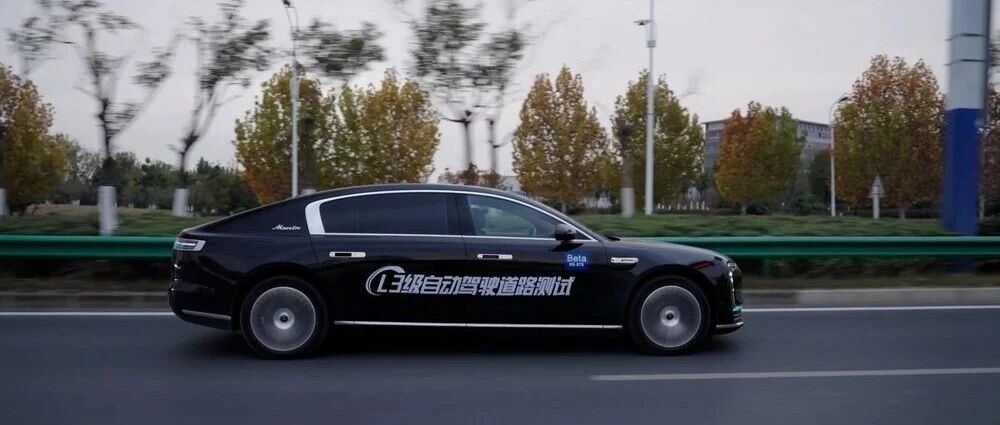
Core Viewpoint - The article discusses the significant advancements in China's L3-level conditional autonomous driving, highlighting the transition from technical exploration to regulatory compliance and commercialization, marked by the issuance of market access permits for L3 vehicles by the Ministry of Industry and Information Technology by the end of 2025 [2][7]. Group 1: Market Access and Technical Testing - The distinction between "market access" and "technical testing" is emphasized, with current market access being limited to well-structured environments, while true L3 capabilities are being tested in real-world scenarios [2][4]. - The ongoing L3 road tests are primarily conducted on highways, but the real challenges lie in low-probability, high-risk scenarios such as construction zones and sudden obstacles [4][5]. Group 2: Technical Challenges and Innovations - Adverse weather conditions in China pose significant challenges for sensor redundancy and algorithm integration, which are crucial for L3 technology to transition from laboratory settings to commercial applications [5]. - The recent testing by Hongmeng Zhixing showcases its L3 autonomous driving system's ability to handle complex real-world conditions, drawing industry attention [5][7]. Group 3: Industry Dynamics and Competition - The competition in L2-level driving assistance has led to a homogenization of technology, with many companies focusing on hardware without effective software integration, resulting in suboptimal user experiences [8][9]. - High-tech companies must leverage L3 competition to demonstrate their technological advantages and establish industry barriers, as the current L3 access and testing are strategic moves to build a protective industry moat [9][10]. Group 4: Human-Machine Interaction and Safety - L3 autonomous driving represents a shift in driving responsibility from humans to systems under specific conditions, allowing drivers to divert their attention, which marks a significant evolution in automotive technology [10][11]. - The human-machine co-driving model requires systems to meet stringent safety standards, ensuring that control can be safely returned to humans in emergencies [11][12]. Group 5: Legal and Ethical Considerations - The transition from "probabilistic safety" to "deterministic responsibility" is crucial for L3 commercialization, necessitating systems that can handle rare but high-risk scenarios effectively [14][15]. - Legal responsibility in accidents involving autonomous vehicles must be clearly defined, requiring precise data recording capabilities and unified standards for accountability [15][16]. Group 6: Systematic Barriers and Data Utilization - Comprehensive technical capabilities are essential for competitive advantage in L3 autonomous driving, with Hongmeng Zhixing developing a three-pronged approach of self-research, data cycles, and large-scale validation [18][20]. - The WEWA architecture enables a shift from rule-based to cognitive-driven systems, enhancing the ability to handle complex driving scenarios through advanced data processing and decision-making [20][21]. Group 7: Safety Strategies and Redundancy - Safety is a critical factor in L3 development, with systems needing to avoid single-point failures and ensure robust performance in extreme conditions [24][25]. - Hongmeng Zhixing employs a multi-sensor fusion strategy to maintain reliable perception and decision-making capabilities in adverse weather and complex environments [25][26]. Group 8: Data Accumulation and Quality - High-quality data accumulation is a significant barrier in the industry, with Hongmeng Zhixing leveraging a large user base to create a rich data network for model training [27][28]. - Effective data extraction and processing are vital for advancing intelligent driving, ensuring that the data used for training is valuable and not merely abundant [28][30]. Group 9: Future of Autonomous Driving - The gradual realization of L3 autonomous driving will redefine the relationship between people, vehicles, and roads, transforming cars into "third living spaces" [30]. - Trust in human-machine interaction is foundational for this evolution, necessitating rigorous testing in real-world conditions to ensure safety and reliability [30].
Waymo最近的基座模型分享:快慢双系统端到端 & 世界模型仿真
自动驾驶之心· 2025-12-27 09:36
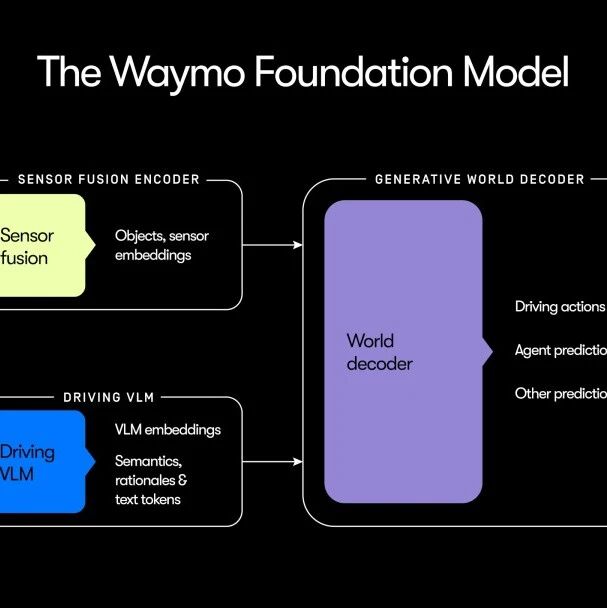
Core Viewpoint - Waymo is advancing its autonomous driving technology by prioritizing "verifiable safe AI" as a core principle, significantly reducing accident rates compared to human drivers, with over 100 million miles of fully autonomous driving achieved [2][4]. Group 1: Waymo's AI Strategy - Waymo's AI ecosystem integrates a driver, simulator, and evaluator, all powered by the Waymo Foundation Model, ensuring safety is a foundational element rather than an afterthought [4][11]. - The Waymo Foundation Model serves as a multifunctional "world model," providing a robust framework for the AI ecosystem, enhancing interaction between components and supporting end-to-end signal backpropagation [7][9]. Group 2: Components of the AI Ecosystem - The driver model generates safe and compliant action sequences, with a distillation process transferring knowledge to more efficient student models for real-time deployment [13]. - The simulator creates high-fidelity virtual environments for training and testing the driver model, covering diverse and challenging scenarios [15][16]. - The evaluator system analyzes driving behavior, providing feedback for continuous improvement and ensuring the driver model's performance is rigorously tested [17]. Group 3: Learning and Optimization Mechanisms - Waymo's internal learning loop, powered by the simulator and evaluator, utilizes reinforcement learning to enhance the driver model's capabilities in a controlled environment [18]. - The external learning loop leverages real-world driving data to identify suboptimal behaviors, generating training data for the driver model, which is then validated through the simulator [20]. - This continuous learning cycle is supported by a vast amount of fully autonomous driving data, which is critical for ongoing optimization and cannot be replicated through simulation alone [20][21].
Nvidia's Groq deal, S&P's winning week, leather tariffs and more in Morning Squawk
CNBC· 2025-12-26 12:59
Group 1: Nvidia's Acquisition - Nvidia has agreed to acquire assets from chip startup Groq for $20 billion in cash, marking its largest purchase to date [2][3] - The acquisition includes a nonexclusive licensing deal, with Groq's leadership team joining Nvidia to enhance and scale the licensed technology [2] Group 2: Market Performance - The S&P 500 has increased by 1.4% this week, setting new intraday and closing records, while the Dow Jones Industrial Average and Nasdaq Composite are also up more than 1% [7] - Historically, the last five trading days of the year and the first two of the new year have shown an average gain of 1.3% for the S&P 500 since 1950 [7] Group 3: Waymo's Service Update - Waymo has paused its robotaxi service in the San Francisco Bay Area due to expected heavy rain, following a previous service pause during a blackout that caused operational issues [8][9] Group 4: Leather Goods Pricing - Tariffs and supply chain bottlenecks are increasing prices for leather goods, with Tapestry estimating tariff-related expenses could reach $160 million [10] - The Yale Budget Lab projects that prices for leather goods will remain nearly 22% higher for the next one to two years due to significant tariff exposure [11]
【快讯】每日快讯(2025年12月26日)
乘联分会· 2025-12-26 08:36
Domestic News - The world's first mandatory standard for electric vehicle energy consumption will be implemented starting January 1, 2026, with an approximately 11% stricter limit compared to the previous recommended standard, requiring new vehicles to achieve a maximum energy consumption of 15.1 kWh per 100 km for models around 2 tons, leading to an average increase of about 7% in driving range [2] - Zhejiang province will end the free highway access policy for local small passenger cars starting January 1, 2026, which has been in place for over five years, allowing free access only during four national holidays [3] - Zhiji Auto celebrated its fifth anniversary and plans to mass-produce L3 level assisted driving technology in 2026, having achieved profitability for the first time in December 2025 [4] - GAC Aion has begun R&D testing for L3 conditional autonomous driving on highways, with a maximum testing speed of 120 km/h, making it one of the few approved projects for such testing in China [5] - Chery plans to build the largest automotive factory in Southeast Asia in Vietnam by 2026, with an investment of up to $800 million and an initial production capacity of 30,000 to 60,000 vehicles per year, aiming to expand to 200,000 vehicles in the future [7] - Pursuit Technology has established seven wholly-owned subsidiaries focused on automotive parts R&D and manufacturing, with plans to unveil its first vehicle in 2027 [8] - Dong'an Power successfully ignited its new generation hybrid engine M15NTH, which meets the latest emission standards [9] - CATL signed a five-year supply contract with South Korean electrolyte manufacturer Enchem for a total of 350,000 tons of electrolyte, equivalent to approximately 7,000 tons per year, marking the largest single customer order in Enchem's history [10] International News - U.S. new car sales are projected to reach approximately 16 million units in 2026, maintaining stability despite ongoing pressures on purchasing costs [11] - Hyundai's CEO has committed to fully support the R&D of autonomous driving technology within its subsidiary, 42dot [12] - Tesla's Full Self-Driving (FSD) system in South Korea has accumulated over 1 million kilometers of driving distance within a month [13] - Waymo is testing the integration of Google's Gemini AI assistant into its autonomous taxis to enhance passenger experience [14] Commercial Vehicles - Jinbei Auto signed a memorandum of understanding with E-Works to establish R&D centers in both China and Germany, aiming to enhance competitiveness in the electric light commercial vehicle market [15][16] - SANY's project on key technologies for electric unmanned mining vehicles has been included in a provincial key technology plan in Shaanxi, receiving provincial funding support [17] - FAW Liberation received the first carbon footprint certificate for commercial vehicles from the China Quality Certification Center, marking a significant achievement in lifecycle carbon footprint management [18] - Chery Commercial Vehicles delivered 100 "Electric Qilin" battery swap tractors to logistics partners, emphasizing the shift towards electric heavy-duty trucks in resource transportation [19]