同花顺

Search documents
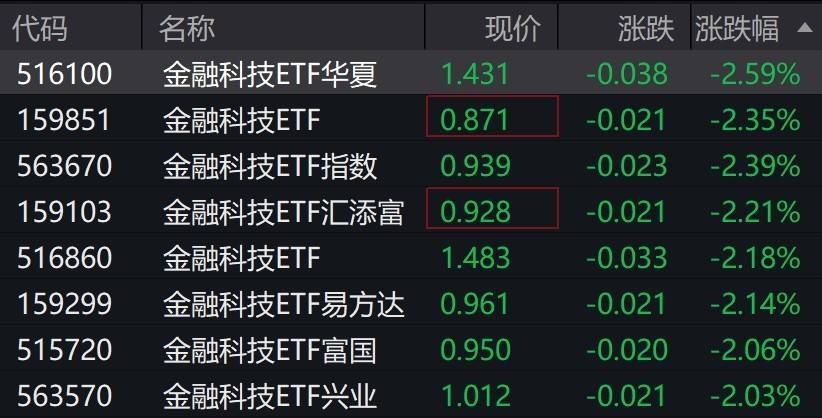
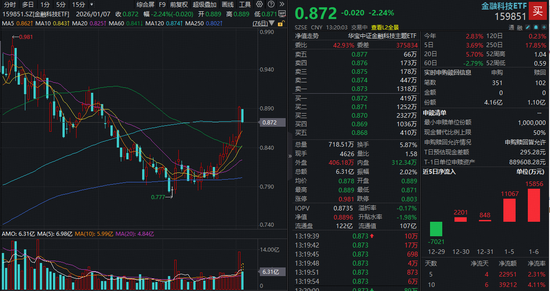
金融科技概念股走弱,金融科技相关ETF跌超2%
Sou Hu Cai Jing· 2026-01-07 06:17
Group 1 - The core viewpoint of the news indicates a decline in fintech concept stocks, with significant drops in companies such as Zhina Zhen and Yinzhijie, which fell over 3%, while Tonghuashun, Dongfang Caifu, and Hengsheng Electronics dropped over 2% [1] - Affected by the adjustment of heavy-weight stocks, fintech-related ETFs experienced a decline of over 2% [1] Group 2 - Specific ETF performance shows that the Huaxia Fintech ETF decreased by 2.59% to 1.431, while the Fintech ETF dropped by 2.35% to 0.871 [2] - Other ETFs also reported declines, with the Fintech ETF Index down 2.39% to 0.939, and the Huizheng Fintech ETF down 2.21% to 0.928 [2] - Institutions suggest that with policy support and a stable macro environment, the financial sector's fundamentals are improving, and the income of financial IT companies is expected to grow gradually [2] - The acceleration of revolutionary stablecoins and the anticipated release of significant financial policies may present investment opportunities in the financial IT sector [2]






高盛坚定看好A股:预计今年仍将实现双位数上涨!
Jin Shi Shu Ju· 2026-01-07 05:53
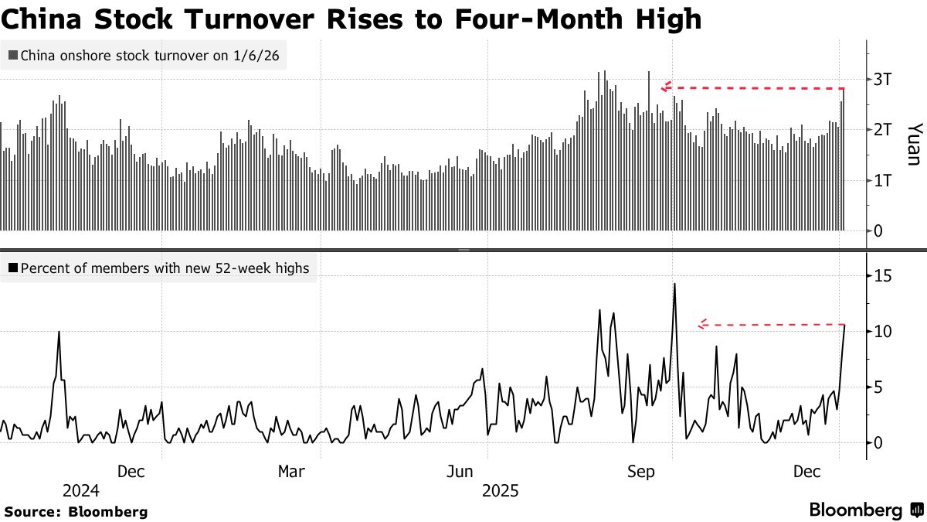
AI播客:换个方式听新闻 下载mp3 策略师们表示:"我们预测2026年股市上涨的动力,几乎完全来自企业盈利增长。"而盈利增长将"由人工智能、'出海'战略以及反内卷相 关政策提供支撑"。 A股单日成交额创4个月新高 高盛策略师预测,2026年内地投资者通过港股通净买入港股的规模有望达到2000亿美元,再创历史纪录。与此同时,海外投资者预计将 调整对中国股市的低配仓位,这或将为市场带来100亿美元的资金流入。 中国股市的上涨势头已强劲延续至新的一年。尽管中国股市2025年已经录得大幅上涨,但高盛仍与其他多家大型机构一道,维持对该市 场的积极展望。这一乐观判断,反映出市场对"盈利扩张、政策扶持、新增增长动能将持续吸引投资者入场"的信心。 2026年开年以来,沪深300指数已累计上涨3.5%,创下四年以来的最高水平;MSCI中国指数涨幅约3.6%,跑赢同期标普500指数。 市场交投热度也印证了投资者的高涨情绪:A股周二单日成交额飙升至2.8万亿元人民币(折合4010亿美元),不仅创下去年9月以来的新 高,还远超过去五年1.13万亿元的日均成交额。投资者融资融券余额同样徘徊在历史高点附近。当日沪深300指数上涨1.6 ...
ETF盘中资讯|日线八连阳后,金融科技ETF(159851)大跌超2%,资金火速申购3亿份!板块当前配置价值有哪些?
Sou Hu Cai Jing· 2026-01-07 05:48
Core Viewpoint - The financial technology sector is experiencing a significant pullback after a strong performance, but there are multiple positive catalysts that suggest potential for future growth and investment opportunities [3]. Group 1: Market Performance - On January 7, the financial technology sector saw a decline after an eight-day rally, with internet brokerage stocks leading the drop, including a more than 6% decrease in Ying Shisheng and over 2% declines in other major firms like Zhinan Zhen and Dongfang Caifu [1]. - The financial technology ETF (159851) experienced a drop of over 2% in the market, but there was a net subscription of over 300 million units, with a trading volume exceeding 600 million yuan [1]. Group 2: Positive Catalysts - A record high in A-share trading volume, surpassing 400 trillion yuan in 2025, is expected to lead to performance releases for internet brokerages in 2025 and the first half of 2026 [3]. - The integration of AI in financial services is creating new growth opportunities, enhancing product value and customer loyalty through applications like smart investment advisory and big data risk control [3]. - The advancement of digital currency, particularly the digital yuan, is anticipated to drive the expansion of its ecosystem and application scenarios, with a focus on companies involved in digital currency services and related IT solutions [3]. Group 3: Investment Recommendations - It is recommended to focus on the financial technology ETF (159851) and its associated funds, which cover a wide range of sectors including internet brokerages, financial IT, cross-border payments, and AI applications [4]. - The financial technology ETF (159851) has demonstrated strong liquidity, with an average daily trading volume of 800 million yuan over the past six months, leading among similar ETFs [4].
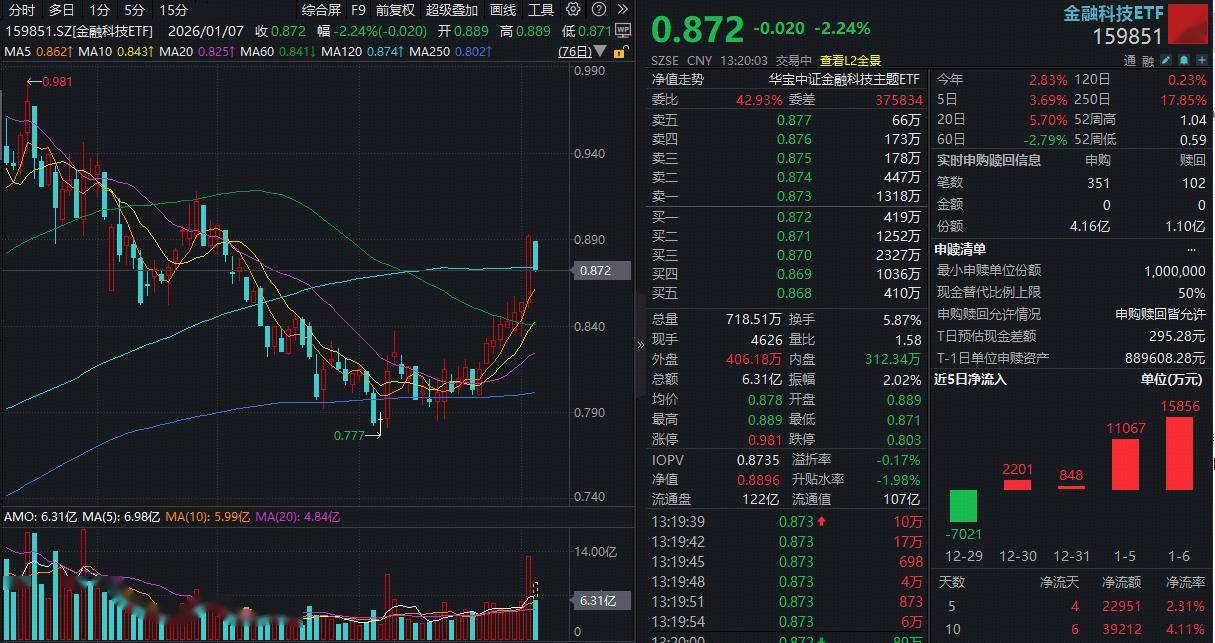
日线八连阳后,金融科技ETF(159851)大跌超2%,资金火速申购3亿份!板块当前配置价值有哪些?
Xin Lang Cai Jing· 2026-01-07 05:35
Core Viewpoint - The financial technology sector is experiencing a correction after a strong performance, but there is significant capital inflow into related ETFs, indicating ongoing investor interest and potential for future growth [1][6]. Group 1: Market Performance - On January 7, the financial technology sector saw a decline after an eight-day rally, with internet brokerages leading the drop, including a more than 6% decline in Ying Shisheng and over 2% declines in other firms like Zhinan Zhen and Tonghuashun [1][6]. - The financial technology ETF (159851), which has the best liquidity among its peers, fell over 2% but saw a net subscription of over 300 million units, with a trading volume exceeding 600 million yuan [1][6]. Group 2: Catalysts for Growth - A-shares achieved a record annual trading volume exceeding 400 trillion yuan in 2025, suggesting continued market activity and potential performance releases for internet brokerages in 2025 and the first half of 2026 [2][7]. - AI is becoming a core driver in finance, with applications like smart investment advisory, big data risk control, and automated operations enhancing product value and customer loyalty. Leading financial IT firms with product capabilities and technological barriers are expected to maintain an advantage [2][7]. - The digital yuan is entering a new phase, with its upgrade to a deposit currency expected to drive significant expansion in its ecosystem and application scenarios. Companies focusing on digital currency applications, IT services for financial institutions, and hardware related to digital wallets and security are recommended for attention [2][7]. Group 3: Investment Opportunities - The financial technology ETF (159851) and its linked funds (Class A 013477, Class C 013478) are highlighted as key investment opportunities, covering sectors such as internet brokerages, financial IT, cross-border payments, AI applications, and Huawei's HarmonyOS [3][8]. - The financial technology ETF has an average daily trading volume of 800 million yuan over the past six months, indicating strong liquidity compared to other ETFs tracking the same index [3][8]. Group 4: Future Outlook - The financial technology sector is poised for a convergence of multiple positive factors, enhancing its investment value [5][10].
内地工业生产景气有望超预期:环球市场动态2026年1月7日
citic securities· 2026-01-07 03:32
Market Overview - A-shares continued to rise, with the Shanghai Composite Index achieving a 13-day winning streak, reaching a 10-year high at 4,083.67 points, up 1.5%[3][14] - The Hang Seng Index surged 1.38% to close at 26,710.45 points, driven by strong performances in brokerage and insurance sectors[10] - European markets showed positive sentiment, with some indices reaching historical highs, while US stocks also experienced gains, led by technology stocks[3][8] Commodity and Forex Trends - Metal prices rose significantly, with London nickel prices soaring over 10%, closing up 8.95% at $18,524.0 per ton, marking the largest increase in over three years[25] - Gold and silver prices continued to climb, with gold rising 1.0% to $4,496.1 per ounce and silver increasing 5.72% to $81.039 per ounce[25] - International oil prices fell, with NY crude oil down 2.04% to $57.13 per barrel, influenced by geopolitical assessments[25] Economic Indicators - December's industrial production in mainland China is expected to rebound due to differences in working days, with a forecasted increase in industrial value added growth[5] - Fixed asset investment growth is anticipated to recover moderately, while export growth is expected to decline due to a high base in 2024[5] - Consumer price index (CPI) is projected to remain around 0.8%, driven by seasonal price increases in fresh fruits[5] Bond Market Insights - US Treasury yields increased by 1-2 basis points, with the 10-year yield reaching 4.17%[28] - Asian investment-grade bonds saw active trading, with new issues performing well in the secondary market, leading to a general tightening of spreads by 1-2 basis points[28] Company News - Palo Alto Networks announced a $3.35 billion acquisition of Chronosphere, aiming to enhance its observability capabilities, with a target price of $203 per share[7][12] - BYD reported a total annual sales of 4.6 million vehicles, with overseas sales reaching 1.04 million, marking a 150% year-on-year increase[12]
低位四call非银-更左侧-更具弹性-更高赔率
2026-01-07 03:05
Summary of Conference Call on Non-Bank Financial Sector Industry Overview - The non-bank financial sector has seen significant capital inflows since October last year, particularly in the insurance segment, which has risen nearly three months. Despite some divergence in floating profits, the outlook for the year remains positive. [1][2] - The brokerage sector has experienced minor pullbacks, with a strong trend and rapid volume growth, surpassing 2.8 trillion RMB in trading volume. Maintaining a range of 2.5 to 3 trillion RMB will benefit the non-bank sector's market expansion. [1][3] Key Insights Insurance Sector - The insurance sector is expected to see a slowdown in performance growth this year (2025), but valuation increases will be the main driver. The regulatory body may classify several large insurers as systemically important financial institutions, enhancing their valuations. [2][4] - Investment strategies should focus on selecting stocks with high safety margins, low valuations, and low growth in the previous year. Recommended stocks include Taiping Insurance in Hong Kong and Taikang in A-shares. [5][6] Brokerage Sector - The overall increase in brokerage stocks is around 4%, with most stocks still in the early stages of recovery. [3][4] - Two investment strategies are suggested: - **Conservative**: Focus on leading brokerages like Guotai Junan and CITIC Securities. - **Aggressive**: Consider traditional brokerages with growth stories and smaller market caps, such as Xiangcai Securities. [5][6] Internet Brokerages - Major internet brokerages like Eastmoney and Tonghuashun have limited future growth potential due to their large market capitalizations. [5][6] - Recommended smaller internet brokerages with higher growth potential include Xiangcai and Dazhihui in A-shares, and Jiufang Zhitu in Hong Kong. These stocks have lower valuations and smaller market caps, indicating better growth prospects. [7] Financial Technology and Stablecoins - The non-bank financial sector is currently seen as having high cost-effectiveness, with a focus on financial technology and stablecoins. Hong Kong is set to issue stablecoin licenses in Q1, which will create a compliant trading environment and replace traditional cross-border payment systems. [8][10] - The cross-border payment market is underestimated, and the recovery of cryptocurrency prices supports this view. [9] Emerging Investment Opportunities - Investors are increasingly interested in diversified financial sectors, including futures and venture capital. The performance of commodity markets, especially precious and non-ferrous metals, is strong, indicating high earnings expectations for futures and venture capital companies. [11] - The digital RMB supply chain and AI+ insurance sectors are also highlighted as areas with significant policy support expected in 2026, presenting growth opportunities for emerging companies. [11]
券商-保险-决胜转型牛-开门红
2026-01-07 03:05
Summary of Conference Call Records Industry Overview - The records discuss the Chinese financial market, particularly focusing on the brokerage and insurance sectors, highlighting a transition towards a "transformation bull" market in 2024 and beyond, driven by reforms and economic shifts [1][2][3]. Key Insights and Arguments - **Macroeconomic Stability**: The easing of macroeconomic risks is a prerequisite for the revaluation of the Chinese market, supported by the government's effective response to the 924 policy and the US-China tensions, which has bolstered market confidence [1][2]. - **Asset Management Demand**: The disappearance of guaranteed returns has led to a surge in asset management demand, with expectations for even greater demand in 2026 [3][5]. - **Market Growth Projections**: Corporate profit growth is projected to reach 10.6% in 2026, with the Shanghai Composite Index expected to break through the 4,200 to 4,300 points resistance level before the Spring Festival [4][5]. - **Capital Inflows**: Approximately 50 trillion yuan in bank deposits are set to mature in the first quarter, with insurance dividends and brokerage fund sales expected to bring in additional capital, potentially exceeding expectations [5]. - **Investment Focus**: Key investment themes include emerging technologies, cyclical consumption aligned with transformation needs, and the financial sector, particularly non-bank financial institutions, which are expected to thrive under low-risk yield conditions [6][7]. Additional Important Content - **Non-Bank Financial Institutions**: These institutions are expected to enhance investment yields by increasing equity allocations in a low-interest environment, which is not mandated by policy but is a strategic response to achieve profit targets [7]. - **Wealth Management Trends**: The approach to wealth management is shifting from vertical platforms to public domain traffic monetization, with a notable increase in brokerage firms that effectively collaborate with public traffic platforms [9]. - **Insurance Sector Opportunities**: The stabilization of interest rates is anticipated to reduce the pressure from interest rate differentials on insurance companies, improving profitability and leading to valuation recovery. The growth in new policies has been significant, with some channels exceeding 50% growth [10][11]. - **Digital Currency Prospects**: The development of digital RMB is expected to gain momentum, particularly with the potential for interest-bearing capabilities, which would enhance its adoption by banks and third-party payment companies [12]. - **Non-Bank Sector Performance**: The non-bank financial sector is projected to perform well in the upcoming spring market, with optimism regarding its growth potential compared to other sectors [13]. This summary encapsulates the critical insights and projections regarding the Chinese financial market, emphasizing the evolving landscape and potential investment opportunities within the brokerage and insurance sectors.
146亿元资金净流入,券商板块机会如何?丨每日研选
Shang Hai Zheng Quan Bao· 2026-01-07 00:30
Core Viewpoint - The influx of approximately 14.6 billion yuan into the brokerage sector on January 6 indicates a strong market interest, driven by favorable policy cycles, valuation recovery, and fund reallocation, suggesting potential growth opportunities for brokerages and financial IT sectors in 2026 [1][2] Policy Environment - Key reforms, including the release of regulations on public fund sales fees and commercial real estate REITs, are expected to inject new momentum into the industry, shifting focus from short-term scale to long-term value [2] - The expansion of REITs is anticipated to create incremental opportunities for brokerage investment banking and asset management businesses, with three core favorable logics yet to be fully priced in by the market [2] Market Dynamics - The divergence in performance, where the A-share major indices rose significantly while the brokerage index fell, indicates a disconnection between valuation and profitability, creating a potential for valuation recovery [2] - The brokerage sector is currently underweight in active equity funds, and with regulatory guidance for public funds to optimize assessments, there is a likelihood of increased allocation to brokerages due to their stable growth and significant index weight [2] Investment Logic - The industry is evolving along differentiated paths, with three main investment themes suggested: - **Mergers and Acquisitions**: Anticipated steady progress in M&A within the brokerage sector, enhancing leverage and capital efficiency, with a focus on companies like CICC, Shougang Securities, and China Galaxy Securities [3] - **Comprehensive Leaders**: Strong, well-capitalized brokerages with balanced business structures are positioned to capitalize on industry trends, with recommendations for Guotai Junan Securities, GF Securities, and CITIC Securities [3] - **Financial Technology**: Increased market activity and digital finance trends favor financial IT and internet wealth management platforms, with attention on companies like Tonghuashun, Jiufang Zhitu, and Wealth Trend, as well as internet finance platforms like Dongfang Caifu and Zhinan Zhen [3]
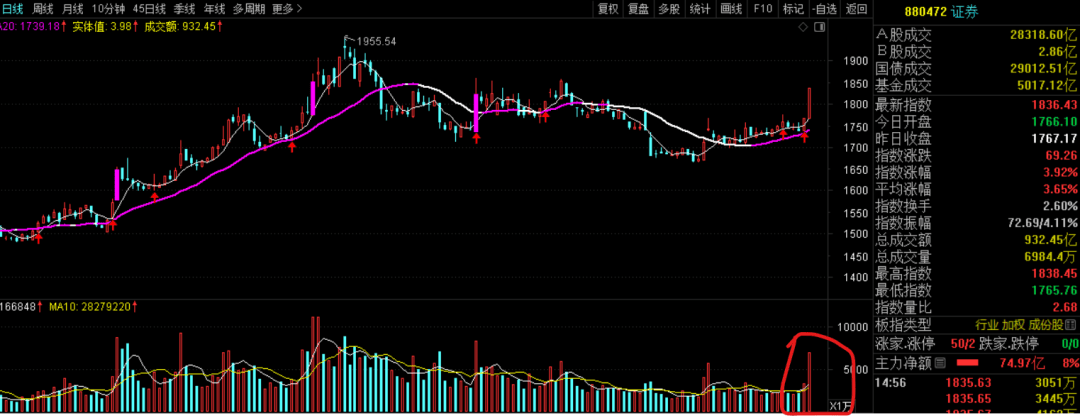
“旗手”归来!券商板块开年爆发 机构解读2026投资主线
2 1 Shi Ji Jing Ji Bao Dao· 2026-01-06 23:38
Core Viewpoint - The A-share market has been performing strongly since the beginning of the year, with the brokerage sector leading the charge, indicating potential for valuation recovery and long-term investment opportunities in the sector [1][9]. Market Performance - As of January 6, the three major A-share indices rose collectively, with the Shanghai Composite Index reaching a ten-year high and recording a 13-day winning streak. The trading volume in the Shanghai and Shenzhen markets reached 2.81 trillion yuan, an increase of 260.2 billion yuan from the previous trading day, marking a three-month high [1]. - The brokerage sector saw significant gains, with stocks like Huazhong Securities and Hualin Securities hitting the daily limit, while others like Changjiang Securities and Guotai Junan rose over 5% [1]. Institutional Insights - Multiple institutions predict that the brokerage sector will benefit from a "slow bull" market and the acceleration of building world-class investment banks, leading to valuation recovery and highlighting long-term investment value [1][9]. - Key investment strategies for 2026 include focusing on "low valuation," "leading brokerages," "mergers and acquisitions," "wealth management," and "overseas business" [1][12]. Policy Impact - The recent comprehensive reform of public funds is seen as a significant policy benefit for the brokerage sector, effective from January 1, 2026, which aims to promote long-term value investment and optimize the investment ecosystem [2][3]. Performance Discrepancy - In 2025, despite a 42.55% increase in revenue and a 62.38% rise in net profit for 42 listed brokerages, the sector's overall stock performance was only up 4.05%, significantly lagging behind major indices like the CSI 300 and the Shanghai Composite [6][8]. - Analysts attribute this discrepancy to high timing difficulty, a mismatch between market performance and earnings, and significant individual stock differentiation [8]. Future Outlook - Predictions for 2026 suggest a shift towards a more stable market with moderate growth in trading volume, with daily trading expected to range between 2.2 trillion and 3.2 trillion yuan [9]. - Regulatory focus on "high-quality development" is expected to expand capital space for leading brokerages, supporting mergers and acquisitions and the development of wealth management and international business [10][11]. Investment Recommendations - Institutions recommend focusing on low-valuation leading brokerages, those with strong wealth management capabilities, and firms benefiting from cross-border asset management trials [12][13]. - Analysts also highlight the importance of investment banking and the potential for improved performance from underwriting and follow-on investments in the context of a recovering market [14].
沪指13连阳再创新高,马年炒马斯克概念!
Sou Hu Cai Jing· 2026-01-06 14:35
Group 1 - The core investment theme for the year revolves around "Musk concepts," particularly in the technology sector, including commercial aerospace, humanoid robots, brain-computer interfaces, intelligent driving, AI applications, and new energy [1][2] - The Shanghai Composite Index has achieved a 13-day consecutive rise, reaching a 10-year high, with trading volume increasing significantly to 2.81 trillion yuan, up 260.2 billion yuan from the previous trading day [1] - The market is currently in a bullish phase, with over 4,100 stocks rising and 143 stocks hitting the daily limit, indicating a strong upward momentum [1] Group 2 - The financial sector, particularly securities, is expected to benefit from the ongoing market rally, with significant trading volume observed, suggesting potential for a wave of upward movement [2][5] - The securities sector is highlighted as having the greatest elasticity, with specific stocks like Tonghuashun, Zhinan Compass, and Dongfang Caifu being identified as key players [5] - The overall market sentiment is optimistic, with expectations for continued strong performance in both technology and financial sectors, indicating a favorable environment for investment opportunities [6]