
盐津铺子

Search documents
食品饮料2026:大年,起点
Orient Securities· 2025-11-16 15:35
Investment Rating - The investment rating for the food and beverage industry is "Positive" (maintained) [5] Core Viewpoints - The food and beverage sector is expected to experience a "difficult to decline" phase starting in 2026, with a clear bottom and upward potential. The growth will shift from valuation recovery to performance-driven [8] - The report emphasizes the importance of "individual stock improvement" and "structural dividends," suggesting that the sector is currently in a performance bottoming phase, with short-term trading opportunities focused on stocks showing significant performance recovery [8] - The report anticipates that the overall performance of the food and beverage sector will improve in 2026, driven by supply-side adjustments and a gradual recovery in consumer demand [8] Summary by Sections Investment Recommendations and Targets - Short-term strategy focuses on trading "individual stock improvement" and "turnaround" themes, recommending stocks such as Miaokelando (600882, Buy), Jinshiyuan (603369, Buy), Gujinggongjiu (000596, Buy), and Shede Liquor (600702, Buy) [4] - Structural dividends are expected to continue, with recommendations for Dongpeng Beverage (605499, Buy) and Yanjinpuzi (002847, Buy) [4] - On the demand side, stability or market share themes are highlighted, recommending stocks like Kweichow Moutai (600519, Buy), Shanxi Fenjiu (600809, Buy), Luzhou Laojiao (000568, Buy), Qingdao Beer (600600, Buy), and Yili Group (600887, Buy) [4]






食品饮料行业点评:近期更新反馈:固本强基,趋时驭势
GOLDEN SUN SECURITIES· 2025-11-16 09:39
Investment Rating - The report maintains an "Accumulate" rating for the food and beverage industry, indicating a positive outlook for investment opportunities in this sector [5]. Core Insights - The food and beverage industry is experiencing a transformation driven by health-conscious consumer trends, product innovation, and channel expansion, with companies actively enhancing their product offerings and exploring overseas markets [1][9]. - In the liquor segment, the supply side is undergoing continuous changes to seek growth, while the demand side is gradually recovering, highlighting the absolute investment value in the industry [2][3]. - The beverage sector is focusing on product innovation and network expansion to uncover growth potential, with a strong emphasis on health upgrades and premiumization [4][7]. Summary by Relevant Sections Liquor Industry - **Water Well**: The company is optimizing its product matrix and plans to launch a new high-end product in 2025, focusing on brand collaboration and expanding its terminal network [2]. - **Jiu Gui Jiu**: The brand is implementing a strategic focus on brand depth and product line simplification, with expectations for improved sales performance [3]. - **She De Jiu Ye**: The company is maintaining its core strategy while expanding its product offerings, particularly in e-commerce, to drive growth [3]. Beverage Industry - **Kang Shi Fu**: The company is committed to innovation and quality, focusing on expanding its product range to meet diverse consumer needs [4]. - **Unified Enterprises**: The company is experiencing stable performance with a focus on product innovation and market expansion, particularly in the instant noodle and beverage segments [7]. - **Hua Run Beverage**: Short-term performance is under pressure due to competition, but long-term growth prospects remain strong due to the essential nature of its products [7]. Health and Wellness Trends - **Anqi Yeast**: The company is targeting over 10% revenue growth, with a focus on expanding its overseas market presence and maintaining cost advantages [9]. - **Xian Le Health**: The company is advancing its global strategy and product innovation to capture new consumer trends, with a focus on high-margin products [9]. - **Jian Yi Health**: The company is enhancing its probiotic offerings and expanding its product lines to meet evolving consumer demands [10]. Overall Market Trends - The food and beverage industry is witnessing a shift towards healthier products and innovative marketing strategies, with companies adapting to changing consumer preferences and exploring new growth avenues [1][4].


10月CPI回暖,消费板块预期修复
Xiangcai Securities· 2025-11-16 08:11
Investment Rating - The report maintains a "Buy" rating for the food and beverage industry [2] Core Insights - The food and beverage industry experienced a slight decline of 0.56% from November 3 to November 7, while the overall market indices showed mixed results, with the Shanghai Composite Index down by 0.18% and the Shenzhen Component Index down by 1.40% [5][10] - The industry valuation is currently at a low level, with a Price-to-Earnings (PE) ratio of 22X as of November 14, 2025, ranking 23rd among Shenwan's primary industries [5][15] - The Consumer Price Index (CPI) showed a year-on-year increase of 0.2% in October, indicating a recovery in consumer sentiment, particularly in service consumption [6][8] Summary by Sections Industry Performance - The food and beverage sector outperformed the broader market, with a 2.82% increase, ranking 6th out of 31 sectors [5][10] - Sub-sectors such as pre-processed foods, baked goods, and dairy products saw increases of 6.93%, 5.07%, and 4.33% respectively [5][10] Valuation Metrics - The food and beverage industry's PE ratio is 22X, with other alcoholic beverages at 58X, health products at 38X, and snacks at 36X, while white spirits, beer, and pre-processed foods have lower valuations at 20X, 23X, and 23X respectively [15] Consumer Trends - The CPI's increase is attributed to policies aimed at boosting domestic demand and the impact of the National Day and Mid-Autumn Festival holidays [6] - Food prices saw a decline of 2.9% year-on-year, with dairy prices down by 1.7% and alcoholic beverages down by 2.0% [7] Investment Recommendations - The report suggests focusing on companies with stable demand and strong risk resilience, as well as those innovating in new products, channels, and consumption scenarios [8][42] - Recommended companies include New Dairy, Andeli, Shanxi Fenjiu, Guizhou Moutai, and Yanjinpuzi [8][42]
中国银河证券:东南亚零食市场快速扩容 国内零食企业或迎出海新机遇
Zhi Tong Cai Jing· 2025-11-14 08:43
Core Insights - The Southeast Asian snack market has surpassed 150 billion RMB, with a compound annual growth rate (CAGR) exceeding GDP growth over the past decade, presenting significant investment opportunities [1][2] - The market can be categorized into three segments: growth markets (Indonesia, Philippines, Vietnam), late growth markets (Thailand, Malaysia, Singapore), and nurturing markets (Laos, Myanmar, Cambodia) [1][2] Market Overview - Indonesia's snack market is valued at 50 billion RMB, with sweet snacks dominating but experiencing slowing growth, while flavored snacks are rapidly increasing [2] - The Philippines has a market size of 30 billion RMB, with a high concentration of local brands in the flavored snack segment [2] - Vietnam's market is worth 15 billion RMB, with a balanced share between sweet and flavored snacks, featuring a more fragmented market with a dominance of foreign brands [2] - Thailand's snack market is valued at 24 billion RMB, primarily driven by flavored snacks, with a fragmented market structure [2] - Malaysia's market is around 10 billion RMB, with a high proportion of sweet snacks and a relatively concentrated market [2] Company Strategies - Companies venturing into Southeast Asia can focus on markets with "market expansion," "undetermined structure," and "category adaptation," with Indonesia, Vietnam, and Thailand as primary targets for growth [2][3] - Successful companies like Calbee and Glico have adopted localized strategies, with Calbee focusing on local brand adaptations and partnerships in Indonesia and Thailand, while Glico emphasizes a unified market approach with localized product modifications [3][4] Domestic Implications - Notable Chinese snack companies such as Qiaqia Food, Ganyuan Food, and others are actively expanding into Southeast Asia, primarily targeting Thailand, Indonesia, and Vietnam [4] - These companies are leveraging their product strengths, localizing flavors and branding, and utilizing a combination of distribution channels including e-commerce and local partnerships [4]

食品饮料步入消费旺季 产业链上市公司乘风布局
Zheng Quan Ri Bao Wang· 2025-11-13 12:28
Group 1 - The food and beverage industry is entering its most important sales window, with capital expenditure growth of 15.15% year-on-year in November 2025, indicating proactive market positioning by listed companies [1] - The industry is experiencing a structural recovery, with significant online sales growth in the liquor sector during the National Day and Mid-Autumn Festival, including over 100% year-on-year growth on JD's platform and a 58% increase on Douyin [1] - Institutional research activity has surged, with 202 total investigations in the food and beverage sector over the past three months, particularly in the snack and seasoning segments [1] Group 2 - Individual companies such as Chongqing Fuling Zhacai, Angel Yeast, and Xiangpiaopiao have been the focus of institutional attention, each receiving multiple investigations in the last three months [2] - Li Gao Food's third-quarter earnings call attracted 88 institutions, showcasing a nearly 40% year-on-year growth in new channel revenue, indicating strong growth momentum [2] Group 3 - Companies are innovating in products, channels, branding, and supply chain capabilities to capitalize on the consumption peak, with examples including Jiu Gui Jiu's successful product launch and Jin Zai Food's channel innovation strategy [3] - Yanjinpuzi is leveraging local sports events to enhance brand visibility and sales, while ensuring stable production orders in preparation for the upcoming peak season [3] Group 4 - Absolute Food is optimizing its supply chain and market dispatch mechanisms to address regional demand fluctuations and market changes, ensuring stable product supply [4] - Research indicates that product innovation and new channel development are key growth strategies for consumer goods companies, with expectations of a fundamental turning point and policy catalysts for traditional consumer categories [4]



“十五五”规划分析及产业投资机遇展望
Ping An Securities· 2025-11-12 10:27
Group 1: Economic Strategy - The "15th Five-Year Plan" emphasizes economic construction as the core focus, aiming to build a modern industrial system centered on advanced manufacturing[9] - Key industrial development lines include "hard technology," advanced manufacturing, domestic circulation, and energy resource security[3] - The plan aims to create a market space of 10 trillion yuan by optimizing traditional industries and fostering emerging sectors over the next five years[8] Group 2: Hard Technology and Advanced Manufacturing - The plan highlights the importance of original innovation and key core technology breakthroughs, particularly in AI and digital technologies[12] - The automotive industry is expected to see accelerated commercialization of L3/L4 autonomous driving technologies during the "15th Five-Year Plan" period[34] - The focus on advanced manufacturing aims to enhance the global competitiveness of traditional industries like chemicals and machinery, with a push towards smart and green manufacturing[8] Group 3: Domestic Circulation and Consumption - The plan stresses the need to boost consumption and expand effective investment, particularly in the real estate sector, to support high-quality development[3] - The "anti-involution" policy is expected to improve the operational environment for construction materials and consumer goods, benefiting companies in these sectors[3] Group 4: Resource Security - The plan calls for strengthening the exploration and development of strategic mineral resources, particularly rare earths, to enhance their strategic importance[3] - It emphasizes the need for a new energy system, focusing on clean and efficient utilization of fossil energy while promoting renewable energy sources[3] Group 5: Market Outlook and Risks - The equity market is expected to maintain high volatility, with a focus on sectors benefiting from industrial recovery and performance superiority[3] - Key risks include macroeconomic fluctuations, lower-than-expected corporate profit growth, and geopolitical uncertainties[3]
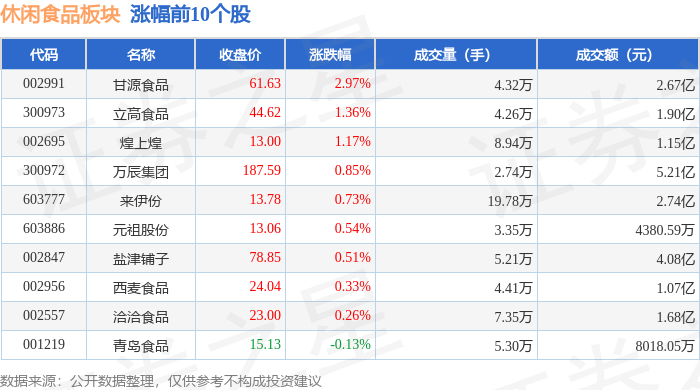
休闲食品板块11月12日跌0.01%,桂发祥领跌,主力资金净流出1.71亿元
Zheng Xing Xing Ye Ri Bao· 2025-11-12 08:42
Market Overview - The leisure food sector experienced a slight decline of 0.01% on November 12, with Gui Faxiang leading the drop [1] - The Shanghai Composite Index closed at 4000.14, down 0.07%, while the Shenzhen Component Index closed at 13240.62, down 0.36% [1] Stock Performance - Notable gainers in the leisure food sector included: - Ganyuan Food: closed at 61.63, up 2.97% with a trading volume of 43,200 lots and a transaction value of 267 million [1] - Lihai Food: closed at 44.62, up 1.36% with a trading volume of 42,600 lots and a transaction value of 206.1 million [1] - Major decliners included: - Gui Faxiang: closed at 14.30, down 2.26% with a trading volume of 273,100 lots and a transaction value of 394 million [2] - Ziyan Food: closed at 19.27, down 2.18% with a trading volume of 29,900 lots and a transaction value of 58.19 million [2] Capital Flow - The leisure food sector saw a net outflow of 171 million from institutional investors, while retail investors contributed a net inflow of 249 million [2] - Specific stock capital flows included: - Ganyuan Food: net inflow of 17.70 million from institutional investors, with a net outflow of 12.58 million from speculative funds [3] - Lihai Food: net inflow of 10.29 million from institutional investors, with a net outflow of 7.30 million from speculative funds [3]


全国县域经济和社会综合发展百强县榜发布,湖南浏阳稳居第五
Zhong Guo Jin Rong Xin Xi Wang· 2025-11-12 06:52
Core Insights - The report highlights the theme of "integrated development of strong counties and prosperous citizens," with Liuyang ranking fifth in the national county economic and social comprehensive development list [1] - Liuyang focuses on high-level construction of a "new model of county economy" and a "pioneering area for common prosperity," implementing the "Five Cities" strategy and enhancing production capacity for high-quality development [1] Economic Performance - Liuyang's GDP is projected to exceed 180 billion in 2024, with multiple economic indicators growing faster than those of Changsha, the province, and the national average [2] - From January to September, Liuyang's GDP grew by 6.2% year-on-year, leading in major economic indicators within the province [2] - The city has established a modern industrial system with a focus on electronic information and biomedicine, aiming to create a national-level industrial cluster worth 100 billion [2][3] Industrial Development - Key industries in Liuyang, including electronic information, biomedicine, intelligent equipment, and green food, achieved a combined output value exceeding 130 billion, with a year-on-year growth of 11.8% [3] - The city has attracted 32 new industrial enterprises and two national "specialized and innovative" small giants [3] Investment and Infrastructure - Liuyang prioritizes investment attraction as a key development strategy, with 125 new projects introduced this year, marking a year-on-year increase of 23 projects [5] - Major projects include a 9 billion investment in a Mini-LED backlight and display module project, and a new display device industrial park [5] Rural Development - As a major grain-producing county, Liuyang's total grain output is projected at 572,700 tons in 2024, ranking first nationally [3] - The city promotes rural revitalization through the integration of primary, secondary, and tertiary industries, enhancing the income and vitality of rural areas [3] Business Environment - Liuyang aims to create a "six good" business environment, focusing on improving the experience for entrepreneurs and ensuring legal protections [7][8] - Initiatives include "entrepreneur reception days," green cards for entrepreneurs, and streamlined administrative processes to enhance service efficiency [8][11] Quality of Life - Liuyang's commitment to improving the quality of life is evident in its focus on ecological sustainability, with air quality rated as excellent for 175 days this year [12] - The city has implemented various social welfare projects, including education and elderly care, contributing to a higher disposable income for residents [13][14]
国信证券:酒类渠道包袱加速去化 大众品品类表现分化
智通财经网· 2025-11-12 02:48
Group 1 - The core viewpoint of the report indicates that the liquor industry is entering a phase of adjustment, with a consensus on reduced growth rates for 2024 and an expansion of performance declines in Q3 reports [1][2] - The food and beverage sector is expected to show stable overall volume and structural differentiation by 2025, with Q1/Q2/Q3 revenues growing by +2.5%/+2.4%/-4.77% year-on-year, and net profits declining by +0.3%/-2.1%/-14.6% [1] - The report highlights that the macroeconomic policies in Q4 could catalyze stock price increases due to low expectations in the capital market and low institutional holdings [1] Group 2 - The liquor sector is recommended for investment, particularly companies with pricing power and regional influence, such as Luzhou Laojiao, Shanxi Fenjiu, and Kweichow Moutai, which are expected to achieve greater growth [2] - The consumer goods sector is anticipated to stabilize and improve in 2025, driven by inventory reduction and macroeconomic policy support, with leading companies in segments like sugar-free tea and functional beverages showing strong revenue growth [3] - The snack food segment reported a revenue increase of +22.4% and an 8.6% rise in profits in Q3 2025, despite rising costs from certain raw materials [3]

盐津铺子跌2.00%,成交额1.46亿元,主力资金净流出432.46万元
Xin Lang Cai Jing· 2025-11-12 02:45
Core Viewpoint - Salted Fish has experienced a stock price increase of 24.81% this year, with a recent decline of 2.00% on November 12, 2023, indicating potential volatility in the market [1][2]. Financial Performance - For the period from January to September 2025, Salted Fish achieved a revenue of 4.427 billion yuan, representing a year-on-year growth of 14.67%, and a net profit attributable to shareholders of 605 million yuan, up 22.63% year-on-year [2]. - Cumulative cash dividends since the company's A-share listing amount to 1.318 billion yuan, with 923 million yuan distributed over the past three years [3]. Stock Market Activity - As of November 12, 2023, the stock price was 76.88 yuan per share, with a market capitalization of 20.971 billion yuan and a trading volume of 146 million yuan [1]. - The stock has seen a net outflow of 4.3246 million yuan in principal funds, with significant buying and selling activity from large orders [1]. Shareholder Structure - As of September 30, 2025, the number of shareholders increased by 65.13% to 18,000, while the average circulating shares per person decreased by 39.44% to 13,663 shares [2]. - The top ten circulating shareholders include significant institutional investors, with changes in holdings noted for several funds [3].