
兔宝宝

Search documents
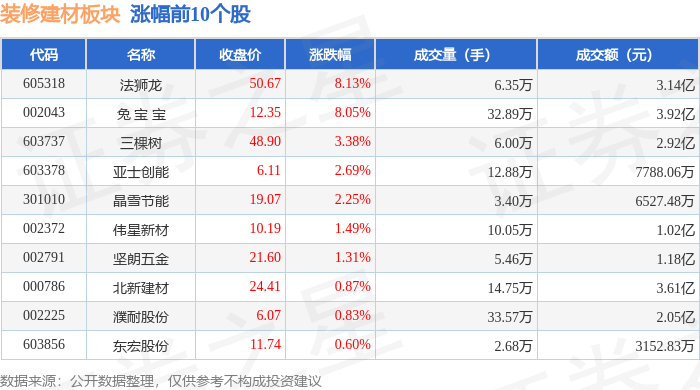
装修建材板块10月14日涨0.87%,法狮龙领涨,主力资金净流出2.31亿元
Zheng Xing Xing Ye Ri Bao· 2025-10-14 08:41
Core Insights - The renovation and building materials sector saw an increase of 0.87% on October 14, with Fa Shilong leading the gains [1] - The Shanghai Composite Index closed at 3865.23, down 0.62%, while the Shenzhen Component Index closed at 12895.11, down 2.54% [1] Stock Performance - Fa Shilong (605318) closed at 50.67, up 8.13% with a trading volume of 63,500 shares and a transaction value of 314 million yuan [1] - Tu Baobao (002043) closed at 12.35, up 8.05% with a trading volume of 328,900 shares and a transaction value of 392 million yuan [1] - Other notable performers include: - San Ke Shu (603737) at 48.90, up 3.38% [1] - Ya Shi Chuang Neng (603378) at 6.11, up 2.69% [1] - Jing Xue Jieneng (301010) at 19.07, up 2.25% [1] Capital Flow - The renovation and building materials sector experienced a net outflow of 231 million yuan from institutional investors, while retail investors saw a net inflow of 246 million yuan [2] - The detailed capital flow for selected stocks includes: - Pu Nai Co., Ltd. (002225) with a net inflow of 28.16 million yuan from institutional investors [3] - San Ke Shu (603737) with a net inflow of 19.53 million yuan from institutional investors [3] - Wei Xing New Materials (002372) with a net inflow of 12.42 million yuan from institutional investors [3]


当前时点,如何看待周期板块
2025-12-22 01:45
Summary of Key Points from Conference Call Records Industry Overview - **Steel Industry**: - Despite record high pig iron production, the decline in metallurgical coke and iron ore prices, along with increased steel billet exports, has not translated into growth in end demand, leading to a continuous drop in steel prices. Rebar profit margins are near breakeven levels [1][3] - Investment in steel stocks should focus on fundamental indicators and supply-demand relationships. After an initial valuation recovery, stocks fell in late March due to a lack of supporting fundamentals. It is recommended to preemptively invest in second-tier stocks benefiting from falling coke and iron ore prices, such as Liugang, Shougang, and Sansteel Mingguang, with significant profit growth expected in 2025 [1][13] - **Energy Metals**: - Strategic resources like rare earths and tungsten are affected by export control policies, with tungsten prices strengthening. The demand for humanoid robots and stabilization of macro demand are expected to drive a recovery in the rare earth market, with companies like China Rare Earth, Guangsheng Nonferrous, and Northern Rare Earth being noteworthy [1][14][16] - The cobalt market is poised for a second wave of price increases due to export bans from the Democratic Republic of Congo, with companies like Huayou Cobalt and Luoyang Molybdenum being highlighted [1][17] - Nickel prices are supported around $15,000 due to Indonesia's measures to strengthen pricing power, with a planned export ban from the Philippines in June 2025 potentially tightening supply [1][18][19] - **Lithium Carbonate Market**: - The lithium carbonate market has seen a significant downward trend due to weak fundamentals, with prices dropping below previous support levels. However, it is believed to have reached a cyclical bottom, making it a good time for long-term investments [1][20] - **Construction Materials**: - The construction materials sector is stable, with a slight improvement in new home sales. Investment opportunities include domestic alternatives and companies like Keda Manufacturing and China National Materials, which are expected to benefit from AI demand and high-end chip packaging materials [1][21] Key Insights and Arguments - **Steel Production vs. Demand**: - High pig iron production does not necessarily indicate strong downstream demand, as evidenced by the ongoing decline in steel prices. Factors such as lower prices for raw materials and increased exports of semi-finished products contribute to this disconnect [1][5][6][7] - **Investment Strategy**: - The steel sector's key indicators include steel prices and gross profit per ton. If these do not align, it hampers the potential for performance recovery. Investors should closely monitor these metrics to adjust strategies accordingly [1][10][11] - **Future Recommendations**: - For 2025, it is advised to focus on second-tier stocks that will benefit from lower raw material costs, which will enhance profitability. Companies like Liugang and Shougang are expected to show significant profit growth [1][13] Additional Important Content - **OPEC's Impact on Oil and Aviation**: - OPEC's recent production increases are expected to benefit oil transportation and aviation sectors, with a projected 20% decrease in fuel costs leading to improved profitability in the aviation industry [4][22][24] - **Chemical Industry Opportunities**: - The chemical sector is seeing opportunities due to the gradual lifting of export restrictions on fertilizers, with companies like Hualu Hengsheng and Luxi Chemical being highlighted for potential gains [4][26] - **Market Dynamics**: - The coal market is currently under pressure due to high inventory levels and weak demand, but upcoming seasonal demand may stabilize prices. Recommendations include focusing on low-cost producers like Shenhua and Yanzhou Coal [1][45][46][47] This summary encapsulates the critical insights and recommendations from the conference call records, providing a comprehensive overview of the current state and future outlook of the relevant industries.
建筑材料3Q2025年季报前瞻:盈利分化,需求是核心
CAITONG SECURITIES· 2025-10-13 09:40
Core Insights - The report maintains a positive outlook on the building materials sector, highlighting a divergence in performance among companies, with demand being a central theme [2][4] - The report emphasizes that the construction materials industry is experiencing a mixed performance, with some companies benefiting from improved competitive dynamics while others face challenges due to demand and pricing pressures [7][10] Group 1: Consumer Building Materials - The consumer building materials segment shows a divergence in performance, with companies like Sanhe Tree and Oriental Yuhong expected to achieve significant growth due to improved competition and reduced pricing pressures [10][11] - The revenue for Q3 is anticipated to remain flat or decline for most building materials companies, but some may see slight year-on-year increases due to favorable competitive conditions [10][11] - Cost factors such as stable or declining prices for key materials like asphalt and PVC positively impact margins for waterproofing and coating companies [10][11] Group 2: Cement Industry - The cement industry faces weak demand from both real estate and infrastructure sectors, with production volumes declining by 5.6% and 6.2% year-on-year in July and August respectively [12][13] - The average price of cement in Q3 2025 was 343.86 RMB/ton, reflecting a decrease of 8.74% quarter-on-quarter and 10.55% year-on-year, indicating significant pricing pressure [12][13] - The report notes that the industry is currently at a low profitability level due to high inventory and rising production costs driven by coal prices [13] Group 3: Glass Industry - The glass industry is experiencing downward pressure on prices and profitability due to declining demand from the real estate sector, with the average price in Q3 2025 at 68.25 RMB/weight box, down 4.42% quarter-on-quarter [19] - High inventory levels persist in the glass sector, with 5,329 million weight boxes reported by the end of September, exacerbating the pricing challenges [19][20] - The report indicates that while raw material costs have decreased, the overall impact on profitability remains negative due to significant price declines [19] Group 4: Glass Fiber Industry - The glass fiber industry is characterized by structural demand differentiation, with high-end products performing better than low-end offerings, leading to a mixed profitability landscape [21] - The average price for non-alkali glass fiber yarn in Q3 2025 was 4,270 RMB/ton, reflecting a year-on-year decline of 44 RMB/ton, indicating pricing challenges [21] - The report highlights that the industry is facing high inventory levels, with 860,000 tons reported by the end of September, contributing to ongoing profitability pressures [21] Group 5: Company Performance Forecast - The report provides a forecast for various companies in the building materials sector, with Oriental Yuhong expected to achieve a net profit of 374-442 million RMB in Q3 2025, reflecting a year-on-year growth of 12%-32% [26] - Sanhe Tree is projected to see a significant increase in net profit, with estimates ranging from 329-366 million RMB, indicating a growth of 64%-83% year-on-year [26] - Other companies like Huaxin Cement and Conch Cement are also highlighted for their potential profitability improvements, with net profit forecasts indicating positive growth trends [26]


反内卷效果逐显,持续重点推荐青鸟消防
HUAXI Securities· 2025-10-13 08:10
Investment Rating - The industry rating is "Recommended" [4] Core Views - The report highlights the benefits of the new national fire safety standards and the commercialization of fire-fighting robots, recommending Qingniao Fire Protection as a leading beneficiary [6] - The cement industry is experiencing self-discipline and price increases under the "anti-involution" initiative, with recommendations for Huaxin Cement and Conch Cement [6] - The photovoltaic glass industry is seeing price increases from a bottoming out, with recommendations for Qibin Group, Fuyao Glass, and Xinyi Solar [6] - The report emphasizes the high demand for specialty electronic fabrics, recommending China Jushi, China National Materials, and International Composites [6] - The report suggests investing in companies with strong operational resilience and high dividends, such as Weixing New Materials and Tubao [6] Summary by Sections Cement Industry - National cement market prices decreased by 0.4% week-on-week, with average shipment rates below 45% in key regions [2][28] - Price adjustments varied by region, with increases in Hebei and Jiangxi, while declines were noted in Beijing, Tianjin, Jiangsu, Zhejiang, and Anhui [2][28] - The report anticipates continued price fluctuations in the cement market due to insufficient demand support [28] Glass Industry - The average price of float glass increased to 1289.81 CNY/ton, a rise of 5.31% from the previous week [2][67] - The industry maintains a production capacity utilization rate of 82.20%, with no significant changes in production lines [67] Real Estate Market - In the 41st week, new home transaction volume in 30 major cities decreased by 46% year-on-year and 33.94% month-on-month [3][23] - The report indicates a slight improvement in second-hand housing transactions in 15 monitored cities, with a year-on-year increase of 15% [3][23] Specialty Electronic Fabrics - China Jushi reported a revenue of 9.109 billion CNY in the first half of 2025, a year-on-year increase of 17.70% [6] - The company is advancing low-dielectric product development, with significant growth in net profit [6] Investment Opportunities - The report identifies investment opportunities in regions like Xinjiang due to increased infrastructure investments related to the 70th anniversary celebrations [7] - Recommendations include companies like Tianshan Shares and Xinjiang Jiaojian, which are expected to benefit from regional investments [7]


建材行业报告(2025.09.29-2025.10.12):中美贸易摩擦升温,关注低位内需板块
China Post Securities· 2025-10-13 05:08
Investment Rating - The industry investment rating is "Outperform the Market" and is maintained [1] Core Views - The report highlights that the recent escalation in China-US trade tensions may shift market risk preferences, leading to increased attention on defensive sectors within the building materials industry that have strong domestic demand and high dividends. Segments such as cement, glass, and consumer building materials, which have lagged in performance this year, are expected to benefit if market sentiment shifts towards "high cutting low" [3][4] - Cement demand is gradually recovering but remains limited, with production in August 2025 at 148 million tons, down 6.2% year-on-year. The implementation of policies to limit overproduction is expected to enhance capacity utilization in the medium term [3][8] - The glass industry is experiencing a downward trend in demand due to real estate impacts, but recent policy catalysts have led to price increases and inventory replenishment in the midstream sector. The report anticipates that environmental regulations will not lead to a drastic reduction in capacity but will increase costs and accelerate maintenance [4][13] - The fiberglass sector is benefiting from demand driven by the AI industry, with expectations for significant growth in low-dielectric products. The report is optimistic about the continued upward trend in both volume and price [4] - The consumer building materials sector has reached a profitability bottom, with no further downward price pressure expected. The report notes a strong demand for price increases and profitability improvements, particularly among leading companies [4] Summary by Sections Cement - The cement market is entering its peak season, with overall demand showing slow recovery. The construction sector is affected by weather and demand release timing, leading to a weak recovery in housing construction [8] - The report emphasizes the importance of monitoring companies like Conch Cement and Huaxin Cement [3] Glass - The glass industry is facing a continuous decline in demand influenced by real estate, but recent policy changes have led to price increases and midstream inventory replenishment [4][13] - Companies to watch include Qibin Group [4] Fiberglass - The fiberglass sector is experiencing a boom driven by AI-related demand, with expectations for explosive growth in low-dielectric products [4] Consumer Building Materials - The sector's profitability has bottomed out, with strong calls for price increases and profitability improvements. Companies like Dongfang Yuhong and Sankeshu are highlighted for potential recovery [4]

市场风格或逐步转向红利与低位蓝筹相对占优,自由现金流ETF(159201)迎低位布局机会
Mei Ri Jing Ji Xin Wen· 2025-10-13 03:37
Core Viewpoint - The A-share market experienced a significant decline on October 13, influenced by weekend news, with major indices dropping and the National Index of Free Cash Flow falling approximately 2% [1] Market Performance - All three major A-share indices opened lower, with the National Index of Free Cash Flow showing a downward trend after a low opening [1] - Leading stocks included silver non-ferrous metals, Rabbit Baby, and Shanghai Electric [1] ETF Insights - The largest free cash flow ETF (159201) followed the index adjustment, presenting a low-position layout opportunity [1] - The management fee for the free cash flow ETF and its linked funds is at a competitive rate of 0.15% for annual management fees and 0.05% for custody fees, which are among the lowest in the market [1] Market Outlook - Guotai Junan Securities suggests that a significant drop in the Chinese stock market could trigger a short-term rebound, but uncertainty may keep the market in a volatile state throughout October [1] - Since April 8, the gap in performance between dividend and technology sectors has widened, indicating a potential market style shift favoring dividends and low-position blue chips, which may act as a stabilizing force during market corrections [1] Investment Strategy - Free cash flow is fundamental for dividend distribution, focusing more on a company's internal growth capabilities, while dividend strategies emphasize the results of dividend distribution [1] - Free cash flow strategies may serve as a foundational tool to balance growth stock investments [1]
海外降息周期开启,外资增量有望边际提升,低费率的自由现金流ETF(159201)交投活跃
Mei Ri Jing Ji Xin Wen· 2025-10-13 03:01
Core Viewpoint - The A-share market experienced a significant decline followed by a recovery, with the National Free Cash Flow Index showing a reduced drop of approximately 1.4%. Leading stocks included Guodian Nanzi, Baiyin Nonferrous Metals, Tubao, and Shanghai Electric [1]. Group 1: Market Performance - The three major A-share indices opened sharply lower but showed signs of recovery during the trading session [1]. - The National Free Cash Flow Index's decline has been narrowing, indicating potential stabilization in the market [1]. Group 2: ETF Activity - The largest free cash flow ETF (159201) followed the index adjustment, with trading volume exceeding 170 million yuan, indicating active trading and frequent premium transactions [1]. - The ETF focuses on industry leaders with abundant free cash flow, covering sectors such as non-ferrous metals, automotive, petrochemicals, and power equipment, which helps mitigate risks associated with single industry volatility [1]. Group 3: Economic Outlook - China’s economic outlook is influenced by expectations of a Federal Reserve interest rate cut, a prolonged low dollar, and a potential short-term increase in gold prices [1]. - Attention is needed on the "14th Five-Year Plan" and the phase escalation of China-US trade tensions, which may impact market sentiment [1]. - The long-term trend of a weaker dollar is expected to continue, and the initiation of an overseas rate cut cycle may aid in the revaluation of RMB assets [1]. - A marginal increase in foreign capital inflow is anticipated in the fourth quarter, which could support the continuation of incremental funds into the A-share market [1]. Group 4: Fund Management - The fund management annual fee rate is set at 0.15%, and the custody annual fee rate is 0.05%, both of which are the lowest in the market [1].
兔宝宝涨2.04%,成交额1.14亿元,主力资金净流出228.12万元
Xin Lang Cai Jing· 2025-10-13 02:47
Core Points - The stock price of Tubaobao increased by 2.04% on October 13, reaching 11.51 CNY per share with a trading volume of 114 million CNY and a market capitalization of 9.55 billion CNY [1] - Year-to-date, Tubaobao's stock price has risen by 1.97%, with significant increases of 9.51% over the last 5 trading days, 8.79% over the last 20 days, and 17.52% over the last 60 days [2] - As of June 30, 2025, Tubaobao reported a revenue of 3.634 billion CNY, a year-on-year decrease of 7.01%, while the net profit attributable to shareholders was 268 million CNY, reflecting a year-on-year increase of 9.71% [2] Company Overview - Tubaobao, established on December 27, 2001, and listed on May 10, 2005, is located in Deqing County, Zhejiang Province. The company specializes in the production and sales of decorative materials, including decorative panels, paints, wall coatings, adhesives, and various furniture products [2] - The main business revenue composition includes decorative materials (77.04%), cabinet products (12.15%), brand usage fees (5.54%), flooring (3.90%), and other products (0.79%) [2] - As of June 30, 2025, Tubaobao had 43,200 shareholders, an increase of 10.64% from the previous period, with an average of 17,035 circulating shares per shareholder, a decrease of 9.29% [2] Dividend and Shareholding - Tubaobao has distributed a total of 2.942 billion CNY in dividends since its A-share listing, with 1.6 billion CNY distributed over the last three years [3] - As of June 30, 2025, the top ten circulating shareholders include notable entities such as Dongfang Alpha Industry Pioneer Mixed Fund and Hong Kong Central Clearing Limited, with some new entrants and exits among the top shareholders [3]
出海+低估值高股息梳理 | 投研报告
Zhong Guo Neng Yuan Wang· 2025-10-13 01:08
Core Insights - The report highlights the current trends in the non-metallic building materials sector, including price changes, inventory levels, and production rates across various materials [1][4][5]. Group 1: Price Trends and Market Performance - The national average price for high-standard cement is 349 RMB/ton, down 53 RMB/ton year-on-year and down 2 RMB/ton month-on-month, with an average shipment rate of 44.5%, a decrease of 1.9 percentage points from the previous month [1][4]. - The average price of float glass is 1289.81 RMB/ton, which represents an increase of 65.07 RMB/ton or 5.31% month-on-month [1][4]. - The average price for 2.0mm coated panels remains stable at around 13 RMB/square meter [1][4]. Group 2: Inventory and Production Metrics - The inventory days for key monitored provinces in the glass production sector are approximately 24.8 days, a decrease of 1.38 days from the previous week [1][4]. - The concrete mixing station's capacity utilization rate is reported at 7.48%, down 0.19 percentage points month-on-month [4]. - The average price for domestic 2400tex alkali-free winding direct yarn is 3524.75 RMB/ton, remaining stable, while the mainstream price for electronic cloth is between 4.3-4.5 RMB/m, reflecting a 6% increase [4]. Group 3: Company Developments and Recommendations - China National Materials Technology announced plans to raise no more than 4.48 billion RMB for projects related to low dielectric fiber cloth production and to repay government funds [6]. - Huaxin Cement plans to grant 257,800 restricted stocks to 11 incentive targets and intends to repurchase shares worth between 32.25 million and 64.5 million RMB, with a maximum repurchase price of 25 RMB/share [6]. - The report continues to recommend investment in African building materials, fiberglass, and electrolytic aluminum sectors, highlighting companies like Keda Manufacturing and Huaxin Cement as key players in international competition [2].

出海+低估值高股息梳理-20251012
SINOLINK SECURITIES· 2025-10-12 12:24
Investment Rating - The report highlights several companies with dividend yields exceeding 5%, including Sichuan Road and Bridge, Rabbit Baby, and others, indicating a positive investment outlook for these firms [2][12] Core Insights - The report recommends focusing on overseas markets, particularly in Africa, for building materials, fiberglass, and electrolytic aluminum sectors, suggesting that companies like Keda Manufacturing and Huaxin Cement are well-positioned for international competition [13] - Continued tracking of AI copper foil and AI electronic cloth is advised, as demand remains strong, benefiting from capital expenditure expansion in semiconductor clean rooms and PCB equipment [3] Summary by Sections Weekly Discussion - Companies with a price-to-earnings (PE) ratio below 15x include Sichuan Road and Bridge (8.8x), China Construction (4.8x), and others, indicating potential undervaluation [2][12] - The report emphasizes the importance of cash dividend ratios for 2024 and 2025, with several companies projected to maintain high dividend yields [2][12] Cycle Linkage - The national average price for cement is reported at 349 RMB/t, down 53 RMB/t year-on-year, with an average shipment rate of 44.5% [4][14] - The average price for float glass increased to 1289.81 RMB/t, reflecting a 5.31% rise, while inventory levels decreased [4][14] Market Performance - The building materials index increased by 2.66%, outperforming the Shanghai Composite Index [17] - Cement manufacturing showed a price adjustment of -0.4%, with regional variations in pricing due to demand fluctuations [21][25] Price Changes in Building Materials - The report notes that the price of 2400tex fiberglass remains stable at 3524.75 RMB/t, with no significant changes expected in the short term [56] - The electronic cloth market shows stable pricing, with current rates between 4.3-4.5 RMB/m [57]