
广汇能源

Search documents
聚酯周报:调油数据走弱,芳烃估值或将止步-20251122
Wu Kuang Qi Huo· 2025-11-22 13:29
1. Report Industry Investment Rating No relevant content provided. 2. Core Viewpoints of the Report - PX is expected to experience a slight inventory build - up in November. With the weakening of aromatics blending data, there is a risk of valuation correction as it is in a slightly oversupplied situation [11]. - PTA's processing fee has slightly recovered, but the upside space is limited without further stimulus. PXN also faces a risk of valuation correction [12]. - For MEG, the supply - demand outlook remains weak in the medium - term. It is recommended to short on rallies as the inventory build - up needs to be mitigated by reducing the load [13]. 3. Summaries According to the Table of Contents 3.1 Week - on - Week Assessment and Strategy Recommendations PX - Price: The 01 contract dropped 56 yuan to 6750 yuan last week, while the CFR China spot price rose 7 dollars to 833 dollars [11]. - Supply: China's load was 89.5%, up 2.7% week - on - week; Asia's load was 79.7%, up 1.2%. Some plants restarted, and imports from South Korea to China increased [11]. - Demand: PTA load decreased to 71%, down 4.7% week - on - week due to plant maintenance [11]. - Inventory: There was a slight inventory build - up expected in November [11]. - Valuation and cost: PXN was 260 dollars as of November 20, up 3 dollars year - on - year. Aromatics blending expectations weakened [11]. PTA - Price: The 01 contract fell 34 yuan to 4666 yuan, and the East China spot price rose 65 yuan to 4630 yuan [12]. - Supply: PTA load decreased to 71%, down 4.7% week - on - week because of accidental maintenance in November [12]. - Demand: Polyester load increased to 91.3%, up 0.8% week - on - week. However, the terminal is gradually entering the off - season [12]. - Inventory: It is expected to enter a phase of inventory reduction [12]. - Profit: Spot processing fee increased 25 yuan to 164 yuan/ton [12]. MEG - Price: The 01 contract declined 114 yuan to 3808 yuan, and the East China spot price dropped 56 yuan to 3885 yuan [13]. - Supply: EG load decreased to 70.8%, down 0.7% week - on - week. There were many accidental plant maintenance events [13]. - Demand: Polyester load increased to 91.3%, up 0.8% week - on - week, but the terminal is in a downward trend [13]. - Inventory: Port inventory increased, but the inventory build - up rate is expected to slow down [13]. - Valuation and cost: Overall valuation is moderately low, but load reduction is needed to slow down inventory build - up [13]. 3.2 Futures and Spot Markets PX - Basis and spreads: The basis weakened, and monthly spreads fluctuated weakly [32]. - Trading volume and open interest: No specific data analysis provided, but figures are presented for reference [35][39][42]. PTA - Basis and spreads: The basis was at a low level, and monthly spreads strengthened [45]. - Trading volume and open interest: No specific data analysis provided, with relevant figures presented [48][52][55]. MEG - Basis and spreads: The basis weakened, and monthly spreads were weak [58]. - Trading volume and open interest: No specific data analysis provided, with corresponding figures given [66][69][72]. 3.3 Paraxylene (PX) Fundamentals - Capacity: New capacity expansions are planned, such as Yulong Petrochemical's 300 - million - ton project in the second half of 2025 [79]. - Supply: Accidental plant outages recovered, and the October import volume slightly declined [82][86]. - Inventory: There was a slight inventory build - up in September [88]. - Cost and profit: PXN was strong, short - process spreads were compressed, and naphtha spreads were strong [92]. - Aromatics blending: Gasoline performance weakened, and the relative value of blending decreased [99][110]. 3.4 PTA Fundamentals - Capacity: New capacity is being added, like Hailun Petrochemical's 320 - million - ton project in July 2025 [132]. - Supply: Load decreased due to accidental maintenance, and exports are also affected [12][135]. - Inventory: Inventory is expected to decrease in the short - term [12]. - Profit and valuation: Processing fees slightly recovered [141]. 3.5 Ethylene Glycol (MEG) Fundamentals - Capacity: New capacity projects are underway, such as Yulong Petrochemical's 80 - million - ton project in September 2025 [145]. - Supply: The operating rate decreased, especially for syngas - based plants [148]. - Inventory: Port inventory continued to increase, and upstream and downstream factory inventories were relatively high [158]. - Cost: Coal prices declined, and ethylene was weak [168]. - Profit: Naphtha - based production profit dropped to a yearly low, and coal - based profit was significantly compressed [171]. 3.6 Polyester and End - Markets Polyester - Capacity: New filament plants were put into operation, and capacity continued to grow [184]. - Basis: Staple fiber basis was strong, and bottle chip basis fluctuated [187]. - Supply: The operating rate slightly increased [190]. - Inventory: Filament inventory was at a low level [197]. - Profit: Filament profit recovered [206]. End - Markets - Operating rate: The operating rate decreased, showing a year - on - year decline [210]. - Orders and inventory: Orders declined, inventory increased, and raw material inventory decreased [219]. - Retail and exports: Domestic textile and clothing retail growth recovered, while exports were weak [223]. - US inventory: US clothing wholesale inventory was below the pre - pandemic high, with a marginal increase [225].
2026年电煤长协签订启动,煤价蓄势待发
Huafu Securities· 2025-11-22 11:13
Investment Rating - The coal industry maintains a rating of "stronger than the market" [7] Core Viewpoints - The report emphasizes that the fundamental goal is to reverse the Producer Price Index (PPI) decline, with October's PPI year-on-year decline narrowing to 2.1%. Coal prices are expected to stabilize, and the lowest coal price in 2025 may represent a policy bottom. The report anticipates further supply-side policies to be introduced [5][6] - The coal industry is viewed as being in a golden era due to energy transformation, with limited supply elasticity and increasing extraction difficulties. The report suggests that coal's status as a primary energy source is unlikely to change in the short term, and coal prices are expected to maintain a fluctuating upward trend [5][6] Summary by Sections 1. Coal Market Overview - As of November 21, 2025, the Qinhuangdao 5500K thermal coal closing price is 834 CNY/ton, unchanged week-on-week, with slight increases in prices from Inner Mongolia, Shaanxi, and Shanxi [3][29] - The average daily output of 462 sample coal mines is 5.508 million tons, a week-on-week increase of 13,000 tons but a year-on-year decrease of 7.4% [3][37] - The inventory index for thermal coal is 188.8, reflecting a week-on-week increase of 2.6 [3][37] 2. Coking Coal - As of November 21, 2025, the price of coking coal at the Jing Tang Port is 1780 CNY/ton, a week-on-week decrease of 80 CNY/ton [4][66] - The average daily output of 523 sample coking coal mines is 758,000 tons, with a year-on-year decrease of 4.7% [4][66] - The coking coal inventory has increased by 20.9 million tons year-on-year, a decrease of 43.2% [4][66] 3. Supply and Demand Dynamics - The report indicates that the daily consumption of the six major power plants has slightly increased to 805,000 tons, with a year-on-year decrease of 1% [37][39] - The operating rates for methanol and urea are at 88.8% and 83.9%, respectively, indicating a high level of activity compared to historical levels [3][39] - The report highlights that coal supply is expected to remain tight due to strict capacity controls and increasing extraction difficulties [5][6] 4. Investment Recommendations - The report suggests focusing on companies with strong resource endowments and stable operating performance, such as China Shenhua, China Coal Energy, and Shaanxi Coal and Chemical Industry [6] - Companies with production growth potential and those benefiting from the coal price cycle are also recommended, including Yanzhou Coal Mining, Huayang Co., and Gansu Energy [6] - The report emphasizes the importance of coal-electricity integration models to mitigate cyclical fluctuations, recommending companies like Shaanxi Energy and Xinji Energy [6]
石油ETF(561360)开盘跌1.17%,重仓股中国海油跌0.34%,中国石油跌0.10%
Xin Lang Cai Jing· 2025-11-21 11:43
Core Viewpoint - The oil ETF (561360) opened down by 1.17% at 1.185 yuan, reflecting a mixed performance among its major holdings [1] Group 1: ETF Performance - The oil ETF (561360) has a performance benchmark of the CSI Oil and Gas Industry Index return rate [1] - Since its establishment on October 23, 2023, the fund has achieved a return of 19.63% [1] - The fund's return over the past month is reported at 7.61% [1] Group 2: Major Holdings Performance - China National Offshore Oil Corporation (CNOOC) opened down by 0.34% [1] - China Petroleum opened down by 0.10% [1] - China Petrochemical remained unchanged at 0.00% [1] - Jereh Group opened down by 1.55% [1] - China Merchants Energy opened up by 0.33% [1] - Guanghui Energy opened down by 0.39% [1] - COSCO Shipping Energy opened up by 0.79% [1] - Hengli Petrochemical opened down by 1.15% [1] - China Merchants South Oil opened down by 0.31% [1] - CNOOC Engineering opened down by 0.53% [1]





金牌董秘倪娟被“炒鱿鱼” 汇通达网络与倪娟各执一词
Xi Niu Cai Jing· 2025-11-21 07:23
11月19日,港股公司汇通达网络(09878.HK)发布公告称,解聘副总裁及董事会秘书倪娟。解聘理由一是倪娟隐瞒了在证监会新疆监管局及上海证券交易 所的违规记录,二是倪娟任职期间未达成绩效目标。 随后,11月20日凌晨,倪娟向媒体发布书面署名声明,反驳汇通达网络说法,称自身无隐瞒且绩效合格,并指汇通达网络单方面修改考核指标设置障碍。目 前倪娟已向南京市玄武区人民法院提起诉讼。 从过往履历来看,倪娟曾是资本市场的"金牌"董秘。 2012-2023年,倪娟担任广汇能源董事、副总经理及董事会秘书,长期负责资本市场与投资者关系工作。2021年,她获评新浪财经第七届"金麒麟·金牌董 秘",2022年,以广汇能源董秘、副总经理身份在多场论坛发言。2023年7月,倪娟正式加入汇通达网络,出任副总裁及董事会秘书,负责公司治理、资本市 场沟通。 公开资料显示,汇通达网络是中国领先的利用数字化技术和供应链能力赋能服务乡镇夫妻店的产业互联网公司,2022年2月18日在香港联交所主板上市。 财务方面,2025年上半年,汇通达网络收入为243.42亿元;经营利润为3.56亿元,同比增长15.9%;归母净利润为1.39亿元,同比增长10 ...


124家A股公司股息率超5%
Di Yi Cai Jing Zi Xun· 2025-11-21 00:31
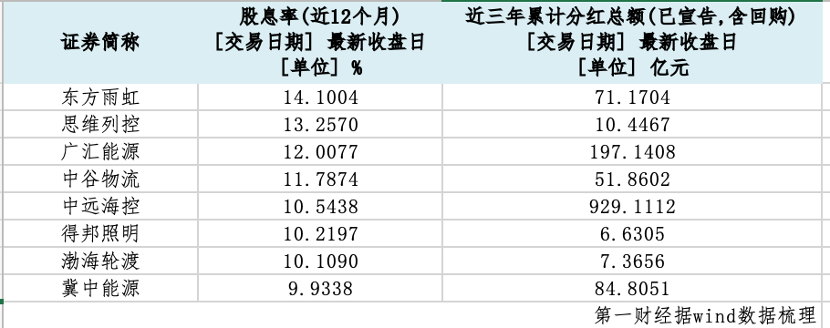
Group 1: Bank Sector Performance - The bank sector in A-shares is gaining attention, with major banks like China Bank and Construction Bank seeing significant stock price increases, with China Bank reaching a historical high [2] - As of November 20, 2023, the total market capitalization of the four major banks in A-shares exceeds 20 trillion yuan [2] - Hong Kong-listed banks are also performing well, with Minsheng Bank leading the gains [2] Group 2: Dividend Trends - A total of 24 out of 42 A-share listed banks have announced mid-term dividends, with a total payout of approximately 263.8 billion yuan, marking an increase from the previous year [2] - High dividend assets are becoming increasingly attractive, with 124 companies in A-shares having a dividend yield exceeding 5%, and 7 companies exceeding 10% [3][4] - The top three companies with the highest dividend yields are Dongfang Yuhong, Siwei Liekong, and Guanghui Energy, with yields of 14.1%, 13.25%, and 12% respectively [5][6] Group 3: Policy Support for Dividends - The regulatory environment is encouraging companies to increase dividend payouts, with the China Securities Regulatory Commission advocating for more frequent and stable dividends [7] - Companies are encouraged to adopt methods like "cancellation-based buybacks" to enhance returns to investors [7] Group 4: Characteristics of High Dividend Stocks - High dividend companies are typically found in stable sectors such as utilities, energy, telecommunications, and consumer staples, which are less affected by economic cycles [8][9] - These companies often have clear and stable dividend policies, viewing consistent dividends as a means to maintain credibility and attract long-term investors [9] Group 5: Risks Associated with High Dividend Strategies - High dividend strategies are not without risks, as some cyclical stocks may experience significant fluctuations in dividend yields [3][11] - There is a caution against "high dividend traps," where declining stock prices artificially inflate dividend yields, potentially indicating deteriorating fundamentals [3][12] - Investors are advised to be vigilant about companies that may use high dividends to attract investment while facing underlying financial pressures [12]

124家A股公司股息率超5%
第一财经· 2025-11-21 00:28
Core Viewpoint - The high dividend-paying stocks, particularly in the banking sector, are gaining attention in the market as they continue to show strong performance and increasing dividend payouts [3][4]. Group 1: Banking Sector Performance - On November 20, A-share banking stocks continued their strong performance, with China Bank (601988.SH) rising by 4%, reaching a historical high, while other major banks also saw increases of over 3% [3]. - The total market capitalization of the four major banks (ICBC, CCB, ABC, and BOC) in A-shares has exceeded 2 trillion yuan [3]. - In the Hong Kong market, Minsheng Bank (01988.HK) led the gains with over a 3% increase, while other banks also saw significant rises [3]. Group 2: Dividend Distribution - As of November 20, 24 out of 42 A-share listed banks have announced mid-term dividends totaling approximately 263.8 billion yuan, marking an increase from the previous year [3]. - High dividend assets are becoming increasingly attractive as deposit rates continue to decline, with many companies in various sectors offering dividends above 4% [7]. Group 3: High Dividend Stocks - There are currently 124 companies in the A-share market with a dividend yield exceeding 5%, with 7 companies yielding over 10% [4][6]. - The top three companies with the highest dividend yields are Dongfang Yuhong (002271.SZ) at 14.1%, Siwei Liekong (603508.SH) at 13.25%, and Guanghui Energy (600256.SH) at 12% [7][8]. - Among the 124 companies with yields over 5%, 85 have seen their stock prices rise in the past year, indicating the resilience of high dividend strategies in the current market [8]. Group 4: Policy Support for Dividends - The regulatory environment is encouraging companies to increase dividend payouts, with the China Securities Regulatory Commission advocating for more frequent and stable dividends [9]. Group 5: Long-term Dividend Trends - For the 2024 reporting period, the companies with the highest dividend yields include Haoxiangni (002582.SZ) at 16.91%, Meiyingsen (002303.SZ) at 15.95%, and Jinshi Technology (002951.SZ) at 14.97% [10][12]. - In 2023, the top dividend yielders were Libai Shares (603519.SH) at 15.34%, Rong'an Real Estate (000517.SZ) at 13.06%, and Yutong Bus (600066.SH) at 11.32% [10][12]. Group 6: Risks of High Dividend Strategies - High dividend strategies are not without risks, as some cyclical stocks may experience significant fluctuations in dividend yields [5]. - Investors should be cautious of "high dividend traps," where declining stock prices artificially inflate dividend yields, potentially indicating deteriorating fundamentals [5][15]. - The market has seen instances where companies maintain high dividends to attract investors despite underlying financial pressures [16][17].




财经早报:124家A股公司股息率超5% LPR连续6个月保持不变丨2025年11月21日
Xin Lang Zheng Quan· 2025-11-21 00:25
Group 1 - The U.S. stock market experienced significant volatility, with the S&P 500 recording its worst day since April, driven by concerns over interest rate cuts and rising risk aversion among investors [2] - The U.S. non-farm payroll data for September exceeded expectations, with an increase of 119,000 jobs compared to the forecast of 50,000, indicating a mixed signal for the labor market [3] - The unemployment rate for September was reported at 4.4%, slightly above the expected 4.3%, suggesting potential challenges for the Federal Reserve in deciding on future monetary policy [3] Group 2 - Trump's 28-point peace plan for Ukraine requires Kyiv to relinquish more territory and agree to never join NATO, which has been met with skepticism from Ukrainian officials [4] - The plan is being pushed by the U.S. for a rapid agreement, despite some terms being previously rejected by Ukraine [4] Group 3 - The stock of Haixia Innovation will resume trading on November 21 after completing a self-examination related to trading volatility [5] - The IPO price for Moer Thread has been set at 114.28 yuan per share, with an estimated market capitalization of approximately 53.715 billion yuan upon listing [6][7] Group 4 - A total of 124 A-share companies have a dividend yield exceeding 5%, with seven companies yielding over 10%, indicating a trend towards high dividend stocks in various sectors [8] - High dividend stocks are concentrated in stable industries such as finance, utilities, and telecommunications, providing a buffer against market volatility [8] Group 5 - The LPR (Loan Prime Rate) has remained unchanged for six consecutive months, with the one-year LPR at 3.0% and the five-year LPR at 3.5%, aligning with market expectations [9] Group 6 - Michael Burry continues to criticize Nvidia and the broader AI hype, despite Nvidia's record earnings and optimistic forecasts for future revenue growth [10] - Nvidia's CFO projected that revenue from AI infrastructure could reach $0.5 trillion by 2025 and 2026, with annual investments in AI infrastructure expected to hit $3 to $4 trillion by 2030 [10] Group 7 - Vanke's recent shareholder meeting authorized the board to provide guarantees for loans from Shenzhen Metro Group, totaling 22 billion yuan, indicating strong support from the major shareholder [11] - Goldman Sachs raised the target price for Zhongji Xuchuang to 762 yuan, anticipating a compound annual growth rate of 59% in net profit from 2025 to 2028, driven by demand for high-speed connectivity [12] Group 8 - Wenta Technology issued a statement demanding the restoration of its rights regarding the control of Nexperia, emphasizing the need for a comprehensive resolution to the semiconductor issue [13][14]


124家A股公司股息率超5%,历年高股息“牛股”含金量如何?
Di Yi Cai Jing· 2025-11-20 11:20
Group 1: Bank Sector Performance - The bank sector is becoming a market focus, with A-share banks showing strong performance, particularly China Bank, which rose 4% to reach a historical high [1] - As of November 20, the total market capitalization of the four major banks in A-shares has exceeded 2 trillion yuan [1] - In the Hong Kong market, Minsheng Bank led gains with over 3% increase, while other banks also saw significant rises [1] Group 2: High Dividend Stocks - There are currently 124 companies in A-shares with a dividend yield exceeding 5%, with 7 companies yielding over 10% [2][3] - The top three companies with the highest dividend yields are Dongfang Yuhong (14.1%), Siwei Liekong (13.25%), and Guanghui Energy (12%) [3][4] - High dividend stocks are not limited to the banking sector but are also found in utilities, energy, and telecommunications, providing a buffer against market volatility [2][3] Group 3: Dividend Distribution Trends - As of November 20, 24 out of 42 A-share listed banks have announced mid-term dividends totaling approximately 263.8 billion yuan, marking an increase from the previous year [1] - Regulatory bodies are encouraging companies to enhance shareholder returns through measures like "cancellation-style buybacks" and multiple annual dividends [5] Group 4: Long-term Dividend Trends - For the 2024 reporting period, the companies with the highest projected dividend yields are Haoxiangni (16.91%), Meiyingsen (15.95%), and Jinshi Technology (14.97%) [6] - In 2023, the top dividend yielders included Libai Co. (15.34%), Rong'an Real Estate (13.06%), and Yutong Bus (11.32%) [7][8] Group 5: Characteristics of High Dividend Companies - High dividend companies are typically found in stable sectors like utilities, energy, telecommunications, and consumer staples, which are less affected by economic cycles [8] - These companies often have clear and stable dividend policies, viewing consistent dividends as a means to maintain credibility and attract long-term investors [8] Group 6: Risks Associated with High Dividend Strategies - High dividend strategies may carry risks, as some companies with high yields may face declining performance or debt issues [10][12] - The phenomenon of "high dividend traps" can occur when a company's stock price falls, artificially inflating the dividend yield without a corresponding increase in earnings [12]




2026&2025年电煤中长协政策对比点评:向市场化方向微调
Guohai Securities· 2025-11-20 11:15
Investment Rating - The industry investment rating is "Recommended" (maintained) [1] Core Viewpoints - The report indicates a slight adjustment towards market-oriented policies in the long-term coal supply contracts for 2026 compared to 2025, with both quantity and price aspects moving closer to market mechanisms [2][7] - The signing volume for coal enterprises is set to be no less than 75% of their own resource volume, while for power generation enterprises, the minimum signing volume should be at least 80% of the demand [2] - The fulfillment rates have been relaxed slightly, with monthly fulfillment remaining at no less than 80%, quarterly fulfillment now being generally no less than 90%, and annual fulfillment also generally no less than 90% [2] - The pricing mechanism for long-term contracts may begin to reference indices, with a monthly adjustment mechanism established for the pricing of coal from production areas [3][4] - The report emphasizes that the coal mining industry continues to show a long-term upward price trend driven by factors such as rising labor costs, increased safety and environmental investments, and higher taxation by local governments [8] Summary by Sections Policy Changes - The 2026 policy document indicates that contracts for coal from production areas must align with reasonable price ranges and establish a monthly adjustment mechanism through negotiation between supply and demand enterprises [3] - The pricing for long-term contracts for coal remains unchanged, with a base price set at current levels [4] Market Performance - As of November 19, 2025, the coal mining sector has shown a performance of 2.3% over one month, 11.3% over three months, and 0.2% over twelve months, compared to the Shanghai and Shenzhen 300 index which recorded 1.6%, 8.6%, and 15.4% respectively [5] Investment Recommendations - The report suggests focusing on robust companies such as China Shenhua, Shaanxi Coal, and others, highlighting their strong cash flow and high asset quality [8] - Specific recommendations include: - Steady stocks: China Shenhua, Shaanxi Coal, and others - Stocks with greater elasticity in thermal coal: Yanzhou Coal, Jinko Energy, and others - Stocks with greater elasticity in coking coal: Huaibei Mining, Pingdingshan Coal, and others [8] Earnings Forecasts - The report provides earnings per share (EPS) and price-to-earnings (PE) ratios for key companies, indicating a positive outlook for several coal enterprises [10]



2025年1-9月新疆维吾尔自治区工业企业有5472个,同比增长9.7%
Chan Ye Xin Xi Wang· 2025-11-20 03:41
Group 1 - The core viewpoint of the article highlights the growth of industrial enterprises in the Xinjiang Uygur Autonomous Region, with a total of 5,472 enterprises reported as of January to September 2025, marking an increase of 484 enterprises compared to the same period last year, representing a year-on-year growth of 9.7% [1][1][1] Group 2 - The report indicates that the number of industrial enterprises in Xinjiang accounts for 1.05% of the national total [1][1][1] - The data referenced in the article is sourced from the National Bureau of Statistics and compiled by Zhiyan Consulting [1][1][1] - Zhiyan Consulting is recognized as a leading industry consulting firm in China, specializing in in-depth industry research reports, business plans, feasibility studies, and customized services [1][1][1]
