长城汽车

Search documents
多家车企1月销量出炉 出口成拉动销量重要因素
Zhong Guo Zhi Liang Xin Wen Wang· 2026-02-05 05:41
转自:中国质量报 多家车企1月销量出炉 出口成拉动销量重要因素 □ 本报记者 岳 倩 近日,多家车企陆续披露新年首月销量数据。整体来看,1月车企销量呈现出同比稳健上升、环比回落 的特征,新能源车与燃油车、新势力与传统品牌的市场表现呈现出结构性分化趋势。在国内存量竞争日 趋白热化的背景下,出口成为车企拉动整体销量、对冲国内市场波动的增长极。 据了解,车企往往选择在年底刺激销量,大部分车企2025年12月的销量基数较高。此外,1月为传统汽 车销售淡季,叠加新能源汽车购置税补贴退坡、以旧换新和报废补贴规则修改等政策换挡影响,因此, 大部分车企出现"环比下滑"的趋势符合市场规律。 传统车企的销量数据显示,有燃油车业务板块的车企在一定程度上对冲了风险,1月表现相对稳健;同 时,海外市场已经成为销量的重要增长极。 央国企方面,上汽集团实现整车批售32.7万辆,同比增长23.9%,环比下降约18.03%;海外销售10.5万 辆,同比增长51.7%。广汽集团销售汽车11.66万辆,同比增长18.47%,环比下滑37.79%,海外销量同比 增长68.59%。 民营企业方面,吉利汽车销量为27.02万辆,同比增长1.29%,环比 ...




“围剿”中国工厂
3 6 Ke· 2026-02-05 05:27
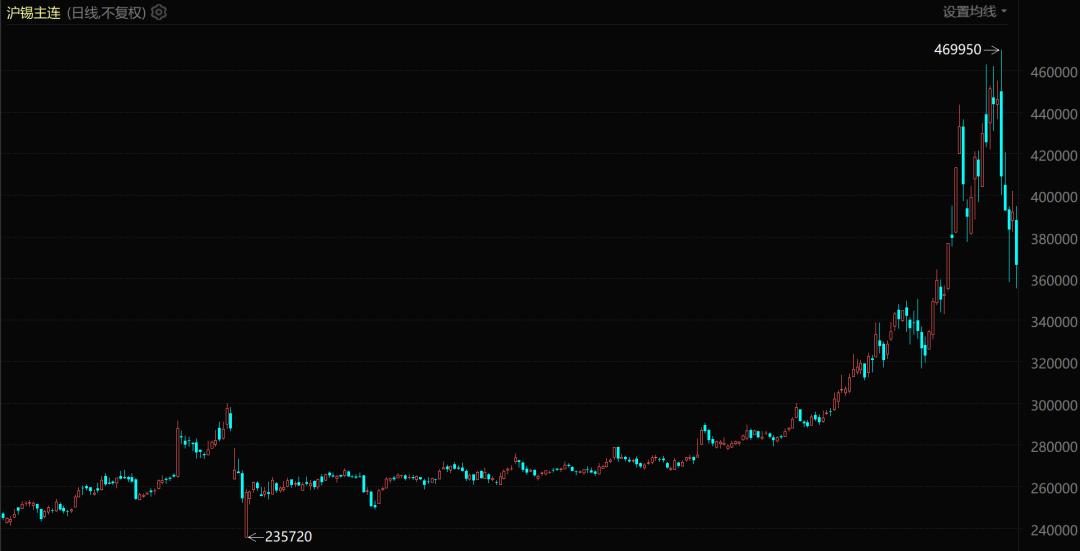
Core Viewpoint - The surge in metal prices, particularly copper, is significantly impacting downstream manufacturing industries in China, leading to squeezed profit margins for manufacturers while upstream companies benefit from rising raw material prices [3][5][9]. Group 1: Price Surge in Raw Materials - In 2025, copper prices increased by 34.34%, and the upward trend continued into 2026 [2]. - The price of lithium carbonate, essential for electric vehicle batteries, skyrocketed from 75,700 yuan per ton in January 2025 to 175,250 yuan per ton by January 23, 2026, marking a 131.4% increase [7]. - Tungsten concentrate prices surged to 520,000 yuan per ton, while tungsten carbide prices rose from approximately 300,000 yuan per ton to 1,200,000 yuan per ton [7]. Group 2: Impact on Manufacturing Industries - The home appliance industry is heavily affected by rising copper prices, with copper accounting for over 20% of the total cost of air conditioners. The copper price reached 105,020 yuan per ton in February 2026, up 42.25% from early 2025, leading to an 8.45% increase in air conditioner costs [10]. - The electric vehicle industry faces significant cost inflation, with UBS reporting that the cost increase for pure electric vehicles (BEVs) due to metal prices alone is approximately 5,600 yuan per vehicle, primarily driven by lithium price increases [12]. - The automotive industry's single vehicle gross profit was only 13,000 yuan in 2025, making it challenging for manufacturers to pass on rising costs to consumers amid fierce competition [13]. Group 3: Upstream vs. Downstream Dynamics - Upstream mining companies are experiencing explosive profit growth due to rising raw material prices, with Zijin Mining forecasting a net profit of 51 to 52 billion yuan for 2025, a year-on-year increase of 59% to 62% [8]. - In contrast, manufacturing companies are facing unprecedented cost pressures, leading to a decline in profit margins. The manufacturing sector's profit margin was only 4.7% in 2025, compared to 15.9% for the mining sector [21][19]. - The overall revenue of China's industrial enterprises has been increasing, but profit margins have been declining, indicating a challenging environment for manufacturers [19][21]. Group 4: Strategies for Survival and Growth - Many Chinese manufacturing companies are exploring ways to extend their business scope internationally, moving beyond low-end products to high-value items like electric vehicles and industrial robots [24]. - Some companies are actively integrating vertically by acquiring upstream resources, such as copper mines, to mitigate the impact of rising raw material prices [24]. - Technological advancements are also being pursued, with companies investing in alternatives to reduce dependency on expensive raw materials, such as the development of sodium-ion batteries [26].







后续车市销量展望
数说新能源· 2026-02-05 04:47
Core Viewpoint - The article discusses the sales performance and market dynamics of the new energy vehicle (NEV) sector in January 2026, highlighting a slowdown in sales due to various factors including consumer behavior and regulatory impacts [5][10]. Group 1: January Sales Analysis - January 2026 passenger car sales are expected to be around 1.7 to 1.75 million units, falling short of market expectations [5]. - The NEV penetration rate in January is projected to be approximately 10 percentage points higher than the same period last year, but shows a decline compared to December [5]. - Consumer sentiment is characterized by a "buy new, not old" mentality, leading to delayed purchasing decisions [5]. Group 2: Market Structure Characteristics - In January, high-end luxury fuel vehicles and economy fuel vehicles under 100,000 yuan performed relatively well, while NEVs impacted fuel vehicles in the same price range [5]. - February sales are expected to decline by about 30% compared to January due to the Spring Festival holiday [5]. - March is anticipated to recover to January's sales levels, with an estimated 30% increase from February [5]. Group 3: Pricing and Regulatory Trends - The pricing strategy for new vehicles in 2026 is focused on "adding features, stabilizing prices, or slight increases," rather than price reductions [6]. - Regulatory measures are tightening, impacting marketing, safety, and pricing practices within the industry [6]. - The regulatory environment is expected to shift the industry focus from rapid iteration and price wars to product quality, brand reputation, and long-term value [6]. Group 4: New Product Launches and Future Outlook - Major automakers like BYD and Geely are set to launch a series of new models in the first half of 2026, with a focus on high voltage, long range, and enhanced smart features [9][10]. - The overall sales growth for 2026 is projected to slow down to single digits, influenced by high base figures and stable subsidy policies [10]. - The industry is expected to see a more stable monthly sales model, reducing the volatility seen in previous years [8][10].


自由现金流ETF中证全指(561080)跌1.55%,半日成交额840.67万元
Xin Lang Cai Jing· 2026-02-05 03:44
Group 1 - The Freedom Cash Flow ETF CSI All Index (561080) closed down 1.55% at 1.330 yuan with a trading volume of 8.4067 million yuan [1] - Major holdings in the ETF include China National Offshore Oil Corporation (CNOOC) down 1.12%, SAIC Motor up 0.14%, Gree Electric Appliances down 0.33%, COSCO Shipping Holdings up 0.07%, Muyuan Foods down 0.15%, Aluminum Corporation of China down 6.77%, TCL Technology down 0.61%, Baosteel down 1.52%, Great Wall Motors up 1.06%, and Chint Electric down 4.14% [1] - The ETF's performance benchmark is the CSI All Index Free Cash Flow Index, managed by Huaan Fund Management Co., Ltd. The fund has returned 35.06% since its inception on April 23, 2025, and 7.11% over the past month [1]



2025年1-12月河北省工业企业有18559个,同比增长0.18%
Chan Ye Xin Xi Wang· 2026-02-05 03:25
Group 1 - The core viewpoint of the article highlights the growth of industrial enterprises in Hebei Province, with a total of 18,559 enterprises projected for the year 2025, reflecting a year-on-year increase of 34 enterprises or 0.18% growth compared to the previous year [1][1][1] - The report indicates that the number of industrial enterprises in Hebei accounts for 3.53% of the national total [1][1][1] - The data referenced in the article is sourced from the National Bureau of Statistics and compiled by Zhiyan Consulting, a leading industry consulting firm in China [1][1][1] Group 2 - The article mentions specific companies related to the industrial sector, including Jizhong Energy, Kailuan Shares, and Xin'ao Shares, among others [1][1][1] - Zhiyan Consulting has been engaged in industry research for over a decade, providing comprehensive industry research reports and consulting services [1][1][1] - The report titled "2026-2032 China Industrial Cloud Industry Market Deep Assessment and Investment Opportunity Forecast" is highlighted as a relevant document for understanding market trends [1][1][1]

1月车市观察:第一名卖了27万辆,但真正的故事在海外
3 6 Ke· 2026-02-05 03:05
Core Viewpoint - The automotive market is currently experiencing a sales downturn, particularly in the electric vehicle (EV) segment, due to a combination of factors including a shift in vehicle purchase tax policy and seasonal demand fluctuations [1][3][4]. Market Performance - In January, nationwide retail sales of passenger vehicles reached 1.794 million units, reflecting a year-on-year decline of 12.1% and a month-on-month drop of 31.9% [3]. - The performance of major automotive brands showed a pattern of "year-on-year differentiation and month-on-month decline," with domestic brands benefiting from their EV offerings while facing pressure from the tax policy change [3][4]. Domestic Brand Performance - Geely Auto topped domestic sales in January with 270,200 units sold, achieving a year-on-year growth of 1% and a month-on-month increase of 14% [5]. - SAIC Group reported sales of 327,400 units, a year-on-year increase of 23.9%, while its domestic brand sales reached 214,000 units, up 39.6% year-on-year [6]. - GAC Group's sales were 116,600 units, marking an 18.47% year-on-year increase, with its domestic brands showing explosive growth [6]. Joint Venture Brands - Major joint venture brands like GAC Toyota and SAIC General saw a recovery in January, with GAC Toyota selling 63,600 units, a nearly 10% year-on-year increase [9][11]. - SAIC General's sales reached 51,000 units, up 8.2% year-on-year, driven by strong performance in its EV and export segments [11][12]. Export Growth - The overseas market has emerged as a significant growth driver for domestic automakers, with many companies reporting export growth rates exceeding 40% [13][14]. - Chery Group exported 119,600 units in January, a 48.1% year-on-year increase, maintaining its position as the top exporter in China [14]. - Geely's overseas sales reached 60,500 units, reflecting a staggering year-on-year growth of 121% [16]. Industry Trends - The overall trend indicates that by 2026, China's automotive export volume is expected to reach 7.4 million units, with EV exports projected to exceed 30% of total exports [17].

平安证券(香港)港股晨报-20260205



Ping An Securities Hongkong· 2026-02-05 02:59
Market Overview - The Hong Kong stock market showed mixed performance with the Hang Seng Index closing at 23,831 points, down 145 points or 0.61% [1] - The market turnover decreased to 82.799 billion [1] - The net inflow of funds through the Hong Kong Stock Connect was 484 million, with Shanghai Stock Connect contributing 283 million and Shenzhen Stock Connect 201 million [1] Sector Performance - Energy and real estate sectors performed well, with coal-related assets rising due to supply constraints from Indonesia, leading to Yanzhou Coal Mining increasing over 10% and China Shenhua Energy rising over 5% [1] - Domestic property stocks also saw gains, with Shimao Group up over 14%, Sunac China up over 8%, Vanke up over 6%, and Yuexiu Property up over 6% [1] - Conversely, chip and tech stocks declined, with Shanghai Fudan down over 5%, Hua Hong Semiconductor down nearly 5%, and Tencent Holdings down nearly 4% [1] US Market Performance - The US stock market had mixed results, with the Dow Jones up 0.53%, while the S&P 500 and Nasdaq fell by 0.51% and 1.51% respectively [2] - Notable gainers included Amgen, which rose over 8%, and Nike, which increased by over 5% [2] - The tech sector faced challenges, with the Nasdaq China Golden Dragon Index down 1.95% and major chip stocks like AMD dropping over 17% [2] Investment Opportunities - The report emphasizes the importance of "technological self-reliance" and AI applications as key themes for future growth in the Hong Kong stock market, suggesting that leading companies in these sectors may see medium to long-term development opportunities [3] - It is recommended to focus on sectors supported by policies aimed at expanding domestic consumption, such as sports apparel and non-essential services [3] - The report highlights the continued value of Hong Kong stocks centered around Chinese assets, particularly in technology, consumer sectors, and undervalued state-owned enterprises [3] Company Highlights - ZTE Corporation (0763.HK) is noted for its comprehensive communication manufacturing capabilities, with a projected revenue of 121.299 billion for 2024, despite a slight decline [10] - The company maintains a high gross margin of 37.91% and is expected to see significant growth in its server and storage revenue, particularly in the AI computing sector [10] - Analysts predict ZTE's net profits for 2025 and 2026 to be 7.98 billion and 8.81 billion RMB respectively, indicating a relatively low valuation compared to its earnings potential [10]
2026车市开局即洗牌:车企“画大饼”,市场“泼冷水”
投中网· 2026-02-05 02:33
Core Viewpoint - The Chinese automotive market in 2026 is experiencing a significant divide, with mainstream automakers setting ambitious sales targets despite a harsh start to the year, indicating a period of adjustment and competition [4][5][10]. Group 1: Market Performance and Predictions - The retail sales of narrow passenger cars are projected to be approximately 1.8 million units in January, reflecting a month-on-month decline of 20.4% and a year-on-year increase of only 0.3% [4]. - The penetration rate of new energy vehicles has decreased to 44.4%, down from previous highs [4]. - Major automakers have set a collective sales target of 23.8 million units for 2026, representing a year-on-year increase of 19% compared to 20 million units in 2025 [7]. Group 2: Strategic Goals and Market Dynamics - Automakers are setting high growth targets to maintain valuations and secure financing, with companies like Leap Motor aiming for a 67.5% increase to 1 million units, and Xiaomi targeting 550,000 units, a 34% increase [8][9]. - The competitive landscape is intensifying, with a clear divide emerging between leading, mid-tier, and struggling automakers, as highlighted by the predictions of accelerated industry consolidation [17]. Group 3: Company-Specific Insights - Geely topped the sales chart in January with 270,000 units, a 1% year-on-year increase, while BYD faced a strategic adjustment with a 30% decline in sales to 210,000 units [12][13]. - Chery's sales were bolstered by exports, with nearly 60% of its 200,000 units sold overseas, highlighting a reliance on international markets amid domestic challenges [13]. - New entrants like Huawei and Xiaomi are gaining traction, with Huawei's AITO brand delivering 57,900 units in January, a 65.6% increase, while Xiaomi delivered over 39,000 units [15]. Group 4: Future Outlook and Industry Trends - The automotive market is expected to see intensified competition, with new vehicle launches and innovative marketing strategies aimed at stimulating demand [16]. - The ongoing consolidation will likely favor companies with strong product capabilities and clear strategies, while those with lower sales volumes may struggle to survive [17]. - The performance of automakers in 2026 will be assessed not just by sales targets but also by their strategic resilience and operational efficiency in navigating market cycles [17].

海外市场成车企销量关键支撑
Jin Rong Shi Bao· 2026-02-05 02:31
Core Insights - In January 2026, the Chinese automotive market entered a traditional off-season, with new energy vehicle (NEV) companies facing significant sales pressure and a reshuffling of the sales rankings [1][2] New Energy Vehicle Sales Dynamics - Hongmeng Zhixing topped the new energy vehicle sales in January with 57,915 units delivered, marking a 65.6% year-on-year increase [2] - Xiaomi Auto delivered over 39,000 units, with a focus on the YU7 model as the initial SU7 model has been phased out [2] - Leap Motor delivered 32,059 units, a 27% year-on-year increase, but showed a notable month-on-month decline [2] - Li Auto's deliveries were 27,668 units, experiencing both year-on-year and month-on-month declines due to delays in the i6 model's delivery [3] - NIO delivered 27,182 units, a 96.1% year-on-year increase, with the new ES8 model performing exceptionally well [3] - XPeng Motors delivered 20,011 units, facing declines as it is in a product iteration phase [3] Traditional Automakers' Performance - BYD achieved total NEV sales of 210,051 units in January, with exports reaching 100,482 units, a 51.47% year-on-year increase [4] - Chery Group exported 119,605 vehicles, a 48.1% year-on-year increase, maintaining its position as a leading exporter [4] - SAIC Group sold 327,413 vehicles, a 23.9% year-on-year increase, with a significant rise in overseas sales [4] - Geely's total sales reached 270,167 units, with a notable increase in exports, achieving a doubling in export numbers [4] - Great Wall Motors sold 90,312 vehicles, with overseas sales growing by 43.77% [5] Market Trends and Future Outlook - The decline in market demand is attributed to changes in the new energy vehicle purchase tax policy and the release of pent-up demand from 2025 [5] - Analysts suggest that the domestic passenger car market's growth momentum will shift towards overseas markets, with companies focusing on international expansion as a core growth strategy [5]
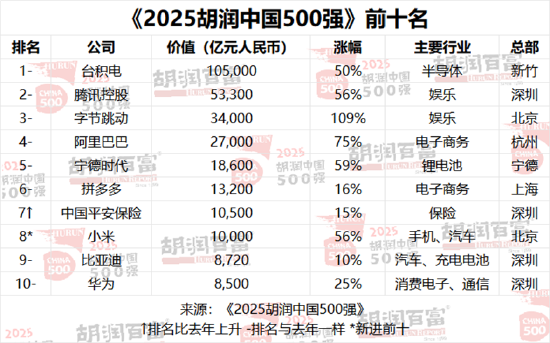
2025胡润中国500强发布:台积电、腾讯、字节跳动位列前三
Xin Lang Cai Jing· 2026-02-05 02:27
Core Insights - The 2025 Hurun China 500 list shows significant growth in company valuations, with TSMC leading as the highest valued private enterprise in China at 10.5 trillion RMB, followed by Tencent and ByteDance [1][9]. Company Performance - TSMC's value increased by 3.5 trillion RMB, driven by strong demand for artificial intelligence, advanced process technology, and a solid market position [3][11]. - Tencent's valuation rose by 1.9 trillion RMB, attributed to strong performance in gaming, advertising, and fintech [3][11]. - ByteDance's value grew by 1.8 trillion RMB, benefiting from advancements in AI [3][11]. - Alibaba's value increased by 1.2 trillion RMB, due to strategic investments in AI and cloud computing, alongside a recovery in traditional e-commerce [4][12]. - CATL's valuation rose by 690 billion RMB, supported by sustained demand in the electric vehicle market [4][12]. - Xiaomi entered the top ten with a valuation increase of 357 billion RMB, driven by growth in its automotive business and premium smartphone sales [4][12]. - Other notable companies include Cambricon, which saw a valuation increase of 370 billion RMB, and NetEase, which grew by 238 billion RMB due to strong gaming performance [4][12]. Industry Trends - The total value of the Hurun China 500 companies increased by 21 trillion RMB (38%) to reach 77 trillion RMB [2][10]. - The semiconductor industry experienced the most significant growth, surpassing the life sciences sector to become the second-largest industry in the list, while industrial products remained the largest [2][10]. - The real estate sector faced the largest decline, followed by retail [2][10]. - The average age of the top 500 companies is 29 years, indicating a relatively young corporate landscape [11]. Geographic Insights - Beijing, Shanghai, and Shenzhen are the top three cities with the most companies on the list, housing 59, 57, and 49 companies respectively [2][10]. - Suzhou emerged as the preferred manufacturing base with 68 companies, while Shanghai was the leading research and development hub with 101 companies [2][10]. New Entrants and Market Dynamics - A total of 95 companies (19%) made it to the list for the first time, with seven companies valued over 100 billion RMB [2][10]. - The threshold for entry into the 2025 Hurun China 500 increased by 7.5 billion RMB to 34 billion RMB, reflecting a 28% rise [2][10].