协鑫科技

Search documents
商业航天产业链观察系列一:太空算力:以星辰为节点,筑算力新接口
Changjiang Securities· 2026-02-23 08:52
Investment Rating - The report suggests a focus on the space computing industry chain, particularly on upstream and downstream core segments, indicating a positive investment outlook for the sector [8]. Core Insights - Space computing represents a new paradigm of deploying computational facilities in Earth's orbit, transforming the traditional "ground-based computing" into "space-based computing" by utilizing distributed orbital computing clusters [5][6]. - The advantages of space computing include the use of continuous solar energy and near-absolute zero cooling environments, which effectively address the energy and heat dissipation bottlenecks faced by ground data centers [6][7]. - The U.S. is leading the charge with technology companies driving advancements, while China is following a government-led approach with collaborative development across academia and industry [7][8]. Summary by Sections Space Computing Overview - Space computing is characterized by the deployment of computational infrastructure in orbit, leveraging radiation-resistant chips and inter-satellite laser communication to create distributed computing clusters [5][13]. - This model allows satellites to evolve from mere data relays to intelligent nodes, enabling real-time data processing and decision-making in orbit, significantly reducing transmission delays [6][16]. Market Dynamics - The rise of space computing is driven by the exponential growth in global computing demand, particularly under the influence of AI, while traditional data centers face significant energy and cooling challenges [6][24]. - The market for space computing is projected to reach $100 billion by 2030, with a recommendation to focus on key segments such as rocket and satellite manufacturing, laser communication, and space computing chip suppliers [8][24]. Competitive Landscape - Major players in the U.S. include SpaceX, which is developing large-scale space data centers, and other tech giants like Google and Amazon exploring space computing ecosystems [7][8]. - In China, significant projects are underway, including the Beijing GW-level space data center and the "Three-Body Computing Constellation" initiative, indicating a robust governmental push towards space computing [7][8]. Investment Recommendations - The report emphasizes the importance of monitoring the entire space computing industry chain, particularly focusing on core suppliers in rocket and satellite manufacturing, laser communication, and space photovoltaic suppliers [8][24]. - Specific companies recommended for investment include leading firms in laser communication and space photovoltaic technologies, as well as suppliers for SpaceX and space computing chips [8].
港股光伏股多数回暖 信义光能涨5.38%
Mei Ri Jing Ji Xin Wen· 2026-02-23 06:59
Group 1 - The Hong Kong solar stocks are experiencing a rebound, with several companies showing significant gains [1] - Xinyi Solar (00968.HK) increased by 5.38%, reaching HKD 3.72 [1] - Junda Co. (02865.HK) rose by 4.95%, trading at HKD 38.2 [1] Group 2 - Flat Glass Group (06865.HK) saw an increase of 4.82%, with shares priced at HKD 11.96 [1] - Kaisheng New Energy (01799.HK) gained 4.1%, with a share price of HKD 3.27 [1] - GCL-Poly Energy (03800.HK) experienced a rise of 2.48%, trading at HKD 1.24 [1]

港股异动 | 光伏股多数回暖 我国光伏产业保持快速发展势头 机构称26年产业链有望实现扭亏
智通财经网· 2026-02-23 06:45
Core Viewpoint - The photovoltaic sector is experiencing a rebound, with several stocks showing significant gains following the release of positive data from the National Energy Administration regarding solar power capacity growth in China [1] Group 1: Stock Performance - Xinyi Solar (00968) increased by 5.38%, trading at HKD 3.72 [1] - Junda Co., Ltd. (02865) rose by 4.95%, trading at HKD 38.2 [1] - Flat Glass Group (06865) saw a rise of 4.82%, trading at HKD 11.96 [1] - Kstar New Energy (01799) increased by 4.1%, trading at HKD 3.27 [1] - GCL-Poly Energy (03800) rose by 2.48%, trading at HKD 1.24 [1] Group 2: Industry Growth Projections - By 2025, China's new photovoltaic installed capacity is projected to reach 317 million kilowatts, representing a year-on-year growth of 14% [1] - Of this, centralized photovoltaic installations are expected to contribute 164 million kilowatts, while distributed photovoltaic installations are expected to add 153 million kilowatts [1] - By December 2025, the total installed capacity for photovoltaic power generation in China is anticipated to reach 1.2 billion kilowatts, reflecting a year-on-year increase of 35% [1] Group 3: Market Dynamics and Future Outlook - Guoyuan Securities indicates that since July 2025, China's "anti-involution" measures have improved the photovoltaic industry's prosperity [1] - Price control and supply-side clearing are expected to drive profitability recovery in the industry, with some tail-end companies exiting the market and leading firms enhancing efficiency through technological upgrades [1] - The photovoltaic industry chain is projected to achieve profitability by 2026, with AI computing power construction potentially creating rigid electricity demand, suggesting that global photovoltaic demand may exceed expectations [1]
江苏徐州:产业链上“春意浓”,创新发展“动力足”
Xin Lang Cai Jing· 2026-02-21 11:04
Core Viewpoint - The XuZhou Economic Development Zone is focusing on innovation-driven development, enhancing industrial chains, and fostering a robust ecosystem of enterprises to achieve high-quality growth and modernization of industries [3][5][9]. Group 1: Company Developments - Bodin Power (Jiangsu) Co., Ltd. is in the final stages of debugging a 15-liter natural gas engine project, expected to commence mass production by the end of February, contributing an estimated 100 million yuan in output with 2,000 orders in hand [1]. - The intelligent workshop of Yanfeng Automotive Trim Systems XuZhou Co., Ltd. utilizes over 40 automated devices to produce smart panel trim with integrated touch and lighting functions, positioning itself as a supplier for well-known brands [3]. Group 2: Industrial Strategy - The XuZhou Economic Development Zone has initiated an "Innovation-Driven Year" with three major action plans focusing on "Artificial Intelligence+", strengthening and extending industrial chains, and nurturing enterprises [3]. - The zone aims to attract both large and small projects to solidify key segments of the industrial chain, fill gaps, and enhance the overall industrial ecosystem [3][5]. Group 3: Innovation and Growth - XuZhou Economic Development Zone is committed to systematic thinking and innovative implementation to optimize traditional industries while nurturing emerging sectors, thereby enhancing resource efficiency and policy integration [5]. - The zone has established a strong foundation for innovation, housing major enterprises like XCMG and GCL, along with several high-tech and innovative firms, and numerous national and provincial research institutions [5][7]. Group 4: Enterprise Ecosystem - The zone currently hosts 200 high-tech enterprises, 8 national-level specialized "little giant" companies, and 73 provincial-level specialized small and medium enterprises, forming a "geese formation" of industrial development [7]. - Companies like XCMG Power Battery and Xinhua Semiconductor are leading in their respective fields, with Xinhua being the largest domestic and third-largest global producer of semiconductor silicon materials [7]. Group 5: Future Goals - The XuZhou Economic Development Zone aims to strengthen leading enterprises, foster quality and innovative companies, and support small and micro enterprises to create a diverse industrial ecosystem [9]. - The goal is to achieve significant breakthroughs and scalable industrialization, moving from initial concepts to full-scale production [9].

电力设备新能源行业2026年投资策略报告:驭风逐光,破卷新章
Guoyuan Securities· 2026-02-12 04:25
Group 1: Photovoltaic Industry - The photovoltaic industry is expected to recover from losses in 2026, driven by supply-side reforms and increased demand from AI infrastructure, with a potential for exceeding global demand expectations[1] - In 2025, China's photovoltaic installations reached 315.07 GW, a year-on-year growth of 13.67%, despite a significant drop in December's installations by 43% compared to the previous year[14] - The average price of polysilicon increased by over 50% from June to November 2025, indicating a recovery in pricing dynamics within the industry[22] Group 2: Wind Power Industry - The wind power sector is experiencing a favorable supply-demand balance, with significant growth expected in offshore wind installations and exports in 2026[1] - Wind power bidding has maintained high levels of activity since 2025, indicating a robust market outlook for domestic wind power growth[1] - The offshore wind market is projected to become a key growth area, with increasing demand for domestic and international projects[1] Group 3: Electric Vehicle Market - In 2025, China's new energy vehicle sales reached 16.49 million units, reflecting a year-on-year growth of 28.2%, continuing the industry's rapid development[2] - The prices of key materials for electric vehicles, such as lithium hexafluorophosphate and vinyl carbonate, surged by 222.67% and 254.21% respectively in the second half of 2025, contributing to improved profitability in the sector[2] - The industry is entering a new phase of quality improvement and efficiency enhancement, driven by technological innovations and supply chain autonomy[2] Group 4: Investment Recommendations - For photovoltaic investments, focus on leading companies with technological and cost advantages, such as GCL-Poly Energy and JA Solar[3] - In the wind power sector, recommend investing in turbine manufacturers like Goldwind Technology and cable companies like Orient Cable, which are well-positioned for growth[3] - In the lithium battery sector, prioritize companies with improving profitability, such as CATL and Guoxuan High-Tech, as the market recovers[8]
国元证券:光伏板块向上趋势明确 风电“海风+出海”迎景气上行
Zhi Tong Cai Jing· 2026-02-12 04:05
Group 1: Photovoltaics - The supply-side clearing and production restrictions in the photovoltaic industry are expected to accelerate, leading to a clear upward trend in the sector [2] - The dual effects of price control and supply-side clearing are likely to drive industry profitability recovery, with some tail-end companies exiting the market [2] - The global photovoltaic demand may exceed expectations due to AI computing power construction and the "14th Five-Year Plan" supporting photovoltaic installations [2] Group 2: Wind Power - The supply-demand structure of the wind power industry in China is reasonable, with good profitability among listed companies [3] - The construction of offshore wind power is expected to accelerate in 2025, becoming a key focus for the marine economy [3] - The wind power bidding has maintained a high level of activity since 2025, indicating a favorable outlook for the industry [3] Group 3: New Energy Vehicles - In 2025, China's new energy vehicle sales are projected to reach 16.49 million units, reflecting a year-on-year growth of 28.2% [4] - The industry is experiencing a recovery in profitability due to effective control of disorderly expansion on the supply side [4] - The second half of 2025 will see significant price increases for key materials, contributing to overall profitability recovery in the sector [4] Group 4: Investment Recommendations - For photovoltaics, focus on leading silicon material and battery component companies with technological and cost advantages, as well as firms leading in production equipment and high-demand auxiliary material companies [5] - In wind power, attention should be given to turbine manufacturers and companies involved in subsea cable production, as well as those in the offshore wind installation sector [5] - In the lithium battery sector, key companies include CATL and others benefiting from the recovery of midstream material prices [6]

电力设备新能源行业2026年投资策略报告:驭风逐光,破卷新章-20260212
Guoyuan Securities· 2026-02-12 02:46
Group 1: Photovoltaic Industry - The photovoltaic industry is experiencing a clear upward trend due to supply-side clearing and demand-side support, with expectations of profitability recovery in 2026 as inefficient companies exit the market and leading firms enhance efficiency through technological upgrades [1][14] - In 2025, China's photovoltaic industry saw a significant increase in installed capacity, reaching 315.07 GW, with a year-on-year growth rate of 13.67%, despite a slowdown in the second half of the year [14][16] - The introduction of policies aimed at preventing "involution" in the industry has led to a recovery in prices, with polysilicon prices rising over 50% from June to November 2025, indicating a shift towards a more rational pricing environment [22][29] Group 2: Wind Power Industry - The wind power industry is expected to benefit from a favorable supply-demand structure, with significant growth anticipated in offshore wind projects and exports, particularly in 2025 [1][3] - The domestic wind power market is projected to continue its growth trajectory, with offshore wind becoming a key focus area, supported by increasing demand for domestic and international markets [1][3] - Investment recommendations include focusing on leading manufacturers in the wind turbine sector and companies involved in high-barrier components such as submarine cables, which are expected to see increased demand [3][3] Group 3: New Energy Vehicles - The new energy vehicle sector in China is projected to achieve sales of 16.49 million units in 2025, reflecting a year-on-year growth of 28.2%, driven by stable market demand and improved product structures [2][3] - The industry is witnessing a recovery in profitability as supply-side chaos is effectively managed, with significant price increases in key materials like lithium hexafluorophosphate and vinyl carbonate [2][3] - The transition to a high-quality development phase is expected in 2026, supported by technological innovations and enhanced supply chain capabilities [2][3] Group 4: Lithium Battery Industry - The lithium battery industry is experiencing a recovery in profitability as inefficient production capacity is eliminated, with key materials seeing price increases and demand from new energy vehicles and energy storage continuing to rise [8][8] - Recommendations include focusing on leading companies in the battery and structural components sectors, which are expected to benefit from the industry's recovery [8][8] - The commercialization of solid-state batteries is accelerating, with several companies making significant progress in this area [8][8]



山西证券:AIDC电源革命创新机 光伏反内卷静待供需拐点
智通财经网· 2026-02-11 03:49
Group 1: Global AIDC and CAPEX Trends - The global demand for intelligent computing (AIDC) is experiencing significant growth, with major cloud companies increasing their capital expenditures (CAPEX). The top three global cloud providers are expected to cumulatively spend nearly $300 billion in CAPEX for the fiscal year 2025. Domestic companies in China are also accelerating their CAPEX, with Tencent's forecast raised from 300 billion yuan to 350 billion yuan for the fiscal years 2025-2027, and Alibaba's forecast increased to 460 billion yuan for the same period [1][2] Group 2: High Voltage Direct Current (HVDC) Technology - High Voltage Direct Current (HVDC) is emerging as a superior solution for powering next-generation data centers. The shift towards high-density and high-energy consumption data centers is driving the upgrade of power distribution systems. The expected market size for global HVDC is projected to reach 2.45 billion yuan, 14.49 billion yuan, and 30.26 billion yuan for the years 2025-2027 respectively [2][3] Group 3: Photovoltaic Industry Developments - The photovoltaic (PV) industry is transitioning towards high-quality development, with domestic PV installations reaching a record high in 2025. The cumulative new PV installations in China from January to November 2025 amounted to 274.89 GW, a year-on-year increase of 33.2%. However, global installation growth is expected to slow down after 2026, with projections indicating a decrease of 6 GW in global installations from 655 GW in 2025 to 649 GW in 2026 [3][4] Group 4: Industry Price Trends and Supply Chain Adjustments - The PV industry is witnessing a price turning point, with new technologies still commanding a premium. After a period of price fluctuations, the prices of PV products began to stabilize in late 2025. The price of BC components is currently at 0.76 yuan/W, showing a premium over TOPCon technology. The upstream segment is expected to benefit first, with significant profit recovery potential in the mid and downstream segments [4][5] Group 5: Investment Recommendations - The focus is on recommending investments in the AIDC sector, particularly in HVDC, SST, and energy storage solutions. Key recommended companies include Zhongheng Electric and Siyuan Electric, with additional attention on Keda Data, Kstar, and others. In the PV sector, recommendations include supply-side improvements and new BC technologies, with key companies such as Flat Glass and Quartz Shares highlighted [5][6]

安泰科:本周多晶硅少量成交 市场或继续保持观望态势
智通财经网· 2026-02-11 03:36
Core Insights - The transaction prices for n-type polysilicon have shown slight fluctuations, with the range for n-type re-investment material at 51,000 to 53,000 CNY/ton and an average price of 51,700 CNY/ton, while n-type granular silicon is priced between 50,000 to 51,000 CNY/ton with an average of 50,500 CNY/ton [1][2] - Market activity has seen a slight rebound, breaking the previous stagnation, with four companies completing small orders, although overall transactions remain exploratory in nature [1] - The transaction structure is characterized by a significant volume of granular silicon sales compared to rod silicon, attributed to weak downstream demand and a cautious market sentiment ahead of the Spring Festival [1] Market Dynamics - Downstream demand has not improved significantly, and the upcoming holiday has led to a low willingness for large-scale procurement [1] - Many silicon material companies are either significantly reducing production or halting operations, resulting in a weak inclination to further lower prices [1] - Granular silicon is achieving more substantial transactions due to its relatively higher cost-performance ratio, making it easier to secure essential orders [1] Future Outlook - The polysilicon market is expected to remain in a stalemate in the short term, primarily influenced by the interplay between weak pre-holiday demand and supply contraction [1] - Post-holiday, as terminal installation projects gradually commence, downstream demand is anticipated to increase, potentially boosting procurement needs [1] - Continuous supply contraction is expected to support improvements in the supply-demand relationship, with recent transactions providing some price floor support [1] - The resolution of core supply-demand conflicts will depend heavily on the comprehensive recovery of terminal demand and the effective implementation of related energy consumption policies [1]
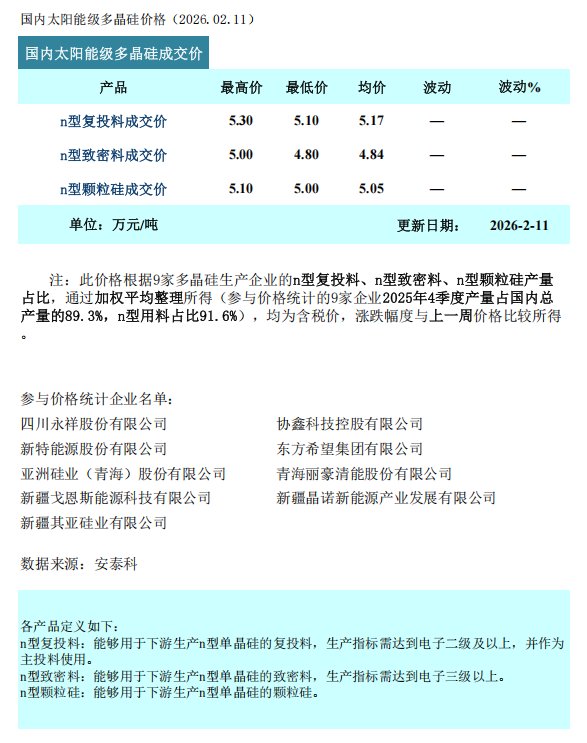
[安泰科]多晶硅周评-市场少量成交 观望情绪仍浓 (2026年2月11日)
中国有色金属工业协会硅业分会· 2026-02-11 03:10
Core Viewpoint - The multi-crystalline silicon market is experiencing a slight recovery in activity, but overall transactions remain cautious and primarily exploratory due to weak downstream demand and production cuts among silicon manufacturers [1][2]. Group 1: Market Prices and Transactions - The transaction price range for n-type re-investment material is between 51,000 - 53,000 yuan/ton, with an average transaction price of 51,700 yuan/ton [1]. - The transaction price range for n-type granular silicon is between 50,000 - 51,000 yuan/ton, with an average transaction price of 50,500 yuan/ton [1]. - The market has seen a slight increase in activity with four companies completing small orders, although the overall transaction volume remains low and primarily consists of tentative trades [1]. Group 2: Market Outlook - In the short term, the multi-crystalline silicon market is expected to remain in a stalemate due to the ongoing struggle between weak pre-holiday demand and supply contraction, limiting price fluctuations [2]. - Post-holiday, as terminal installation projects gradually commence, downstream demand is anticipated to increase, potentially boosting procurement needs [2]. - The recent small transactions in the market may provide some price support, but resolving the core supply-demand conflict will depend heavily on a comprehensive recovery in terminal demand and the effective implementation of relevant energy consumption policies [2].