
景顺长城

Search documents
4只公告上市ETF仓位超60%
Zheng Quan Shi Bao Wang· 2026-01-05 03:24
Core Viewpoint - Three stock ETFs have recently announced their listing, with varying stock positions indicating different investment strategies and market conditions [1] Group 1: ETF Stock Positions - The stock position of the Invesco Hang Seng Biotechnology ETF is 15.90%, while the XQHS300 Quality ETF has a stock position of 62.01%, and the E Fund Shanghai Stock Exchange Sci-Tech Innovation Board Chip ETF has a stock position of 5.37% [1] - In the past month, 23 stock ETFs have announced their listings, with an average stock position of only 29.09%. The highest stock position is held by the Industrial Bank Sci-Tech Innovation Entrepreneurship Artificial Intelligence ETF at 75.70% [1] Group 2: Fundraising and Shareholder Structure - The average number of shares raised by the recently listed ETFs is 4.46 million, with the largest being the E Fund CSI Sci-Tech Innovation Entrepreneurship Artificial Intelligence ETF at 13.36 million shares [2] - Institutional investors hold an average of 18.62% of the shares, with the highest proportions in the Hua Bao CSI Hong Kong Stock Connect Automotive Industry Theme ETF (64.43%), the Jiao Yin CSI Selected Hong Kong and Shanghai Technology 50 ETF (48.92%), and the Guangfa CSI A50 ETF (45.22%) [2] Group 3: ETF Listing Details - The listing details of several ETFs include the establishment date, fundraising scale, and stock positions, with notable examples being the E Fund Shanghai Stock Exchange Sci-Tech Innovation Board Chip ETF with a stock position of 5.37% and the Invesco Hang Seng Biotechnology ETF with a stock position of 15.90% [3]
2025年谁流落亏损榜?“亏损王”爱调仓折腾,多位知名老将在列
Feng Huang Wang· 2026-01-03 23:21
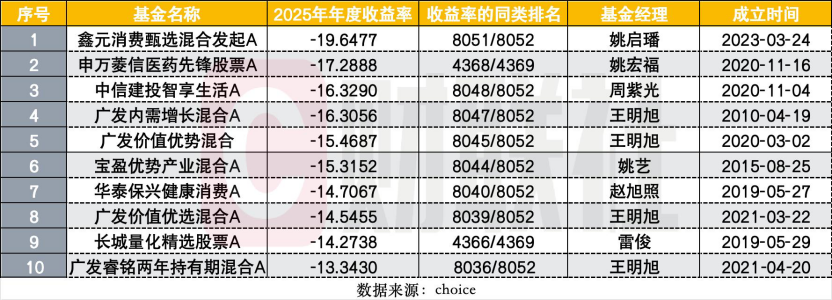
Core Viewpoint - The A-share market in 2025 exhibited a clear structural bull market, with significant performance disparities among active equity funds, highlighted by the top-performing fund achieving a record annual return of 233.29% while others faced substantial losses, including the worst performer with a -19.65% return [1][4]. Group 1: Market Performance - The Shanghai Composite Index, Shenzhen Component Index, ChiNext Index, and Sci-Tech Innovation 50 Index rose by 18.41%, 29.87%, 49.57%, and 35.92% respectively in 2025 [1]. - A total of 4888 active equity products from 160 public fund institutions reported positive returns, while 144 products from 68 institutions experienced losses [1][9]. Group 2: Fund Performance Disparities - The top-performing fund, Yongying Technology Smart Selection, achieved a record annual return of 233.29%, surpassing the previous record set by Wang Yawei in 2007 [1]. - The worst-performing fund, Xinyuan Consumption Selection, recorded a -19.65% return, marking a significant gap of 252.94% from the top performer [2][4]. Group 3: Xinyuan Consumption Selection Analysis - Xinyuan Consumption Selection's poor performance is attributed to aggressive trading strategies, frequent personnel changes, and scale challenges, leading to a lack of coherent investment logic [3][5]. - The fund's industry allocation showed erratic shifts, moving from heavy investments in pharmaceuticals to technology and later to media, missing key market trends [5][6]. Group 4: Fund Manager Insights - Notable fund managers, including Wang Mingxu and Han Weijun, saw their products listed among the worst performers, with their total managed assets shrinking by over 70% compared to previous peaks [3][9][12]. - Xinyuan Consumption Selection faced a critical challenge to meet its scale assessment, needing to grow from 0.29 billion to 2 billion within three months [7][8]. Group 5: Institutional Investment Trends - Institutional ownership in Xinyuan Consumption Selection dropped from over 95% to 42.94% by mid-2025, indicating a significant withdrawal of institutional funds [7]. - The trend of multiple products from the same fund manager appearing on the loss list highlights a broader issue within the industry, affecting even previously successful managers [9][10].

2025年含“港”权益基金成绩:平均收益率21.79%,4只产品业绩翻倍
Huan Qiu Wang· 2026-01-03 01:41
Group 1 - The average return of "Hong Kong" equity funds for the year 2025 reached 21.79%, with 106 funds exceeding a 50% return [1][3] - Four funds achieved a return of over 100% in 2025, with the highest being Qianhai Kaiyuan Hong Kong-Shanghai-Shenzhen Enjoy Life at 122.08% [3] - The strong performance of certain funds was attributed to their investments in hot sectors such as internet, CPO, and biomedicine [3] Group 2 - Despite the strong performance in 2025, the average return for "Hong Kong" equity funds over the past three years was only 13.13%, with only 53 funds surpassing a 50% return [3][4] - Qianhai Kaiyuan Hong Kong-Shanghai-Shenzhen Enjoy Life had the best three-year return at 156.25%, indicating a significant outperformance [4] - Other funds, including Invesco Great Wall Hong Kong-Shanghai-Shenzhen Selected A and Tianhong CSI Hong Kong-Shanghai-Shenzhen Cloud Computing Industry ETF, also achieved over 100% returns in the last three years [4]
华夏基金ETF:12月29日首以DR模式进军海外市场
Sou Hu Cai Jing· 2025-12-29 07:19
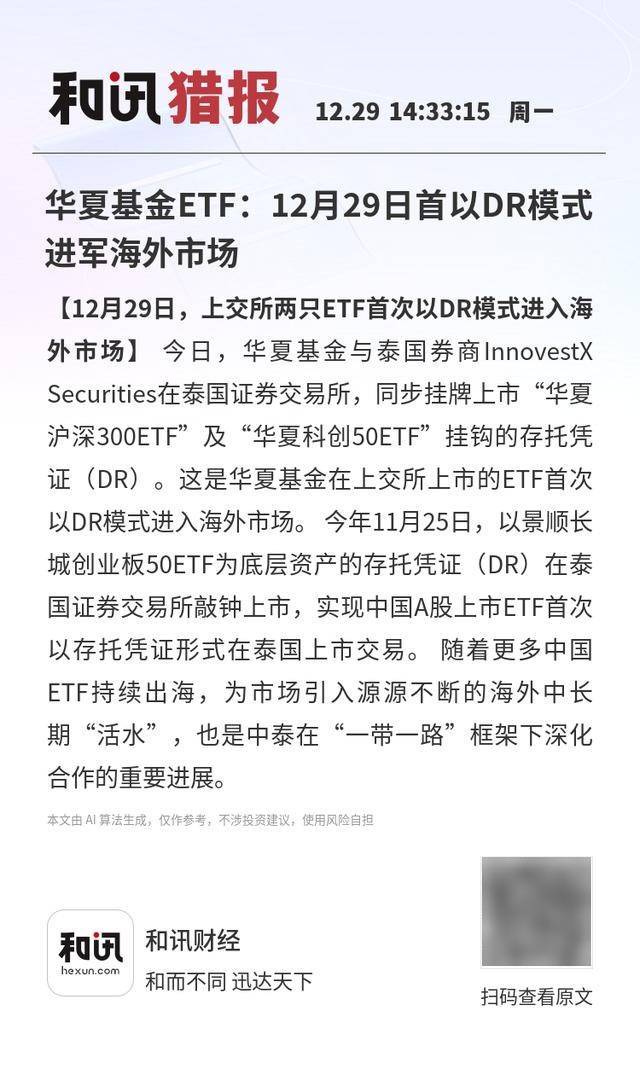
Core Insights - The Shanghai Stock Exchange has seen its first two ETFs enter the overseas market via the DR (Depository Receipt) model, specifically the "Huaxia CSI 300 ETF" and "Huaxia STAR 50 ETF" listed on the Thailand Stock Exchange [1] - This marks the first time that ETFs listed on the Shanghai Stock Exchange have utilized the DR model for international markets, following the earlier listing of the Invesco Great Wall ChiNext 50 ETF DR on November 25 [1] - The ongoing trend of Chinese ETFs expanding internationally is expected to bring significant overseas long-term capital into the market, representing a key development in Sino-Thai cooperation under the Belt and Road Initiative [1]
超半数人“逆市操作”!弄懂ETF投资真相,三种策略悄悄赚钱
市值风云· 2025-12-26 10:13
Core Insights - More than 52% of ETF investors engage in swing trading, which is the dominant trading strategy among this group [9][12][18] Group 1: ETF Trading Strategies - 36% of investors adopt swing trading, characterized by buying low and selling high [9] - 10.2% of investors practice high-frequency trading, completing trades within a day or a few days [11] - 5.7% utilize grid trading, which involves pre-setting orders for automatic low buy and high sell, essentially still engaging in swing trading [11] - The report indicates that ETF trading often runs counter to market trends, with investors buying during downturns and selling during upswings [12][13] Group 2: Performance of Specific ETFs - The largest ETF tracking the Sci-Tech 50 Index, the Sci-Tech 50 ETF (588000.SH), saw a net value drop of 11.3% from March 7 to July 15, while its shares increased by over 20% [16] - From July 16 to September 25, the net value of the Sci-Tech 50 ETF surged by 47%, but its shares decreased from 84 billion to 47.6 billion, a drop of 43% [16] - From September 25 to the present, the ETF's net value fell by 7.6%, yet its shares grew by 14% [17] Group 3: Investor Strategies - Investor A combines long-term investment with swing trading, focusing on semiconductor ETFs and using moving average cross signals for timing [25] - Investor B employs a macro, meso, and micro strategy, analyzing PPI and CPI to determine market cycles and using technical indicators for automated trading [30] - Investor C uses a policy-driven timing strategy, monitoring national strategic movements and employing technical signals to confirm trends before entering positions [35]

景顺长城张欢:2026年新消费投资 更需要在理性中寻找结构机会
Xin Lang Cai Jing· 2025-12-26 08:17
Core Insights - The new consumption sector in 2025 has transitioned from "extreme enthusiasm" to "intense divergence," with pricing gradually returning to rationality [1][5] - Despite market fluctuations, demand for new consumption remains strong, leading to an optimistic outlook for the future [1][5] Group 1: Market Dynamics - The new consumption market has experienced a "roller coaster" of emotions and pricing, shifting from extreme enthusiasm for innovative models to significant divergence, resulting in substantial valuation fluctuations [2][7] - The market is now reassessing the quality and quantity of growth, focusing on management capabilities and potential changes in competitive dynamics due to significant capital influx [2][7] - The consumption market exhibits a clear "K-shaped recovery," where high-net-worth individuals drive high-end consumption recovery, while middle and low-income groups face slower recovery due to employment and income expectations [2][7] Group 2: Investment Opportunities - 2025 is characterized as a year of full pricing for innovation in the new consumption sector, emphasizing the importance of supply-demand "innovation" [3][8] - Companies that can proactively innovate and adapt to changes will gain a competitive edge, particularly those enhancing consumer experiences through supply chain empowerment and emotional value satisfaction [3][8] Group 3: Future Outlook - Looking ahead to 2026, attention should be paid to the "aftereffects" of high prosperity, as an increase in IPOs and active financing and mergers may lead to supply excess and intensified competition [4][9] - Three key areas to watch include: 1. Platform companies capable of navigating cycles, as single-brand models often face limitations [4][9] 2. Early participants in emerging trends, such as health-related products, which are expected to grow rapidly due to rising health awareness and social media-driven consumption [4][9] 3. Companies successfully expanding overseas, where manufacturing often scales more easily than branding, particularly in functional products [4][9] - The new consumption sector must continue to evolve, balancing innovation with an understanding of competitive dynamics and corporate capabilities [4][9]
基金早班车丨主题狂欢与个股寒潮并存,私募年末策略多空分歧加大
Sou Hu Cai Jing· 2025-12-25 00:38
Market Overview - The A-share market showed mixed performance with the Shanghai Composite Index rising by 0.53% to 3940.95 points, the Shenzhen Component Index increasing by 0.88% to 13486.42 points, and the ChiNext Index up by 0.77% to 3229.58 points, as of December 24 [1] - The total trading volume in the Shanghai and Shenzhen markets reached 1.88 trillion yuan, with over 4100 stocks rising [1] Fund News - On December 24, five new funds were launched, primarily stock and ETF linked funds, with E Fund's CSI 800 Index Enhanced A aiming to raise 8 billion yuan [2] - The issuance of stock index funds exceeded 400 billion yuan for the year, setting a new annual record, driven by low fees and clear investment styles [2] - The bond market experienced a downturn, with long-term government bond yields rising, leading to a significant decline in bond fund performance, with mid-to-long-term pure bond fund indices only increasing by 0.81% this year, the lowest in nearly 20 years [2] - The total scale of cross-border ETFs reached 924.1 billion yuan, more than doubling since the beginning of the year, indicating a strong demand for global allocation [3]
景顺长城张欢:2026年新消费投资或向两端迁徙
Zheng Quan Shi Bao Wang· 2025-12-23 09:30
Core Viewpoint - The investment in new consumption is expected to shift towards two ends by 2026, focusing on early-stage categories and those with balanced supply and demand [1] Group 1: Early-stage Categories - Investment will target categories with emerging market demand, such as new efficacy health products, oral health products, innovative materials in medical aesthetics, and pet health products [1] Group 2: Balanced Supply and Demand Categories - Investment will also focus on categories where supply is orderly and may clear, including functional beverages, low-sugar health food and drinks, traditional golden products, bulk snacks, and high-end beauty services, particularly those from small and medium enterprises [1] - Preference will be given to single-brand or platform companies with high growth certainty [1]
机构资金打响收益保卫战 中证A500ETF演绎“翘尾”行情
Zheng Quan Shi Bao Wang· 2025-12-21 23:26
Core Viewpoint - The market is witnessing a significant inflow of funds into the CSI A500 ETF, indicating a shift in institutional investment strategies towards lower-valued sectors as the year-end approaches [1][5][7]. Group 1: Fund Inflows and Market Activity - As of December 19, the CSI A500 index has surpassed the CSI 300 in net inflows, with a total of over 460 billion yuan since the beginning of December, including a single-day inflow exceeding 100 billion yuan on December 17 [2][4]. - The trading activity of the CSI A500 ETF has become notably active since December 10, with daily transaction volumes consistently exceeding 300 billion yuan, peaking at 525.76 billion yuan on December 19 [3][4]. - The total scale of the CSI A500 ETF has exceeded 240 billion yuan, contributing to a total fund scale of over 300 billion yuan across various fund products [4]. Group 2: Institutional Investment Trends - Institutional investors are increasingly favoring broad-based index products like the CSI A500 ETF, indicating a strategic shift from high-valuation technology sectors to undervalued areas [5][7]. - Insurance funds are expected to contribute over 100 billion yuan in new capital to the market, driven by policy changes that encourage increased equity investments [5][6]. - The low-interest-rate environment is prompting a "migration" of resident funds from savings to equity markets, with a significant increase in the allocation to public funds and other investment vehicles [6][7]. Group 3: Market Outlook for 2026 - Analysts predict a more balanced market in 2026, with opportunities emerging in both technology and value sectors, as the market transitions from a growth-driven to a profitability-driven phase [7][8]. - The focus will likely shift towards cyclical industries and sectors with high return on equity, as well as new energy and innovative technologies, which are expected to be key themes in the upcoming market cycle [8].
10万元骤降至10元!QDII基金申购上限调整
Zhong Guo Zheng Quan Bao· 2025-12-20 13:56
Core Viewpoint - The recent adjustments in the subscription limits for QDII funds, particularly the drastic reduction to 10 yuan for the Morgan Nasdaq 100 Index Fund, reflect a broader trend among public funds responding to high demand for overseas investments amid rigid foreign exchange quota constraints [1][2]. Group 1: Market Dynamics - The subscription limit for the Morgan Nasdaq 100 Index Fund was reduced from 100,000 yuan to 100 yuan, and then further to 10 yuan, indicating a near "freezing" of new subscriptions [1]. - Similar actions were observed with other funds, such as the Huatai-PB Nasdaq 100 ETF, which saw its limit drop from 10,000 yuan to 1,000 yuan in October, and then to 100 yuan in November [2]. - The high demand for QDII products has led to significant premiums in the secondary market, with some funds trading at premiums exceeding 20% [2]. Group 2: Supply and Demand Imbalance - As of November 2023, the total approved QDII investment quota reached 170.87 billion USD, with a 2.30% increase in the securities fund category [3]. - The net value of QDII funds reached 939.008 billion yuan by October 31, 2025, marking a 66.72% increase year-on-year [3][4]. - The average premium rate for QDII passive index equity funds exceeded 10% for 14.96% of these funds during the period from December 1 to December 18 [2][3]. Group 3: Risks and Considerations - The high premiums in the secondary market are attributed to a supply-demand mismatch, where the demand for QDII ETFs outstrips the available quotas, leading to potential risks if market sentiment shifts [5]. - Analysts warn that investing in high-premium QDII funds may not be ideal, as a reversal in market conditions could lead to a rapid decline in premiums [5]. - Liquidity risks are also a concern, as some QDII funds have low trading volumes, which could hinder the ability to sell at favorable prices during market downturns [5].
