
孩子王

Search documents
专业连锁板块10月20日涨2.21%,爱施德领涨,主力资金净流入5260.67万元
Zheng Xing Xing Ye Ri Bao· 2025-10-20 08:27
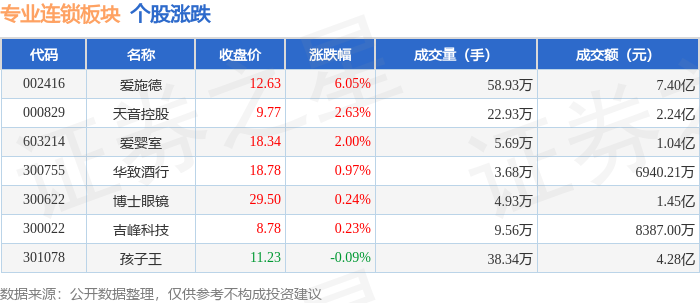
Core Insights - The professional chain sector experienced a rise of 2.21% on October 20, with Aishide leading the gains [1] - The Shanghai Composite Index closed at 3863.89, up 0.63%, while the Shenzhen Component Index closed at 12813.21, up 0.98% [1] Sector Performance - Aishide (002416) closed at 12.63, with a gain of 6.05% and a trading volume of 589,300 shares, amounting to a transaction value of 740 million [1] - Tianyin Holdings (000829) closed at 9.77, up 2.63%, with a trading volume of 229,300 shares and a transaction value of 224 million [1] - Aiyingshi (603214) closed at 18.34, increasing by 2.00%, with a trading volume of 56,900 shares and a transaction value of 104 million [1] - Huazhi Wine (300755) closed at 18.78, up 0.97%, with a trading volume of 36,800 shares and a transaction value of 69.4 million [1] - Boshiyanjing (300622) closed at 29.50, with a slight increase of 0.24%, trading 49,300 shares for a value of 145 million [1] - Jifeng Technology (300022) closed at 8.78, up 0.23%, with a trading volume of 95,600 shares and a transaction value of 83.87 million [1] - Haiziwang (301078) closed at 11.23, with a minor decline of 0.09%, trading 383,400 shares for a value of 428 million [1] Capital Flow - The professional chain sector saw a net inflow of 52.61 million from institutional investors, while retail investors experienced a net outflow of 60.09 million [1] - Aishide had a net outflow of 53.71 million from institutional investors, with a net inflow of 20.75 million from speculative funds [2] - Tianyin Holdings had a net inflow of 14.59 million from institutional investors, while retail investors saw a net outflow of 21.54 million [2] - Aiyingshi experienced a net inflow of 14.85 million from institutional investors, with a net outflow of 12.04 million from retail investors [2] - Jifeng Technology had a net outflow of 7.15 million from institutional investors, while speculative funds saw a net inflow of 7.89 million [2] - Haiziwang had a net outflow of 20.24 million from institutional investors, with a net inflow of 21.67 million from speculative funds [2]






天猫双11国货开门红,毛戈平上美强者恒强:——化妆品医美行业周报20251019-20251019
Shenwan Hongyuan Securities· 2025-10-19 13:23
Investment Rating - The report maintains a positive outlook on the cosmetics and medical beauty sector, highlighting strong performance relative to the market [5][6]. Core Insights - The Tmall Double 11 event showcased strong sales for domestic brands, with significant demand for products from brands like Maogeping and Winona, indicating a robust market response [9][10]. - The cosmetics and medical beauty sector is expected to see continued growth, with Q3 performance meeting expectations and Q4 anticipated to benefit from promotional activities [10][11]. - The report emphasizes the importance of online channels, particularly Tmall and Douyin, in driving sales for domestic brands, which are gaining market share against international competitors [24][26]. Summary by Sections Industry Performance - The cosmetics and medical beauty sector outperformed the market from October 10 to October 17, 2025, with the Shenwan Beauty Care Index declining by 2.5%, which is better than the overall market performance [5][6]. - Key stocks in the sector included Jiaheng Jiahu (+35.0%), Yiyi Co. (+18.6%), and Yanjing Co. (+15.6%), while Maogeping (-7.2%) and Shangmei Co. (-5.4%) lagged [6]. Sales and Market Trends - The report notes that the overall retail sales of cosmetics in China reached 291.5 billion yuan in the first eight months of 2025, with a year-on-year growth of 3.3% [10][16]. - The Tmall Double 11 event attracted over 10 million viewers, with domestic brands experiencing sell-out conditions, indicating strong consumer interest and demand [9][10]. Company Highlights - Han Shu, a brand under Shangmei Co., has shown significant improvement in Tmall channel performance, collaborating with popular influencers to enhance sales [9][10]. - The report highlights the strategic partnership of Han Shu with global ambassador Wang Jiaer, aiming to elevate the brand's international presence and market perception [20][21]. Investment Recommendations - The report recommends focusing on brands with strong online sales growth, such as Maogeping, Shangmei Co., and Shanghai Jahwa, while also monitoring companies like Proya and Marubi for potential performance improvements [12][13]. - In the medical beauty segment, the report suggests investing in companies with strong R&D capabilities and product pipelines, recommending Aimeike as a key player [12][13].


化妆品医美行业周报:天猫双11国货开门红,毛戈平上美强者恒强-20251019
Shenwan Hongyuan Securities· 2025-10-19 12:19
Investment Rating - The report maintains a "Positive" outlook on the cosmetics and medical beauty industry [2]. Core Views - The cosmetics and medical beauty sector has shown stronger performance than the market, with the Shenwan Beauty Care Index declining by 2.5% from October 10 to October 17, 2025, which is better than the overall market performance [4][5]. - The Tmall Double 11 event has seen significant success for domestic brands, with brands like Maogeping experiencing high demand and sold-out products [10]. - The overall performance for Q3 2025 is expected to meet expectations, with a continued upward trend into Q4, driven by promotional events [11][12]. Summary by Sections Industry Performance - The cosmetics and medical beauty sector outperformed the market during the specified period, with the Shenwan Cosmetics Index down by 1.1%, which is 2.3 percentage points better than the Shenwan A Index [4][5]. - Key stocks in the sector included Jiaheng Jiahua (+35.0%), Yiyi Co. (+18.6%), and Yanjing Co. (+15.6%) [6]. Market Trends - The Tmall Double 11 event on October 15 attracted over 10 million viewers, with domestic brands like Maogeping experiencing supply shortages due to high demand [10]. - The overall sales performance is expected to improve in the coming weeks, particularly with the upcoming Douyin Double 11 event [10]. Q3 Performance Outlook - The demand for cosmetics remains robust, with retail sales growth in July and August outpacing the overall market [11]. - The total retail sales of cosmetics for the first eight months of 2025 reached 291.5 billion yuan, a year-on-year increase of 3.3% [11]. - Domestic brands are leveraging online channels effectively, with Han Shu achieving over 2 billion yuan in GMV in Q3 [12]. Company Highlights - Han Shu announced a global partnership with Wang Jiaer, enhancing its international presence and brand recognition [19][22]. - The report recommends focusing on companies with strong channel and brand matrices, such as Maogeping, Shanghai Jahwa, and Up Beauty [14]. E-commerce Data - The report highlights significant growth in e-commerce sales for various brands, with Han Shu achieving a 37% increase in GMV [15]. - The overall e-commerce landscape for domestic brands is expected to continue thriving, supported by promotional events and strategic partnerships [15][18]. Market Dynamics - The report notes that the Chinese skincare market is projected to reach 271.2 billion yuan in 2024, despite a slight decline in growth [26]. - Domestic brands are increasingly capturing market share, with a notable presence in the top ten rankings [26][27]. Investment Recommendations - The report suggests investing in companies with strong growth potential and robust product pipelines, particularly in the cosmetics and medical beauty sectors [14]. - Specific recommendations include Maogeping, Up Beauty, and Shanghai Jahwa for cosmetics, and Aimeike for medical beauty [14].

重视港股新消费估值切换,稳健布局传统龙头
Xinda Securities· 2025-10-19 01:51
Investment Rating - The investment rating for the light industry manufacturing sector is "Positive" [2] Core Insights - The report emphasizes the importance of valuation shifts in Hong Kong's new consumption sector while advocating for a stable investment in traditional leading companies [2] - The paper discusses various segments within the light industry, including paper manufacturing, exports, new tobacco products, smart glasses, gold and jewelry, two-wheeled vehicles, cross-border e-commerce, pet products, IP retail, and maternal and child products, highlighting growth opportunities and market dynamics [2][3][4][5] Summary by Relevant Sections Paper Manufacturing - UPM announced a two-week maintenance shutdown at its Fray Bentos pulp mill, which is expected to lead to a slight increase in pulp prices in Q4. The report anticipates a moderate recovery in cultural paper prices due to limited new capacity and upcoming publishing tenders [2][3] Exports - The report notes that Yi Yi plans to increase its stake in the "Gao Ye Jia" brand, which is expected to contribute significantly to profits by 2026. Additionally, a recent anti-dumping investigation in Canada may benefit compliant leading companies [2][3] New Tobacco Products - Smoore International reported Q3 revenue of 4.196 billion yuan, reflecting a 27.5% quarter-on-quarter increase. The company is expanding its presence in Europe with its HILO brand [2][3] Smart Glasses - Yingmu launched its first multi-SKU smart glasses, addressing user pain points with innovative designs and improved comfort [3] Gold and Jewelry - Lao Pu Gold and Chow Tai Fook are actively engaging in promotional activities, with Lao Pu announcing a price adjustment on October 26. The report expects a boost in sales due to seasonal demand and rising gold prices [3][4] Two-Wheeled Vehicles - Dahon's sales channels are performing well, with significant growth in both offline and online sales. The company is expanding its product range and enhancing its supply chain [3][4] Cross-Border E-Commerce - Karote is adjusting its strategy to mitigate the impact of US-China tariffs, focusing on product diversification and market expansion in the US and Japan [3][4] Pet Products - Zhongchong reported a 15.9% year-on-year increase in revenue for Q3, driven by strong performance in its self-owned brands and overseas business [4] IP Retail - Pop Mart is deepening its long-term IP strategy, while Miniso is accelerating its fashion crossover initiatives to enhance brand value [4][5] Maternal and Child Products - The report highlights the growth of the toy segment within maternal and child retail, driven by innovative store models and IP collaborations [5]
安徽合肥再添一店 永辉超市胖东来模式落地瑶海区
Sou Hu Cai Jing· 2025-10-17 11:20
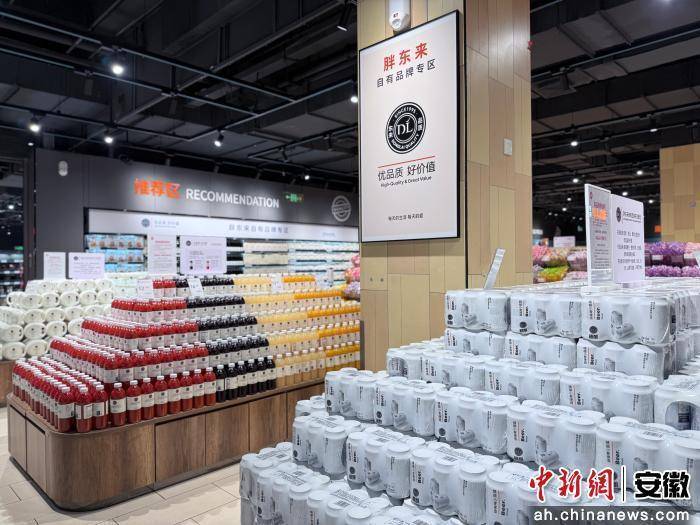
Core Insights - Hefei's consumer capacity has been continuously improving, with significant progress in cultivating regional consumption centers and stimulating market vitality [1] - The opening of the Yonghui Supermarket's new store in Hefei marks the company's eleventh store in the city and the third in the Yao Hai District, indicating a strategic expansion into lower-tier markets [1] Product Structure Optimization - Yonghui has implemented a "product-first" strategy, restructuring its product offerings into three main pillars: "Top Brands," "Yonghui Custom," and "Quality Yonghui" [2] - The store has reduced its product range from 13,883 items to 10,978, with a new addition of 4,539 items, resulting in a 41.3% increase in new products [2] - The proportion of fresh food items has increased from 4.8% to 13%, with a simultaneous rise in imported goods to meet consumer demands for quality and variety [2] Own Brand Expansion - Yonghui plans to develop 500 own-brand products over the next five years, with several items already available in the new store, including orange juice, laundry detergent, and organic vegetables [4] - The fresh food section features a variety of high-quality products, including organic vegetables and premium fruits, alongside a selection of meats and seafood [4] Enhanced Environment and Services - The store has improved its shopping environment by removing mandatory pathways and standardizing shelf heights to create a more open layout [6] - Various customer services have been introduced, including meat processing, seafood cleaning, and additional amenities like health measurement tools and mobile charging stations [6] Pricing Strategy - The store employs a pricing mechanism for fresh-cut fruits and juices, offering discounts based on the time since production, with a focus on selling fresh items only [8] Community Life Center Development - The external rental area of approximately 2,500 square meters includes 25 merchants across various categories, aiming to create a community service platform [9] - Partnerships with well-known brands such as KFC and Luckin Coffee have been established to enhance the dining and entertainment options available in the store [10] Market Strategy and Future Plans - The new store represents Yonghui's commitment to deepening its presence in the Anhui market and supporting local consumption upgrades [11] - The CEO of Yonghui has reported an average customer traffic increase of 80% in remodeled stores, with over 60% of stabilized stores achieving higher profitability than in the past five years [11]

专业连锁板块10月17日跌1.86%,华致酒行领跌,主力资金净流入514.82万元
Zheng Xing Xing Ye Ri Bao· 2025-10-17 08:35
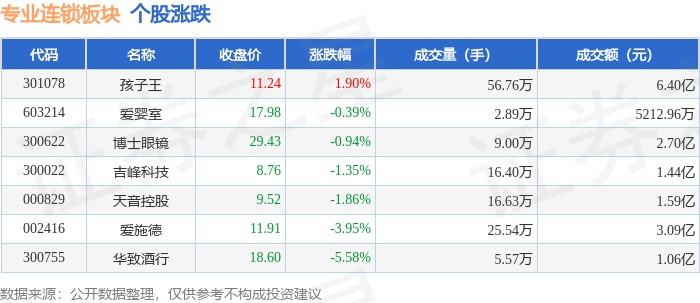
Core Viewpoint - The professional chain sector experienced a decline of 1.86% on October 17, with Huazhi Wine leading the drop, while the Shanghai Composite Index fell by 1.95% and the Shenzhen Component Index decreased by 3.04% [1] Group 1: Market Performance - The closing price for the Shanghai Composite Index was 3839.76, down 1.95% [1] - The Shenzhen Component Index closed at 12688.94, down 3.04% [1] - The professional chain sector's individual stock performance varied, with notable declines in several companies, including Huazhi Wine, which fell by 5.58% [1] Group 2: Stock Data - The stock data for key companies in the professional chain sector showed varied performance, with the following notable figures: - Kidswant (301078) closed at 11.24, up 1.90% with a trading volume of 567,600 shares and a transaction value of 640 million [1] - Aiyingshi (603214) closed at 17.98, down 0.39% with a trading volume of 28,900 shares and a transaction value of 52.13 million [1] - Huazhi Wine (300755) closed at 18.60, down 5.58% with a trading volume of 55,700 shares and a transaction value of 106 million [1] Group 3: Capital Flow - The professional chain sector saw a net inflow of 5.15 million from main funds, while retail investors experienced a net outflow of 25.20 million [1] - The capital flow data indicated that Kidswant had a main fund net inflow of 73.21 million, while Huazhi Wine had a net outflow of 10.11 million from main funds [2]
三胎概念股局部拉升,珠江钢琴、香山股份双双涨停
Mei Ri Jing Ji Xin Wen· 2025-10-17 03:08
Group 1 - The three-child policy concept stocks experienced a partial surge, with Zhujiang Piano and Xiangshan Co. both hitting the daily limit up [1] - Other companies such as Rainbow Group, Kidswant, and Aomei Medical also saw increases in their stock prices [1]




2025世界VR产业大会举行,“AI应用ETF”——线上消费ETF基金(159793)今日回调蓄势
Xin Lang Cai Jing· 2025-10-17 02:33
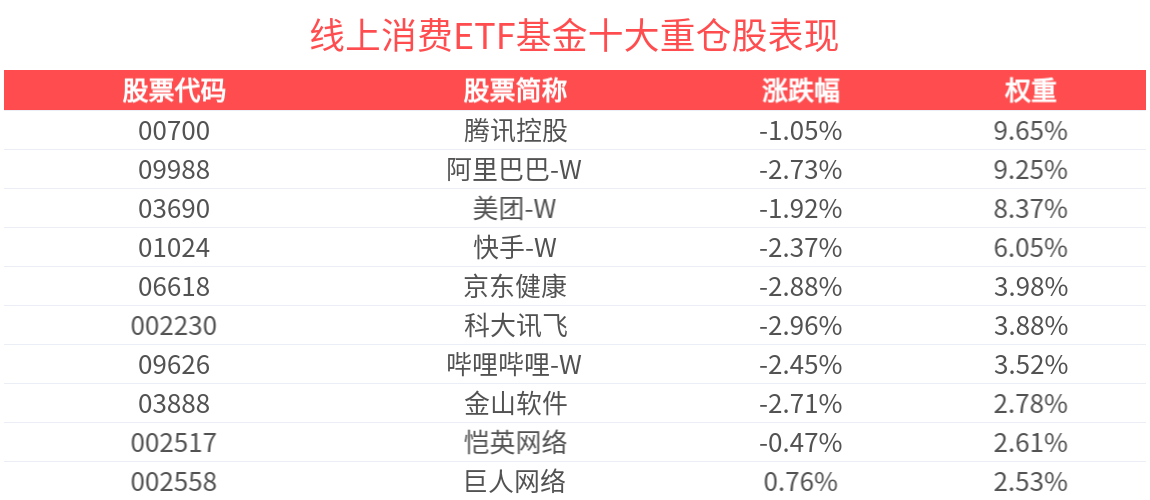
Group 1 - The 2025 World VR Industry Conference will be held in Nanchang from October 19 to 20, focusing on major tech companies like Huawei, Apple, Alibaba, Xiaomi, and Lenovo, as well as leading AR glasses innovators such as XREAL and Rokid, showcasing the latest product technologies and innovative application scenarios [1] - As of October 17, 2025, the CSI Hong Kong-Shenzhen Online Consumption Theme Index (931481) has decreased by 1.68%, with mixed performance among constituent stocks; Kid King (301078) led with a rise of 2.36%, while Donghua Software (002065) fell by 4.17% [1] - The Online Consumption ETF (159793) has dropped by 2.02%, with the latest price at 1.07 yuan, but has seen a cumulative increase of 2.54% since the beginning of October 2025 [1] Group 2 - The CSI Hong Kong-Shenzhen Online Consumption Theme Index tracks 50 listed companies involved in online shopping, digital entertainment, online education, and telemedicine, reflecting the overall performance of online consumption theme stocks in the mainland and Hong Kong markets [2] - As of September 30, 2025, the top ten weighted stocks in the CSI Hong Kong-Shenzhen Online Consumption Theme Index include Alibaba-W (09988), Tencent Holdings (00700), and Kuaishou-W (01024), with the top ten stocks accounting for 55.76% of the index [2] - The weight and performance of key stocks in the index show declines, with Tencent Holdings down by 1.05% and Alibaba-W down by 2.73%, indicating a challenging market environment for these major players [4]



孩子王涨2.09%,成交额9306.49万元,主力资金净流入216.93万元
Xin Lang Cai Jing· 2025-10-17 02:03
Core Viewpoint - The stock price of the company "孩子王" has shown fluctuations, with a slight increase recently, while the overall performance this year has been mixed, indicating potential investment opportunities and market interest [1][2]. Group 1: Stock Performance - As of October 17, the stock price increased by 2.09% to 11.26 CNY per share, with a total market capitalization of 14.203 billion CNY [1]. - Year-to-date, the stock has decreased by 0.45%, but it has risen by 4.45% over the last five trading days [2]. - The stock has appeared on the "龙虎榜" three times this year, with the latest occurrence on April 10 [2]. Group 2: Company Overview - "孩子王" was established on June 1, 2012, and went public on October 14, 2021, focusing on retail and value-added services for maternal and child products [2]. - The company's revenue composition includes 88.10% from maternal and child product sales, 6.83% from supplier services, and smaller percentages from various other services [2]. - The company operates in the "商贸零售-专业连锁Ⅱ-专业连锁Ⅲ" industry and is associated with concepts like new retail, multi-child concept, childcare, e-commerce, and cross-border e-commerce [2]. Group 3: Financial Performance - For the first half of 2025, the company reported a revenue of 4.911 billion CNY, reflecting a year-on-year growth of 8.64%, and a net profit attributable to shareholders of 143 million CNY, up 79.42% year-on-year [2]. - Cumulatively, the company has distributed 187 million CNY in dividends since its A-share listing, with 165 million CNY distributed over the past three years [3]. Group 4: Shareholder Information - As of June 30, 2025, the number of shareholders decreased by 10.72% to 52,200, while the average circulating shares per person increased by 12.73% to 24,029 shares [2]. - Among the top ten circulating shareholders, "南方中证1000ETF" is a new entrant holding 8.1513 million shares, while "香港中央结算有限公司" has exited the list [3].
晨会报告:美方视角下的特朗普关税策略-20251017
Shenwan Hongyuan Securities· 2025-10-17 00:54
Core Insights - The report highlights the adjustments in China's tariff strategy in response to U.S. non-tariff measures, including export controls on rare earths and threats of increased tariffs by Trump, indicating a growing division in U.S. political circles regarding tariff strategies [2][10] - It discusses the strategic flaws in Trump's tariff approach, emphasizing the need for a more nuanced strategy that includes non-tariff barriers and targeted measures rather than broad high tariffs [3][10] - The report suggests that U.S. policymakers are more focused on strategic and security issues rather than just economic outcomes, indicating a potential shift in how trade agreements with China may be structured [3][10] Summary by Sections Section 1: Adjustments in China's Tariff Strategy - The uncertainty surrounding tariffs has increased due to U.S. non-tariff measures since September, including expanded sanctions and new export controls on rare earths [2][10] - China has adopted a more proactive approach compared to the previous tariff phase, utilizing tactical agreements to gain strategic space without compromising core interests [10] - The U.S. political landscape shows bipartisan concern over China's export control measures, indicating a significant shift in strategy [10] Section 2: Flaws in Trump's Tariff Strategy - Trump's historical pattern of releasing strong pre-meeting signals to pressure opponents is noted, with a critique of the economic viability of reciprocal tariffs [3][10] - Recommendations for a refined approach include maintaining conditional tariffs and focusing on targeted export control lists to minimize collateral damage to domestic supply chains [3][10] Section 3: Desired Trade Agreements with China - U.S. policymakers express a preference for smaller, more manageable trade agreements rather than large-scale deals, which may require geopolitical concessions [3][10] - The urgency for Trump to secure a trade agreement is highlighted, as the economic costs of a non-agreement primarily impact the U.S. [3][10] - The report indicates that while formal agreements may not be reached, the ongoing negotiations have already led to some tariff easing effects for China [3][10]
