
德赛西威

Search documents
AI人工智能ETF(512930)涨近1%,京东招募端侧AI芯片领域人才
Xin Lang Cai Jing· 2025-12-12 05:33
Group 1 - The core index of artificial intelligence, the CSI Artificial Intelligence Theme Index (930713), has seen an increase of 0.78% as of December 12, 2025, with notable gains in constituent stocks such as Chipone Technology (688521) up 5.73% and Beijing Junzheng (300223) up 5.26% [1] - JD.com is actively recruiting talent in the edge AI chip sector, focusing on integrated storage and computing AI chips intended for use in robotics and smart home appliances [1] - The "Shandong Province Artificial Intelligence Industry High-Quality Development Action Plan (2025-2027)" aims for the core AI industry in the province to exceed 200 billion yuan by 2027, with an average annual growth rate of over 30% [1] Group 2 - Dongfang Caifu Securities anticipates that next year will be a significant year for the expansion of domestic storage, recommending attention to the overall opportunities in the domestic storage industry chain, including NAND & DRAM semiconductor equipment and HBM storage chips [2] - The CSI Artificial Intelligence Theme Index tracks 50 listed companies involved in providing foundational resources, technology, and application support for artificial intelligence, reflecting the overall performance of AI-related stocks [2] - As of November 28, 2025, the top ten weighted stocks in the CSI Artificial Intelligence Theme Index account for 63.92% of the index, including companies like Zhongji Xuchuang (300308) and Hikvision (002415) [2]





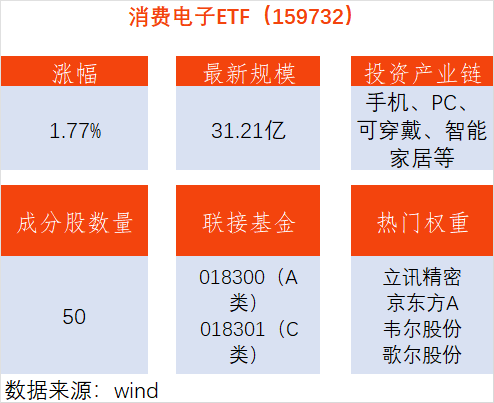
AI眼镜的“车机联动”新模式,消费电子ETF(159732.SZ)上涨1.77%
Sou Hu Cai Jing· 2025-12-12 05:24
Group 1 - The A-share market saw a collective rise in the three major indices, with the Shanghai Composite Index increasing by 0.18%, driven by strong performances in the electronics, power equipment, and non-ferrous metals sectors [1] - The Consumer Electronics ETF (159732.SZ) rose by 1.77%, with notable gains from component stocks such as Dongshan Precision (+6.91%), Jinghe Integrated (+6.57%), Desay SV (+4.81%), OmniVision (+4.49%), and Rockchip (+3.65%) [1] Group 2 - Li Auto officially launched its AI accessory, the Livis smart glasses, in collaboration with Zeiss, marking a strategic move to enhance its brand ecosystem and explore new interaction methods beyond traditional mobile and internet companies [3] - The cross-industry integration may prompt more automotive companies to focus on similar devices, potentially impacting the competitive landscape and driving technological advancements in upstream optical and acoustic sensors [3] - The smart glasses industry chain is expected to have long-term development potential, possibly becoming the next major consumer electronics category after smartphones, warranting continued attention to investment opportunities within the industry chain [3]


夸克AI眼镜新增产线冲产能,人工智能ETF(515980)反转拉升午间收红,成分股芯原股份、云天励飞等涨超5%
Xin Lang Cai Jing· 2025-12-12 05:07
Group 1 - Quark AI glasses have added a new assembly line at Luxshare factory, with production capacity expected to be released gradually starting next week, aiming for full capacity by January to meet the Spring Festival consumption peak [1] - In November, Quark AI glasses officially launched two series, S1 and G1, comprising a total of six products [1] - The CSI Artificial Intelligence Industry Index (931071) rose by 0.88% as of December 12, 2025, with notable increases in component stocks such as Chipone Technology (688521) up 5.61% and Yuntian Lifei (688343) up 5.52% [1] Group 2 - Current policies are generally favorable, with significant support from the financial sector stabilizing market trends, and the political bureau meeting setting a positive tone for next year's economic work, leading to a notable recovery in market risk appetite [2] - The AI industry shows high certainty in its current prosperity, driven by sustained overseas computing power chain demand and advancements in domestic computing power chip performance expected next year [2] - The application side is accelerating, with innovations like Doubao mobile assistant transitioning AI from a "tool" to an "ecosystem entry point," reflecting trends in AI agents, multi-modal technology, and ecosystem collaboration [2] Group 3 - Huafu Artificial Intelligence ETF (515980) provides balanced coverage across all segments of the AI industry, allowing for easy investment in AI [3] - The ETF tracks the only quarterly rebalancing artificial intelligence index in the market, ensuring high-frequency tracking of industry developments [3] - Investors without stock accounts can opt for Huafu Artificial Intelligence ETF linked funds (Class A 008020, Class C 008021) [3]


矿区无人驾驶赛道迎上市潮 易控、希迪等头部玩家开启冲刺
Zhong Zheng Wang· 2025-12-11 14:25
Core Viewpoint - The mining autonomous driving industry is entering a new phase of commercialization, with several companies preparing for IPOs and significant growth in the deployment of autonomous mining vehicles expected in the coming years [1][2]. Group 1: Market Growth and Projections - The China Coal Industry Association predicts that the shipment of autonomous mining trucks will reach approximately 1,400 units in 2024 and surge to 5,500 units by 2026, with 2025 being seen as the year for large-scale application [1]. - According to Frost & Sullivan, the penetration rate of autonomous mining trucks in China is expected to rise from about 6% in 2024 to over 50% by 2030, while the global market for autonomous mining solutions is projected to grow from $700 million in 2024 to $8.1 billion by 2030, with a compound annual growth rate of 51.0% [2]. Group 2: Technological Advancements and Economic Viability - Autonomous mining trucks can operate 24/7, significantly improving vehicle utilization and transportation efficiency, while also optimizing energy consumption and reducing wear and tear on tires and fuel [3]. - A case study from the South Open Coal Mine demonstrated that the average speed of an autonomous mining project was 25 km/h, achieving an average efficiency comparable to manual operations, with a fuel savings rate of up to 20% [4]. Group 3: Business Model Evolution - The industry is shifting from a heavy asset ownership model (TaaS) to a lighter asset model (ATaaS), where clients purchase vehicles and companies provide software and technical support, leading to higher scalability and profit margins [5]. - By 2024, the ATaaS model contributed 453 million yuan to a company’s revenue, accounting for 46% of total revenue from autonomous mining solutions, a significant increase from 0.1% in 2022 [5]. Group 4: Capital Investment and Industry Collaboration - The mining autonomous driving sector is attracting significant investment from various capital sources, with companies like 易控智驾 receiving funding from notable investors such as 宁德时代 and 紫金矿业 [6][7]. - Collaboration between downstream mining companies and upstream suppliers is enhancing the capabilities of autonomous driving firms, exemplified by partnerships that facilitate technology implementation and innovation [7]. Group 5: Shift Towards Electrification - The industry is increasingly moving towards electrification, with several companies launching "no-cab + pure electric" mining trucks that feature large batteries and advanced automation systems [8]. - Over 95% of 易控智驾's autonomous mining trucks are electric, with a cumulative operating distance exceeding 80 million kilometers, indicating a strong trend towards sustainable mining solutions [8].
11月车市基本符合预期,英伟达开源VLA模型
CAITONG SECURITIES· 2025-12-11 13:00
Group 1: Automotive Market Overview - In November, the national retail sales of passenger cars reached 2.225 million units, a year-on-year decrease of 8.1% and a month-on-month decrease of 1.1%, aligning with the initial forecast of a "low start, medium growth, and stable end" trend for the year [5][11][20] - Cumulative retail sales for the year reached 21.483 million units, reflecting a year-on-year growth of 6.1%. The growth rate fluctuated throughout the year, with a notable slowdown in the fourth quarter due to high base effects from the previous year [5][11][20] - The "old-for-new" subsidy policy has been a significant driver for growth, with over 11.2 million applications for subsidies by the end of October, although the average daily subsidy scale dropped to 30,000 units in November due to the suspension of subsidies in various regions [5][11][20] Group 2: Intelligent Driving Developments - NVIDIA has officially open-sourced its new Vision-Language-Action (VLA) model, Alpamayo-R1, marking a significant shift in autonomous driving technology from mere behavior imitation to deeper causal reasoning [6][33] - The model's dataset, approximately 100TB in size, has been uploaded to the open-source community, indicating a move towards more accessible high-end autonomous driving models [6][33] Group 3: Investment Recommendations - The report suggests focusing on companies with strong positions in automotive intelligence and leading software capabilities, including Rui Ming Technology, Dao Tong Technology, Hei Zhi Ma Intelligent, Horizon Robotics, and others [8][39]

车联天下赴港IPO:研发费用常年居高不下 毛利率仍低于行业平均水平 收入激增同时亏损持续扩大
Xin Lang Cai Jing· 2025-12-11 06:17
Core Viewpoint - The company, Cheliantianxia, has submitted its IPO application to the Hong Kong Stock Exchange, aiming to address funding bottlenecks while facing significant challenges related to its business model sustainability and high losses despite rapid revenue growth [1][7]. Group 1: Revenue Growth and Losses - Cheliantianxia's revenue surged from 369 million to 2.656 billion yuan from 2022 to 2024, marking a growth of over six times, with a notable 523.3% increase in 2023 due to the booming smart cockpit market [2][8]. - Despite high revenue growth, the company reported cumulative net losses of 968 million yuan, with losses in the first half of 2025 reaching 262 million yuan, exceeding the total losses of 2024 [2][8]. - The company's cash flow from operating activities has been negative, with net outflows increasing from 250 million yuan in 2022 to 1.011 billion yuan in 2024, indicating a lack of self-sustaining business capability [2][8]. Group 2: High R&D Costs and Low Profit Margins - The root cause of the losses is attributed to high R&D expenditures and low gross margins, with a gross margin of 16.2% in 2024, which, although improved from 9.5% in 2022, remains below industry averages [2][8]. - R&D expenses have consistently been high, while raw material costs increased by 17.5% in 2024 due to price hikes from suppliers like Bosch, further squeezing profit margins [2][8]. Group 3: Customer and Supply Chain Concentration Risks - The company faces significant risks due to extreme concentration in its customer base, with over 98% of revenue coming from the top five customers, and a single largest customer contributing nearly 60% [3][9]. - In 2024, revenue growth slowed to 15.6% due to weak sales from the largest customer, and revenue in the first half of 2025 declined by 0.7%, highlighting the adverse effects of customer concentration [3][9]. - The company's reliance on Bosch is critical, with 82.9% of purchases in 2023 and 80.3% in 2024 coming from them, which limits Cheliantianxia's bargaining power and supply chain autonomy [3][9]. Group 4: Industry Competition and IPO Challenges - Cheliantianxia operates in a highly competitive market, ranking second in China's smart cockpit domain, but faces challenges from competitors with stronger technological innovations [4][10]. - The IPO proceeds are intended for R&D and capacity enhancement, but the market is focused on whether the company can address three key challenges: profitability, customer structure optimization, and supply chain resilience [4][10]. - The company's debt ratio stands at 198.3%, with cumulative losses of 1.272 billion yuan, raising concerns about maintaining high valuations post-IPO if profitability is not quickly demonstrated [4][10]. Group 5: Conclusion on Value Reassessment - The IPO of Cheliantianxia represents a shift from scale expansion to quality survival in the smart automotive supply chain sector, revealing the real challenges faced by the industry after a period of enthusiasm [5][11].
计算机行业2026年度投资策略(212页完整版):追逐星辰大海的科技浪潮
Guotou Securities· 2025-12-11 02:35
Group 1: Overview of the Computer Sector - The computer sector is experiencing a recovery in fund allocation, with a 4.46% holding ratio in Q3 2025, an increase of 1.93 percentage points from Q2 2025 and 2.24 percentage points year-on-year from Q3 2024 [7][12] - The computer sector's market capitalization accounts for 5.27% of the total A-share market, indicating a low allocation that presents upward potential [7][12] - The computer index has risen by 27.62% as of December 1, 2025, outperforming the CSI 300 index by 11.32 percentage points [12] Group 2: Domestic Substitution Trends - The domestic substitution trend is clear, with significant replacement opportunities in the computer industry, particularly in EDA, electronic measurement instruments, and cybersecurity [3][21] - The EDA market is projected to reach $14.5 billion by 2025, with domestic firms increasing their competitiveness through self-developed and acquired technologies [26][31] - The electronic measurement instrument market is expected to grow rapidly, driven by technological advancements and increased R&D investments [63][75] Group 3: Artificial Intelligence Applications - The AI sector is expanding across various industries, with demand for GPU, servers, IDC, power supplies, and liquid cooling systems driving growth [3][21] - The domestic and international AI model iterations are ongoing, with a focus on world models and physical AI as future trends [3][21] - End-side AI applications, including smart glasses, robotics, and intelligent driving, are emerging as key areas for implementation [3][21] Group 4: Future Industries and Innovations - Quantum technology is anticipated to bring disruptive innovations in computing, communication, and measurement, creating new opportunities [3][21] - The satellite internet sector is accelerating constellation construction, with potential releases in measurement and simulation demands [3][21] - The integration of technology and finance is expected to yield significant dividends through innovative disruptions [3][21] Group 5: Investment Recommendations - Recommended investment targets in the EDA sector include Huada Jiutian, GY Electronics, and Broadcom [53][90] - In the CAD sector, focus on Zhongwang Software and Haocen Software [53][90] - For CAE, consider Zhongwang Software and Holley Technology [53][90]
大摩:25家公司有望引领全球人形机器人行业,包括均胜电子、地平线等汽车零部件公司
Quan Jing Wang· 2025-12-10 05:57
Core Insights - Morgan Stanley's report indicates that humanoid robots are expected to drive a rise in tech stocks, with the market projected to exceed $5 trillion by 2050 [1] - The report identifies 25 companies likely to dominate the industry, focusing on those with expertise in AI, computing chips, cameras, sensors, and motion technology, including 7 Chinese firms [1] Company Highlights - The 7 Chinese companies listed include Alibaba, Baidu, and iFlytek, along with four automotive component suppliers: Joyson Electronics, Horizon Robotics, Hesai Technology, and Desay SV [1] - These automotive component and chip companies have already launched robot-related products and solutions based on their automotive business [1] - Joyson Electronics has positioned itself as "Automotive + Robotics Tier 1" and has introduced a range of products, including robot control systems and AI solutions, while collaborating with various robotics companies [1] Industry Trends - The report aims to shift investor focus from humanoid robot manufacturers to foundational component suppliers, as these suppliers are expected to benefit as robots become mainstream [1]


2026年汽车年度策略:去伪存真,聚焦景气赛道核心资产
2025-12-10 01:57
Summary of Conference Call Records Industry Overview: Automotive Industry in China Key Insights - In 2025, the market share of domestic brands in China's automotive market is expected to rise significantly to 66%, with BYD, Geely, and Chery leading in sales growth, achieving sales of 3.7 million, 2.81 million, and 2.28 million units respectively, representing year-on-year growth of 14%, 40%, and 13% [2][4] - The market for low-end models priced below 100,000 yuan is projected to grow the fastest, while high-end models priced above 300,000 yuan are experiencing a downward trend due to price wars [1][3] - Domestic brands have captured 78% of the market share in the 100,000-150,000 yuan segment, with expectations to increase to 85% in 2026 [4][5] Export Performance - In 2025, China's exports of new energy vehicles (NEVs) are expected to grow rapidly, particularly in Western Europe and emerging markets in Asia, Africa, and Latin America, with total exports reaching 5.62 million units [6] - Notably, NEV exports reached 250,000 units, exceeding expectations, with major export regions including Central and South America, the EU, and the Middle East [6] Competitive Landscape - Joint ventures and foreign brands are actively launching new models and increasing local production to compete, such as Toyota's RAV4 plug-in hybrid and a collaboration model between Volkswagen and Xiaopeng [8] - The competition in the domestic market is intensifying, with a clear trend towards high-end models, as new models like BYD Seal 09 and Xiaomi U9 gain attention [7] Future Outlook for 2026 Market Trends - The domestic automotive market is expected to see increased competition and a clear trend towards high-end models, with several new models set to launch [7] - Chinese automakers are expected to increase investments in Europe and emerging markets, with overseas factory capacities gradually being released [9] Technological Developments - The automotive parts industry is evolving towards globalization and new technological avenues, focusing on opportunities in the European market, particularly in robotics and AI liquid cooling technology [11] - The development of intelligent driving technology is accelerating, with L2 level automation becoming more common in lower-priced models, while L4 level applications are expanding commercially [12][15] Investment Recommendations - In the passenger vehicle sector, focus on high-end and export growth, particularly recommending companies like BYD, Geely, Great Wall, and leading automotive brands [29] - In the automotive parts sector, prioritize companies with global layouts and strong ties to leading automakers, as well as those involved in AI transformation, including AI liquid cooling and robotics [29] Key Drivers for Intelligent Driving - Four main drivers are expected to propel the L2 market: policy support, market awareness, cost reduction, and technological iteration [18][20] Conclusion - The automotive industry in China is poised for significant growth, driven by domestic brands' increasing market share, rapid export growth, and advancements in technology. Investors should focus on companies that are well-positioned to capitalize on these trends, particularly in high-end models and intelligent driving technologies.

德赛西威:2025年上半年公司智能座舱业务继续保持增长
Zheng Quan Ri Bao Wang· 2025-12-09 09:44
Core Viewpoint - The company Desay SV aims to develop intelligent cockpit solutions that meet future smart travel scenarios, focusing on enhancing human-machine interaction [1] Group 1: Business Growth and Strategy - The intelligent cockpit business is expected to continue its growth into the first half of 2025, driven by a diversified product portfolio, market extension strategies, new product development, and strong new customer orders [1] - The rapid advancement of AI and smart driving technologies will lead to richer application scenarios for intelligent cockpits, resulting in continuous upgrades and increased penetration of higher-level intelligent cockpit products [1] Group 2: Market Opportunities and Challenges - The market space for intelligent cockpits is expected to expand continuously due to the integration and ongoing upgrades of smart driving and intelligent cockpit technologies, which will enhance vehicle efficiency, optimize costs, and improve user experience [1] - The cross-domain integration poses higher challenges for the industry, necessitating high-level R&D and engineering capabilities in both smart driving and intelligent cockpit fields [1] Group 3: Competitive Position - The company has established a leading position in both the intelligent cockpit and smart driving sectors, and the cross-domain integration is anticipated to further enhance its competitive edge in the industry [1]