洪都航空

Search documents
订单大增!军工基金单月飙涨20%,“十四五”收官年催化行情
Hua Xia Shi Bao· 2025-07-02 06:29
Core Viewpoint - The military industry sector in the A-share market has shown strong performance in June, with military-themed funds achieving significant gains, driven by a fundamental shift in the industry’s business environment [1][2]. Group 1: Fund Performance - Military-themed active equity funds (Class A shares) recorded an average monthly increase of 7.31% as of June 30, significantly outperforming mainstream stock indices [1]. - The top 10 military funds all surpassed an 11% increase, with the top performer, China Europe High-end Equipment A, achieving a remarkable 20.19% monthly gain [2]. - Key to the success of these funds is the deep exploration of core assets, with leading funds holding shares in major military enterprises benefiting from domestic military equipment upgrades and increased military trade exports [2]. Group 2: Industry Fundamentals - The military industry is showing signs of recovery, with improved order volumes in the first quarter of 2025, particularly in missile, aviation engine, military communication equipment, and unmanned systems sectors [2]. - Companies like Aerospace Electric and Zhenhua Technology are positioned well within the missile supply chain, experiencing a notable recovery in orders [2]. - The military sector's theoretical growth potential is significant, with estimates suggesting a minimum of 100% growth and a maximum of 300% by 2025, as indicated by the cyclical nature of military planning [3]. Group 3: Technological Advancements - The military industry has made significant technological breakthroughs, enhancing market confidence in its capabilities [4]. - The production capacity of the Wenchang Satellite Super Factory is set to reach 1,000 satellites annually, which will lower manufacturing costs and benefit companies in satellite communication and navigation [4]. - Despite the military sector's current high valuation, its scarcity and defensive attributes make it a focal point for capital allocation [4]. Group 4: Future Outlook - As the "14th Five-Year Plan" concludes, there is an expectation for a concentrated release of orders, which will drive performance recovery in the military sector [5]. - The initiation of the "15th Five-Year Plan" is anticipated to provide new growth expectations, supported by increased military trade exports and advancements in national defense modernization [5]. - The upcoming 80th anniversary of the victory in the Chinese War of Resistance against Japan is expected to catalyze interest in the military sector [5]. Group 5: Policy and Geopolitical Factors - Recent policies, such as the Military Scientific Research Reward Regulations, are aimed at incentivizing military technological innovation, particularly in critical areas like aviation engines [6]. - The escalation of geopolitical conflicts is likely to sustain demand for military equipment, reflecting a market reassessment of the value of air superiority assets [6]. - The military sector's fundamentals remain strong, with a positive outlook for core military companies' performance, although caution is advised regarding potential geopolitical fluctuations [6].
再论军工投资逻辑,重点推荐军贸、新质战斗力、军工电子、弹药等主线
2025-07-01 00:40
Summary of Military Industry Conference Call Industry Overview - The military industry is experiencing significant investment opportunities due to global geopolitical tensions and an arms race, particularly highlighted by China's military equipment performance in the India-Pakistan air conflict, which has increased international recognition of Chinese military products [1][2]. Key Points and Arguments - **Investment Opportunities**: The military sector is expected to benefit from increased order delivery tolerance from institutions, driven by geopolitical tensions and high-end equipment exports [1][2]. - **Market Events**: The upcoming 93rd anniversary military parade is anticipated to boost market activity, alongside the conclusion of the 14th Five-Year Plan and the initiation of the 15th plan, which may lead to expedited orders [3][5]. - **Performance Metrics**: In the first half of 2025, the defense industry index outperformed the broader market, driven by a reversal in industry sentiment and concentrated order issuance [1][10]. - **Valuation Trends**: The military industry's valuation has risen to the 75th percentile, indicating potential for further growth, shifting from EPS-driven to PE-driven factors due to increased global asset allocation demand [8][21]. - **Contract Liabilities**: A 12.7% increase in contract liabilities in Q1 2025 suggests a pre-order phenomenon, indicating future performance improvements [11][9]. Important but Overlooked Content - **Geopolitical Context**: The ongoing geopolitical tensions, including conflicts in Ukraine and the Middle East, are expected to sustain demand for military equipment, with countries like South Korea and Japan increasing their defense budgets [19][16]. - **Technological Advancements**: The military sector is focusing on new combat capabilities, including unmanned systems and high-speed weapons, which are crucial for future military strategies [7][29]. - **Investment Recommendations**: Key investment areas include military trade exports, military electronics, and ammunition, with specific companies highlighted for their potential [5][30][31]. Future Outlook - The military industry is poised for continued growth, driven by strategic security asset allocation and the global expansion of Chinese military assets, particularly in the arms trade [21][22]. - The upcoming 15th Five-Year Plan is expected to clarify future directions for the military sector, enhancing market confidence and potentially leading to increased order flows [15][13]. This summary encapsulates the critical insights from the military industry conference call, highlighting the current landscape, investment opportunities, and future trends.
聚焦空天国防的航空航天ETF天弘大涨5%!投军工更加关注“制空权”
Quan Jing Wang· 2025-06-30 06:52
Core Viewpoint - The military industry sector has experienced a significant surge, driven by various catalysts and heightened market sentiment, particularly in the aerospace and defense segments, with a notable focus on the upcoming military parade and advancements in domestic military technology [1]. Group 1: Market Performance - The Tianhong Aerospace ETF (159241) saw an intraday increase of over 5%, with trading volume exceeding 600 million yuan [1]. - Key stocks such as Guoke Military Industry rose over 11%, while others like Zhongbing Hongjian and Changcheng Military Industry hit the daily limit [1]. Group 2: Industry Catalysts - The upcoming military parade on September 3, commemorating the 80th anniversary of the victory in the War of Resistance Against Japan, is expected to showcase new military technologies, increasing market interest in military advancements [1]. - Despite some easing in international geopolitical tensions, NATO members have agreed to raise defense spending to 5% of GDP by 2035, reinforcing expectations for global military investment growth [1]. Group 3: ETF Characteristics - The Tianhong Aerospace ETF closely tracks the Guozheng Aerospace and Aviation Industry Index, focusing on key areas such as fighter jets and satellite industries, aligning with emerging themes like low-altitude economy and commercial aerospace [2]. - The ETF has the highest "military content" among its peers, with 96.24% of its constituent stocks belonging to the defense and military industry [3]. Group 4: Sector Highlights - The index also leads in "drone content," featuring companies deeply involved in drone technology, making it the highest in the market for drone-related investments [4]. - It covers the aerospace industry chain comprehensively, with over 73% weight in aviation and aerospace equipment, marking it as the highest in "aerospace content" among military indices [5]. Group 5: Financial Performance - The constituent stocks of the Guozheng Aerospace and Aviation Industry Index exhibit stronger technological attributes and clearer valuation logic, aligning with the trend of military modernization towards high-end aerospace [6]. - The forecasted revenue growth rate for the index is projected to reach 42.73% by 2025, surpassing traditional military indices [7].
军工周报:阅兵消息官宣,主战装备+新型作战力量将参-20250629
NORTHEAST SECURITIES· 2025-06-29 13:44
Investment Rating - The report rates the defense and military industry as "Outperforming the Market" [2] Core Views - The global geopolitical situation remains tense, with ongoing conflicts such as the Russia-Ukraine war and rising risks in the Middle East, leading to an intensified arms race and increased focus on military construction [4][38] - The defense industry is expected to see a recovery in demand as the "14th Five-Year Plan" approaches its final year, with long-term growth certainty supported by clear development goals for 2035 and 2050 [4] - The upcoming military parade on September 3 will showcase both traditional main battle equipment and new combat forces, highlighting advancements in military capabilities [3][40] Summary by Sections Market Review - The defense and military index rose by 6.90% last week, outperforming major indices such as the Shanghai Composite and Shenzhen Component [12] - The current PE (TTM) for the defense and military sector is 79.92 times, with sub-sectors showing varied valuations: aerospace equipment at 143.52 times, aviation equipment at 69.14 times, ground weapons at 174.36 times, naval equipment at 50.76 times, and military electronics at 102.36 times [20][21] Key Recommendations - Recommended companies include: 1. Downstream manufacturers: Hongdu Aviation, AVIC Shenyang Aircraft, AVIC Xi'an Aircraft, and AVIC Helicopter [4] 2. Military new technologies: Lianchuang Optoelectronics, Guangqi Technology, and Zhongjian Technology [4] 3. Underwater equipment: Hailanxin, Yaxing Anchor Chain, and Zhongke Haixun [4] 4. Missile industry chain: Feilihua, Guoke Military Industry, and Zhongbing Hongjian [4] 5. Military titanium materials: Western Superconducting [4] 6. Electronic components: Hongyuan Electronics and Aerospace Electronics [4] 7. Military trade direction: Zhongwu Drone [4] Industry Dynamics - Recent policies related to deep-sea technology indicate significant development potential, particularly for specialized equipment like UUVs, supported by top-level planning [3] - The military trade market is expanding, with recent announcements of procurement from Pakistan for Chinese fighter jets, indicating a growing opportunity in military exports [39]


【金工】市场仍待上攻合力——金融工程市场跟踪周报20250629(祁嫣然/张威)
光大证券研究· 2025-06-29 13:34
Market Overview - The A-share market experienced a strong rally this week, with the North Securities 50 index leading the major broad-based indices with a weekly increase of 6.84% [3] - Major indices saw comprehensive gains, with the Shanghai Composite Index rising by 1.91%, the CSI 300 by 1.95%, and the ChiNext Index by 5.69% [4] Trading Sentiment - The market's strong rise was accompanied by a steady increase in trading volume, indicating improved liquidity [3] - The volume timing indicator for the North Securities 50 remains cautious, while other major indices have shifted to a bullish signal [3] Fund Flow - ETF funds showed signs of profit-taking, with an overall net outflow from equity ETFs, particularly in the Sci-Tech Innovation Board and small-cap stocks [3] - Southbound capital saw a net inflow of 28.381 billion HKD, with the Shanghai Stock Connect contributing 13.489 billion HKD and the Shenzhen Stock Connect 14.892 billion HKD [10] Valuation Metrics - As of June 27, 2025, broad-based indices such as the Shanghai Composite, CSI 300, CSI 500, and CSI 1000 are at "moderate" valuation percentiles, while the ChiNext Index is at a "safe" valuation percentile [5] - In terms of sector valuation, industries like electricity and public utilities, home appliances, food and beverage, agriculture, non-bank financials, and transportation are classified as "safe" [6] Volatility Analysis - The cross-sectional volatility of the CSI 300 and CSI 500 index constituents increased week-on-week, indicating an improved short-term Alpha environment [7] - Conversely, the cross-sectional volatility of the CSI 1000 index constituents decreased, suggesting a weakening short-term Alpha environment [7] Institutional Focus - The top five stocks attracting the most institutional attention this week were Huichuan Technology (151 institutions), Weigao Medical (144), Jingbeifang (79), AVIC Chengfei (66), and Cangge Mining (64) [9]


江西培育壮大先进制造业集群(奋勇争先,决战决胜“十四五”)
Ren Min Ri Bao· 2025-06-28 21:49
Group 1 - The core viewpoint emphasizes the importance of integrating innovation and industry chains to enhance industrial development momentum, with a focus on advanced manufacturing clusters in Jiangxi province [1][2][4] - Jiangxi's advanced manufacturing clusters include electronic information, copper-based new materials, and aviation, with three clusters recognized as national advanced manufacturing clusters, achieving a total revenue of 171.27 billion yuan in Q1 2023, a year-on-year increase of 10.17% [1][4] - The L15 "Falcon" trainer aircraft has become a leading global trainer aircraft, with over 5,000 units delivered globally [1] Group 2 - Companies in Jiangxi are actively collaborating with national research platforms to drive technological innovation, such as Jiangxi Zhongke Hongqian New Materials Co., which aims to produce 3,000 tons of catalysts annually, generating over 1 billion yuan in revenue [2] - The province has seen over 18,000 enterprises engage in digital transformation, with more than 11,000 implementing digital upgrades, and 36 national 5G factories established [3] - Jiangxi's electronic information industry has maintained a scale of over 1 trillion yuan for three consecutive years, with significant growth in the photovoltaic industry driven by companies like JinkoSolar [4]
9月盛大阅兵,军工投资梳理
2025-06-26 14:09
Summary of Key Points from Conference Call Records Industry Overview - The conference call focuses on the **defense and military industry** in China, particularly in relation to upcoming military parades and global military spending trends [1][2][4]. Core Insights and Arguments - **Market Sentiment and Pricing Mechanism**: The pricing of the defense and military sector is significantly influenced by retail investors and speculative funds, with major events like the Zhuhai Airshow acting as catalysts for buying behavior [1][3]. - **Global Military Spending Trends**: Increased military spending by NATO countries may lead to a global arms race, compelling other nations to boost their military budgets, thus impacting international military balance [4]. - **Upcoming Military Parade**: The military parade in September is expected to showcase China's emerging military capabilities and new equipment, enhancing its deterrent power and demonstrating the cost-effectiveness of Chinese military products to international clients [1][5]. - **Performance of Chinese Military Equipment**: Conflicts such as the Russia-Ukraine and India-Pakistan disputes highlight the superior performance of Chinese military equipment, indicating China's rising strength in the global defense sector [1][5]. - **2025 as a Pivotal Year**: The year 2025 is anticipated to be a turning point for the defense industry, marking the culmination of the 14th Five-Year Plan, with a significant increase in weapon orders and expected performance improvements for major companies [6][7]. Additional Important Content - **Investment Directions**: Key investment themes in the defense sector include military trade, restructuring, and new types of weaponry [9][10][11]. - **Restructuring Opportunities**: The integration of major military groups, such as China Shipbuilding and China Heavy Industry, is expected to create investment opportunities [11][25]. - **Focus on New Weaponry**: The industry is shifting towards new generation weaponry, including advanced aircraft and unmanned systems, which are crucial for future military capabilities [12][16][17]. - **Emerging Technologies**: There is a growing emphasis on unmanned systems, underwater operations, hypersonic weapons, and electronic warfare capabilities as key areas for investment [16][17][26]. - **Market Dynamics**: The defense sector is currently experiencing a phase of adjustment, with many stocks at the bottom of their price cycles, but expected to recover as backlogged orders are fulfilled [2][7]. Conclusion - The defense and military industry in China is poised for significant growth driven by geopolitical tensions, upcoming military displays, and strategic investments in new technologies and restructuring efforts. The year 2025 is highlighted as a critical juncture for the sector, with expectations of improved performance and increased military capabilities.
军工周报:全球地缘政治局势紧张,看好军工板块投资机会-20250622
NORTHEAST SECURITIES· 2025-06-22 11:13
Investment Rating - The report maintains a positive outlook on the defense and military industry, particularly in light of the current global geopolitical tensions, indicating a favorable investment opportunity in this sector [3][36]. Core Insights - The defense and military sector is expected to benefit from the recovery of demand and the elimination of previous disruptions, with a long-term growth certainty supported by national defense modernization goals set for 2035 and 2050 [5][38]. - The report highlights the increasing importance of drone technology in modern warfare, emphasizing its cost-effectiveness and operational advantages [4][36]. - The low-altitude economy is identified as a burgeoning sector, with significant policy support and commercial opportunities emerging [4][35]. Summary by Sections Market Review - The defense and military index fell by 2.01% last week, ranking 17th among 31 sectors, with a current PE(TTM) of 74.63 times [3][20]. - The sub-sectors show varying PE ratios, with aerospace equipment at 134.59 times and ground weaponry at 148.10 times [20]. Key Recommendations - Focus on companies with strong demand and product depth in the downstream manufacturing sector, such as Hongdu Aviation, AVIC Shenyang Aircraft, and AVIC Xi'an Aircraft [5][40]. - Highlight new technology firms in the military sector, including Lianchuang Optoelectronics and Guangqi Technology [5][40]. - Emphasize underwater equipment companies like Hailanxin and Yaxing Anchor Chain [5][41]. - Recommend missile industry chain companies such as Feilihua and Guokexun [5][42]. - Suggest companies involved in military-grade titanium materials and electronic components, including Western Superconducting and Hongyuan Electronics [5][43][44]. Industry Dynamics - The report notes that geopolitical tensions, particularly in the Middle East, are driving interest in military investments [3][36]. - The low-altitude economy is highlighted as a significant growth area, with various local governments implementing supportive measures to foster development [31][35].

【投资视角】启示2025:中国低空物流行业投融资及兼并重组分析(附投融资事件、产业基金和兼并重组等)
Qian Zhan Wang· 2025-06-21 01:10
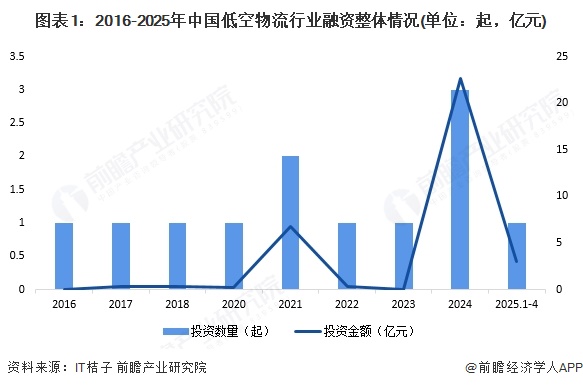
Group 1 - The low-altitude logistics industry in China has seen a low level of investment and financing activity, with a significant increase in investment amount in 2021 to 680 million yuan, followed by a surge to 2.27 billion yuan in 2024 [1][8] - Investment rounds in the low-altitude logistics sector are primarily early-stage, focusing on A-round and angel financing, indicating that the industry is still in its developmental phase with many innovative companies seeking funding for technology development and market expansion [2][8] - The majority of financing events in the low-altitude logistics industry are concentrated in Zhejiang, Beijing, and Shanghai, with Zhejiang leading at 7 events, followed by Beijing with 3 and Shanghai with 2 [6][8] Group 2 - The primary focus of investment in the low-altitude logistics industry is on drone delivery, with several significant financing events recorded from 2016 to 2025 [8][9] - Investors in the low-altitude logistics sector are predominantly capital organizations, accounting for 92% of the investment, with notable investors including Sequoia China and Matrix Partners [5][8] - There are numerous industry investment funds related to low-altitude logistics, although no private equity funds specifically for low-altitude logistics have been identified [12][8] Group 3 - Vertical acquisitions to expand business areas have become mainstream in the low-altitude logistics industry, with several notable mergers and acquisitions recorded from 2016 to 2025 [15][8] - The overall investment and merger activity in the low-altitude logistics industry remains low, with a concentration of investments from capital institutions primarily in Zhejiang, Beijing, and Shanghai [8][16]
伊朗霍尔木兹海峡震一震,世界经济抖三抖!
首席商业评论· 2025-06-18 03:58
Group 1 - The article discusses the impact of the conflict between Israel and Iran on global energy markets, highlighting that a strike on Iranian nuclear facilities led to a significant spike in Brent crude oil prices by 13%, the highest since the Russia-Ukraine conflict [5][7] - The importance of the Strait of Hormuz is emphasized, as it is a critical passage for 20% of the world's oil and 25% of liquefied natural gas (LNG) trade, with major implications for global energy supply if it were to be blocked [12][9] - The article outlines the vulnerabilities of modern industrial supply chains, particularly how disruptions in the Strait of Hormuz can affect various sectors, including energy-intensive manufacturing in Germany and the solar glass industry in China [8][7] Group 2 - The article details the potential for crisis arbitrage, noting that companies like LONGi Green Energy are capitalizing on the situation by securing contracts for solar projects in the Middle East, reflecting a shift towards energy independence in the region [18][19] - There is a surge in demand for safe-haven assets such as gold and U.S. Treasury bonds, indicating a strong market reaction to geopolitical tensions [22][24] - The military sector is also seeing increased interest, with companies like Hongdu Aviation receiving orders for military equipment from Middle Eastern countries, showcasing a growing demand for defense capabilities [25][27] Group 3 - The article suggests that China should consider a "dual-loop design" for energy supply routes to mitigate risks associated with the Strait of Hormuz, including potential pipeline projects to bypass the strait [29][30] - It highlights the need for technological advancements and local supply chain adaptations in response to potential disruptions, such as the reliance on strontium ore from Iran for manufacturing permanent magnet motors [30][17] - The article concludes that the ongoing conflict is reshaping global business dynamics, emphasizing the importance of energy sovereignty and the need for companies to possess physical, financial, and political capital to survive in a changing landscape [34][33]